A hotel KPI dictionary: one name, one formula and one source for every number in the monthly pack
Two reports disagree because formulas leave choices open, not because one is wrong. Build a hotel KPI dictionary that fixes names, formulas, sources and owners once, in writing.
AI draft · awaiting editorial review

Contents
Key takeaways
- Two reports disagree because a formula leaves choices open, not because one of them is wrong; the dictionary closes those choices once, in writing.
- A metric is not usable until it has four fields: name, formula, source system and owner.
- A room taken out of order leaves the denominator; house use usually stays in it, and the dictionary must say which.
- Revenue is either net or gross of taxes and service, never both in the same column of the same pack.
- One named person may change a definition, and every change carries a version number and an effective date.
A hotel KPI dictionary is a short internal document that gives every metric in the monthly pack one name, one formula, one source system and one owner, so two reports cannot disagree. It fixes the choices a formula leaves open: rooms or beds, net or gross of tax, booking date or stay date.
For example, the revenue manager's occupancy figure and the owner's occupancy figure differ by a few points, and both came out of the same system. Nobody is lying. The two reports are answering slightly different questions, and no document says which question the hotel has agreed to ask. After reading this you will be able to build the document that says so: a hotel KPI dictionary with one page per metric, a rule for every disagreement and a change process that keeps the pack trustworthy month after month.
Why do two reports show two different occupancy rates?
Because each report answers a slightly different question: which rooms count as sold, which count as available, and which date the night belongs to. A dictionary settles those three choices once, in writing, and the gap disappears.
The numerator is the first fork. A sold room night may or may not include complimentary rooms, house use, day-use rooms and rooms occupied by staff. Each inclusion moves the rate. The denominator is the second: available rooms may be total keys, total keys minus out of order, or total keys minus out of order and house use. Three bases, three answers.
The date basis is the third. Stay date (the night the guest sleeps), posting date (when the charge reaches the ledger) and arrival date put a stay that crosses month end into different months. Run time matters too: a report produced before night audit closes the business day is provisional, and the same report rerun after the close will not match it. Rooms against beds is a fourth fork, covered in occupancy by rooms or by beds: two rates, two answers: a twin room is one room night and two bed nights, so the two rates separate as soon as family and group business arrives. Finally, late edits, a room moved to out of order or a cancellation posted after the file was saved, change the base without changing the file that was already sent.
| The disagreement | What each report is doing | The line that ends it |
|---|---|---|
| Occupancy differs by a few points | One counts rooms, the other beds | "Occupancy is counted in room nights" |
| Occupancy differs after a renovation | One deducts out of order rooms, the other does not | "Out of order rooms leave the denominator" |
| ADR differs | One divides by paid room nights, the other by all occupied nights | "ADR divides by occupied room nights including complimentary" |
| Pickup differs | One dates bookings by arrival, the other by the day made | "Pickup uses booking made date" |
| Revenue differs | One report is net of tax and service, the other gross | "Revenue is net of VAT and accommodation tax" |
What goes on a dictionary page for each metric?
Four fields make a metric usable, name, formula, source and owner, and six more make it auditable. One page per metric, no exceptions, and the page is the authority when a meeting disagrees.
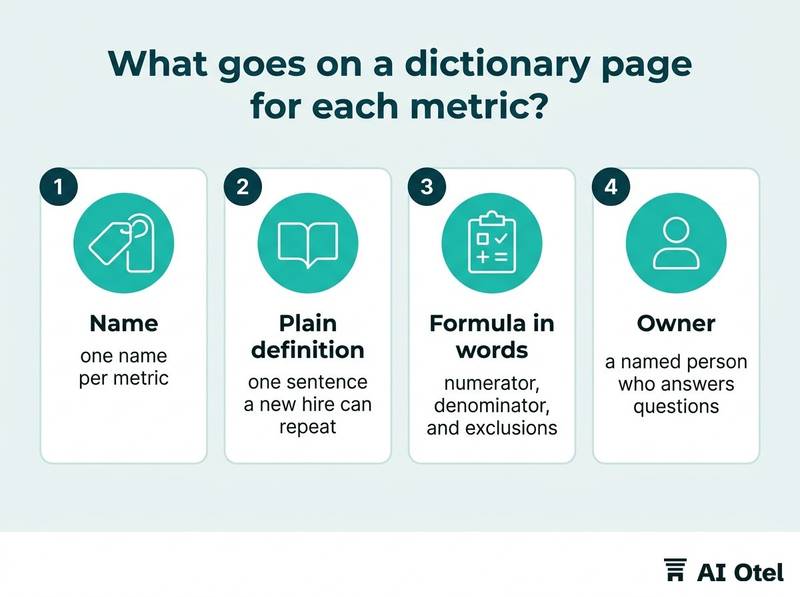
The name is one name per metric in the language of the pack, with any abbreviation spelled out once on first use. The plain definition is one sentence a new hire can repeat without reciting the formula, so the metric survives the person who built it. The formula comes in words first, then in symbols: numerator, denominator, and an explicit list of what is excluded from each. The source names the system of record and the exact report or screen, plus the time it is run relative to night audit. The owner is a named person who answers questions and approves changes, never a department, because a department cannot sign.
The ten fields
ChecklistComplete this checklist for every metric before it enters the pack
- Name
- Plain definition
- Formula in words
- Numerator
- Denominator
- Exclusions
- Source system and report name
- Run time relative to night audit
- Currency and tax basis
- Owner, version, effective date, one change-log line and a worked example
The worked example is one closed month, with real or clearly labelled illustrative numbers, so a reader can reproduce the figure by hand and trust the source. Version and effective date mean any printed figure can name the rule it was produced under.
Which rooms count as sold, available, out of order or house use?
A sold room is a room night a guest occupies or pays for, and an available room is capacity the hotel could have sold. Out of order and house use are the two places hotels quietly disagree, and both change the rate more than most people expect.
Out of order means the room cannot be sold for a physical reason, and it leaves both the numerator and the denominator. Out of service, a minor repair that could be sold at a push, normally stays in the denominator. Choose one rule and write it down. House use covers rooms taken for staff, a site inspection or a complimentary stay: decide whether it counts as sold at zero revenue, which lowers ADR, or is excluded from both sides. Complimentary and press stays follow the same decision and carry the same effect on ADR, so treat them in the same line of the dictionary.
Day use is revenue without a room night. Keep it out of the occupancy rate and show it as its own line, or the rate and the ledger will never reconcile. Count keys the way the system counts them: a suite sold as one unit is one room night even when it has two bedrooms, and connecting rooms sold together are two. A guest who stays past the standard departure time on the last day does not create a second room night unless the room is charged as one. A walked guest is not a room night in your house; the charge, the cost of the alternative room and the commission all sit somewhere, and the dictionary says where. The formulas behind these choices are set out in RevPAR, ADR and occupancy rate: formulas and common mistakes.
Watch outOut of order is a physical judgment, not a revenue one
A room left empty because the hotel expects low demand is available, not out of order. Counting empty rooms as out of order flatters the occupancy rate and hides the decision that produced it.
Is revenue net or gross, room only or total?
Both are legitimate, and the pack must pick one as the headline and label the other, because a gross figure and a net figure cannot share a column. The label belongs on the face of the report, not in a footnote.
State whether revenue is before or after value added tax and the accommodation tax where it applies, and confirm the treatment of your own invoices with your accountant, since the reporting convention and the tax computation are two different questions. Decide whether the service charge is revenue of the hotel, a pool distributed to staff, or revenue at one stage and a cost at another, and never let the same lira appear twice.
Keep the ratios clean. Room revenue alone feeds ADR and RevPAR; total revenue feeds TRevPAR; mixing the two inside one ratio produces a number nobody can defend. An all-inclusive or half-board price has to be split between room and food and beverage before any of it enters room revenue, and the split rule is a hotel decision that must be written down, because the tax treatment of that split is a separate matter. OTA commission is either deducted from revenue, which gives a net figure, or shown as a distribution cost, which gives a gross figure; both are common, and the error is changing the choice halfway through the year. Say which month recognizes cancellation fees, no-show charges, refunds and voided charges, and whether a reversal reduces revenue or sits on its own line. For foreign currency, fix the rate and the day it is taken and apply the same rule to every report, so two departments cannot convert the same booking differently.
Key pointPrint this line on every revenue page
"Room revenue, net of value added tax and accommodation tax, after OTA commission, converted at the central bank rate of the last business day of the month." Fill in your own choices; the point is that the reader never has to ask.
Bookings: made date, stay date, cancelled or no-show?
A booking carries at least three dates and two possible endings, and every report picks one of each. The dictionary names the date basis and the ending for every booking metric, and keeps the two views apart.
Made date drives pickup and pace: rooms on the books for a given stay date, counted from the day each was booked. Stay date drives occupancy and revenue: the night the guest actually sleeps in the room. A cancellation is an event on the day it is posted, but it removes a room night from the stay date; both views are legitimate and both are needed, so label them rather than choosing one.
A no-show is a room held and not used. If a charge is raised it is revenue without a room night; if not, it is a cancellation at the last moment. Say which, and say on which day it is counted. A cancelled booking that comes back is one booking with a history, not two bookings, unless the dictionary says otherwise, or pickup will double count it. For groups, rooms held are not demand until they are picked up: the metric is the pickup curve against the block, not the size of the block. And credit the channel that took the booking, not the last one touched, unless the hotel runs a written attribution rule and applies it to every report.
Who is allowed to change a definition?
One named person owns the dictionary, and every change is versioned, dated and announced before the month it applies to. Everything else follows from that single rule.
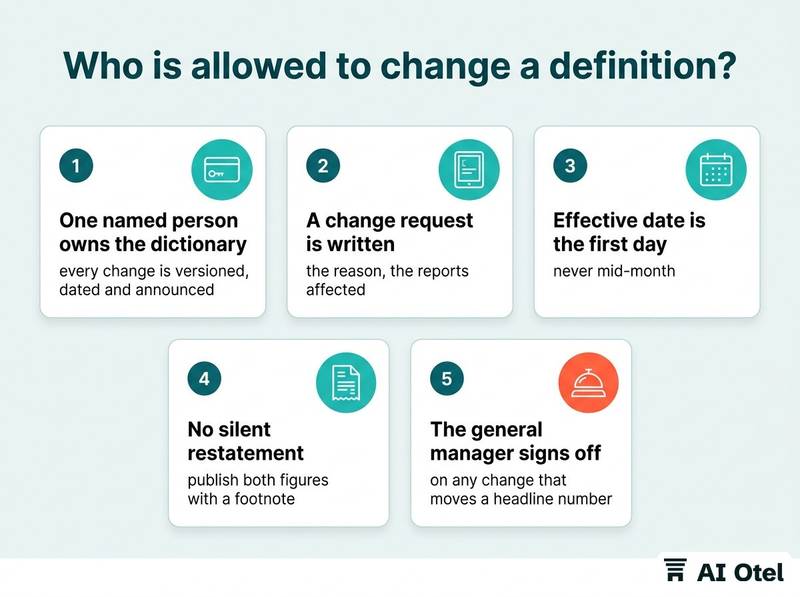
Ownership sits with finance or revenue, one person named on the page, with a named deputy for the weeks they are away. A change request is written: the reason, the reports affected, and the expected size of the shift, so the decision is about a number rather than a preference. The effective date is the first day of a month, never mid-month, so no single month is ever reported on two bases. There is no silent restatement: if a past month is recomputed, either publish both figures with a footnote or restate it and say so in the pack.
The general manager or owner signs off on any change that moves a headline number; small clarifications can be handled by the owner alone. Test the new definition against a closed month whose figures are already agreed, and show the difference before adopting it. The change log lives in the same file as the dictionary, one line per version, so the history travels with the document.
NoteA definition change is not a correction
The old figure was right under the old rule, so the footnote says which rule produced it rather than implying that someone made a mistake.
How do you publish the dictionary with the monthly pack?
Put the dictionary in front of the pack, not in an appendix, and print the version number on every page that carries a number. A definition nobody can find at the moment of argument does not exist.
Page order is a one-page summary of the headline metrics first, then the pack, then the detailed pages behind it. Every report header carries the dictionary version and the run time relative to night audit, so a printed page can always be traced. Keep a meeting room copy of the ten to fifteen metrics that appear in every review, with formula and owner, pinned where the meeting happens. A new hire reads the dictionary in the first week and reproduces one figure from the worked example, which is the only test that proves the document works.
Compare only the metrics whose definitions are identical across hotels, and let genuinely local metrics stay local, as discussed in one report across several hotels: what a group can compare. A budget against actual comparison only means something when both sides use the same rule, so the dictionary is the precondition for the variance meeting rather than a companion to it, a point developed in budget vs actual in hotels: reading the monthly variance. Review once a year, and again whenever the property management system, the channel mix or the tax basis changes. Hotels evaluating a new system can see how a hotel operating system can carry fixed report definitions, and how a public statement of what is built and what is not helps that evaluation.
ChecklistRun this checklist before the pack goes out
- Version stamp on every page
- Dictionary summary attached at the front
- Owner named
- Every changed definition flagged with a footnote
- Every figure traceable to a named report
- No metric in the pack without a formula
What to do next
Take the next monthly pack, pick the five metrics that cause the most argument, and write the four fields for each: name, formula, source and owner. Agree them in one meeting, add the version number and the effective date, and put the page at the front of the pack. The rest of the dictionary can follow one metric at a time. The point of the exercise is not tidier paperwork: it moves the argument from which number is right, which nobody can settle, to which rule the hotel has chosen, which it can.
Frequently asked questions
Should OTA commission be deducted from room revenue or shown as a cost?
There is no universal rule, and both conventions are in use. Deducting it gives a net room revenue that matches what the hotel keeps; showing it as a distribution cost gives a gross revenue that matches the rate the guest paid. The only real error is changing the choice mid-year, because ADR and RevPAR then move for a reason that has nothing to do with trading. Pick one, print it on the report, and keep it for the full year.
Does a complimentary room count in the occupancy rate?
It depends on the rule the hotel writes. Counting it as a sold room at zero revenue raises the occupancy rate and lowers ADR; excluding it from both sides leaves the rate lower and ADR higher. Neither is wrong, but the two must not be mixed across reports. Put complimentary, house use and press stays on one line of the dictionary and apply the same treatment to all three.
Is a no-show a sold room?
It is revenue if a charge is raised, but it is not an occupied room night, so it stays out of the occupancy rate. The dictionary should say on which day the charge is recognized and whether the room returns to inventory for the rest of the stay. Without that line, the booking report and the revenue report will disagree every month with a no-show in it.
How often should the dictionary be reviewed?
Once a year as a routine, and again whenever the property management system changes, the channel mix shifts materially, or the tax basis of the reports changes. Each review produces a new version with an effective date on the first of a month. Between reviews, only the named owner may approve a change, and every change gets a line in the log.
Can a hotel group use one dictionary for all its properties?
For the headline metrics, yes, and it should, otherwise a group report compares different questions. Metrics that depend on the property, such as outlet revenue or spa capture, stay local and are marked as local. The test is simple: if two hotels define a metric differently, it cannot appear in a group comparison until one definition is chosen for both.