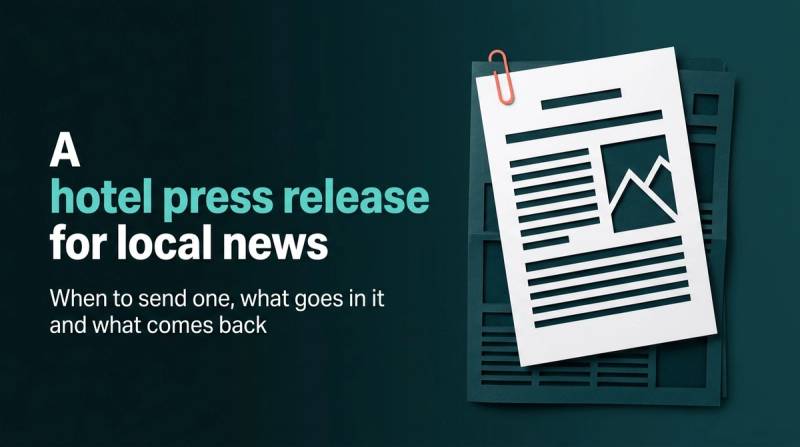
A hotel press release for local news: when to send one, what goes in it and what comes back
A hotel press release for local news works only when it reports a real change. This guide covers timing, content, photos, and logging coverage for editors.
AI draft · awaiting editorial review
Contents
Key takeaways
- A local editor uses a hotel release only when it changes something for their readers: a place that now exists, a date for the diary, or a decision that affects the street.
- One page with a printable first paragraph, one named quote and a short fact list works better than a two-page brochure.
- Send three to five horizontal, captioned photos in the same email; a picture desk will not chase you for them.
- Send to named journalists and editors, never to a general inbox, and follow up exactly once.
- Coverage is never guaranteed and never bought as news: keep a log of what ran, where and with which photo, so the next release starts from evidence.
A hotel press release for local news is a one-page written notice sent to journalists when something has actually changed: a renovation finished, a season opening, a new restaurant, a dated charity event. Send it to named local editors a week or so ahead, with three to five captioned photos. Coverage is never guaranteed, so log what runs.
The renovation is finished, the pool opens on Saturday, and the hotel's own social accounts have said so three times. The district paper has printed nothing, because nobody sent it anything an editor could use. This guide covers the whole cycle of a hotel press release for local news: what counts as news, what goes on the page, whom to quote, which photos to attach, whom to send to, and how to keep the log that makes the second release easier than the first.
What makes hotel news a story a local editor will use?
An editor uses a release when it changes something for their readers and can be said in one sentence: a place that now exists, a date they can put in the diary, or a decision that affects the neighborhood.
The event types that usually pass the test are concrete. A renovation or new facility that is finished and open to people who are not staying overnight. A season opening or closing with a date. A new restaurant, bar or chef, with opening hours and a statement on whether local residents can book. A dated charity or community event with a place and a time. A change that touches the street, such as a restored facade, a new shuttle stop or a reopened public path.
Apply the so-what test before writing anything. Write the sentence a reader would repeat to a friend. If the sentence only works with the hotel's name in it, it is advertising, not news. News carries a date and a change; a general pitch about the hotel being pleasant has neither, and an editor reads it as a request for free advertising.
Give the hyperlocal angle first. Name the street, the neighborhood and the district. A district paper and a city paper need different opening paragraphs built from the same facts, and both need the place named in the first line, not the third.
Keep certain things out of the news channel entirely: price promotions, packages, loyalty programs, and rankings or awards with no local consequence. Those belong in advertising, where the hotel controls the placement. Keep a running list of candidate stories through the year, so a release is written from a real event rather than invented on a quiet week. A hotel marketing plan that lists the year's stories in advance is the natural home for that list.
ChecklistThe local news test, five items to tick before writing anything
- Something has changed and it has a date
- A person who does not work at the hotel can use it: eat there, attend it, or drive past it
- It can be said in one sentence without adjectives
- It names a street or a neighborhood
- It is not a price offer
What goes in a one-page hotel press release?
One page, five blocks, in this order: headline, dateline and news paragraph, one quote, the facts, then contact details and a note on the photos.
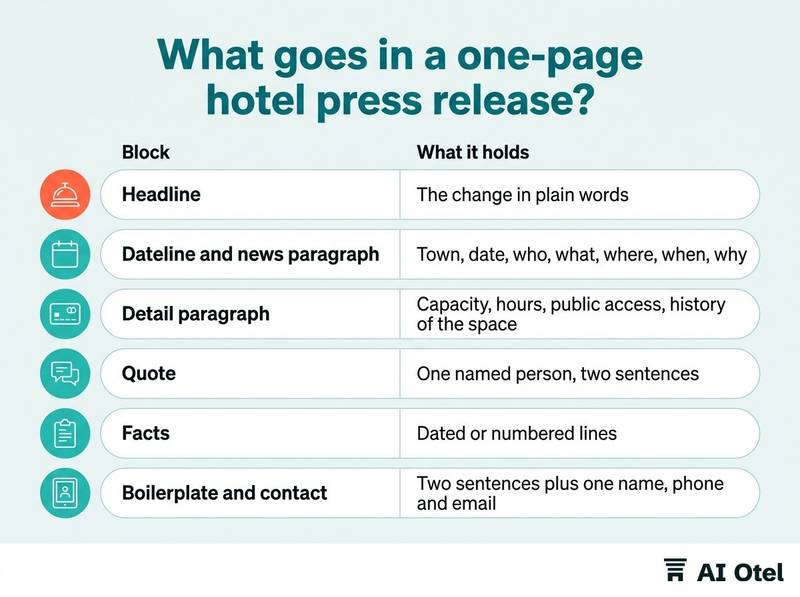
The headline states the subject, the verb and the change, in under about twelve words, with no adjectives. It should read as a line an editor could print above the story. "Hotel X opens 60-seat restaurant on Çarşı Street" works; "Hotel X unveils exciting new dining concept" does not.
The dateline and first paragraph carry the news: town and date, then who, what, where, when and why in forty to sixty words, written so it can be printed exactly as it stands. Most editors take the news from this paragraph alone. The detail paragraph answers the questions an editor would otherwise ask on the phone: capacity, opening hours, whether local residents can book, what was in the space before, and who carried out the work.
| Block | What it holds | Length |
|---|---|---|
| Headline | The change in plain words | Under 12 words |
| Dateline and news paragraph | Town, date, who, what, where, when, why | 40 to 60 words |
| Detail paragraph | Capacity, hours, public access, history of the space | 60 to 100 words |
| Quote | One named person, two sentences | Two sentences |
| Facts | Dated or numbered lines | 3 to 6 lines |
| Boilerplate and contact | Two sentences plus one name, phone and email | Short |
The facts block holds three to six short lines, each a fact with a date or a figure where one genuinely exists. Never pad it with estimates. The boilerplate is two sentences describing the hotel, its location and its room count, worded identically every time so a journalist can paste it. The contact block holds one name, one phone number, one email address, and a line saying photos are available, with the file names. Keep the whole document between 300 and 450 words.
Who may be quoted, and what should the quote say?
Quote one named person who can speak for the decision, and let the quote explain why it was done and what happens next.
Choose the person with authority over the change: the owner, the general manager, or the chef for a kitchen story. A quote from someone who did not make the decision reads as filler, and editors recognize it. The quote must say something only that person can say: the reason, the constraint, the next step. It must not repeat the news paragraph in the first person.
Keep it to two sentences of spoken language, with no adjectives and no promises about service levels, prices, rankings or future openings that are not already certain. Write the quote, read it back to the person, and get a clear yes in writing before the release leaves. A quote printed wrongly becomes a correction you cannot undo.
Guest quotes need written permission, and they put a private person's name in a local paper, which is a data question as well as a courtesy. Leave guests out unless a guest offers. Keep partners and suppliers out of the first release too: several voices blur who is speaking, and a partner can be quoted in a second release about their own part.
Watch outQuotes that cause corrections
A quote that fixes an opening date, states a price, claims a ranking, promises a view or a service level, or says anything about a competitor will be printed as written and cannot be withdrawn. Keep the quote to the reason and the next step, and have the speaker approve the exact wording.
Which photos should I send, and how should they be captioned?
Send three to five horizontal photos that show the thing the release is about, each with a caption and a credit line, inside the same email as the release.
The technical rules are simple and non-negotiable. Wider than they are tall, at least 2000 pixels on the long edge, no text or logo burned in, no heavy filters, no stock images. The set should cover four jobs: one wide shot of the space, one detail a reader would notice, one with people doing something ordinary such as a chef plating or a receptionist at the desk, and one exterior that shows where the place is.
Caption twice. Put the captions in the body text under the release, and in the file names, so a picture desk can match image to caption after the email is forwarded. Each caption carries who, what, where, when and the photo credit.
People in the frame need permission for press use, and staff need to know the image may appear in print. Keep a one-line record of who agreed and when. Do not send ten photos: a picture desk chooses from three to five and ignores the rest, and you can offer more on request. Keep the same set in a folder you can link to, so a second outlet can use it without another email exchange. Leave video and drone footage out of the first email; they follow separate rules and separate permissions, covered in the guide to hotel promo video and drone shots. For the full brief you hand a photographer, see the hotel photography shot list and delivery terms.
ChecklistThe photo package, six checks before sending
- Three to five images, all wider than they are tall
- At least 2000 pixels on the long edge
- No burned-in logo or text
- Every person in frame has given permission for press use
- Every file name states who, what and where
- A credit line is written in the body text
Whom do I send it to, and when?
Send to named people at a short list of local outlets, timed to the news: a week or so before a dated event, and on the day itself for something already finished.
Build the list by reading the outlets. Find who writes about restaurants, who covers the district, who edits the business page. Record the name, the beat and the address, and update the list when a byline changes. Send one email per journalist, addressed to them, with the release as plain text in the body and the photos attached or linked. Not a PDF alone, and never a single message with twenty addresses in blind copy.
The subject line states the news in six to eight words, sentence case, no exclamation marks, no "press release" label. Timing follows the news: three to ten days ahead for a dated event, so a weekly paper can plan; the day it opens for a finished renovation; never after the event has passed, because there is no story left. Send on a weekday morning. Monday and Friday inboxes are crowded, and a release that arrives at 18:00 is read the next day at best.
Follow up once, two or three days later, adding one new fact or the photo set, then stop. Repeated chasing closes the door for the next release. Between releases, keep the list warm: answer a query, pass on a correction, send a photo when asked. A journalist who has used you once is the easiest second hit.
TipThe send, in one line
One named journalist, one subject line stating the change, the release as plain text, three to five captioned photos, and a single follow-up two or three days later with one new fact. Everything else, including the second follow-up, reduces the chance of the next email being opened.
What comes back, and how do I keep a log?
Usually nothing, sometimes a short item or a request for a photo or an interview, and occasionally a correction you have to help fix. Coverage is never guaranteed and never bought as news.
The realistic returns are few. Silence. A two-paragraph item with one photo. A phone call asking for detail. A request for an interview or a second image. Or an invitation to buy advertising, which is a separate transaction from editorial coverage. If a paid item runs, the outlet should label it as advertising. Do not present it in your own materials as coverage, and do not log it as one.
If something prints wrong, send one short factual note naming the error, the correct fact and where it comes from, and ask for a correction. Do not argue the tone.
Log every send. The log is the evidence base: it shows which angles and which outlets actually produce, and it holds the links you need for the website, the press kit and next year's plan. Review it once a quarter, drop the outlets that never respond, and give more to the ones that asked for more.
| Field | What to record |
|---|---|
| Date sent | The day the email left |
| Outlet and type | Daily, weekly, online, radio |
| Journalist and beat | Name and what they cover |
| Angle used | One sentence |
| What ran | Nothing, item, interview, correction |
| Link | The published piece |
| Photo used | File name |
| Correction sent and outcome | Date and result |
| Follow-up date | The one follow-up |
| Next idea for this outlet | One line |
How do I reuse the news on my website and Google profile?
Publish the same facts on a permanent page of your own site, link to any coverage, and post a short version to your Google profile, so the news keeps working after the print run.
The news page holds the headline, the news paragraph, the quote, the photo set with captions, and links to anything published. Give it one stable address and never change it. Keep the page dated and factual: if it is later rewritten as marketing copy, the link from the article no longer matches what a reader finds.
The Google profile post is two or three sentences, one photo and a link to the news page. Posts expire, so the page remains the record. For the profile itself, the facts and photos that must stay current are covered in the guide to Google Business Profile facts and photos for hotels.
Add the release and the photo set to a standing press kit folder, so a journalist writing months later finds the facts without asking you. The same facts feed the newsletter, the reception screen and the note the sales team sends to agencies: one source, several uses, no contradictions. Do not republish a journalist's article in full. Quote one line, credit the outlet and link to it. A hotel that keeps one set of facts and one room inventory behind every channel avoids the contradictions that come from three people updating three lists; for how rates and availability reach each channel, see the distribution platform overview and the hotel operating system.
NoteOne fact, one wording
The news paragraph, the quote and the photo captions should be identical on the news page, in the press kit and in the release. When a fact changes, change it in all three on the same day, because a journalist may quote any of them.
What to do next
Pick the one change your hotel can put a date on this quarter, and write the news paragraph before anything else. Then build the photo set and the named contact list around it. The release itself is the smallest part of the work: the list and the log are what make the second release easier than the first.
Frequently asked questions
How long should a hotel press release be?
One page, roughly 300 to 450 words. The first paragraph must be printable as it stands, because many editors take the news from it and nothing else. Photos are listed and attached, never pasted into the document, and the boilerplate stays identical every time.
Can a hotel pay a local paper for coverage?
Advertising is bought and editorial is not, and the two must stay separate. Ask the outlet for its advertising terms if you want a paid placement, expect it to be labelled as advertising, and do not record it in the log as coverage. A paid item that looks like news costs credibility with the same journalists you will need next time.
What should a hotel do when nothing new has happened?
Do not send a release. Offer a story idea instead, such as access to a kitchen during service, an interview with the person who runs a department, or an explanation of how a seasonal decision is made. Keep the contact list warm with answers and corrections, and wait for a change with a date before writing again.
What belongs in a standing hotel press kit?
A two-sentence description of the hotel, a fact sheet with room count, outlets, opening hours and location, five to ten captioned photos with credits, logo files, one named contact with a phone number and email, and the last two releases. Keep it in one folder with a stable link so a journalist can help themselves.