AI at night: what an assistant may answer or do when no manager is in the building
Define clear rules for AI assistants during night shifts. Learn how to answer guest questions, prepare actions for morning approval, and escalate emergencies safely.
AI draft · awaiting editorial review
Contents
Key takeaways
- The night rule is written in daylight: every request either fits a rule the hotel recorded or it waits for a person.
- An assistant may answer alone only from facts the hotel has stored; a missing fact becomes "I will check", never a guess.
- Money, booking changes and complaints are prepared overnight and approved in the morning, with the guest told when to expect an answer.
- A short list wakes a person: safety, security, and a guest with no room. Every name on it has agreed to be called.
- The morning review is where the system improves: one list, three questions per entry, at most one rule changed.
At night an AI assistant, software that answers guests and can act in the hotel's systems, should follow a written three-tier rule: answer from recorded facts, prepare an action for a person in the morning, or wake a named person. Money, bookings and complaints wait for a human.
It is 02:40. A guest messages the hotel: the room next door is loud and they want to move. The receptionist is on a round, the manager is asleep, and the assistant has a few seconds to decide whether this is an answer, a draft or a phone call. That decision should not be made by software in the moment. It should have been made weeks earlier, in an office, in daylight. This article gives you the AI assistant hotel night shift rules as one written three-group scheme, the escalation list, the morning review and five test scenarios, so your night team knows exactly what the assistant may do when nobody senior is awake.
Why is night different from day for a hotel AI assistant?
At night the guest's questions are the same but the person who can say yes is asleep. The assistant stops helping staff and starts standing in for them, so its authority has to be written down before the shift begins.
In the daytime an assistant sits next to someone who can approve; at night there is nobody to ask, so each request either fits a recorded rule or waits. The risk is not a clumsy sentence, it is a wrong action: a room held, a charge removed, a message sent that cannot be recalled. Night staff are busy with late arrivals, security rounds and the night audit, and the assistant earns its place by answering the twentieth wifi question without pulling anyone off the desk.
Tired guests tolerate a slow honest holding reply better than a fast wrong one. Write the rule in daylight with the night manager in the room: a rule invented at 02:00 is a rule invented under pressure. Keep the rule to three groups and name them the same way in every document, so a new night receptionist can learn it in one shift.
| Group | What the assistant does | Typical night examples | Who decides |
|---|---|---|---|
| Answer alone | Replies from recorded facts | Wifi, breakfast hours, parking, check-out time, directions | The hotel's written fact sheet |
| Prepare for morning | Drafts an action with its reason | Late check-out with a price, upgrade, charge waiver, invoice correction | A named manager before the morning meeting |
| Wake a person | Escalates immediately | Fire, medical, security incident, guest with no room, suspected fraud | The duty manager on the phone tree |
What the guest is told differs by group: the answer itself in group one, a holding reply with a time in group two, and in group three, what the assistant has actually done, never "someone is coming".
What may the assistant answer alone at night?
Only questions whose answer the hotel has already written down and stored where the assistant can read it.
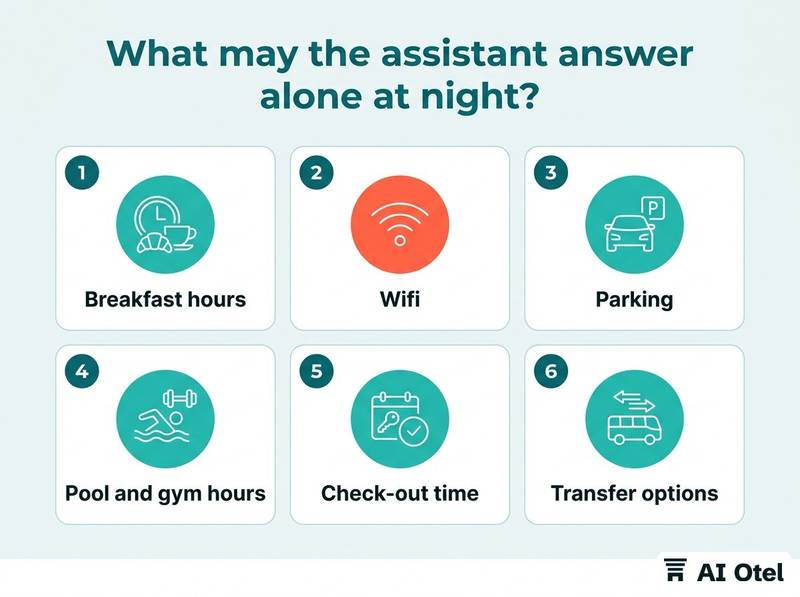
The fact sheet covers breakfast hours, wifi, parking, pool and gym hours, check-out time and the late check-out policy, transfer options, pet policy, address and directions, and how to request an invoice. If a fact is missing the assistant says it will check and gives a time. It never fills the gap with a plausible answer, because a plausible answer at night becomes a complaint at breakfast.
Availability and price are not group one unless they come from live inventory. A quoted rate is a commitment, not information. A guest's own bill may be read back to them, line by line; it may not be changed. Answer in the guest's language where the hotel holds that language, since a correct answer in the wrong language is still a bad answer.
Log every answer with the fact it used, so the morning review can check the source and not only the wording. Keep the fact sheet short and dated: a fact nobody has confirmed for a year is a guess with a filing cabinet. If guests keep writing outside staffed hours, pair this with after-hours inquiries and an auto-reply that helps instead of annoys.
ChecklistBefore the assistant answers alone at night, record these facts
- Reception and phone hours
- Wifi network and password
- Breakfast times and location
- Check-out time and late check-out policy with its price
- Parking and garage access
- Pool, gym and spa hours
- Airport transfer options and who arranges them
- Pet and child policy
- Exact address and driving directions
- How a guest requests an invoice
- The name and number of the duty manager for the current night
What should be prepared overnight and approved in the morning?
Anything that changes a record or costs money but will not harm the guest by waiting until morning.
Typical entries: a late check-out with its price, a room upgrade, a refund or a charge waiver, an invoice correction, a change to a group rooming list, a request for a specific room. The assistant drafts the action together with its reason and the rule it applied, so the approver sees the working and not just the wish.
The guest receives a holding reply that names a time, for example "the manager will confirm by 09:00". Never a promise, never silence. Give the queue an owner and a cut-off: everything prepared overnight is decided before the morning meeting, or dropped with an explanation to the guest.
Two outcomes are allowed, approved as drafted or changed by the person. A draft that is silently ignored is worse than no draft at all, because it teaches the night team that the queue goes nowhere. Name in the rule what may never enter this group, for example a refund above a set amount or a complaint that mentions injury or safety.
This is where software design matters. AI Otel's PMS assistant is built: it answers questions about a hotel's own property in plain language, carries out routine actions, and a person confirms anything sensitive, with 207 actions in three safety tiers (June 2026). That structure mirrors the three night groups. The detail is on the platform's PMS page and the wider platform overview.
What must wake a person, and who?
Safety, security, and any guest who has no room to sleep in. The list is short, and every name on it has already agreed to be called.
The list: fire or flooding, a medical emergency, a security incident, a guest with no room after an overbooking or a double sale, suspected payment fraud, a suspected data incident, a death, a police visit. Build a phone tree with a first, second and third name, each with a number, a response window, and an instruction for what to do when nobody answers inside it.
The assistant never says "someone is coming" unless the call connected. It reports what it has done: "I have called the duty manager and left a message". The night team must be able to start the same escalation by hand; the assistant is an extra path, never the only path. Test the tree once a month with a real call, at night, and time how long the first person takes to answer.
Write down who is allowed to say yes to what: a free night, a room move, a taxi at the hotel's cost. Authority that is not written down is authority nobody uses. For the wider context, see hotel security from the entrance to the night shift.
Watch outNever promise help before the call connects
An assistant that says help is on the way before the call has connected turns a small night problem into a broken promise. The guest waits, nobody arrives, and the morning starts with a complaint the hotel cannot defend.
What about guest messages with money or a complaint in them?
They are never answered alone. A complaint at night is an emotion problem before it is a facts problem, and money is not moved by software at 03:00.
Separate "what is this charge" from "remove this charge". The first is read from the bill and is group one; the second is group two at the earliest. A complaint gets an acknowledgment, an apology for the experience rather than an admission of fault, and a named time when a person will respond.
The assistant may not promise compensation, a free night, a refund or a discount. Those are the manager's words in the morning. A message already sent to a guest cannot be undone: a change inside the system can be reversed, a sentence in an inbox cannot, which is the core problem in irreversible actions in hotel AI such as messages, refunds and invoices.
Keep the transcript. At night nobody remembers the exact wording, and the morning review depends on it. If a complaint mentions safety, injury, discrimination or the police, it leaves this group and goes straight to the phone tree.
How does the morning review of the night's entries work?
One list, one owner, twenty minutes, the same time every day.
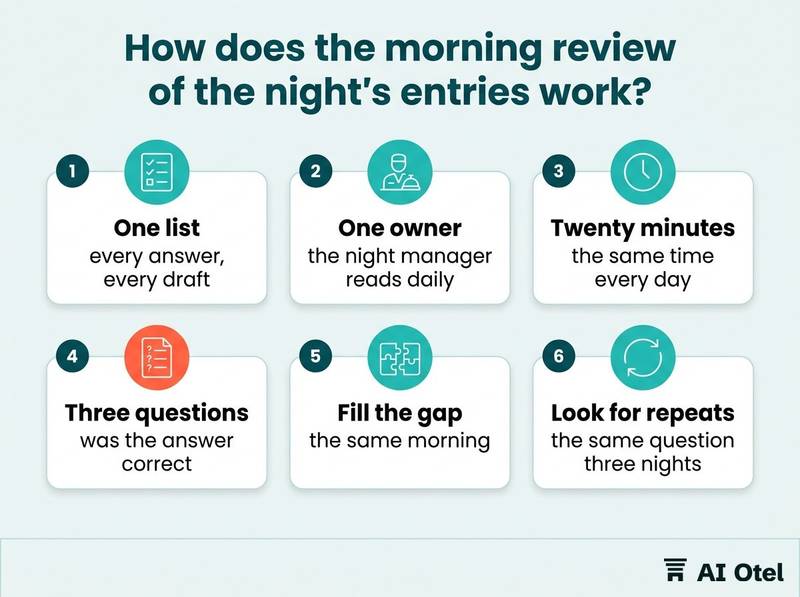
The list holds every answer, every draft and every escalation, with the time and the rule that was used. Ask three questions of each entry: was the answer correct, was the escalation right, does a fact or a rule need to change.
When the assistant said "I will check", the gap is the cheapest improvement available. Fill it the same morning. Look for repeats: the same question three nights running is a missing sign, a missing page or a wrong fact, not a difficult guest.
The night manager reads the list daily; the general manager reads the week once and changes at most one rule. Date every change and keep it, so next month's review can see whether it worked or quietly disappeared. If the night audit itself is the bottleneck, the question of whether a small hotel needs someone awake at 03:00 is worth settling alongside this routine.
How do you test it with five night scenarios?
Run five scripted nights with the people who actually work nights, before the season starts and not during it.
The five: a 02:00 wifi question, a late check-out request that carries a price, a noise complaint from the next room, a guest with no room, and a request that requires waking the duty manager. For each one check three things: what the guest was told, how long the holding reply took, and whether the right person was called.
Run it as a table-top exercise first, then live on a quiet night with a staff member playing the guest. Re-run after any rule change and after any new hire joins the night team. Write the result on one page; a test nobody recorded is a test nobody can repeat.
Checklist
- Wifi question at 02:00: answered from the fact sheet, no staff involved
- Late check-out with a price: drafted with its reason, guest given a time, nothing charged
- Noise complaint: acknowledged, no compensation promised, a person named for the morning
- Guest with no room: duty manager called, guest told what was actually done
- Request needing a wake-up call: call connected and timed, guest not told "someone is coming" before it did
What to do next
Write the three lists this week: what the assistant may answer alone, what it prepares for the morning, and who it wakes. Then run the five night scenarios with the people on the night shift and read the first week's entries together. The parts form one loop: a written rule, a log, a morning review, a better rule. If you want to see how a built assistant with tiered confirmations behaves in practice, you can request a briefing.
Frequently asked questions
Can an AI assistant check a guest in when reception is closed?
Check-in creates a record, takes a payment and starts a guest identity notification, so it touches money and records and belongs with a person confirming. The assistant can collect the details and prepare the check-in for whoever is on duty. Whether reception may be closed at all is the hotel's own decision, and its own procedure decides who is allowed to complete a check-in.
What should the assistant say when it does not know the answer?
That it will check and when the guest will hear back. Guessing is the one failure that damages trust fastest at night, because the guest acts on the answer. The unanswered question is logged and the fact sheet is fixed the next morning.
Can the night receptionist overrule the assistant?
Yes, always. A person outranks the software, and the override is logged like any other entry. If overrides repeat on the same question, the rule or the fact is wrong and the morning review should change it.
How do we stop it promising a refund?
Refunds and charge waivers never sit in the answer-alone group. The assistant may state what the bill shows and say a person will review the request, with a time. The rule should list the words it may not use: refund, free, on us, discount, compensation.