Answering a corporate rate request (RFP): what to ask, how to price and how to write the reply
A corporate RFP is a request for rates, not a commitment. Learn to test volume against your calendar, choose the right rate structure, and write a clear reply.
AI draft · awaiting editorial review

Contents
Key takeaways
- The volume figure in a corporate RFP is the company's estimate of its own travel, not a commitment, so ask for the month-by-month and day-of-week spread before you price anything.
- Displacement is the test: a corporate night is worth signing only if it beats what the same room would earn from the business you would otherwise sell.
- A fixed rate, a discount off the public rate and seasonal tiers each solve a different problem; the wrong structure costs more than the wrong number.
- Last room availability is a concession with a price, because it removes your ability to close the corporate rate on a night you could sell higher.
- A good hotel corporate RFP response is one page plus a rate table, answers the company's questions in their order, and ends with a date you will call.
A corporate RFP is a company's written request for room rates across set dates, cities and terms. Answer it in four moves: read what the document leaves out, ask the company for its monthly night pattern and booking behavior, test the volume against your own calendar, then reply on one page with rates, terms and a follow-up date.
A rate grid arrives by email: six cities, four date bands, a volume figure and a deadline. The number you type into that grid will hold for a year, and the grid invites you to fill it in without asking a single question back. After reading this guide you will know what to ask before pricing, how to test the volume against your own demand, which rate structure to offer and how to write a reply that protects the hotel.
What does a corporate RFP ask for, and what does it leave out?
It asks for a price across named dates, cities and room types, plus the terms the company wants. It rarely says how those nights are spread across the year, who books them, or who pays.
The core of the document is a grid: property or city, date bands, room type, board type, and an empty rate cell for you to fill. Around the grid sit the terms: the cancellation window, last room availability, payment terms, whether the rate is net or commissionable, and what the room rate includes. Read the deadline and the required reply format first, because a late reply, or one that ignores their template, is often not read at all.
The volume line is the company's estimate of its own travel, not a commitment. Treat it as a forecast and ask how it was built. What is usually missing matters more than what is written down: the monthly and day-of-week spread, booking lead time, average length of stay, the share of bookings made in the last few days before arrival, and whether the traveler or the company pays. Also missing: whether the company books through a travel management company (a firm that buys and manages travel on an employer's behalf) or self-books, and whether the rate must be loaded into a booking tool before anyone can use it. For more on that channel, see how a travel management company buys hotel rooms for business travelers.
A multi-city or chain-wide request is a different decision from a single-property one. You may be one line in a grid of twenty, and the effort of replying should match that.
ChecklistCheck the document against this list
- Rate grid: cities, date bands, room types, board
- Volume figure: ask how it was built
- Cancellation window: does it match your own policy
- Last room availability: yes or no, and at what price
- Payment terms: who is liable, when the invoice is issued
- Inclusions: breakfast, taxes, wifi, parking
- Reply deadline and format
If the account is one you expect to negotiate over years rather than sign once, the groundwork is the same as agreeing corporate rates with companies describes: the RFP is only the opening move.
What should you ask the company before you price?
Ask for the shape of the demand rather than the total: which months, which nights of the week, how far ahead people book, and who pays.
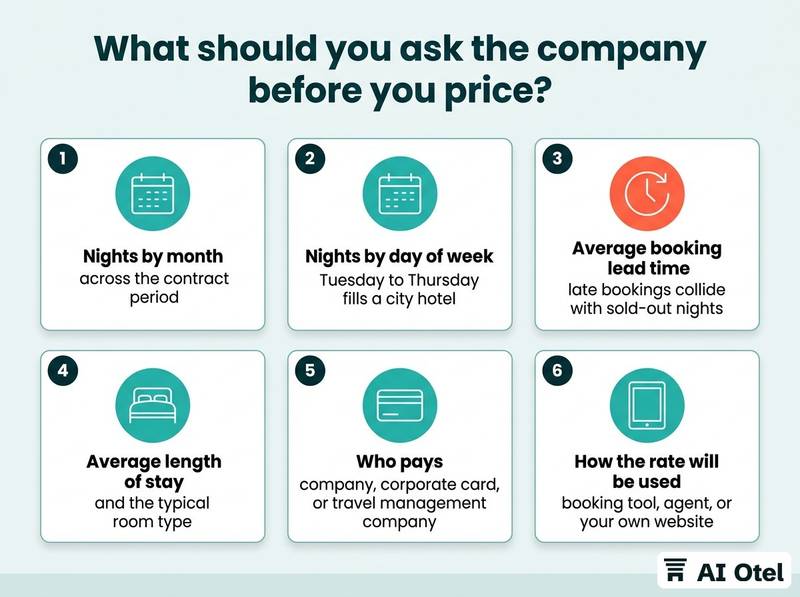
Monthly night distribution across the contract period comes first, plus the day-of-week pattern. An account that fills Tuesday to Thursday is worth more to a city hotel than to a resort, and the reverse is just as true. Booking lead time and the share of bookings made inside the last few days matter because late bookings are the ones that collide with your sold-out nights and force the awkward conversation.
Average length of stay and the typical room type tell you what product you are actually selling. Single-occupancy midweek business is a different product from a family weekend, and it should not carry the same rate. Who pays changes the contract: the company on account, the traveler with a corporate card, or a travel management company that invoices later. Each one changes your credit risk and your cancellation terms.
Ask how the rate will be used: loaded into a booking tool, quoted by an agent over the phone, or booked by the traveler on your own website. A rate nobody can find is a rate nobody books. Ask whether they need instant confirmation or accept a request the hotel answers by hand within a stated time. Finally, ask what happened with their previous hotel. Why the account moved, and what they were unhappy about, tells you more than the volume figure does.
ChecklistSend these questions back with the RFP
- Nights by month for the contract period
- Nights by day of week
- Average booking lead time
- Average length of stay and usual room type
- Who pays, and who is liable for a no-show
- How the rate will be loaded and used
- Why the account is moving
How do you check the requested volume against your own demand?
Lay the requested nights onto your own calendar month by month and night by night, and compare them with the pace you already have, not with last year's total.
Build a simple grid: month band, requested nights, rooms already booked for those dates, the occupancy band you expect, and a judgment of adds, neutral or displaces. Displacement is the business you would have sold anyway at a higher rate. The question is not whether the corporate rate is profitable on its own, but whether it beats what the same room would earn. The method is the same one used in group displacement analysis, applied to a corporate block instead of a group block.
Weekday and weekend nights are different products. A block that displaces Tuesday business may be free capacity on a Saturday, and the reverse is just as true. Shoulder months and need periods are where a corporate agreement earns its place. Peak dates are where it costs you, and that is where you should be least generous.
Compare the block the company asks you to hold with the rooms it actually took at its previous hotel. The gap between the two is your real risk.
| Month band | Requested nights | Your current pace | Action |
|---|---|---|---|
| Peak season | High block | Near capacity | Tier high, exclude peak dates |
| Shoulder | Medium block | Room to add | Offer best rates here |
| Low season | Any block | Empty | Adds business, be generous |
| Midweek vs weekend | Mostly midweek | Weekend weak | Welcome it in city hotels |
For example, take a company asking for 400 nights a year at a rate below your public rate. If most of those nights fall in months you already fill, the agreement costs more than it brings. If they fall in your two weakest months, the same rate is good business. The number is the same; the calendar decides.
Fixed rate, discount or tiers: which structure should you offer?
Match the structure to how the company books and how much control you need over the calendar. A fixed rate buys simplicity, a discount buys flexibility, and tiers buy both at the cost of a longer explanation.
A fixed negotiated rate is one number per room type for the whole contract period. It is easy to load and easy for the company to budget, but it is wrong on your strongest nights and it can sit above your public rate when demand falls. A discount off the public rate keeps the guest a set amount below whatever you sell publicly. It protects you in weak demand, but it gives the company no budget certainty and it moves every time you reprice.
Tiers, by season, by month band or by volume reached during the year, price the calendar honestly. They take more work to explain and to load, and the company will ask which tier applies on which date. Whichever you choose, watch for rate inversion: if your public rate falls below the corporate rate, the corporate traveler books the public rate and the agreement stops meaning anything. Write a floor and a rule for what happens when the two cross.
| Structure | Best when | What you give up | Watch |
|---|---|---|---|
| Fixed negotiated rate | Predictable, shoulder demand | Peak-night margin | Inversion in weak demand |
| Discount off public rate | Unpredictable dates | Budget certainty for them | Rate moves when you reprice |
| Seasonal or volume tiers | Uneven calendar | Simplicity in loading | Tier disputes on dates |
Prefer inclusions to a deeper rate. Breakfast, late check-out, parking or an upgrade subject to availability cost you less than a rate cut and are easier to withdraw at renewal. State the currency, whether the rate includes VAT and the accommodation tax, and who bears a change in either. A silent currency assumption becomes a dispute in month three. Never publish a rate you cannot honor for the full contract period. A rate you withdraw in July costs you the account.
Which terms protect the hotel in the reply?
The rate is only half the agreement. Last room availability, cancellation, payment and the rate-loading deadline decide whether the account is profitable.
Last room availability means the corporate rate stays bookable while any room in the hotel is for sale. It is a real concession: it removes your ability to close that rate on a night you could sell at a higher price. Price it, or decline it in writing. Cancellation needs a defined window, a definition of what counts as a cancellation, and a no-show charge. A corporate no-show costs the same as a leisure one.
Payment terms should say who is liable, when the invoice is issued and what the credit terms are. Company-pays and traveler-pays are different contracts with different risk. For a first-year account, a card guarantee or a deposit is normal; put it in the reply rather than in the first dispute. Write the inclusions list out in full: breakfast, taxes, wifi, parking, fitness access. The argument six months later is always about what the room rate was understood to include.
Watch outLast room availability is not a formality
It keeps the corporate rate open on every night a room is for sale, including the nights you would otherwise close it. Decide whether you are selling it, and at what rate premium or in exchange for what volume, before you sign.
If the hotel cannot honor a confirmed booking, the reply should state in writing what the hotel does. Have your legal adviser confirm that wording before you send it, and keep the same wording in every contract. Rate loading needs a named deadline, channel and responsible person on each side: a rate that is agreed but never loaded is not a rate. Put the review date into the agreement, not into your calendar alone.
How should the one-page reply be written?
Answer their questions in their order, put the rates in a table, put the terms in short bullets, and end with a date you will call.
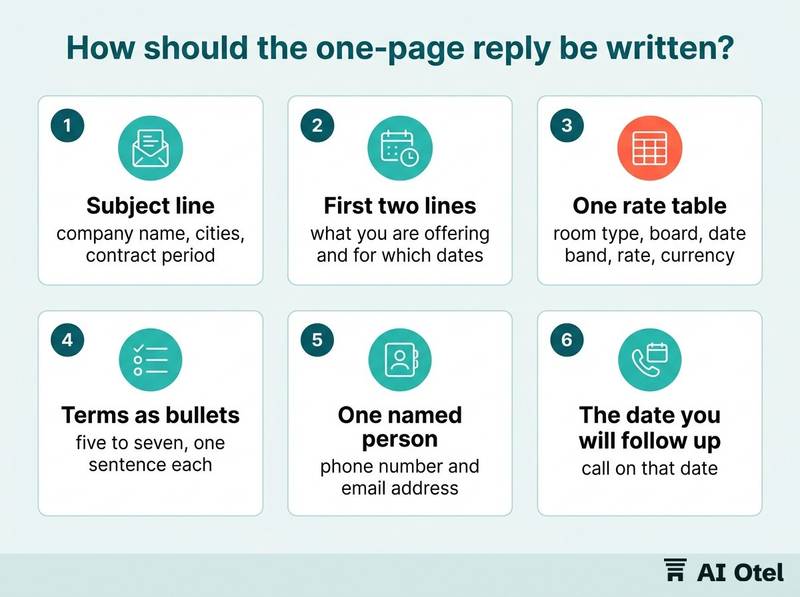
The subject line should carry the company name, their reference if they gave one, the cities and the contract period, so it is findable in an inbox six months later. The first two lines say what you are offering and for which dates, in plain words. No preamble about your hotel's history.
One rate table: room type, board, date band, rate, currency and what is included. A price buried in a paragraph reads as negotiable. Terms as five to seven bullets, one sentence each, in the same order as their document. If they asked about last room availability, answer it directly rather than leaving it out.
Close with what you need from them: confirmation of volume by month, the loading details and the billing contact. Then one named person, with a phone number and an email address. Give the date you will follow up, and call on that date. A reply without a next step waits for their decision; a reply with a date moves it. Keep it to one page plus the rate table. A long reply reads as a negotiation, a short one reads as a decision.
TipThe one-minute test
Hand the reply to a colleague who does not know the account. They should find the price, the three most important terms and the next step within a minute, without reading the whole page.
If you have not built your standard documents yet, start from a hotel sales kit for agencies and companies: the fact sheet, the rate sheet and the contact sheet do most of this work once and serve every request after it.
When should you review the account?
At the review date you wrote into the agreement, and with actual numbers rather than impressions.
Look first at nights actually used against the volume the company estimated. The gap tells you what the account is really worth and what to ask for at renewal. Then look at realized rate: what the corporate business actually paid once cancellations, no-shows, upgrades and inclusions are counted, not the headline rate in the contract.
Booking behavior matters as much as volume: lead time, length of stay, and whether the bookings came through the agreed channel or around it. Whether the rate was used at all is the quiet question. An account that signs and never books is a line in someone else's grid, not a partnership.
Before the review, decide what would make you walk away, so the decision is made with numbers rather than in the meeting. What to change at renewal: the structure, the last room availability concession, the cancellation window, the inclusions. Hotels that manage corporate accounts alongside agency business usually fold this into the rhythm of a yearly B2B sales plan.
What to do before the next request lands
Write your own one-page standard: the seven questions you send back, the three rate structures you are willing to offer, and the terms you will not move on. Then the first reply takes an hour instead of a week, and every reply after it starts from the same honest baseline.
If you are rebuilding that standard, it is worth seeing how a hotel operating system keeps reservations, billing and corporate client portals in one place, or how a distribution hub, built with seed data, lets hotels publish contracted rates to agencies and shows the working behind every quote; no agency is connected yet.
Frequently asked questions
What is last room availability in a corporate hotel agreement?
It means the corporate rate stays bookable for as long as any room in the hotel is for sale, including nights the hotel would otherwise close that rate. It is a concession with a cost, so decide whether you are selling it and at what premium or in exchange for what volume. Write the definition into the contract rather than leaving it to the company's template.
Should a hotel give a fixed corporate rate or a discount off the best available rate?
A fixed rate suits an account with predictable, mostly low-season or shoulder demand, because it is simple to load and to budget. A discount off the public rate suits an account whose dates you cannot predict, because it protects the hotel when demand falls. Tiers combine both when the calendar is uneven, at the cost of a longer explanation.
How many room nights should a company commit to in an RFP?
Ask for nights by month and by day of week rather than one annual figure, and treat the number as a forecast. Compare the block the company asks you to hold with what it actually took at its previous hotel. Put the review date into the agreement so the estimate can be tested against actuals.
Who pays for a corporate hotel stay, the company or the traveler?
Either is common, and the answer changes the contract. Company-pays means credit terms, an invoice address and a named person liable for no-shows. Traveler-pays means a card guarantee at booking and a cancellation policy the traveler understands. Ask before you price, because the two carry different risk.
When should a hotel renegotiate a corporate rate?
At the review date written into the agreement, using actual nights, realized rate and booking behavior rather than the original estimate. An account that underuses its volume or books around the agreed channel should be repriced or restructured. Decide in advance what would make you walk away.