Asking guests for a review: timing, wording and what you must not offer
Ask for reviews the morning after departure with a short, personal message. Never offer discounts or gifts for scores, as this breaks trust and platform rules.
AI draft · awaiting editorial review
Contents
Key takeaways
- The desk ask and the written ask are two different acts: at departure you ask permission to send a link, and the review itself happens later in the guest's own time.
- A request is two sentences and one link that opens the review form directly; anything longer is a survey or a newsletter wearing a request's clothes.
- Never trade a room, a discount, an upgrade, a gift, loyalty points or a refund for a review or a score, because a bought review stops being evidence for the next traveler.
- The strongest ask goes to the guest whose complaint you actually resolved, made by the person who resolved it, after the guest confirms the fix.
- Log every request with its date, channel and outcome, and read the topics in the reviews monthly rather than the average score.
Ask for a hotel review in two sentences with one link, sent the morning after departure, to a guest whose stay ended well or whose complaint you resolved. Never ask at the desk with a queue behind. Offer nothing of value for a review or a score: no room, discount, upgrade, gift, points or refund.
The guest is at the desk, the taxi is waiting, and the receptionist slides a tablet across the counter with the review form already open. That single gesture decides whether the review you get next week describes a stay or a transaction. Asking hotel guests for a review is a small, repeatable process: choose the guest, ask permission at departure, send one short message the next morning, offer nothing, and record what comes back. This guide gives you the wording, the timing and the one rule you must never break.
Who should you ask for a review?
Ask the guest whose stay ended well and the guest whose complaint you genuinely resolved. Skip everyone else, because a request sent to a guest who left unhappy invites the review you did not want.
Build the ask list from today's departures, not from the whole guest database, and filter it with one question: is anything still open for this guest? If there is a dispute, a promise not yet kept or a room move still pending, that guest is not on the list today. The list is daily work, not a monthly export.
The resolved complaint is the strongest ask you have. That guest can describe something specific that changed, which is exactly what the next traveler reads for. Ask only after the guest has confirmed the fix, and ask by name. Exclude the guest with a disputed charge, the guest still waiting for a room move, the guest who checked out early, and the guest who was relocated to you from another property. For groups and corporate bookings, the person who signed the contract is not the person who stayed: ask the meeting planner separately and never the attendee list.
Ask the person who served them: the receptionist who checked them out, the guest relations manager who handled the complaint, the spa supervisor. A request from a named person reads as a request; one from "the team" reads as a mailshot. One request per stay, addressed to the lead guest on the reservation by name, not one message per person in the room. Send only to people who stayed with you and gave you an address during the stay. A purchased or scraped list produces reviews that describe nothing.
When should you send the review request?
Ask in person at departure if the moment is calm, and send the written request the morning after check-out. Not at the desk with a queue behind, and not three weeks later.
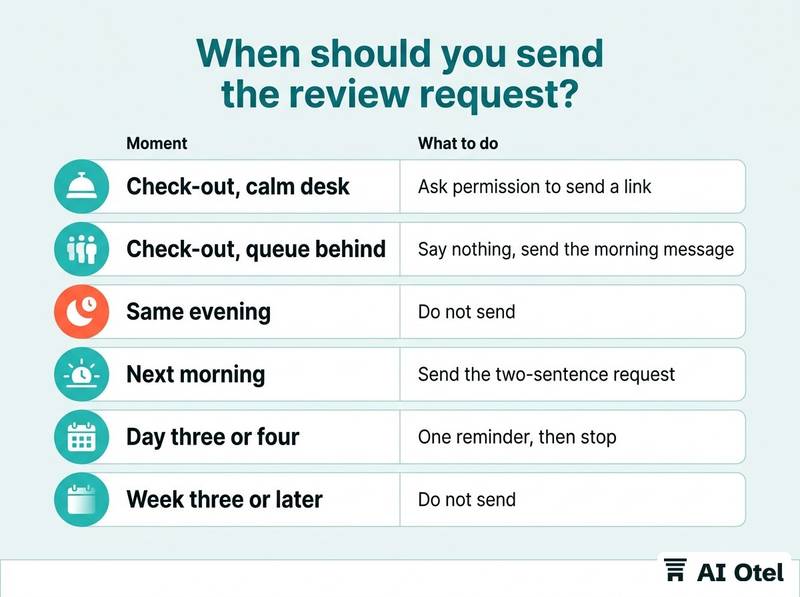
At the desk you ask permission to send a link; the review itself happens later, in the guest's own time and on the guest's own device. This separation is what keeps the desk ask from becoming pressure. The two acts are different and should be written down as different steps in your routine.
Send the morning after departure, timed to the guest's morning rather than yours: a guest on a 06:00 flight is not reading email at 22:00 the night before. Not the same evening, because the guest is travelling and the bill is still fresh, so a request arriving with the invoice reads as part of the invoice. Not a week later either, because the details have faded and the message arrives in a different context. If your system sends in batches, send the next batch, not the next month.
One reminder, three to four days after the first, and only if the first was not opened or not answered. A second reminder is a complaint about the guest. For long stays, ask at the end of the stay, never in the middle, because a mid-stay request interrupts the service you are still delivering. Tie the send to the departure record rather than to a fixed hour of the day, so the message follows the stay and not the clock. If you also collect feedback in other ways, keep the review request separate from comment cards and QR feedback forms, which serve a different purpose.
| Moment | What it does to the guest | What to do |
|---|---|---|
| Check-out, calm desk | Guest is present and unhurried | Ask permission to send a link, take the answer |
| Check-out, queue behind | Guest is exposed in front of strangers | Say nothing, send the morning message |
| Same evening | Arrives with the bill and the journey | Do not send |
| Next morning | Guest is home or in transit, stay still fresh | Send the two-sentence request |
| Day three or four | No answer yet | One reminder, then stop |
| Week three or later | Details gone, reads as a mailshot | Do not send |
What should the review request say?
Two sentences and one link: name the stay, ask for the review, give the address that opens the form. Anything longer is a survey or a newsletter.
Sentence one anchors the stay: "You stayed with us in room 412 from 3 to 6 May." It proves the message is not a mailshot and helps the guest place you immediately. Sentence two asks and gives the link: "If you have two minutes, a review here helps other travelers and helps us." Then the address, on its own line.
One link, opening the review form itself, not the hotel homepage and not a page that asks for a login. Every extra step loses people, and the guest owes you none of them. No attachment, no PDF, no image-heavy template. Plain text from a named person with a working reply address gets read and gets answered.
Write in the language the booking was made in, and sign with the name of the person who served the guest, not the hotel's general address. Do not put a rating question in the request. "How was your stay, one to five?" is a survey, and a survey placed before the review shapes the review. Do not put an offer, a discount code or a competition entry in the same message. A promotion is a different message with a different purpose, and mixing them turns the request into a trade.
ChecklistCheck before any request leaves the building
- One named guest
- The stay named by room and dates
- One link that opens the review form directly
- One named sender with a reply address that a person reads
- No offer, no discount code, no rating question anywhere in the message
What must you never offer for a review?
Never trade anything of value for a review or for a score: no free night, no discount, no upgrade, no gift, no loyalty points, no refund, no entry into a draw. This is the standard the major booking platforms set, and it is the safest practice for trust in any case. Incentive rules are not identical everywhere, so check the specific policy of each platform you use before you offer anything in exchange for feedback.
The reason is not only the platform's rule, it is the evidence. A review bought with a discount is a price, and a reader who suspects a price stops believing every other review on the page. "Leave five stars and get a free breakfast" is worse than a discount, because it buys the number rather than the text, and the number is what other travelers use to sort. This matters for visibility as well as trust, because what guests actually write is what the next traveler reads, and how review order works follows the text, not what you hand out at the desk.
Never ask staff, family or a supplier to post, and never write a review of your own property. One discovered, and the whole page is in question, including the honest reviews. The rule has to be written and handed to the people who talk to guests, because the offer is usually made by a well-meaning receptionist at 23:00, not by a manager in a meeting.
What you may do is thank the guest after the review, answer the review in public, and fix what it names. A thank-you after the fact is not a payment. If a guest asks what they get for a review, the answer is nothing, said warmly, and the request is withdrawn on the spot.
Each review platform publishes its own policy on incentives and on who may post. Read the current text of the platforms that matter to you before you design anything, because the wording differs and it changes. Where money or contract terms are involved, confirm your own case with your legal adviser.
Watch outThe one sentence that costs you the page
Treat any message that links a reward to a review or a score as forbidden. The ban covers discounts, upgrades, gifts, points, refunds and prize draws, and it applies to what staff say at the desk as much as to what marketing sends by email.
How do you ask in person at departure without pressure?
One sentence, offered as a choice, with an easy no. The desk ask is a request to send a link, not a request for the review.
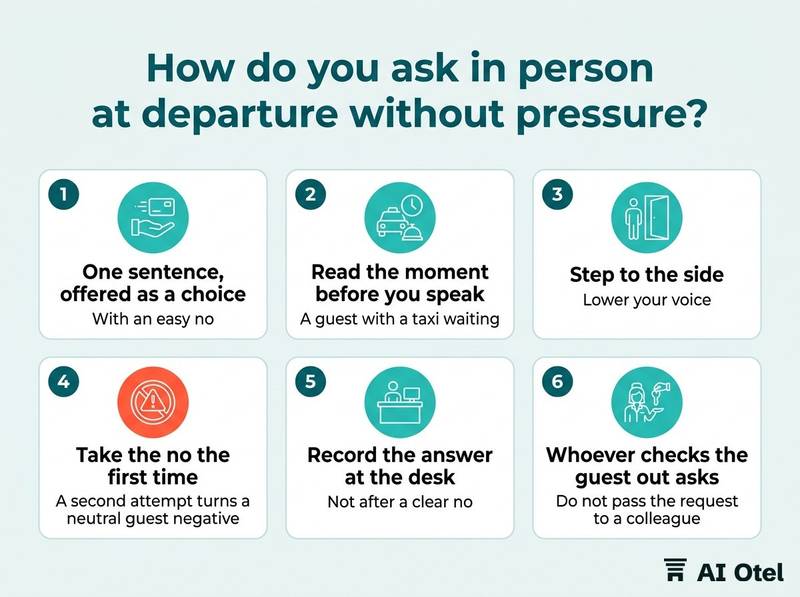
Read the moment before you speak: a guest with a taxi waiting, a disputed minibar charge or a crying child is not a guest to ask. Step to the side of the desk and lower your voice. Never hand a tablet across the counter with the form already open, and never ask in front of a queue. If the guest says they will do it now, give them the link or the code and turn away. Watching someone write a review is pressure, whatever you intended.
Take the no the first time. "Of course, thank you for staying" ends it; a second attempt turns a neutral guest into a negative one. Record the answer at the desk, so the morning message does not arrive after a clear no. Whoever checks the guest out asks. Do not pass the request to a colleague the guest has never met, and do not leave it to whoever is free at that moment.
TipTwo lines for the desk
The ask: "If you enjoyed the stay, may I send you a link tomorrow where you can say so? It helps us." The reply to a no: "Of course, thank you for staying with us." Say the ask once, then return to the check-out.
How do you track requests and the review mix?
Log every request and its outcome, and read the topics in the reviews monthly rather than the average score. You cannot improve a request process you do not record.
Start with five columns in a spreadsheet: departure date, guest name, who asked, channel and date sent, and whether a review appeared. Without the log you cannot tell a quiet month from a broken send, because a template that stopped going out looks exactly like guests who stopped replying. Give the log one owner and one weekly reading. A review routine that lives in three inboxes is a routine nobody runs.
Read the mix, not the mean: which topics appear in the low reviews, such as noise, breakfast, check-in wait or air conditioning, and whether the same topics appear in the high ones. Compare reviews that came from a request with the ones that arrived on their own. They answer different questions: one measures your process, the other measures your reputation. Keep the request separate from the satisfaction survey: the survey asks what you want to know, the review asks what the guest wants to say, and merging them weakens both. If your team is small, fold this into a weekly reputation routine for a small team, and keep the questions you control in the guest satisfaction survey where they belong.
| Column | What it tells you |
|---|---|
| Departure date and guest name | Ties the request to a real stay |
| Who asked | Shows whether the desk or guest relations is actually asking |
| Channel and date sent | Shows whether the template is still going out |
| Review appeared, yes or no | The only outcome you can count |
| Topic named in the review | Turns a score into a work item for a department |
If you want the request to reach guests through more than email, a guest app, built and working ahead of launch, can carry offers during the stay and requests from the guest, and a hotel operating system, also built and working ahead of launch, keeps the departure record in the same system as the reservation and the bill. The principle stays the same whatever the channel: one short request, one link, nothing offered.
What to do next
Write the two-sentence template and the one-line rule about offers today, hand both to the front desk, and open the log with this morning's departures. The pieces fit together in one order: choose the guest, ask permission at the desk, send the link the next morning, offer nothing, and read what comes back by topic rather than by score.
Frequently asked questions
Is it allowed to offer a discount or a free upgrade for a hotel review?
Treat anything of value tied to a review or a score as forbidden, because it turns the review into a price and the next traveler stops trusting the page. The platforms publish their own policies on incentives and on who may post, so read the current text of the ones that matter to you. Where money or contract terms are involved, confirm your own case with your legal adviser.
How many reminders should a review request have?
One, sent three to four days after the first, and only if the first was not opened or not answered. A second reminder reads as a complaint about the guest and costs more in goodwill than the review is worth. If the guest said no at the desk, send nothing at all.
Should we ask every guest for a review?
No. Ask the guest whose stay ended well and the guest whose complaint you resolved, and skip anyone with an open dispute, an unfinished fix or an early departure. A request sent to an unhappy guest produces the review you were trying to avoid, and it arrives in public.
What do we do if a guest posts a bad review after we asked them?
Answer it in public, factually, without arguing and without naming staff, and take the topic to the department that owns it. Do not ask the guest to remove it and do not offer anything to change it. Write the reply for the next guest, who will read it alongside the review.
Can reception ask for a review at check-out?
Yes, as a request for permission to send a link later, said once, quietly, away from the queue. What reception must not do is hand over a tablet with the form open, ask in front of other guests, or repeat the request after a no. The review itself belongs to the guest's own time.