Baking bread in the hotel or buying it in: a cost sum for the breakfast buffet
Decide whether to bake or buy bread by comparing total costs per cover. This guide provides a worksheet to calculate ingredients, labor, energy, waste and supplier terms for your hotel.
AI draft · awaiting editorial review
Contents
Key takeaways
- The decision is a cost per cover comparison, not a taste debate.
- Baking in-house must cover ingredients, labor, energy, space, waste and equipment.
- Buying in must cover delivery reliability, returns, minimum orders and quality drift.
- Bake-off bread can be the middle route when fresh finishing matters more than full production.
- Review the decision when covers, wages, energy or supplier terms change.
Hotel bakery make or buy bread decisions mean comparing the total cost and quality of baking in-house with buying finished or part-baked bread. Use covers, ingredient cost, labor, energy, space, waste and supplier terms to calculate cost per cover, then choose the route that protects breakfast quality.
A breakfast manager sees three things before ten in the morning: the bread invoice, the baker or the early shift that stands in for one, and the trays carried back from the buffet half untouched. From those three observations the question forms: should this hotel bake its own bread or buy it from a supplier? This article gives you the cost lines to include on both sides, a worksheet that turns them into cost per cover, and a decision rule with a review date, so the choice rests on your own numbers rather than on habit or a supplier's pitch.
What does it cost to bake bread in a hotel?
Baking bread in-house costs more than flour, water, salt and yeast. The full price includes the baker's time, oven energy, space, equipment, waste and the risk that a buffet runs short at peak. A kitchen that prices bread by ingredient cost alone is comparing one line of one column.
Start with a standard recipe and a portion cost, so each tray has a known ingredient cost. If the recipe says 10 kilograms of flour, 200 grams of salt and 40 grams of yeast make 22 loaves, and each loaf serves 16 covers, then the ingredient cost per cover is fixed before anyone touches an oven. This is the same discipline described in standard recipes and portion cost, applied to the bread line.
Then add direct labor: mixing, shaping, proofing, baking, tray handling, cleaning and supervision. Dough does not wait, so the labor is often at unsocial hours, and unsocial hours cost more. Add energy for ovens, proofers, refrigeration and hot holding, taken from the hotel's own utility records rather than a supplier brochure. Add space and equipment: oven time, counter space, proofing space, trays, mixers, maintenance and depreciation. A deck oven that sits idle for twenty hours a day still has to be paid for.
Add waste: overproduction, stale bread, trim, failed batches and bread returned from the buffet. Finally, add opportunity cost. The staff hours, oven time and counter space spent on bread could produce other items that earn more on the buffet or the à la carte menu. If the pastry section could sell its oven time to viennoiserie at a higher margin, that forgone margin belongs in the in-house column.
| Cost line | Bake in-house | Buy in | What to record |
|---|---|---|---|
| Ingredients | Recipe cost per tray | Included in price | Recipe, invoice, yield |
| Labor | Mixing, shaping, baking, cleaning | Receiving, storage, handling | Minutes and hourly rate |
| Energy | Ovens, proofers, refrigeration | Chiller or freezer space | Utility records, meter |
| Space and equipment | Oven time, counters, depreciation | Storeroom space | Hours, maintenance log |
| Waste | Failed batches, stale bread, trim | Short or damaged deliveries | Weight by reason |
| Supplier terms | None | Minimums, fees, returns | Contract, delivery notes |
When does buying bread for breakfast make sense?
Buying bread makes sense when a reliable supplier can deliver the volume, quality and timing the buffet needs without adding hidden cost. Reliability is a cost line, even though it never appears on an invoice. A late delivery at 07:00 with 200 covers expected is not a discount; it is an emergency.
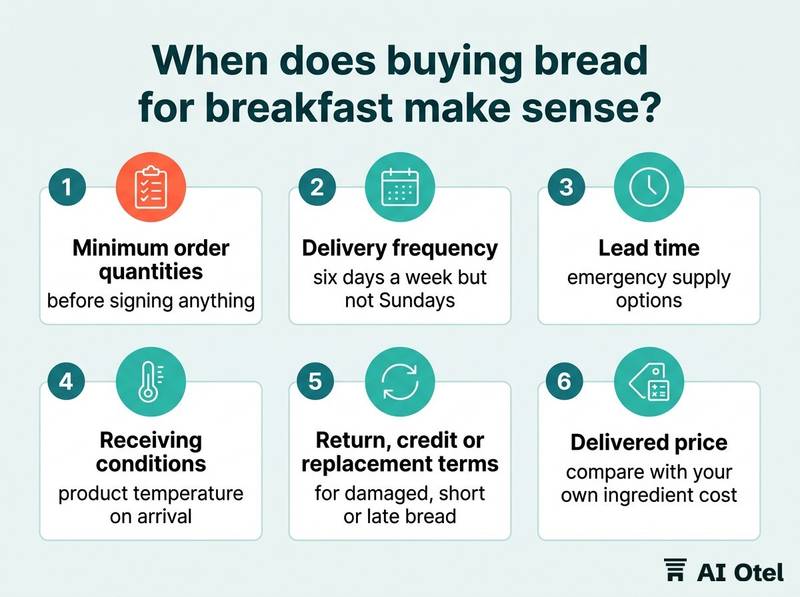
Check the supplier's minimum order quantities, delivery frequency, lead time and emergency supply options before signing anything. A bakery that delivers six days a week but not Sundays has just moved Sunday production back into your kitchen. Check receiving conditions: product temperature on arrival, freshness, packaging, shelf life and the rate of rejected deliveries. Check return, credit or replacement terms for damaged, short or late bread, because those terms decide who pays for the supplier's bad day.
Compare the delivered price with your own ingredient cost, but do not stop there. Delivered bread still needs receiving, storage, handling and waste control, and a quality correction when the standard slips. Test whether the supplier can meet peak covers, special diets and menu changes, for example a gluten-free item added for a conference group. Finally, run a purchasing and receiving procedure so the kitchen does not accept quality drift quietly: every delivery checked against the written bread standard, every shortcoming logged and raised.
How do you compare in-house bakery and bought bread per cover?
Compare the total cost of each route for the same breakfast standard, then divide by the number of covers served. The comparison is only honest when both columns describe the same product and the same service, so define it first: same loaf type, slice count, weight, dietary items and presentation on the buffet.
Record covers, meaning the number of breakfasts served, not the number of loaves. Covers determine buffet demand, and demand is what both routes exist to serve. If you are unsure how to set expected covers from occupancy and arrivals rather than habit, the same logic applies as in setting buffet quantities from arrivals. For in-house, add ingredients, direct labor, energy, space or oven time, waste and equipment cost. For bought bread, add delivered price, delivery fees, storage, handling, waste and any quality correction.
Show cost per cover, not cost per loaf, and keep the worksheet simple enough for the kitchen to update weekly. A worksheet nobody updates is a decoration. The broader method is the one described in food and beverage cost control in hotels, applied to a single line.
ChecklistThe worksheet, on one page
- Standard product: loaf type, weight, slice count, dietary items
- Covers served in the week
- Ingredient cost per tray and trays needed
- Labor minutes and hourly rate
- Energy estimate from utility records
- Space or oven time, valued per hour
- Waste by weight and reason
- Supplier price per unit and delivery terms
- Cost per cover for each route
- Decision date and review date
What about quality and freshness at the breakfast buffet?
Quality is part of the decision, but it must be judged against the hotel's written standard, not against a vague idea of artisan bread. "Freshly baked" is not a standard. A standard says: crust color and crispness, crumb structure, slice size and thickness, aroma at service, temperature at the buffet, and how the loaf behaves after ninety minutes under heat lamps.
Run a labeled test with kitchen, F&B and front office staff, and with guests if the hotel can arrange it. Serve the in-house loaf and the bought loaf side by side, unlabeled for guests, labeled for staff, and record which one disappears and which one comes back. Watch how each bread behaves under heat lamps, on trays and through repeated refills. A loaf that is excellent at 06:30 and cardboard by 08:30 fails the standard no matter how it tested at delivery.
Check whether guests leave bread because it is stale, too dense, too soft or poorly sliced, and record guest comments and waste by item so quality has an operational signal rather than an anecdote. Link the bread decision to buffet set-up and refill rules, not to the kitchen alone: smaller trays refilled more often protect both quality and waste, as covered in the guide to buffet item list and set-up. A good loaf served badly loses to a mediocre loaf served well.
Can bake-off bread be the middle route?
Bake-off bread can be the middle route when the hotel wants fresh aroma and control without carrying a full bakery. The hotel buys part-baked loaves or frozen dough from a supplier and finishes the bake in its own ovens. The guest smells bread baking; the kitchen does not employ a baker.
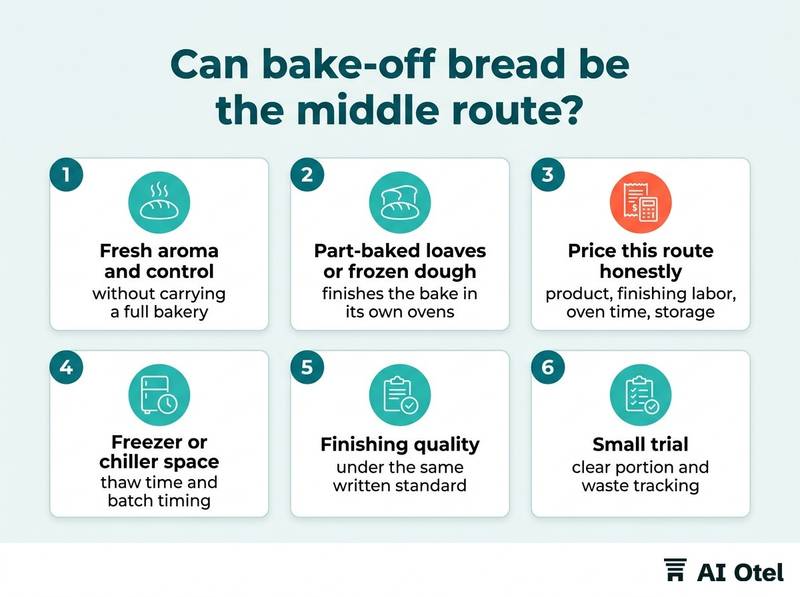
Price this route honestly too. Add the cost of the bought product, the finishing labor, the oven time and the storage. Check freezer or chiller space, thaw time and batch timing for peak service, because a frozen dough program that cannot hit the 07:00 rush has solved the wrong problem. Compare finishing quality with both fully bought bread and fully in-house bread under the same written standard.
Before changing the standard, run a small trial with clear portion and waste tracking. Give the staff one measurable result to own: fresh bread at the start of service, every day, at a known cost per cover. If the trial holds for two or three weeks across weekday and weekend patterns, bake-off is a legitimate answer. If it does not, the trial cost far less than a failed full change.
What mistakes distort the make or buy decision?
The usual mistake is comparing ingredient price with supplier price, while leaving out labor, energy, waste, timing and quality. That comparison is rigged in advance, because it puts every cost on one side and only one cost on the other.
Watch outCompare totals, not price tags
A make or buy decision is wrong if it compares ingredient price with supplier price. Include labor, energy, space, waste, timing and quality before choosing.
Other common distortions: using a single quiet Tuesday instead of peak, weekend and low season patterns; ignoring the cost of a chef's time when the kitchen is already stretched; counting sold room nights while ignoring covers actually served at breakfast; and forgetting waste from overproduction, failed batches and bread left on the buffet. On the buying side, accepting a supplier's price while ignoring late delivery, short delivery or poor quality hides the real cost until the morning it fails.
Two more: applying the bread answer to every pastry item without separate tests, because croissants and simit have different labor, waste and shelf-life profiles; and deciding once, then never reviewing when covers, wages, energy, menus or supplier terms change. A decision that was right at 120 covers may be wrong at 180.
What to do next
Run a one-week worksheet for the breakfast bread line, using the hotel's own covers, recipes, supplier invoices and labor records. Set a decision rule in advance, for example: choose the route with the lower cost per cover, unless the difference is under a threshold you set and the quality test clearly favors the other. Set a review date, and choose in-house, bought or bake-off based on cost per cover and the standard guests receive. If the numbers point toward a wider review of kitchen systems, the same discipline extends to a hotel operating system that keeps restaurant sales, billing and reports in one place, built and working, ahead of launch, and to what is built and what is not before any technology enters the sum.
Frequently asked questions
Should a small hotel bake bread for breakfast?
A small hotel should buy or use bake-off bread when covers are low, labor is scarce, oven space is limited or the bread list is simple. In-house baking works when covers are steady, staff time is genuinely available and the quality difference is clear to guests. Run the same worksheet either way; the arithmetic does not care about the size of the hotel.
Does baking bread reduce food cost?
It can lower ingredient cost, but it can raise labor, energy, waste and equipment cost. The honest answer comes from total cost per cover for the same bread standard. In-house baking can be cheaper at scale, and the ingredient saving can be smaller than the labor and energy it buys.
How do I test bake-off bread before changing the menu?
Run a short trial with clear portion rules, and record covers, waste, finishing time, guest comments and staff feedback. Compare the result with the current route using the same worksheet and the same written bread standard. Decide on the trial's numbers, not on the supplier's sample basket.
When should the hotel review the bread decision?
Review it when breakfast covers change, wages or energy costs move, the supplier changes terms, the buffet menu changes or waste rises. A fixed review date once or twice a year is enough for a stable operation; the triggers above justify an earlier look.