Cancellation protection as an add-on: what the hotel can offer and how to price the choice
A cancellation protection add-on is a paid option on a direct booking that lets guests cancel or move dates. Learn the three forms, how to price the fee from your own cancellation record, and the wording needed to avoid parity issues.
AI draft · awaiting editorial review
Contents
Key takeaways
- A cancellation option is a rate condition the hotel writes and sells, not an insurance policy: the fee buys a stated right to cancel or move dates, nothing more.
- Price the option from your own cancellation record by lead time, because the longer the gap between booking and arrival, the more chances the hotel has to resell a returned room.
- A date change keeps the money in the hotel and the guest in the booking; a refund takes both out.
- Keep the base room rate and its conditions identical on every channel: the option is an extra sold on the direct booking, not a discount.
- Write the deadline, the payout, the exclusions and the way to exercise the option in the same words on the booking page, the confirmation and the guest app.
A cancellation protection add-on is a paid option on a direct booking that lets the guest cancel or move dates under stated terms. The hotel can offer three forms: a flexible rate, a separately priced cancellation option, or a date change option, each priced from its own cancellation record by lead time.
A guest is one click from a non-refundable booking and hesitates. The hotel either loses the booking or drops into a flexible rate it never priced, and both outcomes cost money it did not plan for. This article gives you the three forms a cancellation protection add-on can take, a way to choose between them by lead time and segment, a method to price the fee from your own cancellation record, and the wording the booking page needs so the desk is never left explaining what the page should have said.
What is a cancellation protection add-on?
It is a stated right attached to a booking, bought with a fee or a higher rate, that lets the guest cancel or move dates within limits the hotel sets. The hotel sells three forms of it, and each one moves risk in a different direction.
Form one is the flexible rate: the right is bundled into the room price, so every guest pays for it, including the majority who never cancel. Form two is the paid cancellation option: the base rate stays non-refundable and the guest buys the right separately; when the guest uses it, the fee stays with the hotel and the room charge is refunded or credited exactly as the terms say. Form three is the date change option: no money leaves the hotel; the value moves to another date inside a window, subject to availability and any rate difference.
On a non-refundable rate the guest carries the risk of losing the money and the hotel carries the risk of an empty room. The add-on trades part of the hotel's risk back for a price, which is why the price has to be calculated rather than copied.
An option is not a deposit. A deposit is money held against the stay and returned or offset at checkout; an option fee buys a right and is normally kept when the right is used. The three forms can sit side by side on the same booking page, as long as the guest can see in one line what each one costs and what each one gives back.
| Form | What the guest pays | Who carries the risk | Fits when |
|---|---|---|---|
| Flexible rate | A higher room rate, every guest | The hotel | Long lead times; seasons where a returned room resells |
| Paid cancellation option | Base rate plus a separate fee | Shared: guest loses the fee, hotel refunds the room | Mixed segment; enough direct volume to make the offer visible |
| Date change option | Base rate plus a small fee or nothing | Guest keeps the value, hotel keeps the cash | Seasonal and repeat guests who can move dates |
Which of the three forms fits your hotel?
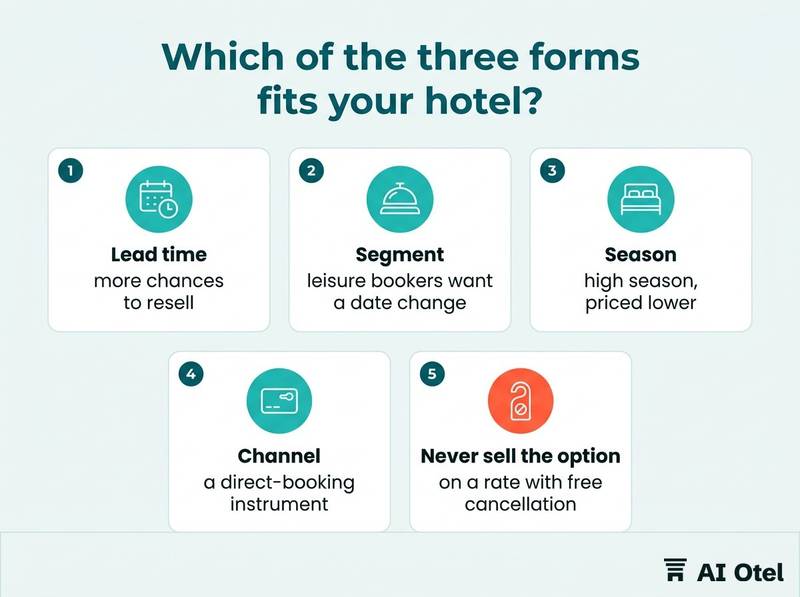
Start with lead time, then segment, then season, then channel. The form that fits is the one whose risk the hotel can actually carry at that lead time.
Lead time before segment
The longer the gap between booking and arrival, the more chances to resell a returned room, so a cancellation option is cheaper to honor on early bookings and expensive on last-minute ones. Segment comes second: leisure bookers tied to school holidays or a fixed flight want a date change; business and last-minute bookers rarely use any of the three. Season comes third: in high season a returned room usually resells, so the option can be priced lower or offered freely.
Channel matters too. The option is a direct-booking instrument. If most of your volume arrives through booking sites, the reach is small and the effort should go elsewhere first. And never sell the option on a rate that already includes free cancellation, because the guest would pay twice for one right and will notice.
What to do when the room cannot resell
In shoulder and low season a returned room may not resell at all, so price the option higher or limit it to certain dates. Cash is the other half of the question: a date change keeps the money inside the hotel, a refund takes it out, which matters in a month with thin margins or a large payment due.
Groups and allotments run on their own contracts and cut-off dates. Do not bolt a retail option onto them; write the release terms into the group contract instead.
How do you price the option from your own cancellation record?
Price it from what a cancellation actually costs your hotel in each lead-time band, then divide that cost across everyone who buys the option, not only the guests who use it.
Pull your own record first: cancellations by rate plan, by lead-time band and by channel, over at least a full year so the season sits inside the sample. If you have not measured this yet, start with measuring your cancellation rate by channel and lead time; the pricing method below depends on it.
For each band, estimate the cost of one cancellation: the room revenue at risk multiplied by the share of returned rooms that stayed unsold in that band. Then estimate how often buyers use the option. That rate, not the overall cancellation rate, decides the fee, because a guest who bought the right is more likely to use it than one who did not.
The break-even line
Set the fee so that fee times buyers covers loss per use times uses, with a margin. A fee below that line means the hotel pays for the option every time it is used. Decide the payout before the price: one night, the full room charge, or a credit toward a later stay. A capped payout is easier to price and far easier to explain at the desk.
Why the take-up rate matters more than the cancellation rate
Recheck the numbers each season. The record moves with the market and with your own rate plans, and a fee set two years ago is a guess now. Do not price from an industry average: the cost of a cancellation depends on your resale, your lead times and your season, and none of those are average.
NoteA worked example, illustrative only
Suppose a hotel sells the option to 100 guests in one lead-time band. One guest in ten uses it, and each use costs the hotel about 0.4 of a room rate on average, because the returned room often stays unsold. The expected loss is 10 uses times 0.4, or 4 room rates across 100 buyers, so a fee of about 0.05 of the room rate covers it with a small margin. Run the same arithmetic on your own numbers: the resale share is the variable that decides the answer.
What should the booking page say?
It should say, in plain words and in one place, what the guest pays, what the guest gets back, by when and how the right is used. Anything the guest has to ask at the desk was missing from the page.
Name it plainly and use the same name everywhere: cancellation option, date change option. Never insurance, assurance or guarantee. State the deadline in hours before arrival, with the time zone, so a guest booking from another country cannot misread it. State the payout exactly: the room charge refunded, a credit toward a later stay, or a date change, and what is not returned, such as the fee itself or extras already consumed.
State how to exercise the right: in writing, through which address or screen, and what counts as proof that the request arrived in time. Keep the exclusions to one short list in plain words; a long list of conditions reads as a trap and costs bookings. Show the fee as its own line before payment, never added quietly at checkout. The same discipline applies to writing clear and consistent cancellation terms across every surface the guest sees.
ChecklistBefore publishing, check
- The product name is not insurance or guarantee
- The deadline is in hours with a time zone
- The payout is stated in money or in a date change
- The fee is shown as its own line
- The way to exercise the right is written
- The exclusions fit in one short list
- The same text appears on the page, the confirmation, the guest app and the bill
Is cancellation protection an insurance product?
No. It is a condition of the booking contract between the hotel and the guest, written and sold by the hotel, and it changes only what happens to this booking.
An insurer's travel policy is a separate contract with a regulated insurer and pays according to a list of insured events. The hotel's option does not underwrite events; it adjusts the terms of one reservation. Do not promise to cover events the hotel does not control, such as illness, a closed border or a canceled flight, unless the hotel writes those events into its own terms and prices them. If the hotel wants to cover those events, that is an agreement with an insurer or a broker, not a rate plan, and it sits outside the booking system.
Keep the fee as its own line on the guest bill so the accountant can treat it correctly and the guest can see what was bought.
Watch outThe word insurance creates an expectation of cover
Calling a rate condition insurance turns a booking term into an expectation of a policy. If the page uses the word, the guest will ask for a policy number and a claims decision, and the hotel has neither.
Does a paid option break rate parity with booking sites?
Not by itself. Parity compares the same room, the same date and the same conditions, and an extra service sold on top of an identical rate is not the same room at a lower price.
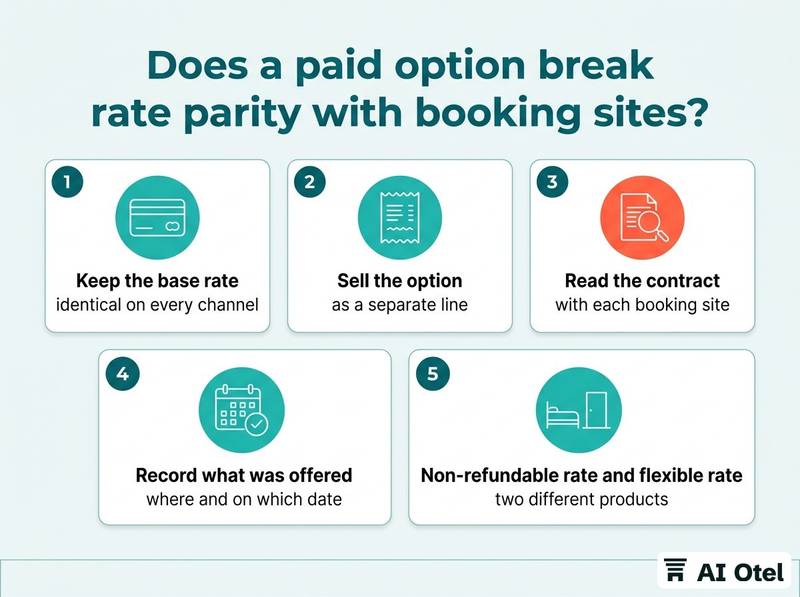
Keep the base rate and its cancellation terms identical on every channel, then sell the option as a separate line on the direct booking. If the option effectively makes the direct booking cheaper for identical conditions, read the contract with each booking site before publishing it, because that is where a parity complaint starts. Record what was offered, where and on which date, so a parity check can be answered with a screenshot and a timestamp instead of a memory.
What counts as the same conditions
Reservations that arrive through booking sites carry the cancellation rules set in that channel; the hotel's own option does not change them. The steps for handling cancellation fees on booking site reservations run on those channel rules, not on yours. A non-refundable rate and a flexible rate are two different products, and the gap between them is the price of certainty; set that gap deliberately rather than by habit. The same discipline applies to early booking and non-refundable rates, which are the usual place where a direct offer and a channel rate drift apart.
How do you trial the option and decide whether to keep it?
Run it on one rate plan, one segment and one window, define the measures before launch, and set the review date on the day you start.
Limit the trial to one rate plan so the option's effect is not mixed with a price change somewhere else in the hotel. Measure four things: how many guests buy it, how many buyers use it, how many returned rooms resell and at what rate, and net revenue per booking against the same plan without the option. Compare like with like: the same dates last year, or a control rate plan running alongside at the same time.
The stopping condition
Set the review date and the stopping condition in advance, so the decision is not made on the strength of one good week. Small samples mislead: a handful of bookings cannot separate the option's effect from the season, and a quiet month will look like a failed product. If take-up is near zero, suspect the price or the wording before the idea itself, and change one of them at a time. Write down what you learned about resale by lead time, because that number is useful for every other rate decision in the hotel.
What to do next
Pull last year's cancellations by rate plan and lead-time band, pick one of the three forms for one rate plan, set the fee from your own resale numbers rather than an industry figure, write the terms in the same words on every surface, and fix the review date before launch. The three forms are not rivals: the flexible rate sells certainty to everyone, the paid option sells it to the guests who want it, and the date change keeps the booking alive when the guest cannot travel.
If you want the option to reach the guest on the hotel's own surfaces, a booking engine and a guest-facing app that can show the offer, the fee line and the payout in the same words are the minimum plumbing; a hotel operating system that keeps one room inventory and one set of terms across the hotel's own site is where such an offer lives, and so is a guest app that carries the same wording through the stay.
If you are reading this as a traveler rather than a hotelier, you can browse hotels in Türkiye (opens in a new tab) and compare what each one offers.
Frequently asked questions
Can a hotel charge a fee for the right to cancel?
The hotel publishes its own rate conditions, and a separately priced option is one of them. The fee must be visible before payment and the terms must say exactly what it buys. Whether a particular charge is enforceable in a particular case is a question for counsel, and the written wording is what any dispute will turn on.
What is the difference between a flexible rate and a paid cancellation option?
A flexible rate bundles the right to cancel into the room price, so every guest pays for it, including those who never cancel. A paid option keeps the base rate low and lets the guest buy the right separately, so only the guests who want it pay for it. The second needs a fee calculated from the hotel's own cancellation record; the first needs a deliberate gap between the two rates.
Should the option fee be refunded when the guest cancels?
Normally no. The fee buys the right, and using the right consumes it, while the room charge is refunded or credited as the terms say. The page must state this before payment, in the same sentence as the payout, so the guest does not learn it at the desk.
How far before arrival should the option stay usable?
Set the deadline by the resale window, not by habit: the shorter the window left to resell the room, the higher the fee has to be. Write the deadline in hours before arrival with the time zone, and apply the same deadline to the date change option so the two do not contradict each other.