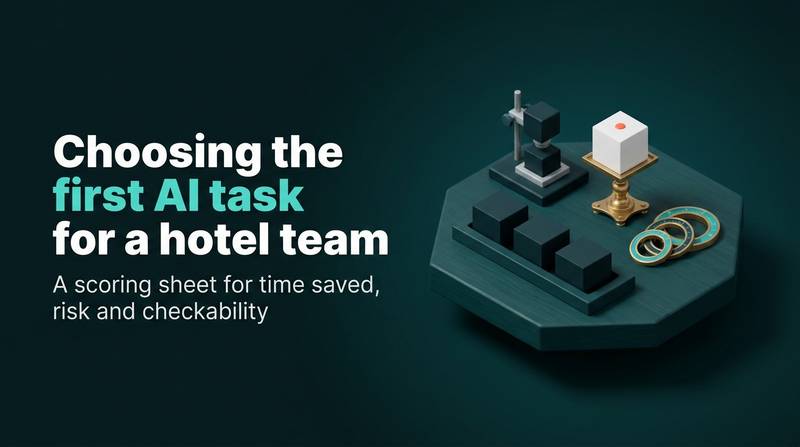
Choosing the first AI task for a hotel team: a scoring sheet for time saved, risk and checkability
Score each candidate task on time saved, risk and checkability to pick the best first AI task. This guide provides a scoring sheet, launch checklist and review method.
AI draft · awaiting editorial review
Contents
Key takeaways
- A first AI task is a measurement, not a transformation: one task, one owner, one written check and a review date teach more than five tasks started at once.
- Score every candidate 1 to 3 on hours, risk and checkability, and write the reason next to each number, because a score without a reason cannot be argued with later.
- A task whose wrong output reaches money, a legal record, a published rate or a guest's personal data is not a first task, however many hours it saves.
- The check is the design: if the person on shift cannot compare the output against a source document in about a minute, the task is not ready.
- Record the chosen task, its owner, its risk score and its review date in the hotel's AI register, so the second task starts from a written precedent instead of a memory.
Score each candidate task 1 to 3 on three questions: hours it takes now, what happens if the output is wrong, and how fast a person can check it. A scoring sheet is a one-page table that ranks tasks by those numbers. Pick the highest-hours, lowest-risk, easiest-to-check task, name one owner and a review date.
A general manager asks each department head to try artificial intelligence and gets back five ideas, three tools and no way to tell whether any of it worked. The problem is rarely enthusiasm. It is that nobody wrote down what the task cost before the tool arrived. After reading this, you will have a one-page scoring sheet for your first AI task, a launch checklist and a four-week review that ends in a written decision.
Why should a hotel start with one AI task instead of five?
One task gives a before-and-after you can compare. Five tasks give five half-answers and no evidence.
Every candidate task needs an owner who reads the output every working day for four weeks. Five tasks means five owners, five checking habits and no shared lesson. The hours figure also has to be measured before the tool arrives: without a two-week baseline, the review compares a feeling with a feeling.
A first task is mostly a checking routine. A hotel can design one checking routine well at a time, and that routine is the reusable asset. The check written for the first task becomes the template for the second, which is why the first one should be easy to check rather than impressive.
One task can also be withdrawn cleanly if it fails. A five-department program cannot be stopped partially, so it usually continues long after everyone has lost interest. Write the decision down: task, owner, risk score, check and review date, kept in an AI register that holds every use, its owner and its risk tier on one sheet. The second choice is then argued against a precedent rather than against memory.
Which tasks belong on the candidate list?
Ten tasks, roughly two per department, all of them already done by a person today and all of them producing a document someone reads.
The test for a candidate: the task exists now, a named person does it now, and the output is text a colleague reads, such as a draft, a summary, a translation or a work order. Ask each department head for two candidates, not ten; a long list hides the real cost, which is the reading time it creates.
Next to each candidate, write what the person will compare the output against. If nothing can be named, the task is not checkable yet. Leave off anything that writes straight into a system of record, anything that needs data the hotel does not hold, and anything nobody does today. Describe each candidate in one sentence with a verb and an object: draft the reply, summarize the thread, translate the menu. Vague candidates score vaguely.
Include at least one candidate you expect to reject on risk. It makes the scoring rule visible to the team instead of theoretical.
| Department | Candidate task | What the person compares the output against |
|---|---|---|
| Front desk | Draft the reply to a pre-arrival question about parking, transfer or early check-in | The reservation record and the hotel's own policy |
| Front desk | Summarize a long guest email thread into three lines for the shift handover | The original thread |
| Housekeeping | Turn a verbal maintenance note into a written work order | The room itself and the note |
| Housekeeping | Summarize the shift handover for the next supervisor | The supervisor's own log |
| Restaurant | Draft menu descriptions and allergen notes from the kitchen's ingredient list | The kitchen's ingredient list |
| Restaurant | Translate the menu into one more language | The original menu |
| Sales | Draft the first reply to a corporate request for a proposal | The rate sheet and the request |
| Reservations | Summarize the day's booking changes into a paragraph for the morning meeting | The reservation system's own report |
| Marketing | Draft three social posts from a photographed event | The event details |
| Back office | Draft the reply to a supplier's price-change email | The contract and the previous price |
Front-desk candidates in particular benefit from knowing which front-desk tasks change with AI and which stay human before they go on the list.
How do you score time saved, risk and checkability?
Give every candidate three numbers from 1 to 3, one per question, and write the reason next to each number. This is the core of the first AI task hotel scoring sheet.
Hours: measure the task over two ordinary weeks with the person who does it. The score is the hotel's own measurement, not an industry figure, and the bands below are an example the hotel can change. Risk: score the worst realistic outcome, not the average one. Ask what a guest, an accountant or a regulator would see if the output went out unchecked. Checkability: score the person who will actually do the check, at the hour they will do it. A check that needs the one colleague who understands the contract is a 3, not a 1.
The rule: a risk score of 3 removes the task from the first round whatever its hours. Among the rest, pick the highest hours score minus the checkability score. Do not average the three into a single number; the three questions answer different things, and an average hides the disqualifier.
| Score | Hours a week the task takes now | What happens if the output is wrong | How the check works |
|---|---|---|---|
| 1 | Under two hours | A colleague catches it before anyone outside the team sees it | One comparison against one document, under a minute |
| 2 | Two to six hours | A guest reads it, or another department works from it | Two documents, or one document and one system screen, a few minutes |
| 3 | More than six hours | It reaches money, a legal record, a published rate or a guest's personal data | Needs expertise or a second system, or cannot be done on shift |
The hour bands are an example; the numbers come from the hotel's own two-week measurement. Write the reason in the cell: "risk 2 because a guest reads the reply" is a decision someone can review; "risk 2" alone is not.
Which tasks should wait for a later round?
Anything that writes into a system of record, touches guest personal data or cannot be checked on shift waits, however many hours it saves.
Money and fiscal records come first on that list: posting a charge to a guest's bill, issuing an invoice, closing the business day. A wrong figure there is not a draft waiting for a correction, it is a reconciliation. Legal notifications sit beside them: in Türkiye every stay involves a payment, a fiscal document, a guest identity notification (KBS) and personal data (KVKK), and a task that produces or submits one of those records is not a first task.
Guest personal data is a question before it is a productivity question. If the task needs an identity number, a passport scan or contact details in the prompt, the hotel's written rule on what staff may paste into a tool comes first; a written hotel AI policy on what staff may share with AI chat tools settles it. Published prices and availability wait too: a wrong rate that reaches a channel is a commercial loss a check cannot undo, because the booking already exists. Finally, contested answers, such as complaint replies, refunds and anything written about a staff member, have no single correct output, so the checker has nothing to compare against. And if nobody can say how long the task takes now, the four-week review has no comparison and the result is an opinion.
Watch outA wrong draft costs a minute; a wrong posting costs a reconciliation
Move a task to a later round if it does any of the following: - it posts to a system of record - it produces a legal or fiscal record - it needs guest personal data in the prompt - it publishes a price Confirm the hotel's own personal data and fiscal duties with its accountant or legal adviser.
How do you pick one task, name an owner and a check?
Write four lines on one page: the task, the owner's name, the check in one sentence, and the review date.
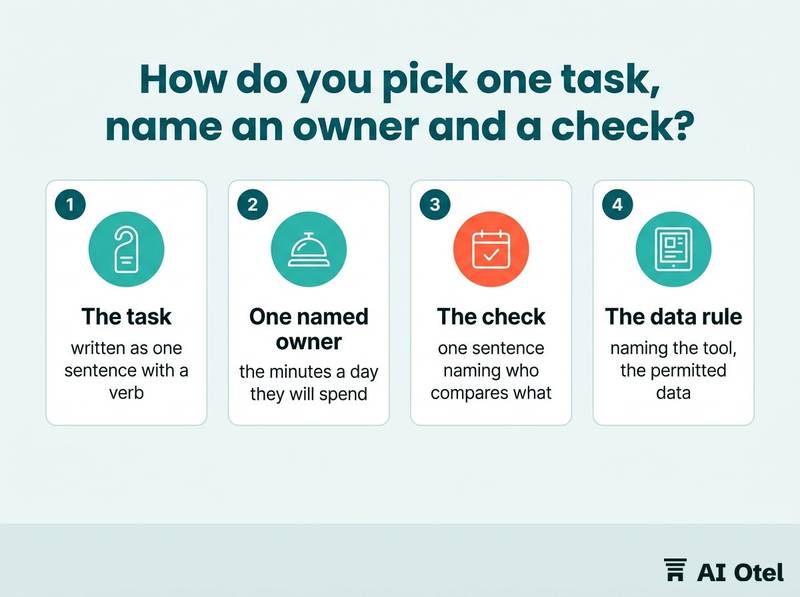
The owner is a named person, not a department. They read every output for four weeks and keep the log, and their manager knows those minutes are part of the job. The check is one sentence with a verb and a document: before the draft is sent, the reservations supervisor compares the dates and the rate against the reservation record. The check must be independent of the tool; the checker reads the source document, not the tool's explanation of its own answer.
The tool matters less than the check, but the data question comes before the first paste: which tool, which data may go into it, who may use it. Record the task, owner, risk score, check and review date in the same register as every other AI use, so the hotel can show what it decided and when. Tell the team what is being tested and what is not: the other nine candidates are waiting, not cancelled, and that sentence protects the next round. Before launch, it is worth reading how to test a hotel AI assistant before staff or guests use it.
ChecklistLaunch checklist
- The task written as one sentence with a verb and an object
- One named owner, and the minutes a day they will spend reading output
- The check written as one sentence naming who compares what against which document, before it leaves the department
- The two-week baseline in hours, written down before the tool arrives
- The data rule naming the tool, the permitted data and the permitted users
- The review date and the three possible outcomes
- The register entry with task, owner, risk score, check and date
What does the four-week review decide?
One of three outcomes, decided against the baseline: keep, change or stop.
Keep: the log shows the owner spends less time on the task, and the check caught at least one error that would otherwise have left the department. Change: the task is right but the check is too slow, or the output needs so much rewriting that the draft is not a draft; narrow the task to one question type or one language and run four more weeks. Stop: the check costs more than the task, or the owner cannot keep up the daily reading; stopping is a result to write down, not a failure to hide.
Compare the log with the two-week baseline, never with a promise made by a tool or a colleague. Whatever the outcome, two things carry forward: the check template and the register entry. That is what makes the second task cheaper than the first. Set the next review date before the meeting ends, or the decision quietly becomes permanent.
Key pointThe review rule
The review compares the log with the baseline, not the tool with a promise. Keep if time saved and errors caught; change if the check or the rewriting is too heavy; stop if the check costs more than the task.
What to do next
Write the ten candidates this week, score them on one page, and put the review date in the calendar before anyone opens a tool. The method is the whole article: hours, risk and checkability, then one task, one owner, one written check and four weeks. If you want to see how a hotel operating system records reservations, bills and reports in one place, the platform overview and the PMS pages show what the software holds; the choice of the first task stays yours.
Frequently asked questions
Can a hotel start its first AI task with a free chat tool?
The tool is the smaller decision; the written rule comes first. Name which tool is permitted, which data may go into it and who may use it. Guest personal data, contracts and unpublished rates stay out until the hotel has decided otherwise with advice. Then design the check, because the check is what makes the output usable.
How many hours a week must a task take before it is worth starting?
There is no universal threshold, and any figure quoted as one should be treated with suspicion. Measure the task for two weeks. If one person finishes it in a few minutes a day, the saving is small and the check may cost more than the task. Prefer a task where the output replaces a blank page, such as a first draft or a translation.
What if the AI output looks right but is wrong?
That is exactly why checkability is scored before the task is chosen in the first AI task hotel scoring process. The check compares the output against a source document, never against how plausible it reads. Read every output in the first week, then keep a fixed share of outputs read in full for the rest of the run, and log what the check caught.
Does the first task need a budget or management approval?
A draft-and-check task needs a named owner, a written check and a register entry more than it needs money. Approval is needed where guest personal data, money or a published rate is involved, and the register entry is the record of what was approved and by whom.
How do we know when to stop?
Decide the stop conditions before the run starts, not at the review. Three are enough: the check takes longer than the task, the owner cannot keep the daily reading, or the output needs full rewriting every time. Any one of them ends the run, and the reason goes into the register.