Did the AI tool save time? A four-week log on one hotel task
Replace impressions with data by logging minutes to a finished, correct output. This guide shows how to run a four-week trial on one hotel task, counting corrections and rework to decide if an AI tool truly saves time.
AI draft · awaiting editorial review
Contents
Key takeaways
- A time saving is only real when it is measured on the same task, by the same person, with the same log fields before and after.
- Corrections and rework belong in the same minutes column: a fast draft that needs long fixing has cost time.
- Write the pass threshold and the stop condition before week one, or the result will be reinterpreted after it.
- Two trial weeks read as a pair protect you from one unusually good week and one unusually bad one.
- A four-week trial on one task cannot show what the tool does at scale, in another season, or after the novelty fades.
Measure one task, one owner, one log. Keep a baseline log, the same record kept before the tool arrives, for two weeks; then log two weeks with the tool, counting minutes to a finished, correct output plus corrections, rework and guest-visible errors. Write the pass threshold first, and read both trial weeks, not the best one.
The vendor says the tool saves hours. Your front office manager says it feels faster. Nobody has written down a single minute, so the decision at the end of the month will rest on impressions. A four-week log on one task replaces the impression with a number you can defend. This article shows how to measure time saved by an AI hotel task: which task to pick, what to log, how to count corrections, and how to write the decision rule before the trial starts.
What should a hotel measure to know if an AI tool saved time?
Measure minutes to a finished, correct output on one named task, and count corrections, rework and guest-visible errors in the same minutes. Everything else is a feeling.
Define the task tightly enough that two people would agree on where it starts and stops. For example: answer a pre-arrival question that arrives by email, from opening the message to sending the reply. If the boundary is vague, the stopwatch is vague too.
Log time per instance, not per day. A daily total hides the difference between ten easy cases and one hard one, and that difference is exactly what the trial needs to see. Count only finished output: a draft nobody sent is not work done.
Record corrections as minutes, and note who caught the error and at what stage. Record handoffs and interruptions as well, because a tool that moves work to a senior person has not removed the work. Keep the fields identical across all four weeks; a field added in week three cannot be compared with weeks one and two. The same discipline applies when you test a hotel AI assistant before staff or guests use it: the test is only as good as its fixed fields.
ChecklistFix the log fields before week one
- Date and time
- Task instance number
- Who did the work
- Start and stop in minutes
- Tool used (yes or no)
- Minutes to a first usable draft
- Minutes spent correcting
- Correction category
- Who caught the error (staff or guest)
- Output sent (yes or no)
- Short note
Which task should you pick for a four-week trial?
Pick one task that happens often, has a clear finished state, is easy to check, and carries little legal or financial consequence if it goes wrong.
Frequency matters because the task needs enough repetitions in each two-week phase that one bad day does not decide the result. A task that comes up several times a day is a safer choice than one that comes up twice a week. Bounded output matters because if you cannot say what "finished" looks like, you cannot time it.
Reversibility matters most. A wrong draft caught inside the hotel costs minutes; a wrong message sent to a guest costs trust. Keep one owner and one system on the task: if two people and three tools touch it, the log measures your process, not the tool.
Avoid on a first trial anything that ends in a fiscal document, a KBS guest identity notification, a rate sent to a channel, or a reply to a legal complaint. Those need a different kind of review. Finally, write the task definition in one sentence and get the person who actually does the work to agree with it before you start. The same preparation belongs on the buying side, in the questions to ask an AI vendor before buying for your hotel.
| Candidate task | Why it suits a four-week trial | What to watch |
|---|---|---|
| Replies to standard pre-arrival questions | High volume, one owner, reversible | Tone and factual accuracy about the property |
| First drafts of review responses | Bounded, easy to check | Promises the hotel cannot keep |
| Shift handover summary | Internal, low consequence | Missing detail the next shift needs |
| Translation of standard guest messages | Clear finished state | Meaning drift in complaints |
How do the four weeks run, and what must stay the same?
Weeks one and two record the task as it is done today; weeks three and four repeat the same record with the tool in place. Only the tool changes.
Run the baseline first and resist improving the process during it. A tidy-up in week two makes the tool look better than it is, and the comparison quietly breaks. Keep the log light enough to survive: a form that takes longer to fill than the task will be abandoned by the third day. Log each instance as it happens, not from memory at the end of the shift.
In weeks three and four, count the time spent operating and checking the tool, not only the time spent waiting for it. Log setup and learning time separately in week three, so it neither flatters nor ruins the comparison. Note the days the tool was unavailable and what people did instead; those days are part of the result. Keep the human review step in place for the whole trial, because removing it changes the task and ends the comparison.
Watch outNothing moves between phases
Do not change the task, the log fields, the shift or the person between week two and week three. If you must change one of them, restart the baseline.
Why do corrections and rework decide the answer?
Because a fast draft that comes back wrong costs the hotel the correction time as well as the drafting time, and the correction usually lands on a more senior person.
Fix correction categories before week one: wrong fact, wrong guest or booking, missing detail, wrong tone, formatting, policy error. Separate errors caught before sending from errors caught by the guest. The second is a guest-side effect, not just a minute.
Count rework wherever it lands. If a receptionist drafts and the front office manager fixes, both sets of minutes belong in the log. Watch the pattern, not only the total: minutes falling while the correction rate rises is a warning, not a win. Treat near-misses as data. A wrong draft that a person caught tells you what the tool does when nobody is watching, which is the same logic behind reading an AI tool's test results for accuracy, false alarms and missed cases.
Decide in advance how many guest-visible errors end the trial, and write that number into the rule.
Key pointThe only number that counts
The only number that counts is minutes to a finished, correct, sent output. Draft speed is not a result.
What do staff comments and guest-side effects add?
The log shows what happened to the minutes; the people doing the work and the guests receiving it show what happened to the quality of the work.
Ask the same three questions at the end of every week, in all four weeks, so the answers can be compared. Ask the person who corrects the output, not only the person who runs the tool. The reviewer sees the errors the operator never notices.
Watch for work that moves rather than shrinks: the tool produces a draft and a senior person now reviews everything. That is a real cost, even when the receptionist's minutes fall. Use guest signals the hotel already collects, such as reply times, repeated questions and complaint themes. Do not run a guest survey for a four-week trial on one task.
Note enthusiasm and resistance openly. A team that wants the tool to succeed may correct more quietly and report less. Record any change in what staff tell guests about response times, because a promise made in week three outlives the trial.
TipThree end-of-week questions
Where did the tool save you time this week, and where did it cost you time? What did you have to fix, and how did you notice it? What would you tell a colleague at another hotel about this task now?
What decision rule should you write before week one?
Write the threshold, the stop condition and the decision maker before the first log entry, so the result cannot be reinterpreted after it.
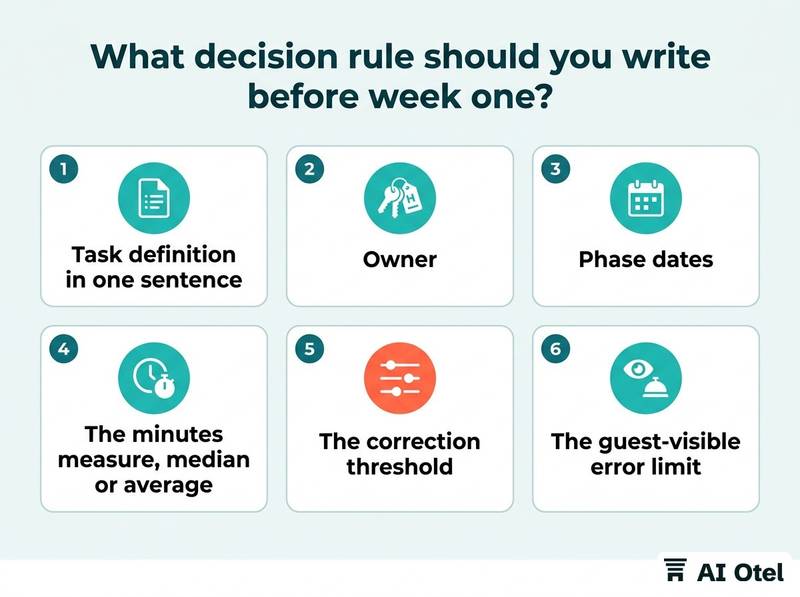
Use a rule with two conditions: minutes to a finished output must fall, and the correction rate must not rise beyond a level you name. Use the median of each week rather than the average, so one catastrophic day does not decide the trial. Require the improvement to appear in both trial weeks, not one.
Name a stop condition that ends the trial immediately: a guest-visible error of a named kind, a data protection concern, or a cost the team cannot absorb. Name who decides, on what date, and what "keep" means: extend to a second task, renegotiate, or stop. Write the rule on one page and have the general manager and the task owner sign it before week one. The same insistence on a written, pre-registered rule is how serious buyers approach AI model evaluation for hotel work.
ChecklistRule template items
- Task definition in one sentence
- Owner
- Phase dates
- The minutes measure, median or average
- The correction threshold
- The guest-visible error limit
- The stop condition
- The decision date
- The decision maker
- What each outcome means
What can a four-week trial on one task not tell you?
It cannot tell you what the tool will do at scale, in another season, on another task, or after the novelty fades.
One task, one team, one month. The result does not transfer to another department or another property without a new log. Novelty is the quiet confounder: week three is often the strongest week because everyone is paying attention to the tool and to the log.
Season and mix matter. A quiet month and a full month produce different tasks, different volumes and different costs of error. Rare but serious cases are the bigger gap: the errors that matter most happen least, so four weeks may contain none of them.
The trial also says nothing about integration, contract terms, data protection duties, vendor continuity or price. Those are separate questions with separate answers. And it cannot tell you whether the tool is accurate in general. It can only tell you whether it was accurate enough on this task, in this hotel, in these four weeks. If you want to see what a fuller hotel technology stack looks like on paper, read about a hotel operating system and the platform around it; a trial on one task is a much smaller question.
NoteReport a local fact, not a verdict
A trial result is a local fact, not a product verdict. Report it as "on this task, in this hotel, over these four weeks", and keep the wording when you take the decision to the ownership meeting.
What to do next
Pick the task this week, write the log fields and the decision rule on one page, and run the two baseline weeks before anyone talks to a vendor. The pieces fit together in one order: one task, one owner, one log, corrections counted as minutes, a rule signed in advance, and a result reported as a local fact rather than a product verdict.
Frequently asked questions
How long should an AI trial run in a hotel?
Four weeks is a workable minimum for one task: two weeks of baseline and two weeks with the tool. What matters is enough repetitions in each phase, so a task that happens rarely needs a longer window. The calendar is not the rule; the number of logged instances is.
Should we measure average or median time per task?
Decide on the median, because one unusually hard case can pull an average far from the normal day. Report both if the team finds it useful, but write the decision rule on the median so the outcome cannot be argued after the fact. This is how you measure time saved by an AI hotel task without letting a single bad day decide it.
What if staff prefer the tool but the minutes do not improve?
Preference is a real signal about adoption, but it is not a time saving. Look at where the work moved, whether the correction rate fell, and whether guests received something better. Then apply the rule you wrote before week one rather than rewriting it now.
Can we test two tasks at the same time?
Not on a first trial. Two tasks mean two logs, two owners and two sets of corrections, and a good result on one hides a weak result on the other. Run them one after the other, and carry the lessons from the first log into the second.
Do we need a guest survey to judge the trial?
No. Use the signals the hotel already collects, such as reply times, repeated questions and complaint themes, and keep guest-facing changes small for the four weeks. A survey adds cost and noise to a test that is about minutes and corrections.