Express checkout: the bill under the door, the signed folio and the minibar check
Express checkout moves the work earlier, it does not remove it. This guide designs the sequence: which stays qualify, when to check the folio and minibar, how to settle the bill, and which departures always require the front desk.
Contents
Key takeaways
- Express checkout moves the work earlier, it does not remove it: the folio is verified the night before, not at the door.
- A minibar or damage charge first shown on an emailed bill is a dispute, so the count happens while the guest is still there or it is not charged.
- A key in the drop box proves a key came back, not that a guest checked out; the front office still has to close the folio and release the room.
- Any departure involving cash, a company bill to sign or a disputed charge belongs at the desk, whatever the hour.
- The guest's written authorization, collected at check-in, is what makes a charge without a signature defensible.
Express checkout is a departure route where the guest leaves without stopping at the front desk: the folio is checked and settled in advance, the bill is emailed, and the key is dropped in a box. It suits stays with no open charges, no dispute and a card already authorized.
It is 05:40, the taxi is waiting, and the guest is standing at a dark reception desk holding a key card. Express checkout exists to make that scene impossible, and it usually fails for one reason: nobody checked the bill while the guest was still there to agree with it. A hotel express checkout procedure that works is a sequence of earlier steps, not a box in the lobby. This article designs that sequence: which stays qualify, what the night-before folio check covers, when the minibar is counted, how the bill is settled and sent, and which departures always go to the desk.
What is express checkout at a hotel, and which stays qualify?
Express checkout is a departure route in which the guest leaves without stopping at the desk: the folio is prepared and settled in advance, the bill is sent by email, and the key is dropped. It only works for stays where nothing is left to agree at the door.
The decision is made at check-in or during the stay, not at 05:40. The guest opts in, reads what will happen, and signs the authorization while a member of staff is present. Defined once, the terms are simple: the folio is the guest's bill, routing means which account a charge is posted to, and settlement means taking the money against the card authorization already on file.
A stay qualifies when a card is authorized for the room, the tax and a margin above the expected extras; no cash settlement is planned; no agency or company folio needs a signature; no complaint or dispute is open; and a working email address sits on the reservation. Group master accounts, tour series departures and multi-room bookings where one person pays for others are excluded, because those need a signature at the end.
The trade-off is real: express checkout removes the last human check on the bill, so an earlier check has to replace it. A hotel that skips the earlier check is not offering a faster departure, it is postponing a correction. Keep the route visible in the reservation: a flag on the booking, a note on the rooming list, and a marker the night auditor can see.
Key pointThe one-question test
Before a stay is marked express, ask: if this guest walked out right now, could the hotel close the folio without asking anything? If the answer is no, the stay is not express.
What does the night-before folio check cover?
The night-before check confirms that every charge on the folio is correct, posted and routed to the right account, so that the morning bill is a copy rather than a calculation.
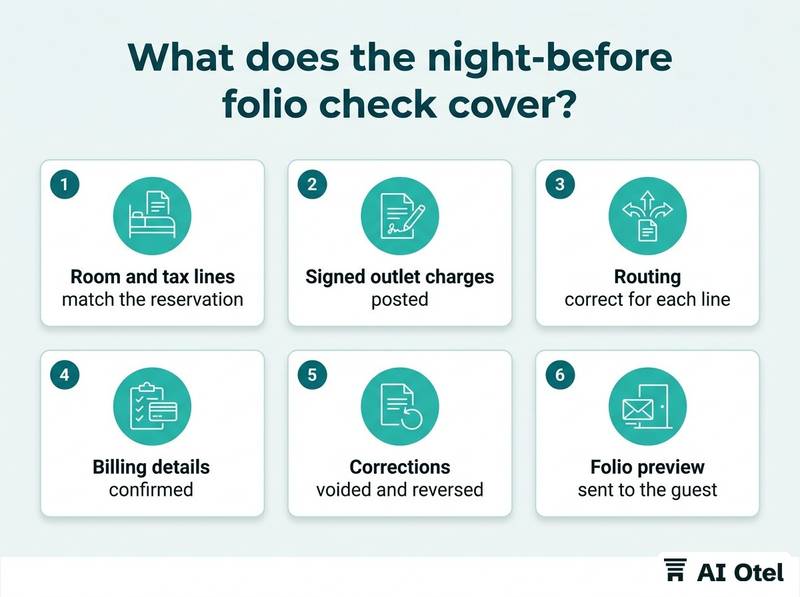
Start with the room and tax lines against the reservation: nightly rate, number of nights, package inclusions, agreed discounts, complimentary items and any rate change made during the stay. Then collect the outlet charges: restaurant, bar, spa, laundry, parking, transfers. A charge signed to the room but never posted will make the morning bill wrong.
Check routing next. A charge that belongs to a company or agency master account must sit there and not on the guest, and a charge the guest pays personally must not be left on the master. Confirm the details the guest wants on the document: name as written on the identity document, billing address, and for a corporate request the company's tax details.
Correct by voiding and reversing, never by deleting. The folio should show the original line, the reversal and the reason, because that trail is what settles an argument later. Where the guest is in the hotel that evening, send a preview of the folio to the room or to their email and ask them to confirm or query it. A guest who has already seen the total rarely disputes it at dawn.
Do the check at a fixed hour that fits the hotel's operation, after the restaurant and bar have closed their day and before the night audit closes the business day. The mechanics of the full departure, including how the folio becomes an invoice, are covered in the full hotel checkout process, from the bill to the goodbye.
ChecklistNight-before folio check
- Room and tax lines match the reservation
- Every signed outlet charge is posted
- Routing is correct for each line
- Guest and company billing details confirmed
- Corrections voided and reversed with a reason
- Folio preview sent to the guest
- Check completed before the night audit closes the day
When should the minibar and room check happen?
Before the guest leaves, or not as a charge. A minibar count taken after departure cannot be shown to the guest, so the count is scheduled into the evening or the early morning, before the key goes into the box.
The minibar is a physical count, and the guest's agreement to minibar charges comes from the registration card or the terms accepted at booking. A charge invented after the guest has gone tests that agreement to its limit. Practical options exist for every size of hotel: an evening count at turndown, a self-declaration card the guest fills in and signs at departure, sensor-equipped minibars where the hotel has them, or a refundable deposit settled when the guest leaves.
Damage and smoking checks belong to housekeeping after departure, but a damage charge needs photographs, a written description and a conversation with the guest. A silent debit on a card is how a complaint becomes a chargeback. The card authorization must cover the possible extras: if the hold only covers the room, the hotel has nothing to settle a late minibar against, and the guest is gone. How much to hold and why is explained in card pre-authorization and deposits at hotel check-in.
Write the timing into the hotel's rule: minibar counted at a stated hour, posted to the folio, and the folio locked after that. Staff then have a defensible answer when a guest asks why a bottle of water appears on the bill. For a very early departure, the count can happen the evening before, with the guest told that anything taken after the count will be charged on declaration.
Watch outA charge the guest first sees by email
A minibar or damage charge that the guest first sees on an emailed bill is a dispute, not revenue. If the count cannot happen while the guest is present, the safer choice is to absorb the item and fix the process.
How is the bill settled and sent, and what makes the signed folio?
The card is settled against the authorization already on file, the folio is sent as a PDF to the address on the reservation, and the guest's written authorization, collected earlier, is what makes that charge defensible.
The signed folio is the guest's signature on the registration card or on a separate express checkout authorization that names the card, sets a limit and states the email address the bill will go to. Without that signature, an emailed bill is an invitation to dispute, and the hotel has no way to show the guest agreed to be charged while absent. With it, the hotel can produce the document and the send record together.
Send two things: the folio as a PDF for the detail, and a short plain-text summary with the amount charged, the last four digits of the card and a contact for questions. Guests forward the summary and read the PDF only when something looks wrong. Record what was sent and when: if a guest says the bill never arrived, the send log answers the question in one line.
The folio is not the fiscal document. The invoice or electronic document is issued separately by the hotel's accounting within the legal period, and questions about format, timing and corrections belong to the hotel's accountant, not to the front desk. One more rule: settle once. Re-attempting a declined card several times in the same hour is how a guest's bank starts refusing the hotel's transactions.
Where do keys go, and how is the departure recorded?
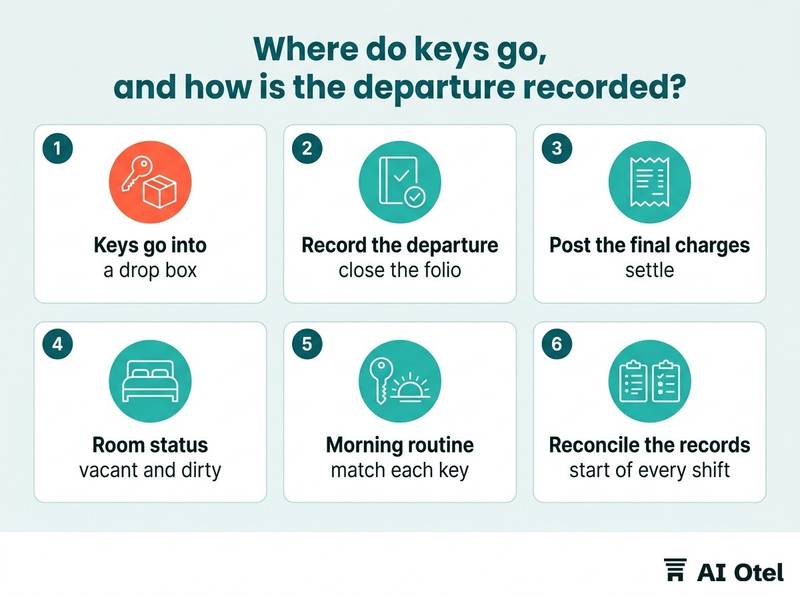
Keys go into a drop box, a sealed bag or a tray at the desk, and none of those closes the stay. The front office must still record the departure, close the folio and release the room.
Place the drop box where guests actually leave: the lobby exit, the garage, the night entrance. A box behind reception is a box nobody uses. Empty and log it at fixed times. A returned card key is wiped and re-encoded before reuse; a missing card is a cost and a security item, and charging the guest for it by default creates more complaints than it prevents.
The system steps are the same as any departure: post the final charges, settle, close the folio, change the room status to vacant and dirty, notify housekeeping, and remove the guest from the in-house list. If the departure is not recorded, the in-house count and the night audit carry a guest who has already left, and the room stays unsellable for a day it was free.
The classic failure is a key in the box with an open folio: the box says the guest left, the system says they are still in the house. The two records have to be reconciled at the start of every shift. Give the desk a short morning routine: open the express list, match each key or email confirmation to a closed folio, and flag anything still open before the housekeeping sheet is printed. The lists that drive this routine are described in the arrivals, departures and in-house lists the desk reads daily.
Which departures always go to the desk?
Any departure where money, identity or a signature is still unresolved goes to the desk, however early the hour. The desk is not slower than the drop box for these cases, it is the only route that ends with a closed folio and a guest who agreed.
| Situation | Why it cannot be express | What the desk does |
|---|---|---|
| Cash settlement or change due | Cash needs a handover and a receipt | Count out, receipt, close folio |
| Company or agency folio needing signature or stamp | The payer must sign the document | Print master folio, collect signature |
| Disputed charge or minibar disagreement | The guest must see and agree the line | Show the posted charge, adjust or confirm |
| Damage claim | Needs photos and a conversation | Present evidence, agree the amount |
| Guest wants to extend or split the bill | Changes the folio and the room state | Rebook, split, settle each part |
| Group master or tour series departure | One account covers many rooms | Close the master after all rooms |
| Identity or guest notification correction | Legal records must be right | Correct, then close the folio |
| Card declines at settlement | No valid authorization to settle against | Keep folio open, contact the guest |
| Guest asks for a document the hotel cannot email | Needs a printed or stamped document | Issue at the desk before departure |
Tell the guest at check-in, not at 05:40. A guest who knows on arrival that a company bill needs a signature will come down five minutes earlier. For the early hours, keep one person reachable and put a phone number at the desk, so an express guest with a problem is not standing in an empty lobby. Review the list monthly against real departures and look for recurring situations that a small change at booking could move to the express route.
What to do next
Write the hotel's express checkout rule on one page: the qualification test, the hour of the night-before folio check, the minibar count hour, the wording of the guest authorization, the location of the key drop and the list of departures that always go to the desk. Then run one real departure through it end to end, from the evening check to the closed folio, and fix whatever broke before the next guest tries it at dawn.
Frequently asked questions
Can a hotel charge for the minibar after the guest has checked out?
It depends on what the guest agreed to in the registration card or booking terms, and on whether the hotel can show the item was taken. The practical rule is to count before departure or take a deposit, because a charge first seen on an emailed bill is easy to dispute. The wording of the hotel's own terms is a question for its adviser.
Is the folio the same as the invoice?
No. The folio is the hotel's record of the guest's charges and payments. The fiscal document is issued separately by the hotel's accounting within the legal period, and its format, timing and correction rules are questions for the hotel's accountant.
What should the desk do if the card declines at express checkout?
The stay stops being express. Contact the guest before they leave the property if possible, keep the folio open, and follow the hotel's written procedure for unsettled accounts. Do not re-attempt the card repeatedly in a short window, and do not mark the room as departed with an open balance.
Should every guest be offered express checkout?
No. It is opt-in, and it only works where the bill is settled, the routing is clean and the guest has signed the authorization. Offering it to a stay with a company folio or an open complaint creates work for the desk later, not less.