Film and TV crews as hotel guests: quoting a long group with odd hours and equipment
Quote film crew hotel group bookings as contracts, not individual reservations. Learn to price long stays, separate extras, manage daily rooming list changes, and secure weekly payments.
AI draft · awaiting editorial review

Contents
Key takeaways
- The counterparty is the production company, so the quote, the rooming list and the invoice all belong to one contract, not to the individuals who sleep in the rooms.
- A crew rate should be earned by committed room nights, applied only to the nights the group actually fills, with sold-out nights protected.
- Anything that opens a department early, keeps it open late or takes space from paying guests is a priced line: early breakfast, late hot meals, truck parking, equipment storage and laundry.
- One named contact on each side, one versioned rooming list and a daily change cutoff turn a list that changes every morning into a billable record.
- Bill weekly and reconcile against the contract line by line, because a production company is a project company that can close when the shoot ends.
A film crew booking is a long-stay group contract with a production company, not a set of individual reservations. Quote it as room nights at a length-based rate, price every extra that changes staff hours or space as a separate line, and attach a release schedule, a rooming-list deadline and a deposit.
The request arrives on a Thursday: a six-week shoot starting in three weeks, forty rooms, breakfast at 05:30, a hot meal after wrap, two trucks and a room for the camera equipment. Nothing in it is a normal reservation, and the rate the coordinator is asking for was built for a weekend leisure guest. After reading this guide you will be able to quote the film crew hotel group booking as a contract: a rate earned by volume, extras priced by countable units, a rooming list that survives daily change, and a payment routine that closes before the production company does.
What does a production office actually ask for?
It asks for certainty: a fixed number of rooms for an uncertain number of weeks, meals outside kitchen hours, and space for vehicles and equipment. Read the request as a contract problem, not as a reservation.
Start by separating the four populations inside one request. Cast are often upgraded and sometimes placed on a quieter floor for privacy. Crew take standard rooms, often twins. The production office may be a sleeping room or a meeting room used as a workplace. Local day hires need no room at all. Block and price them separately, because they consume different rooms at different rates.
Identify both roles on the other side. The line producer usually signs the contract; the production coordinator usually sends the changes. Get both names, with a phone number and an email address, into the contract before the first room is held.
Treat the dates as soft until locations and permits are locked. Ask which arrival and departure dates are fixed and which are provisional, and give the quote a validity window so a moved start date is a new conversation. Ask for the earliest call time and the latest wrap time before pricing meals: a 05:30 breakfast and a 23:00 hot meal are requests a shooting schedule produces, and both change how the kitchen is staffed.
Collect the space requirements in numbers: how many trucks, how long and how high; whether a generator runs overnight; how many square meters of secure storage the camera and lighting departments need; whether wardrobe, makeup or a medic needs a room. Ask how the production pays before you quote: a company invoice with a purchase order number and a tax number, a bank transfer on agreed terms, or weekly settlement. The answer changes what you are willing to hold.
Notice what the group does not want: spa, pool view, lobby bar. It wants quiet rooms for people sleeping after a night shoot, and a front desk that is not surprised by a 04:00 departure.
Cast, crew and the production office are three different products
NoteOne contract, two directions
The request is a contract with a production company, not a set of individual bookings. The hotel's obligations run to the company, while the guests' comfort runs to the individuals: the two need separate rules in the same document.
How should a hotel price a long crew stay?
Price the commitment, not the promise: build a rate ladder that is earned by guaranteed room nights, apply it to the nights the group actually fills, and keep sold-out nights out of the discount.
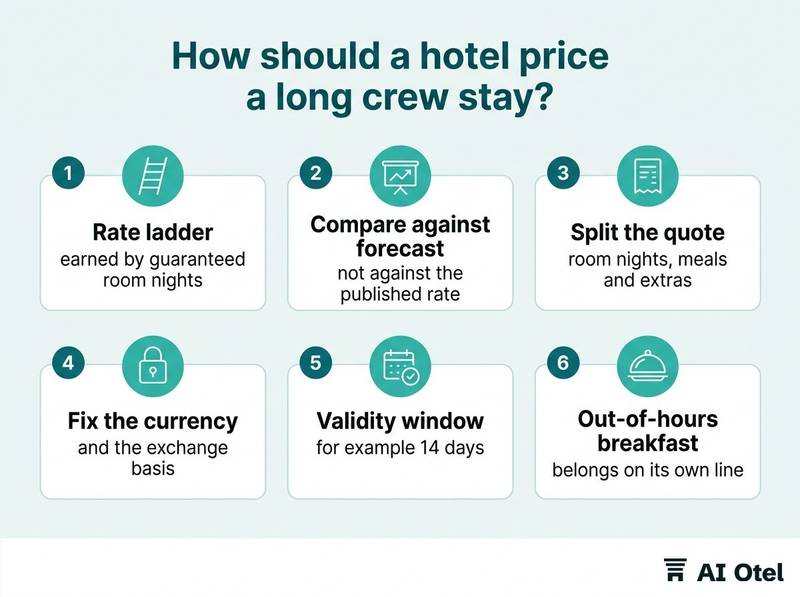
Set three or four rate steps tied to committed room nights, either per week or for the whole stay, so the discount is earned by volume rather than granted on the first email. For example, a hotel might offer one rate up to 250 committed room nights, a lower one to 500, and a third above that, with the step reached only when the commitment is real.
Compare the group against the hotel's own forecast for those dates, not against the published rate. A crew filling midweek nights in a soft month is worth more than the same rooms in a week the hotel would sell anyway. This is the same arithmetic that governs pricing weekly and monthly stays without losing peak nights.
Split the quote into room nights, meals and extras. A single all-in figure per person cannot be reconciled when the shoot ends and hides which line is losing money. Ask which nights the rooms are actually needed: a six-day shooting week with one rest night is not a seven-night pattern, and pricing it as one gives away a night per room per week.
Fix the currency and the exchange basis in the contract, and confirm with your accountant how the room and meal lines are taxed before the quote leaves the hotel. Give the quote a validity window, for example 14 days, and state in writing what happens if the start date moves or the room count falls.
Do not fold an out-of-hours breakfast into the room rate. The cost of that breakfast is kitchen labor at an hour the hotel does not normally staff, and it belongs on its own line.
The quiet period: price the nights the group fills
TipThe cheapest-looking group can be the most profitable
When a crew fills nights the hotel would otherwise leave empty, a low rate still adds revenue with little displacement. The comparison is always against the hotel's own forecast for those exact dates, never against the published rate.
Which extras should be priced separately?
Any request that opens a department early, keeps it open late, or takes space away from paying guests is a priced line, not a courtesy.
Price by a unit the hotel can count: per person for meals, per bay per day for parking, per square meter per week for storage, per kilo or per piece for laundry. Set a minimum on labor-driven items: a hot meal for six people costs the same kitchen shift as a hot meal for thirty, so set a minimum headcount or a flat call-out fee.
Set order cutoffs and write them into the contract: packed meal boxes ordered by 20:00 the night before, late hot meals confirmed by 16:00. Record who is liable for damage to the parking area, the storage room and the hotel's own equipment, and photograph the condition at handover in both directions.
Keep these lines outside the room rate. Once an extra is inside the rate, the hotel cannot stop providing it when the schedule changes and the cost stays. Check that each extra has an owner inside the hotel: a named person who confirms the order, delivers it and signs the charge to the master folio.
| Request | Ask before pricing | How to charge | The trap |
|---|---|---|---|
| Early breakfast | Which days, what headcount, hot or boxed | Per person, flat call-out below a minimum | Folding it into the room rate |
| Hot meal after late wrap | Confirmed by what time, how many | Per person, minimum headcount | Six guests costing a full shift |
| Packed meal boxes | Order cutoff, contents, delivery point | Per box, ordered by cutoff | Same-day orders with no kitchen notice |
| Truck and generator parking | Vehicle size, height, overnight running | Per bay per day | Damage and fuel spills with no liability clause |
| Secure equipment storage | Square meters, duration, access hours | Per square meter per week | Storing valuables with no written condition report |
| Production office room | Sleeping room or workspace, hours | Day rate or room rate plus power | Free workspace that displaces a sellable room |
| Laundry | Pieces per person per week, turnaround | Per kilo or per piece | Crew laundry mixed into guest laundry at cost |
| Extra housekeeping | How often linen changes for long stays | Per change, per room | Daily full cleans priced as standard |
| Day rooms for night shoots | How many, until what hour | Day-use rate | Giving them away as a favor |
| Lobby water and coffee station | Restock frequency, who serves | Flat daily fee | An open bar the hotel absorbs |
How do you manage a rooming list that changes daily?
With one named contact on each side, one versioned file, and a daily cutoff after which changes cost money.
Name one coordinator at the hotel and one at the production. All changes pass through those two people, never through the front desk at the moment a guest arrives. Keep a single rooming list file with a version number and a timestamp: the latest version wins, older versions are archived, and the file is the record used at reconciliation.
Set a change cutoff, for example 16:00 for same-day arrivals. Later changes are accepted subject to availability and are written down as such. Separate name changes from room-night changes: swapping two names is free, an added room night is charged at the contract rate, and a released night inside the cutoff counts against the commitment.
Give the front desk a printed arrival list each morning and one rule: crew requests for room moves, extras or late checkout go to the coordinator, not to the receptionist on duty. Authorize incidentals per room in writing, stating what the production pays (room, breakfast, parking) and what the guest pays (minibar, spa, laundry).
Reconcile the list against the property management system every morning, not at the end of the shoot, so a discrepancy is a same-day question rather than a month-old argument. The same block, rooming list and master folio mechanics that govern any group, explained in our guide to the block, rooming list and master folio for group bookings, apply here with tighter daily discipline.
Name changes, night changes and no-shows are three different events
A name change swaps one sleeper for another and costs the hotel nothing. A night change adds or removes a room night and moves money. A no-show keeps the room held and, under a normal attrition clause, is charged. Writing these as three separate rules in the contract removes most of the end-of-shoot argument.
ChecklistThe front office daily routine
- Check the versioned rooming list against the system
- Confirm the day's arrivals and departures
- Confirm meal counts for the next day
- Confirm parking bays and storage needs
- Log every change with the name of the person who authorized it
- Send the updated list back to the coordinator
- File the version
How many rooms should you keep for regular guests?
Keep enough to protect the business you already have: never commit the last room of a type, and never commit a sold-out week to a group rate.
Run the displacement arithmetic before signing: the group's room nights at the contract rate against the room nights the hotel would otherwise sell at its own rate. If the answer is negative, the group pays the difference or takes different dates. The full method is in our guide to group displacement analysis before accepting the group.
Protect a floor or a room type. Placing the crew in one block, away from suites and the best rooms, leaves something for the transient guest who books next week. Watch the tail: a shoot that wraps early leaves rooms the hotel turned away, and the release schedule plus the attrition clause are the only protection against it.
Judge the base the group creates. A block that fills otherwise empty midweek nights adds revenue with little displacement; the same block over a sold-out holiday week costs the hotel money. Tell the hotel's own contracted corporate and agency accounts in advance if a block reduces the availability they expect, so the relationship is not damaged by a surprise.
Decide in advance what an extension means: a new negotiation at the rate in force at that time, not an automatic right to the original price.
Watch outThe risk sits at the end, not the beginning
The shoot wraps early, the rooms have already been refused to other guests, and without a release schedule and an attrition clause the hotel carries the empty nights alone.
Hotels that want outside help running this arithmetic can work with the ecosystem's hotel growth and consultancy arm, and the underlying tools, from a hotel operating system that holds the block, the folios and the daily reconciliation in one place, are built to make the routine above a report rather than a spreadsheet.
How should payment and the end-of-shoot reconciliation work?
Bill weekly rather than once at the end, and reconcile against the contract line by line before the production company closes its books.
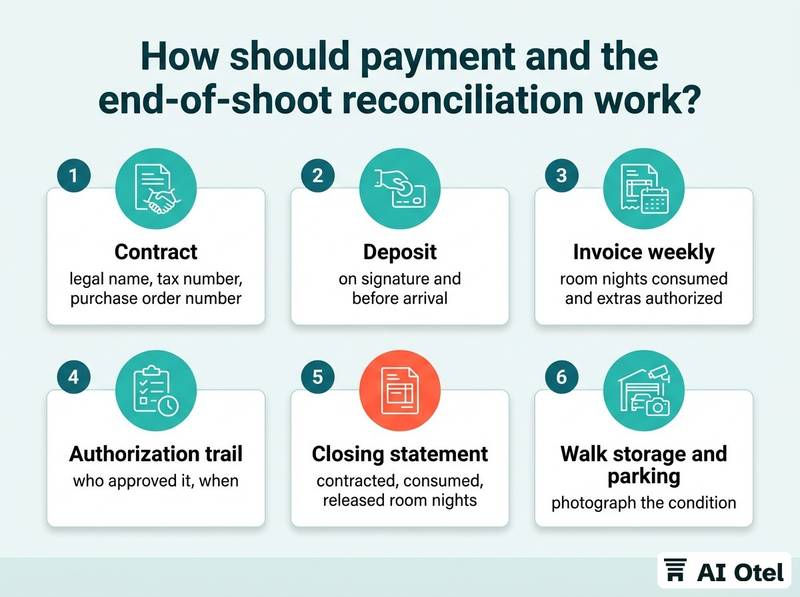
Contract with the production company's legal name, tax number, address and purchase order number. An invoice that does not match the purchase order is a payment delay, whatever the reason. Take a deposit on signature and a second payment before arrival, and grant credit terms only after a credit check. A production company is a project company and can close when the shoot ends.
Invoice weekly for room nights consumed and extras authorized, so a dispute is about one week rather than six. Keep an authorization trail for every extra: who approved it, when, and for which room. Without it, the charge is arguable at the end.
Issue one closing statement at the end: contracted room nights, consumed room nights, released room nights, no-shows, meals served, extras by category, deposit applied and balance due. Walk the storage room and the parking area with the coordinator before departure and photograph the condition in both directions. Hand the whole file to the hotel's accountant, contract, rooming lists and statements together, and confirm the tax treatment of each line with them. The same release and payment structure used for congress groups, covered in our guide to room blocks, release schedules and payment terms, transfers directly to a shoot.
Build the template before the phone rings
Build one crew quote template before the next request arrives: four blocks for room nights, meals, space and extras, a rate ladder tied to committed room nights, a release schedule, a rooming-list deadline and a deposit. Every section of this guide feeds that one page, and the page is what turns a six-week shoot from a risk into a base of business the hotel can defend to its own forecast.
Frequently asked questions
How far in advance should a hotel quote a film crew hotel group booking?
As soon as the production office gives dates, even provisional ones, but quote with a validity window and say which dates are fixed. Locations and permits move, so the quote should state what happens if the start date shifts or the room count falls.
Should a crew be quoted per room or per person?
Per room night for the rooms, per person for the meals, and per unit for the extras. A single per-person figure cannot be reconciled at the end of the shoot and hides which line is losing money.
What happens if the shoot ends earlier than planned?
The release schedule and the attrition clause decide it. Rooms released inside the agreed cutoff are charged or counted against the committed room nights, and the deposit is applied to the closing statement.
Can a hotel refuse to hold rooms before the rooming list arrives?
The contract sets the list deadline. Rooms not named by that deadline return to inventory, and the production is told in writing, which protects the hotel without ending the relationship.
Does a crew need a different contract from a normal group?
The skeleton is the same block, rooming list and master folio arrangement, with four additions: space and parking clauses, liability for equipment and damage, a purchase order requirement on the invoice, and meal times outside normal service.