Guest parking at a hotel: counting spaces, charging, full-lot days and who may park
Treat parking as a counted resource to avoid disputes. Learn to measure usable bays, set clear charges, and manage full-lot nights with a written sequence.
AI draft · awaiting editorial review
Contents
Key takeaways
- A hotel's parking capacity is the number of bays a car can enter, open its doors in and leave without moving another car, which is usually lower than the painted count.
- Free or paid guest parking is a commercial decision the hotel makes once and writes into the rate plan, the booking confirmation and the sign at the entrance.
- A sold-out night needs a written full-lot sequence: who gets the last bays, where overflow cars go, and what the front desk says at the barrier.
- The plate list is the control that makes a barrier or an attendant work, and it holds personal data, so keep it short and keep it for a stated period.
- What the hotel says about damage belongs in the confirmation and at the entrance, before the guest parks, not on a sign the guest reads afterwards.
Hotel guest parking management means treating spaces as a counted resource: count the bays a car can actually use, decide in writing whether guests pay, keep a plate list that separates guests from staff and outside cars, and state on the confirmation what happens when the lot is full.
It is 22:40 on a sold-out Saturday. The barrier reads full, the last bay holds a staff car, and the guest at the desk booked a rate that said parking available. What happens in the next four minutes was decided long before tonight. This article gives you the pieces to decide in advance: how to count usable bays, how to set and post a parking charge, what to do when the lot is full, and how to word the confirmation so the barrier never becomes an argument.
How do you count a hotel's usable parking spaces?
Count the bays a car can enter, open its doors in and leave without moving another car. That number is almost always smaller than the painted lines, and it is the only number worth planning with.
Painted lines versus usable bays
Walk the lot at peak occupancy, not when it is empty. A bay that only works when its neighbor is free is not a bay on a sold-out night. Subtract what is permanently lost: columns, ramps, technical rooms, storage cages, bicycle racks and any bay a van cannot use because of a low pipe or a tight turn. In a basement lot, measure the turning circle with an actual car. A circle that needs a three-point turn costs a bay and a minute at every arrival.
Count separately the bays that are not guest bays: coach and minibus stands, the loading bay, staff bays, and disabled bays, which stay free rather than becoming overflow. Then compare the usable figure with peak simultaneous demand, not with room count alone: rooms sold at double occupancy, plus event and restaurant covers, plus day guests.
What the number is actually for
Write the number down as a resource the front desk can see, the same way it sees rooms: bays in use, bays free, bays blocked. A number in a drawer is not a control. Recount after every physical change: a new terrace, a bike rack, an EV unit, a storage container. Each one quietly removes a bay, and EV charging bays take space before they take power.
ChecklistThe counting walk, done together by technical service and front office
- Count painted bays from the plan.
- Drive the lot and strike every bay that fails the door-opening test.
- List bays lost to columns, ramps, storage and equipment.
- Mark disabled, loading, coach and staff bays separately.
- Note height and width limits at the entrance.
- Write the final usable figure and the date it was measured.
Should hotel guest parking be free or paid?
It is mainly a commercial decision, and it works best when it is decided once and priced as part of the room product rather than sprung on the guest at the barrier.
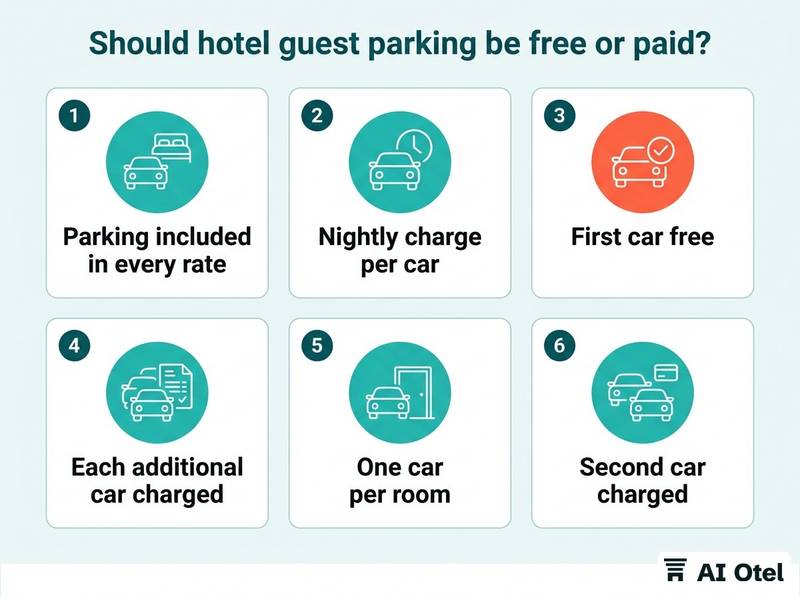
Three models work in practice: parking included in every rate, a nightly charge per car posted to the guest bill, or the first car free and each additional car charged. Included parking is a rate fence. It appeals to guests arriving by car and it removes a conversation at check-in, but it means the hotel carries the cost of the lot inside the room rate. A paid lot lowers the visible room rate on a comparison screen and adds a step at arrival. Decide which of those two effects you want before you set the price.
If you charge, post it as a charge on the guest bill with a clear description, exactly like a minibar line, so it appears in the night audit and in reports. A cash fee collected at the barrier that never reaches the bill is a control gap. Write the exceptions in advance: one car per room, second car charged, day guests, event guests, guests with a disabled badge, long-stay guests.
Say it in three places with the same words: the rate plan, the booking confirmation and the sign at the entrance. A charge the guest first meets at the barrier becomes a complaint at check-out. Tax treatment, invoicing and how the charge appears on a fiscal document are questions for your accountant, not for the front desk.
What do you do when the hotel car park is full on a sold-out night?
You follow a sequence written in advance: a small reserve of bays, a named overflow lot, a published order of who gets the last spaces, and a script the front desk uses at the barrier.
Who gets the last bays
Hold a reserve. Keep a few bays unassigned until late evening for guests who booked a parking-inclusive rate, guests with a disabled badge, and late arrivals. Publish the order of priority so staff do not improvise at 23:00: guests who bought parking with the rate first, then disabled badge holders, then by arrival time. Say it early: a confirmation line and a message on the day of arrival stating that parking cannot be guaranteed on sold-out nights prevents the argument at the barrier.
Give the front desk the decision, not the security guard. The person who can move a room, offer a transfer or approve the overflow lot is the person who answers the guest. Never let a guest circle the block while staff look for a space. Two minutes of searching is fine; ten is a complaint and a review.
The overflow arrangement
Agree the overflow in writing before you need it: which nearby lot, who pays, who escorts the guest, how the guest gets back, and who is called when the lot closes. Test the arrangement once in low season. Log every turn-away with time, plate and what was offered. After a month the log tells you whether to rent more bays, convert a store room, or change the rate plan.
ChecklistThe full-lot sequence, in order
- Check the reserve bays and any bay blocked by equipment.
- Check the plate list for cars that left without checking out.
- Call the overflow lot and confirm a space.
- Tell the guest the price and who pays before the car moves.
- Log time, plate, room and outcome.
- Post any charge or credit to the guest bill the same night.
Plate list, barrier or attendant: which setup fits your hotel?
Match the control to the risk. A plate list suits a small lot, a barrier controls revenue and turnover, and an attendant solves the full-lot conversation and witnesses damage. Most hotels end up with a plate list plus one of the other two.
A plate list holds the plate, the room, arrival and departure, and the bay if bays are assigned. Someone must own it, and it must be updated when a car leaves, not only when it arrives. A barrier needs a fallback for the night the system fails: a manual release, a named key holder, and a rule for the guest who lost the ticket. An attendant costs a shift but buys two things a barrier cannot: a person who can redirect a car when the lot is full, and a witness when a car is damaged.
Mixed setups work well. The barrier controls the gate, the plate list says who is inside, and the camera supplies evidence when a claim arrives. Know the failure modes before you buy: barrier down in a power cut, plate recognition misreading a letter, a staff car in a guest bay, a delivery van blocking the ramp. A plate is personal data. Keep only the fields you use, restrict who can see the list, and set a retention period with your data protection adviser rather than keeping years of plates by habit.
| Setup | Best for | What it costs you | Main failure mode |
|---|---|---|---|
| Plate list only | Small lots, low turnover | Staff discipline | Nobody updates departures |
| Barrier with ticket or plate recognition | Revenue control, high turnover | Hardware, fallback plan | Power cut, misread plate |
| Attendant | Events, tight lots, damage disputes | A shift | No authority to redirect |
| Plate list plus barrier | Most city hotels | Both disciplines | Records disagree, no reconciliation |
Who may park: outside cars, staff cars and event guests
Guests first, everyone else by rule and by record. Without that rule the guest bays disappear one car at a time, and nobody notices until a sold-out night.
Staff parking goes in a separate area or under a fixed cap. A staff car in a guest bay on a sold-out night is the most common leak in the whole system, and the easiest to fix with a marked area and a named owner. Outside cars, meaning neighbors, taxi drivers and nearby businesses, need a sign and a policy the hotel can actually carry out. Agree with your lawyer what the hotel may do before anyone promises to remove a car.
Event and restaurant guests get a time-limited arrangement: plate recorded at the door, bay released when the event ends, and a clear line on whether the charge goes to the event bill. Suppliers and contractors get a delivery window and a bay, not the ramp. A van parked across the entrance at 09:00 costs more than the delivery saves.
Watch the car that stays after check-out. A late departure with a car in the lot is a bay the next arrival cannot use, so tie the bay to the room's departure time. Run a nightly walk that compares the plates on the ground with the list. It takes ten minutes and it catches the staff car, the abandoned car and the guest who parked two vehicles.
TipThe nightly plate walk
Take the list to the lot after the last arrival, read every plate, and mark the ones not on the list. Decide each one the same night: staff, supplier, event or unknown. Write the outcome next to the plate.
What does the hotel say about damage and theft in the car park?
Say it before the guest parks, in plain words, and record the car's condition at entry. A sign discovered after an incident settles nothing; what the hotel owes in a given case is a question for your insurer and your lawyer.
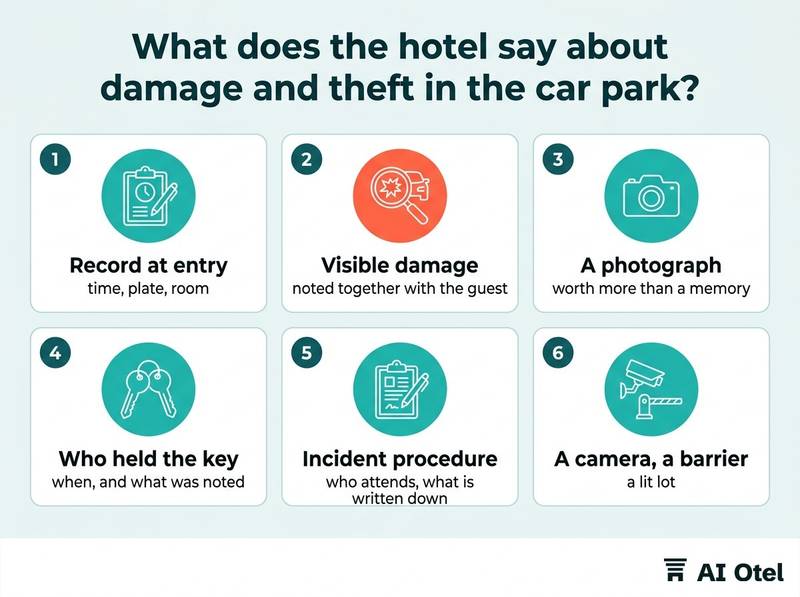
Write what the hotel offers, what it does not offer, and whom the guest should contact. Three short sentences at the entrance and in the confirmation beat a long disclaimer nobody reads. Record at entry: time, plate, room, and any visible damage noted together with the guest. A photograph where the hotel's own rules allow it is worth more than a memory. If the hotel keeps guests' keys, the record matters more, not less: who held the key, when, and what was noted at handover. For key handling and damage records in a valet setup, see keys, damage records and who answers for the car.
Give the front desk an incident procedure: who attends, what is written down, when the insurer is called, and what the guest is told at that moment. Confirm with your insurer what the policy covers for vehicles left in the hotel lot, and whether charging for parking changes that answer. This is the question most hotels never ask until a claim arrives.
Do not advertise secure parking unless you can describe what makes it secure. A camera, a barrier and a lit lot are things you can describe; safe is not. Keep the legal question in one place: ask your lawyer once, get the wording approved, and stop rewriting the sign after every complaint.
Watch outWording principles for the entrance sign and the confirmation
State whether parking is free or charged. State whether a space is guaranteed. State that the hotel does not accept responsibility for items left in the vehicle. Give the number to call when something happens. Keep it to four lines and use the same words in both places.
What goes on the booking confirmation and the listing?
One short parking paragraph, identical on the website, the booking sites, the confirmation and the sign: whether parking is included, whether it must be requested, whether it is guaranteed, and what happens when the lot is full.
Cover the practical limits in the same paragraph: one car per room, height limit, whether vans and minibuses fit, whether trailers are allowed, and where EV charging sits. Keep the facility text on booking sites honest. A listing that says parking with no qualifier creates an expectation the lot cannot meet on a sold-out night, and the argument happens at your barrier.
If parking is included, make it visible to the front desk as part of the rate, so the person at check-in knows before the guest says it. Put the full rules on the house rules page and link to it from the confirmation, so the short paragraph stays short; see hotel house rules: what to write and where guests see them. Describe the accessible route, not only the bay: distance to the entrance, step-free path, and whether the bay is under cover. Review the wording every season and after every full-lot complaint. The paragraph is the cheapest fix in the whole parking system.
Key pointA confirmation paragraph the hotel can adapt
Parking is included for one car per room and cannot be guaranteed on sold-out nights. Cars taller than the entrance limit cannot enter the garage. If the lot is full, the front desk will direct you to a nearby lot and tell you who pays. For accessible parking, tell us before arrival.
What to do next
Walk the lot tonight with a car, strike every bay that fails the door-opening test, and write the usable number down. Then write the four-line parking paragraph and put it in the same words on the confirmation, the listing and the sign. Every other decision in this article, from charging to the full-lot sequence, depends on that number and that sentence.
Frequently asked questions
How many parking spaces should a hotel have per room?
There is no ratio that fits every hotel, and a design habit is not a rule you can rely on. The working measure is peak simultaneous demand: rooms sold at double occupancy, plus event and restaurant covers, plus day guests. Count usable bays, not painted lines, and check any local planning requirement with your municipality.
Is hotel parking free for guests in Türkiye?
It is the hotel's own commercial decision, so it varies by property and by rate. The guest should look for the parking line in the rate plan and the confirmation, which should say whether parking is included, whether it must be requested, and whether it is guaranteed. A hotel that charges should post the charge to the guest bill like any other charge.
Can a hotel tell a guest the car park is full?
The hotel controls its own lot, so it can run out of spaces, and it should say so in advance rather than at the barrier. If parking was sold as part of the rate, the hotel should deliver a space or arrange an equivalent and say who pays. How that promise is worded and enforced is a question for your lawyer.
Do we have to keep a list of guest plate numbers?
A plate identifies a person, so it is personal data under KVKK (kişisel verilerin korunması kanunu). Keep only the fields the operation uses, restrict who can read the list, set a retention period, and delete on schedule. Confirm the retention period and the notice you give guests with your data protection adviser.
What happens if a guest's car is damaged in the hotel car park?
Record what happened, when, and what the guest reported, and call the insurer the same day. The entrance sign does not by itself settle who pays; that depends on the wording the hotel uses and on the policy. Keep the record even when the hotel believes it is not responsible.