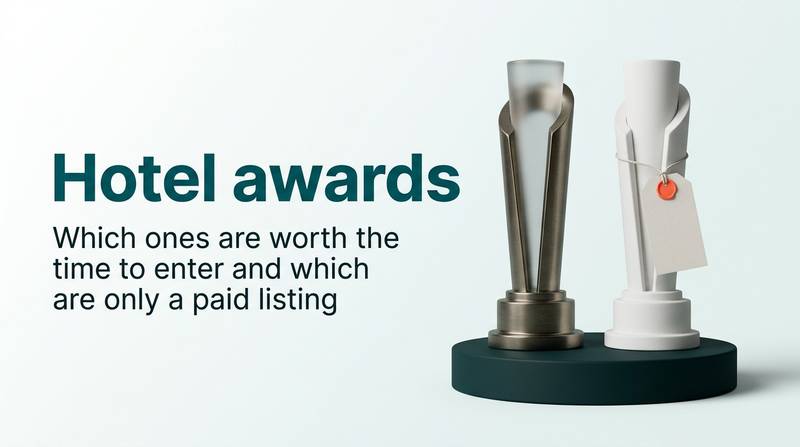
Hotel awards: which ones are worth the time to enter and which are only a paid listing
Sort hotel awards by selection method to see what each one proves. Learn the real costs in money and staff hours, and how to display badges honestly.
AI draft · awaiting editorial review
Contents
Key takeaways
- The selection method, not the trophy, decides what an award proves: reviews, a vote, a jury and a fee each tell a guest something different.
- Paying to enter a judged competition is normal; paying so that the word winner appears next to your name is advertising, and should be budgeted as advertising.
- The staff hours inside a submission usually cost more than the entry fee, and they come back every year.
- An honest badge carries four things: the award name, the awarding body, the year, and the exact category with its scope.
- Answer five questions in writing before paying: who decides, on what evidence, at what cost, what a guest can check, and what happens when you stop paying.
A hotel award is a distinction given by an outside body after a stated selection process. It is worth entering when the winner is chosen by verified guest reviews, a public vote or a published jury, and the fee covers administration rather than the outcome. A paid listing is a badge that arrives with the invoice.
An email arrives offering your hotel a plaque, a certificate and a page in a directory, and it asks for a payment by Friday. Nobody entered a competition, and nobody will judge anything. The same week, a program you did enter asks for a submission file you have not started. This article gives you a way to sort the two apart: how award programs actually choose winners, what entering costs in money and staff time, how to spot a paid listing, and how to display an award so it survives a second look.
How do hotel awards choose their winners?
Sort any program you meet into one of four methods: verified guest reviews, a public vote, a panel of judges, or payment. The method tells you what the award proves and how much work it will take.
Review-based awards score your property from stays a platform has verified, so the hotel does not apply, it qualifies. The work is spread across the year: service, review replies, and fixing the causes behind repeated complaints. Public votes work differently: the winner is whoever brings the most voters. The cost is campaign time with guests, past guests and followers, and the result measures your audience rather than your quality.
Jury and expert panels ask you to submit a file, sometimes followed by a site visit, and published criteria decide. Read the criteria before writing a word, because the file is scored against them and nothing else. Paid entry and membership programs make the fee the condition of entry; when the fee also decides the outcome, the program is selling placement, whatever the certificate says. Hybrid programs are common and legitimate: a fee covers administration and a jury decides, but the fee is still a cost and the file is still yours to write.
Read the method as a guest would. A review badge says many guests were satisfied. A jury badge says a small group judged a submission. A vote badge says the hotel has an audience. If you want to understand how a review platform builds its scores before relying on that route, read how a review platform ranks hotels and what a hotel can influence.
| Selection method | What the hotel supplies | What a guest can check afterward | Cost shape |
|---|---|---|---|
| Verified guest reviews | No application; year-round service and review handling | The platform's own score page and comments | Staff time only |
| Public vote | A voter campaign | The vote total and its page | Campaign time |
| Jury or expert panel | Submission file, evidence, sometimes a site visit | The published criteria and the winners list | Entry fee plus writing and photography |
| Paid entry or membership | Payment | Nothing beyond the invoice | Fee plus annual renewal |
What does entering an award cost, in money and staff time?
Two costs, and the second is usually larger: the fee you pay and the file you build. Both return every year.
Fee shapes to look for include a fee per category, a membership, a table at the ceremony, a plaque and certificate pack, a photography package, and a license to use the winner logo in your own marketing. Read the terms of that license: where the logo may appear, for how long, and whether the year is fixed on it.
File work is where the hours go: writing against the criteria, collecting evidence such as guest comments, project notes, training records and supplier letters, photography, translation into the program's language, and a manager's sign-off. Then there is the day itself: travel, a ceremony, a dinner. Budget the manager's time as a cost, not as a perk of the role.
Category choice changes the cost. A narrow category with strong evidence takes fewer hours than a broad one where you compete on presentation. Compare the same hours against other work: review replies, a guest survey, or fixing the two complaints that repeat most often. If you want a structured alternative for that comparison, the questions and timing of a guest survey are a good benchmark for what the same week of staff time could produce instead.
TipCount the hours before you count the fee
A submission that takes a week of a manager's time costs more than most entry fees, and it is the part nobody puts on the invoice.
Set a yearly ceiling for awards inside the marketing budget, and treat the renewal as part of the same decision rather than a new one. If you run your year from a written plan, the ceiling belongs there; the structure of a marketing plan with a calendar you can run the year from gives awards a natural slot.
What are the signs of a paid listing?
The clearest sign is that payment is the condition of entry: no criteria, no judges, no evidence, and a badge for everyone who pays.
Separate paid entry from paid outcome. Paying to enter a judged competition is normal; paying so that the word winner appears next to your name is advertising. Look for the criteria page. If it does not say who decides and on what evidence, there is nothing for a guest to check afterward. Ask what happens if you do not pay: if the answer is that the listing disappears, you are buying placement.
Ask for the judging panel and the previous winners. A program that will not show either is selling space. Check the badge terms: where it may be used, for how long, and whether the year is fixed on it. If you decide to buy anyway, record it as advertising, set a reach target, and judge it by enquiries and mentions rather than by prestige.
ChecklistSigns the offer is a listing rather than a competition
- You were selected without applying
- The email asks for payment before it names any criteria
- Every entrant receives a badge in a tier
- The package includes ad space, a plaque or a gala table
- The deadline is soft and the offer returns every month
- The criteria page is missing, or says only that entries are judged on excellence
- The same organization sells the same badge at several prices
- The renewal invoice arrives without a new submission
What do guests and travel agencies actually check?
Guests check the name, the year and the category, and whether they recognize the body that gave it. Agencies check your contract, your rates and your reliability, and read the award as one line in a presentation.
A badge is read in a second. Without a year and a category it reads as decoration, and decoration does not answer the question the guest is asking: is this the hotel I am looking for. Click-through matters too: if the badge does not lead to the awarding body's own page, the guest has no way to confirm it.
Review-based badges carry weight because the guest can open the platform and read the score and the comments behind it. That is also why review integrity matters: a score built on removed or unfair reviews does not survive a second look, and hotels that keep their review record clean are protecting an asset, not just a ranking. For the mechanics of that, see what each platform removes and how to report fake reviews.
Agencies and corporate buyers work from contracts, allotments, rates and past performance. An award helps a sales conversation; it does not change a rate sheet. What an award can do: support a rate, earn a mention in a roundup, give a sales manager an opening line, and give the team a reason to hold a standard. What it cannot do: repair a weak score, replace photography, or make a rate fit a market it does not fit.
How should a hotel show an award honestly?
Name the award, the body that gave it, the year, and the exact category with its scope, and change nothing else.
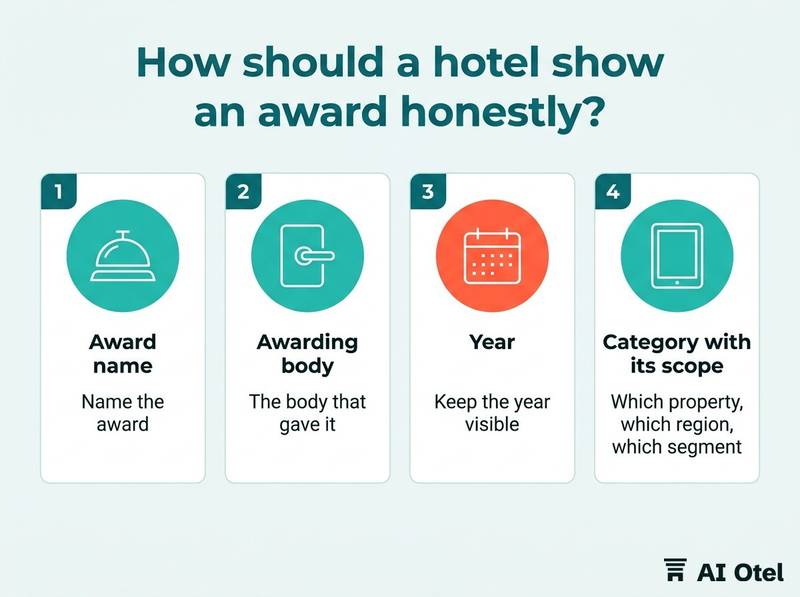
The four parts of an honest badge line are the award name, the awarding body, the year, and the category with its scope, meaning which property, which region and which segment. Do not stretch scope. A regional category is not a national one, an award for the restaurant is not an award for the hotel, and a category judged on one season is not a year-round claim.
Keep the year visible. An award given for one year, shown two years later without its year, is a claim the reader cannot date. Do not imply a relationship you do not have: no logos of institutions or bodies you have no agreement with, and no recommended-by line from a directory that sold you a listing.
Placement matters. The about page, the press page, the sales deck and the email signature carry an award well. On the booking page keep it small and link to the awarding body's page. If your hotel presents itself to guests through its own digital front door, the same rule applies there: keep the badge honest and linked, as with a hotel's own guest app, where offers and information are shown in one place.
Keep one evidence folder per award: the certificate, the program's page, the date and the exact category wording. A journalist or an agency may ask to see it. If someone challenges the wording, correct it the same day. Arguing costs more than the badge is worth.
Watch outThree wordings to avoid
"Award-winning hotel" on its own becomes the award name, the body and the year. "Winner, national category", when the category was regional, becomes the category exactly as the judges wrote it. "Recommended by" a directory you paid becomes "listed in" that directory, with the year.
What five questions should a hotel answer before entering an award?
Who decides, on what evidence, at what cost, what a guest can check afterward, and what happens when you stop paying. If any answer is missing, do not enter.
Question one, who decides: a platform's verified stays, a public vote, a named jury, or the invoice. Question two, on what evidence: published criteria you can write against, or a general promise of excellence. Question three, at what cost: the fee, the renewal, the ceremony, and the hours the file will take. Question four, what a guest can check: a page that shows the winners, the year and the criteria. Question five, what happens when you stop paying: the badge goes, or the listing goes. The second answer tells you what you bought.
ChecklistThe five questions in the order to ask them
- Who chooses the winner, and is the method published?
- What evidence is scored, and can we write against the criteria?
- What do the fee, the renewal and the staff hours add up to?
- What can a guest or an agency open to confirm the award?
- What changes if we do not renew?
Run the questions against a calendar. List every program you are considering with its deadline, its fee, its renewal date and the person who owns the file. Review the list once a year next to the marketing plan, and drop any award that has produced no enquiry, mention or sales conversation in two cycles. Keep the files: last year's submission is next year's draft, and the evidence folder makes a renewal cheap.
What to do next
Take the one award you are considering now and answer the five questions in writing before you pay anything. The parts fit together as a single test: the selection method tells you what the award proves, the cost tells you what it takes, the display rules tell you what you may say, and the calendar stops the decision from being made again by invoice.
Frequently asked questions
Is a paid hotel award worth the money?
Separate a fee for entry from a fee for the outcome. Where a named jury decides, the fee buys administration and the value sits in the evidence file and the story you can tell. Where payment produces the badge, treat it as advertising: give it a reach target, a budget ceiling and a review date, and judge it by enquiries and mentions.
Can we write award-winning hotel on our website?
Yes, if it is true, and better if it is specific. Name the award, the awarding body, the year and the category, and keep the scope the judges used. The phrase on its own is a claim a guest cannot check, and it is the version most likely to be challenged.
Do awards change our OTA ranking or commission?
Commission and rate come from your contract with the agency or platform, not from a badge. Ranking rules belong to each platform and are published there, so read them at the source. An award is not a lever a hotel can pull on a platform.
How long can we keep showing an award?
Show it with its year for as long as the claim stays true and the awarding body's page still exists. An award given for one year, shown later without that year, is a claim the reader cannot date. Refresh the page when the year changes and remove badges from programs that have closed.
Which award should a small independent hotel start with?
Start with the one whose selection method matches evidence the hotel already has: guest reviews, a specific project, a restaurant, or a way of working you can document. Choose a narrow category, enter one program in the first year, and reuse the file next year instead of spreading the same hours across several entries. That is how hotels find the hotel awards worth entering: by matching the method to the evidence they already hold.