Quiet room requests: recording the promise, choosing the room and what to say when it fails
A quiet room request is a promise the front desk must keep. This guide shows how to map quiet rooms, record requests so they survive to arrival, and handle failures with clear scripts.
AI draft · awaiting editorial review
Contents
Key takeaways
- Quiet is a property of a specific room in a specific building, so a hotel has to decide which rooms it will call quiet before it can promise anything.
- A request typed into a free-text comment box dies at the shift change; a structured field on the reservation survives to the room block.
- The desk may promise the room it controls and a move if that room fails; it may not promise silence, a noise level or a room number weeks ahead.
- When the quiet room is gone, the guest should hear it from the desk at check-in, with the reason and one concrete alternative, not discover it at midnight.
- Every noise complaint logged against a room number turns a repeated problem into a maintenance job instead of an argument.
A quiet room request is a guest preference the front desk treats as a promise. Record it as a structured note on the reservation, keep a map of which rooms are actually quiet in your building, assign in a written priority order, and when the room is gone, say so at check-in and offer a move.
It is 23:40 and the guest in a fourth-floor room is on the phone: the window sits above the terrace bar, and she says she asked for a quiet room when she booked. Somewhere between the booking and the room block, her request stopped being information and became a promise nobody checked. This article shows how to decide which rooms in your building count as quiet, how to record the request so it survives to arrival, what the desk may honestly promise, and the exact words to use when the promise cannot be kept.
What makes a room quiet in your building?
Quiet is not a room type. It is the sum of what sits next to, above, below and outside one particular room, so two rooms of the same category on the same floor can differ completely.
Start with the noise that comes from outside. The street and the loading bay, delivery hours, the garbage collection point, terrace or bar music, a schoolyard, construction, and any place of worship that calls early: ask which of these touch which facade, not which floor. A room facing an inner courtyard on the second floor may be quieter than a fifth-floor room above the terrace.
Then walk the inside of the building. The elevator shaft and machine room, ice and vending machines, the housekeeping closet, connecting doors, plumbing risers and drainage, ventilation and fan coils, an echoing atrium or corridor, and a ballroom or kitchen directly below all reach specific rooms. The guest's own neighbors count too: corridor traffic from late arrivals and early departures is the most common internal source, and the hotel controls where it routes people.
The building fabric decides how much of this reaches the bed. Single or double glazing, door undercut and seals, wall construction, floor level, and corner rooms with two exposed facades each change the answer for a given room.
The three kinds of noise a hotel can and cannot fix
Time matters as much as position. A room that is quiet at 15:00 may sit above the bar at 23:00 and beside the housekeeping trolley at 08:00, so test at the hours guests sleep. The decision rule that follows: call a room quiet only if it has no known noise path at night. If it has one, it is conditional, and a conditional room cannot carry a promise. If you want a broader method, see a room check for noise, light, temperature and pillows.
ChecklistDo the walk once, in writing
- Elevator shaft and machine room
- Ice and vending machines
- Housekeeping closet and linen store
- Connecting doors
- Plumbing riser
- Ventilation and plant room
- Bar, terrace, kitchen and ballroom adjacency
- Street, loading bay and garbage point
- Window type
- Door seals
- Corridor distance to the lifts
For each, note the room numbers it touches and the hours it is audible.
How do you map quiet rooms once and keep the map current?
Walk every room at the hours guests sleep, give each room a tier, and keep the tier list where the person who blocks rooms actually works.
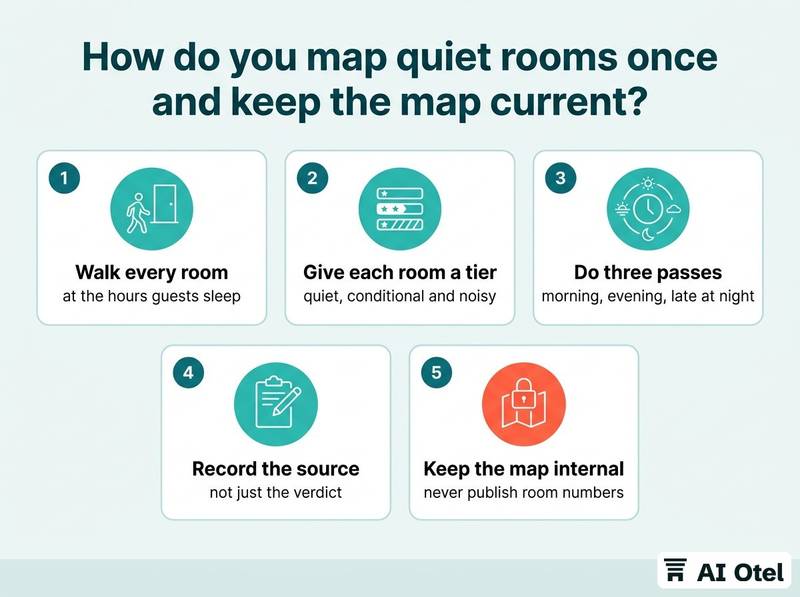
Do three passes: one in the morning for housekeeping, deliveries and breakfast service; one in the evening for the bar, terrace and restaurant; one late at night for corridor traffic and plant noise. Record the source, not just the verdict. "Above the terrace, music until 01:00" is usable at the desk; "noisy" is not.
Use three tiers: quiet, conditional (quiet with the window closed, or quiet on one side of the room) and noisy. Conditional rooms are still sellable; they simply cannot carry a promise. Keep the map in the property's own records next to the room list, and give reservations and the front office read access to the same version, so nobody works from a photocopy from two renovations ago.
Set review triggers: a renovation, a new bar or terrace, a change in delivery hours, a new plant room, or a room that repeats on the complaint list. And keep the map internal. Never publish room numbers as guaranteed quiet rooms on the website or in the booking engine, because the moment you publish, the conditional rooms become promises.
How do you record a quiet room request so it survives to arrival?
Record it as a structured preference on the reservation, with the reason and the source, then confirm back what the hotel will actually do.
A free-text comment box is read by one person and lost by the next. Use a fixed field with a small set of values: away from the elevator, away from the street, high floor, away from the bar or terrace, no connecting door. Attach the note to the reservation, not only to the guest profile: the room blocker reads the reservation on the day; the profile is history.
Note who took the request and when. A request with a name and a time is easier to honor and far easier to explain when it fails. Ask one follow-up question: which noise is the guest avoiding? A light sleeper, a family with a baby, a shift worker and a guest with an early flight need different rooms.
Then send a pre-arrival message that confirms the request is recorded and states what the hotel can do, without confirming a room number before the block is final. Keep the wording identical across the booking channel, the confirmation email and the desk, so the guest hears the same promise twice. A guest app installed from the browser is one place to hold that pre-arrival exchange, because the request and the confirmation then live in one record rather than in three inboxes.
TipNote wording that survives a shift change
"Quiet requested: away from elevator and street. Reason: light sleeper, early flight. Taken by [name], [date and time], via [channel]. Desk to confirm at check-in and offer a move if it does not suit."
Who gets the quiet room when several guests ask?
The hotel needs a written order of priority before the first argument, and the person who blocks rooms applies it, not the person who happens to be at the desk at 15:00.
Write the rule down and keep it short enough to memorize. A rule invented at the counter will not survive the second request of the day. Criteria a hotel can defend include a documented medical need, length of stay, a repeat request from the same guest, the room type or rate paid, how early the booking was made, arrival time, and loyalty status. Choose the order and publish it internally.
Apply the rule at the room block, because the block is where the promise is kept or broken; check-in only reveals the decision. Make the assignment visible in the reservation, so any colleague can see why this guest received that room and can explain it without guessing. When two guests have equal claims, the second one hears about the alternative before arrival, not at the desk with a suitcase. The mechanics of this decision are covered in assigning rooms before arrival: blocking, upgrades and special requests.
Watch for quiet stock being consumed silently by upgrades. If the quiet rooms are also the best rooms, say so in the rule and reserve a share of them for quiet requests.
What may the front desk promise about a quiet room?
The desk may promise what the hotel controls: this room, its position in the building, and a move if it does not suit. It may not promise silence.
| The desk may say | The desk must not say | Why |
|---|---|---|
| "This room is away from the elevator and the street" | "This room is completely silent" | Position is controlled, sound is not |
| "We will move you if we have a room" | "We will definitely move you" | Availability is not known in advance |
| "Your request is recorded on the reservation" | "Your request is guaranteed" | A record is not a guarantee |
| "We will check the room before you go up" | "Nobody has ever complained" | A check is a fact, a claim about other guests is not |
Explain the trade-off honestly. A high floor away from the street may sit under rooftop plant; the desk should know which rooms those are before the guest asks. Written confirmation must match what the desk can deliver on the day of arrival, so the confirmation text should describe the room's position, not the guest's experience of it.
The promise belongs to the hotel, not to the individual receptionist. If the desk cannot keep it, a supervisor decides what replaces it. Train the sentence, not the intention: staff who improvise under pressure promise more than the building can deliver.
What do you say when the quiet room is gone?
Say it at check-in, before the guest finds out at midnight, with the reason in plain words and one concrete alternative.
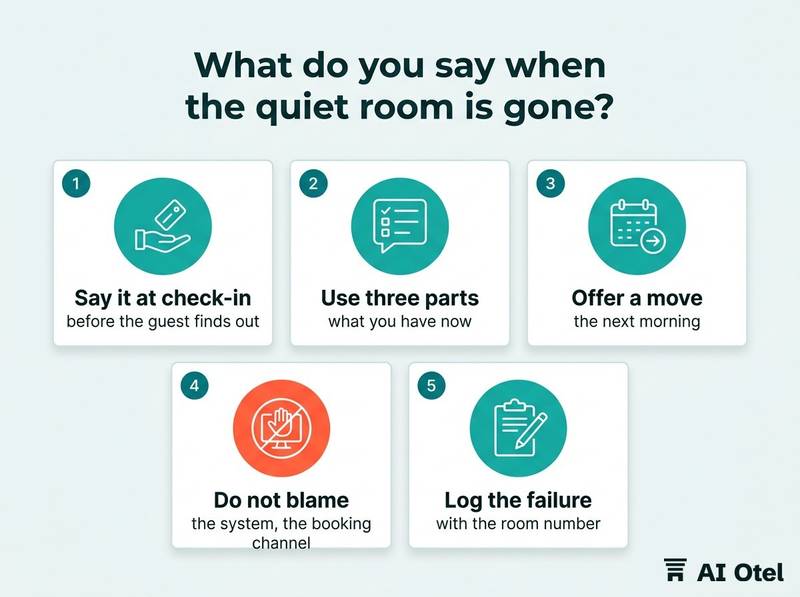
Use three parts: what you have now, why the quiet room is not available, and what you can do today and tomorrow. Offer a move the next morning when a quiet room frees up, and write it into the reservation so the morning shift acts on it without being told twice. Do not blame the system, the booking channel or the guest; the guest hears an excuse and stops listening to the alternative.
Earplugs or a white-noise machine are a supplement to the move, never a substitute for it, and they should be offered without being asked. If the hotel is noisy that week, because the terrace is open late, a renovation is running or a wedding is in house, tell arriving guests before they ask. Log the failure with the room number and the reason: one guest's bad night becomes a pattern the hotel can fix. Compensation is a management decision under the hotel's own written rule; the desk should know who can decide and how quickly, so the guest is not left waiting. For the mechanics of the move itself, see room change requests: when to move a guest and how to do it well.
Watch outThe words to use, and the words to avoid
Use: "Your request was recorded and I could not honor it. The quiet rooms are taken this week and the terrace is open until 01:00. I can move you to a room on the other side tomorrow morning and I will hold it now." Avoid: "The system did not show it", "everyone asks for that", "it is not that loud", "there is nothing I can do".
How do you review noise complaints by room?
Log every noise complaint against the room number and its source, then read the list on a fixed rhythm. A room that repeats is a building problem, not a guest problem.
Record the date and time, the room, the source (street, corridor, neighbor, plant, bar), the action taken, and whether the guest moved. Separate three kinds: building noise that maintenance can fix, neighbor noise that needs a house rule and a night response, and street noise that needs glazing, seals or a change in allocation. The night call itself has its own method, covered in answering the night noise call and preventing the next one.
Read the list monthly and rank it by repetition. Fix the rooms that appear most often first, then re-test at the hour the complaint was made. Compare complaints with nights sold for that room: a room with repeated complaints over many nights is a different case from one with repeated complaints over very few. Feed the results back into the tier map and the priority rule, so the review changes the next assignment rather than only describing the last one. Share the summary with housekeeping and maintenance, not only the front office, because most fixes are theirs.
What to do next
Before the next check-in, write two short documents: the list of rooms your hotel will call quiet, and the sentences the desk may use about them. Then move the request out of the comment box and into a field the room blocker reads, so the promise is made once, in the same words, and can be kept or honestly withdrawn. If you are reviewing your systems for this, a hotel operating system that keeps reservations, room assignment and guest communication in one place is the natural home for both documents.
Frequently asked questions
Can a hotel guarantee a quiet room?
No hotel can guarantee silence, because the next guest, the street and the building's plant are outside its control. What it can commit to is a specific room it has checked, a note on the reservation, and a move if the room does not suit. The written confirmation should say exactly that.
How should a guest phrase a quiet room request so it works?
Name the noise being avoided, such as street, elevator, bar or corridor, instead of the word quiet, because it tells the hotel which rooms to avoid. Ask for the request to be added to the reservation, not just mentioned on the phone, and ask for written confirmation of what the hotel will do. Repeat it at check-in before going up.
Is a higher floor always quieter?
No. Rooftop plant, elevator machinery, a rooftop bar and wind exposure can make top floors louder, while low floors suffer from street traffic and the loading bay. Position relative to the noise source matters more than height, which is why the hotel maps rooms rather than floors.
Should the quiet request sit on the guest profile or the reservation?
Both, but the reservation is what the person blocking rooms reads on the day. A profile note helps a returning guest and saves them repeating themselves; a reservation field is what gets action on this stay. The two should agree.
What should the desk do if the guest asks for a discount because the room was noisy?
Treat it as a management decision under the hotel's own written rule, not something the desk improvises at midnight. The desk records the complaint, offers the move, and hands the decision to whoever holds that authority, so the guest gets one answer instead of three.