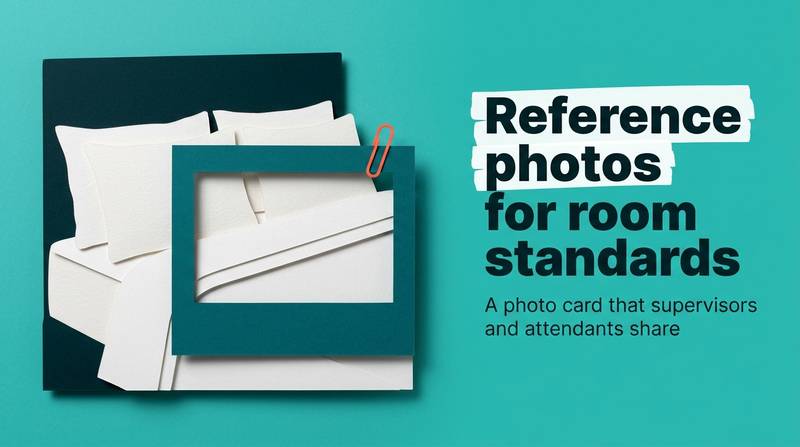
Reference photos for room standards: a photo card that supervisors and attendants share
A photo card fixes the reference point for room standards, so attendants compare the room to a picture, not a supervisor's memory. Learn which shots to take, when to retake them, and how to use them in training and inspection.
AI draft · awaiting editorial review
Contents
Key takeaways
- A photo card fixes the reference point: the attendant compares the room to a picture, not to a supervisor's memory.
- Shoot one card per room type, plus a variant for each seasonal set-up, and date every version.
- Take the photos in daylight from marked positions, in a vacant room, with no guest belongings and no staff faces without consent.
- Retake the card after any refurbishment, linen or amenity supplier change, and whenever inspection keeps failing the same detail.
- The card is a reference, not a score: inspection still records what is missing and why.
A room standard photo card is one sheet per room type showing the finished room exactly as it must be released: bed, bathroom, amenities, minibar and desk, shot from fixed positions in daylight with no guest belongings. Supervisors and attendants work from the same pictures, so the standard stops depending on who is on shift.
The supervisor says the bed is not right. The attendant says this is how I was shown. Both are describing the same room, and neither can point at anything except the other person's memory. This article shows how to turn hotel room standard reference photos into a working card: which shots to take, how to shoot them so they show the standard rather than the day, when to retake them, and how to use them in training and inspection.
Why do written room standards drift away from the room?
Because words describe the room in outline and leave the details to whoever is training that day. A photo removes the interpretation.
A written standard says the bed is neatly made. It does not say where the duvet fold sits, which way the pillow seam faces, or how far the runner hangs over the foot. Each trainer teaches from memory, so two trainers produce two versions, and both believe they are teaching the written standard. A new attendant copies the room next door rather than the folder, because the room next door is visible and the paragraph is not.
The drift compounds quietly. When the person who knew the detail leaves, the version standing in the rooms becomes the standard by default. One supervisor's judgment is consistent; three supervisors across three shifts are not, and the difference shows up as rework. The card does not replace the written standard. It pins the parts words cannot carry, so the sentence and the picture say the same thing.
The practical gain is in disputes. A released room is discussed against a picture both people can look at, not against rank. That alone changes the tone of a correction.
Which shots belong on a room standard photo card?
Six to nine shots per room type, always in the same order, so the card reads like the room does when the door opens.
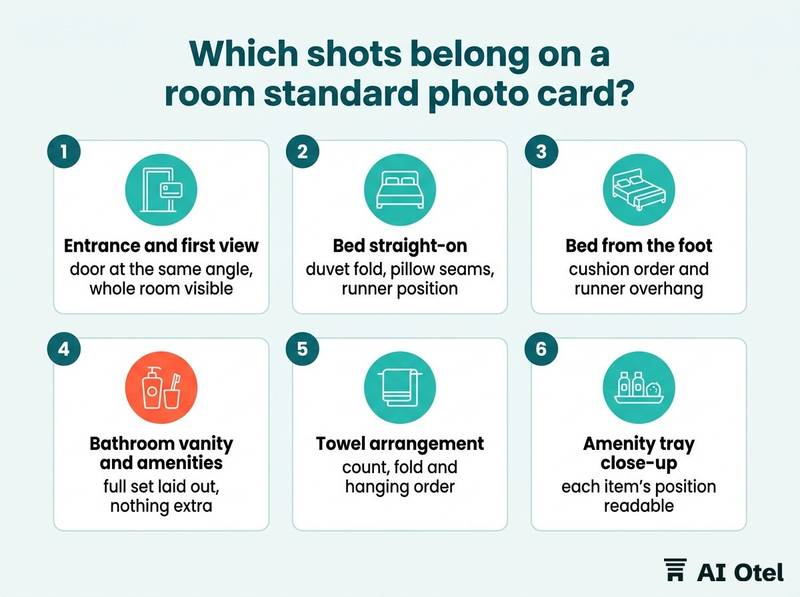
The entrance shot comes first: the door open at the same angle, showing the whole room and the window wall, because this is the first view a guest gets. The bed gets two shots, one straight-on of the made bed and one from the foot showing runner, cushions and pillow arrangement. The bathroom section covers the vanity with the amenity set laid out, the towel arrangement, and the shower or bath left exactly as it must be found.
Then the close work. The amenity set needs a close shot of the tray or shelf, close enough that the count and the position of each item are readable. The minibar is shot open, with the same items in the same positions, and the price list visible if the hotel displays one. The desk and work area shot covers chair position, lamp, notepad, remote and television card: the items guests move and attendants must reset.
Room-type extras, such as a balcony, kitchenette, sofa bed, connecting door or accessible fittings, are shot once rather than spread over a second card. And add the usual failure: the one detail this property keeps getting wrong, photographed correctly and labeled as the point to check. If your team follows the room cleaning order that produces this set-up, the card simply shows what the end of that order looks like.
ChecklistA shot list the supervisor can work down in order, one line per photo. Each line names what the photo must prove, not just what it shows
- Entrance and first view: door at the same angle, whole room visible
- Bed straight-on: duvet fold, pillow seams, runner position
- Bed from the foot: cushion order and runner overhang
- Bathroom vanity and amenities: full set laid out, nothing extra
- Towel arrangement: count, fold and hanging order
- Amenity tray close-up: each item's position readable
- Minibar open: stock positions and price list
- Desk and work area: reset items in place
- Room-type extra: balcony, kitchenette or accessible fittings
- The usual failure detail: shot correctly and labeled as the check
How do you take the photos so they show the standard, not the day?
Shoot in daylight from fixed positions, in a vacant room, with nothing in the frame that is not part of the standard.
Use a vacant or out-of-order room. Never shoot a room with a guest in it, and never leave a guest's belongings in the frame. Work in daylight with the curtains open the same way in every shot, room lights on as the standard requires, and no flash, which flattens texture and shifts color. Mark the standing position with tape while shooting and note it on the card, so the next shoot can be compared with this one.
Hold the camera at eye height, level, and away from the wide end of the lens, which bends the edges of the room and makes the bed look longer than it is. Clear the frame: no carts, no linen bags, no cloths, no water bottles, no coats, no staff walking through. Photograph the room as released, after inspection, not halfway through set-up. Keep the original files with their dates. The printed card is a copy of a record, not the record itself.
Watch outGuest belongings and staff faces
A photo of a guest's belongings is a record of a guest and belongs in the same protected category as any other guest data, so it stays out of the card and out of shared training folders. Staff appear only with written consent, and hands-only shots are enough for most how-to pictures.
How many cards does a hotel need, and when do you retake them?
One card per room type, plus one variant for each seasonal set-up, and a new version whenever the room itself changes.
Sort by room type, not room number: standard double, twin, family, suite, accessible. A corner room with a different layout gets its own card only if the finished look genuinely differs. Seasonal variants are separate cards or clearly marked pages: winter duvet and extra blanket, summer light linen and pool towel, the seasonal welcome item.
Retake after refurbishment, new furniture, a new linen or towel specification, an amenity brand or bottle change, a minibar range change, a new television or safe, or a change of signage and directory. Retake as well when inspection keeps failing the same detail: either the photo is out of date or the training is, and both are fixed by looking at the card. Every card carries a version number and a date. Keep the old version until the new one is signed off, then withdraw it, so two versions never hang side by side. Name the owner: the executive housekeeper approves the standard, a supervisor or trainer takes the photo, and the rooms manager is told when a room type changes.
| Trigger | What to reshoot | Who signs off |
|---|---|---|
| Refurbishment or new furniture | Affected room type, all shots | Executive housekeeper |
| Linen or towel specification change | Bed and bathroom shots | Executive housekeeper |
| Amenity or minibar supplier change | Amenity close-up and minibar | Floor supervisor, with housekeeper approval |
| Seasonal set-up change | Bed, amenities, welcome item | Executive housekeeper |
| New or converted room type | Full card | Executive housekeeper and rooms manager |
| Repeated inspection failure on one detail | That single shot | Floor supervisor |
Seasonal set-ups pair naturally with the first-week training checklist for seasonal staff, since both change at the same time of year.
How do you use the card in training and in inspection?
Show the card before the attendant touches the room, and open it again at the inspection, so one picture teaches and checks the same thing.
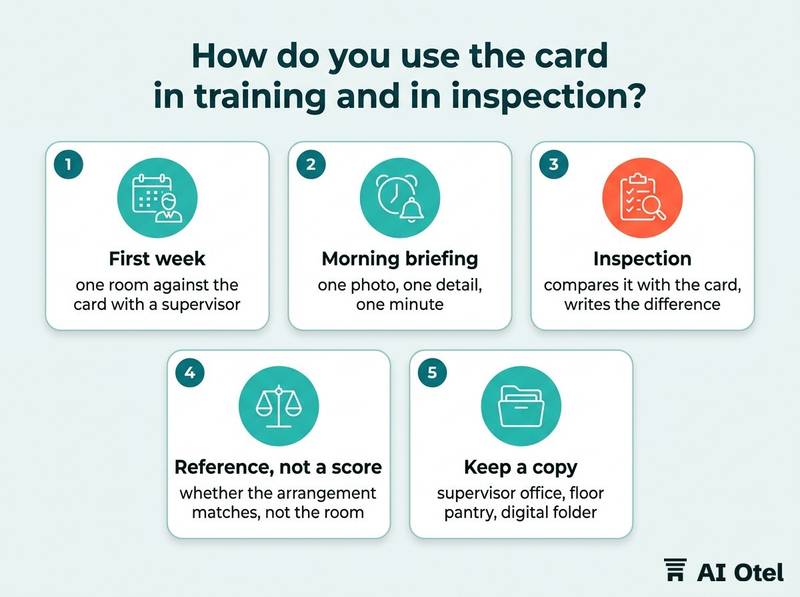
In the first week, the new attendant sets one room against the card with a supervisor, then alone, then compares the result with the photo. At the morning briefing, use one photo, one detail, one minute, and rotate the detail instead of repeating the bed every day. At inspection, the supervisor inspects the room, then compares it with the card, and writes the difference in words, for example two towels instead of three, not just a fail.
The card is a reference, not a score. Rooms fail for missing items, damage or dirt; the card tells you whether the arrangement matches, not whether the room is clean. When a room cannot match the card because an item is out of stock or a fitting is broken, the supervisor records the reason. The card is not quietly set aside. Keep a copy where attendants actually pass: the supervisor office, the floor pantry, and the digital folder the team already opens.
TipOne detail a day
Choose the shot the property fails most often, put it on the briefing table, and ask one attendant to set that detail while the others watch. The card stays the reference; the briefing is where it gets used.
For the release decision itself, the card sits alongside the room inspection checklist a supervisor works through before release, and the briefing rhythm comes from the housekeeping morning briefing checklist. Hotels that manage housekeeping inside a hotel operating system can keep the digital card in the same place the team already opens for tasks and reports, and the same version discipline applies on the platform as on paper.
What should the card itself carry, and who may change it?
Each card carries the room type, the date, the version, the person who approved it, and a one-line standard under every photo. Only the executive housekeeper changes it.
The header states the property, the room type code, the date taken, the version number and the approving manager. Under each photo sits one line stating what the picture asserts, for example three towels folded in thirds with the logo facing out. Add a short acceptable-variation note, so the card is not read as rigid: a guest-requested extra pillow, a folded blanket in the wardrobe, a cot in the room.
Keep a change log on the back: what changed, when, and why, so the next executive housekeeper inherits the reasoning and not only the picture. Write the card in the languages the team reads, not only in the management language. Set a fixed annual review date even when nothing has changed, so the card is looked at rather than assumed. And use one version number across print and digital copies, so a supervisor and a trainer never argue from two different sheets.
What to do next
Pick one room type this week, shoot it in a vacant room from marked positions, print the card, and use it at the next briefing and the next inspection before you extend the method to the other types. The written standard, the photo and the inspection record then say the same thing, and the standard stops living in one person's head.
Frequently asked questions
Should the room standard photo card be printed or digital?
Both, with one version number. The print goes where the work happens, the supervisor desk and the floor pantry, because it is read with wet hands and no screen. The digital copy holds the original files, the change log and the training folder. When the two disagree, the version number decides which one is current.
Can we use the hotel's marketing photos for the card?
No. Marketing photos are styled, lit for the brochure, often shot in a show room and sometimes retouched, so they show a room the attendant cannot reproduce. Hotel room standard reference photos must show the room as the attendant will leave it, under the hotel's own lighting, with the hotel's actual linen and amenities.
What do we do when a supplier changes an amenity bottle and the photo is out of date?
Treat it as a retake trigger. In the gap, attach a dated written note to the card naming the change and who approved it, and reshoot at the next cycle. Never let the old photo stand unmarked, because attendants will read the picture first and the note second.
Who should appear in the photos?
Nobody, in most shots. Hands-only pictures are enough to show a fold, a tuck or an amenity layout. Staff faces appear only with written consent, and never on a card that leaves the property or is shared outside the team.
How many photos are too many for one room type?
When the card needs a second page, it has stopped being a card and become a manual nobody reads at the door. Keep the core shots in a fixed order, add the one detail the property keeps failing, and move anything else to the written standard.