Renting out unused space off-season: terrace, meeting room or car park, and when it pays
Earn from idle hotel space by comparing rent, run and bundle models. Use a one-page cost test and a one-quarter trial to decide if it pays before committing a season.
AI draft · awaiting editorial review
Contents
Key takeaways
- A space earns only if its income covers the costs it creates: cleaning, energy, staff hours, wear, management time and the disruption to paying guests.
- Rent, run and bundle carry different risk: rent transfers the work and most of the margin, running keeps control and adds payroll, bundling sells the space inside a room and food bill.
- The go/no-go decision fits on one page: idle months, realistic uses per month, price per use, direct cost per use, management hours and the cost of disturbing guests.
- Settle access, hours, cleaning, damage, cancellation, liability and an end date in writing before the first booking, and have your own legal adviser read the draft.
- Run one space for one quarter with the review date and the kill criteria written down before the trial starts.
Unused space rental means earning from a hotel asset that is not a bed: a terrace, meeting room or car park. It pays only when the income covers the costs the space creates, the disruption to paying guests and the contract risk. Test one space for one quarter before committing a season.
In February the terrace seats nobody, the meeting room holds stacked chairs and the car park holds three cars. Every room sold that month was priced, costed and argued over. The space earns nothing and still costs something: heating, lighting, cleaning, insurance. This article shows how to find which space is genuinely idle, compare the three ways to earn from it, price it from its own costs, and decide with a one-page test and a one-quarter trial.
How do you find out which space is actually idle?
Build a month-by-month calendar for every non-room space and record what it earns today. A space is a candidate only if it is empty for whole days or weeks, separable from guest areas, and usable while the hotel's rooms are not full.
Start with an inventory. List every non-room space with its floor area and its access: terrace, garden, meeting and event rooms, car park, storage, laundry, the kitchen outside service hours. Then mark twelve months for each one in four states: used by guests, used by operations such as storage or staff, empty, partly used. The empty weeks are the asset.
Record today's income and today's cost for each space, including the energy spent heating, cooling or lighting a space nobody uses. An empty hall kept at a usable temperature all winter is not free.
Separate "free to in-house guests" from "idle". A terrace guests use in July is not idle in July, and renting it then removes an amenity the room rate already pays for. The same logic applies to parking places guests expect at midnight.
Note the physical constraints before you fall in love with a use: a separate entrance, toilets reachable without crossing guest areas, sound separation from rooms, power capacity, lift access, and how many parking places the use consumes. Check the building's frame too: the facility's registered type and capacity, and whether the space is declared as a guest area. Your adviser confirms what your own registration allows.
Rank the spaces by idle months multiplied by separability. The winner is usually a space with its own door and its own floor, not the biggest room in the building.
ChecklistIdle space audit, one line per space
- name and floor area
- separate entrance: yes or no
- toilets reachable without crossing guest areas
- sound separation from guest rooms
- parking places consumed
- months empty
- months used by guests
- months used by operations
- current income
- current cost of holding it empty
Three ways to earn from a space: rent it, run it or bundle it
Rent hands the space to someone else for a fixed fee, run means the hotel staffs and sells the use itself, and bundle means the space is sold together with rooms and food, usually to a group.
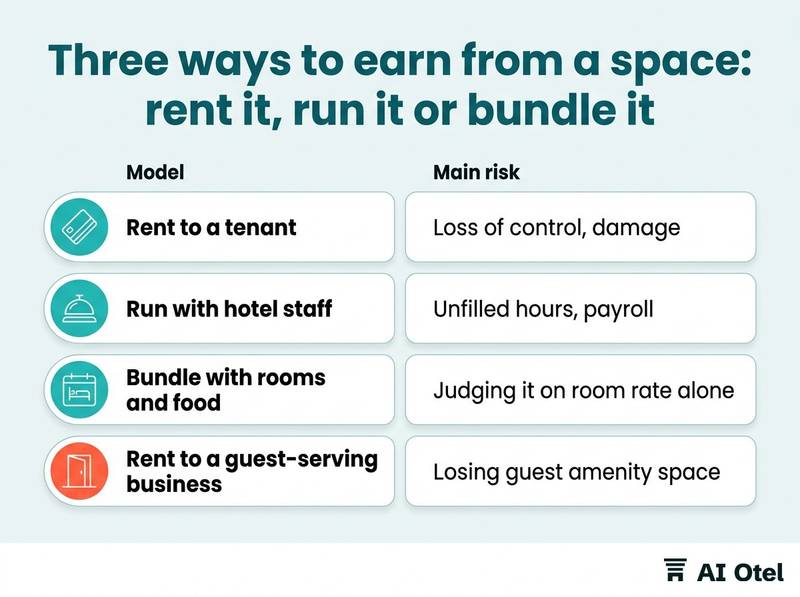
In rent, a tenant pays a monthly or per-event fee, brings its own customers and staff, and the hotel keeps a predictable number with little daily work. The trade is control: the hotel gives up who walks through the building.
In run, the hotel sells the space by the hour or the day, staffs it, cleans it and often caters it. Margin per use is higher, but every hour of demand has to be found by the hotel's own selling. A hotel with no events or sales function will underfill the space and pay staff to wait.
In bundle, the space becomes the reason a group books rooms and food: for example a meeting plus twenty rooms, or a wedding plus sixty. The space's income is hidden inside the room and food bill, so measure it as contribution to the group, not as rent. A space sold to a group is quoted like any group: space, rooms, food and setup in one price, with the space's cost visible in the calculation so the group is not judged on the room rate alone. The vocabulary of this trade is worth knowing; see MICE explained for hotels, term by term.
There is a partial fourth option: rent to a business that serves your guests, such as a hairdresser or a small gym. It earns rent and adds an amenity, but it also occupies space your guests could use.
Choose by what the hotel lacks. A hotel with no events team should rent. A hotel with a strong food and beverage team should run or bundle, because it already owns the selling and the staffing.
| Model | Who finds the customer | Who carries empty-month cost | Main risk |
|---|---|---|---|
| Rent to a tenant | The tenant | Mostly the tenant | Loss of control, damage |
| Run with hotel staff | The hotel | The hotel | Unfilled hours, payroll |
| Bundle with rooms and food | The hotel's sales | Shared in the group quote | Judging it on room rate alone |
| Rent to a guest-serving business | The business | The business | Losing guest amenity space |
What does each model cost, line by line?
Every use of a space carries direct costs before it carries any income: cleaning, energy, staff hours, setup and wear. Write them per use, not per month, or the comparison with a room rate means nothing.
Cleaning and reset: hours per use, the deep clean after an event, and who pays for the reset when a tenant leaves the room as it was found. Energy: heating, cooling and lighting for the hours of use, plus the cost of keeping an empty hall usable through the weak months. Staff hours: reception, security, technical and cleaning time. Count them even when they come from existing staff, because they are hours not spent on guests.
Setup and furniture: tables, chairs, screens, heaters, a stage, and the labour of moving and storing them between uses. Wear and damage: paint, floors, furniture, the car park surface. Hold a reserve per use rather than waiting for the repair bill.
Two lines decide marginal cases. The first is lost amenity: the in-house guest who cannot use the terrace, or cannot find a parking place, on the night the space was sold. The second is management time: contracts, invoicing, coordination, complaints. It is the line owners forget most often.
Insurance and liability need their own check: who answers for damage by a tenant's guests, whether the policy covers commercial use of the space, and what changes when a business rather than a hotel guest uses it. Ask your insurer these three questions before the first booking.
Watch outThe cost that arrives after the season
Hold a damage reserve per use and do a walk-through before and after every event. Before the first booking, ask your insurer three questions: damage by a tenant's guests, commercial use of the space, and cover when the space is rented to a business rather than used by hotel guests.
What does an outside booking do to the guests already in the hotel?
It changes the hotel the paying guest booked: sound, parking places, lift queues, toilets and the sight of strangers in the lobby. The test is separation: can the outside use reach its space without crossing guest areas?
Sound is the most common failure. A terrace event at eleven at night is heard in the rooms facing it. Write an end time and a sound limit into the agreement before the space is sold. Parking is the second: a car park rented to a nearby office is empty again when guests return in the evening, but a wedding takes the places all night. Count the places an outside use takes before you quote it.
Access matters as much as sound. A separate entrance, a service corridor or a lift reserved for the event keeps the two populations apart. If the only route is the lobby, the guest experience changes with every booking. Facilities follow the same rule: toilets, coat storage and a bar taken by an event are facilities the guest cannot use at that hour. And someone must hold the keys, lock up and answer the phone at midnight when an alarm sounds.
Treat a complaining guest as a cost, not as noise. In a small hotel one public review can outweigh the fee from a single event. The rule: if the outside use cannot be separated physically, price it as if it disturbs guests, restrict it to hours when the hotel is quiet, or do not sell it in high season at all.
TipThe separation test
Walk the route an outside visitor takes from the street to the space. If it crosses the lobby, the pool or a guest corridor at a busy hour, the space is not separable: sell it with fixed hours and hotel staff present, not as an hourly self-serve rental.
A one-page go/no-go test before you commit a season
Put seven numbers on one page and the decision usually makes itself: months available, realistic uses per month, price per use, direct cost per use, contribution, management hours and the cost of disruption.
Months available come from the calendar, not from hope. A space idle for two months cannot carry an annual contract. Realistic uses per month is the number a tenant or your own sales team will deliver in the weakest month, not the best one. Price per use is what a real buyer will pay in that month; ask two actual buyers before writing the plan.
Direct cost per use is cleaning, energy, staff hours at their real cost, setup and the damage reserve, added together. Contribution per use is price minus direct cost; monthly contribution is uses multiplied by contribution. Compare it with the alternative, which is the space used by in-house guests or left empty.
Break-even uses is the fixed setup cost, such as furniture, signage, a separate entrance or marketing, divided by the contribution per use. Then subtract management hours and disruption. If the contribution is smaller than the cost of the hours the space consumes, the answer is no, however attractive the fee looks.
Write the kill criteria on the same page: a month below break-even, two guest complaints about the same cause, a tenant who pays late twice.
ChecklistOne-page test items
- space name
- months available
- realistic uses per month, in the weakest month
- price per use
- direct cost per use
- contribution per use
- monthly contribution
- fixed setup cost
- break-even uses
- management hours per month
- disruption cost
- decision: yes or no
- kill criteria
What has to be settled in writing before the first booking?
Access, hours, cleaning, damage, cancellation, liability and an end date. An agreement that leaves any of these to goodwill will be tested in the first month.
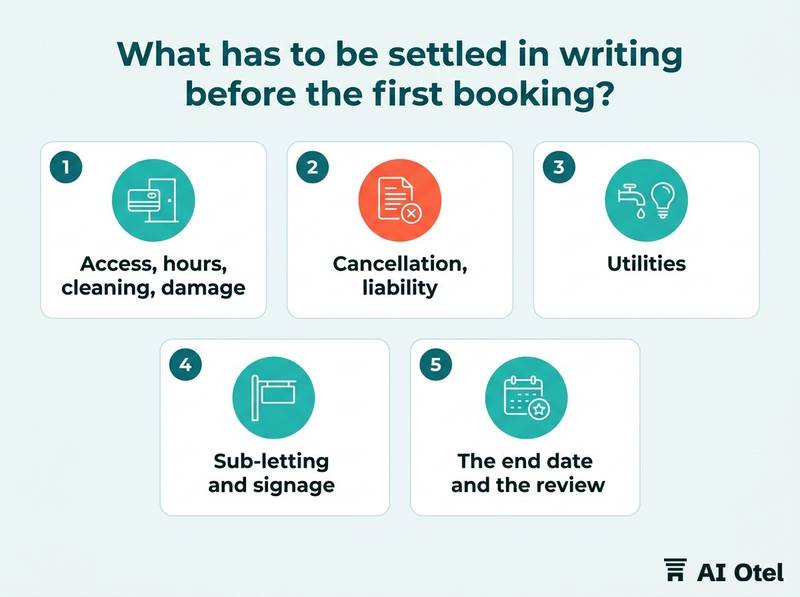
Define the space and the hours precisely: which square meters, which entrance, which days, from when to when, and the latest hour for sound. Cleaning: who cleans, to what standard, and who pays for the reset after an event. Damage: a deposit, a walk-through with photographs before and after each use, and a rule for who arranges and pays for repairs.
Utilities deserve a line of their own. A hall heated by the hotel's boiler is a cost the fee has to cover, whether it is metered or included. Cancellation and postponement decide who keeps what if the tenant cancels in the weak month the hotel was counting on.
Liability and insurance: which policy answers for a guest of the tenant, a car in the lot, or a contractor on a ladder. Sub-letting and signage: whether the tenant may bring another business in, and what the hotel's name may be used for in the tenant's advertising.
Finally, the end date and the review: a fixed term with a written review point, so one bad season does not become a long commitment. Have your own legal adviser read the draft before signature: the commercial points are yours to decide, the legal form is theirs to check. If the space will be shown to buyers, the same preparation applies to site inspections for agencies, wedding couples and company buyers.
NoteThe cheapest damage record
Photograph the space empty, from four corners, on the day before the first use and again after the last. Date the photographs and keep them with the agreement.
How do you run a one-quarter trial?
Pick one space, one model and one quarter, write the review date before the first booking, and measure the same numbers every month.
Choose the quarter that is weakest for rooms and strongest for the space's use: a heated hall in January, a terrace in April, a car park in the month the nearby offices are full. One space only. Two trials at once teach nothing about either, and the staff hours double.
Write the review date and the kill criteria on the same page as the go/no-go test, and show that page to the people who will do the work. Measure monthly: uses, income, direct costs, management hours, guest complaints and staff overtime. Keep a dated log of every complaint with its cause; the pattern decides, not the single event.
At the review, apply the same test again: continue, change the model, or stop. A trial that cannot be stopped is not a trial. Feed the result into the seasonal cash plan, the way cash flow planning for a seasonal hotel treats every weak-month contribution: space income helps cover fixed costs between seasons, it does not replace room revenue.
What to do next
Open the calendar this week and mark, for each non-room space, the months it sits empty. Take the single space with the most idle weeks and separable access, and run the one-page test on it with real numbers and two real buyers. If it passes, trial it for one quarter with the review date and kill criteria written down, and let the trial decide whether the space earns next season.
Frequently asked questions
Can a hotel rent out its meeting room when it has no events of its own?
Yes, if the room is separable from guest areas and the facility's registration allows the use; your adviser confirms the second point. Then choose the model: rent it to an operator for a fixed fee, run it with hotel staff, or bundle it with rooms and food for groups. The cost lines in each model differ, so price the same room three ways before choosing.
Is renting the car park to a nearby business a good idea?
It is the cheapest space to rent because it needs no cleaning, staffing or setup, but it competes directly with guests' parking. Count the places guests need at peak, rent only the surplus, and settle access control, damage and liability in writing. A car park rented to offices in daytime hours usually clears before guests return.
How should a hotel price a terrace or hall for an outside event?
Price from cost per use plus disruption, not from what a nearby venue charges. Add cleaning, energy, staff hours, setup, a damage reserve and management time, then add the cost of the guest who cannot use the space. The result is the floor; the market decides how far above it you can go.
What do we do when a tenant's event disturbs hotel guests?
Prevention is written, not negotiated at midnight: fixed end times, a sound limit, a named hotel contact and a route that avoids guest areas. Log every complaint with its date and cause, and treat two complaints from the same cause as a trigger to change the hours or stop the use.
Does off-season space income replace room revenue?
No. It is a contribution to fixed costs in the months rooms earn least, and it rarely covers the gap alone. Treat it as one line in the seasonal cash plan, measured against its own costs, and keep the room strategy separate.