Serving Turkish coffee to guests: cup, water, sugar order and where to offer it
Master the fixed sequence for serving Turkish coffee in hotels, from the sugar question to tray placement. Learn where to offer it, how to cost each cup, and how to train staff with a two-language card.
AI draft · awaiting editorial review
Contents
Key takeaways
- Sugar goes into the cezve during brewing, so the sugar question must be asked before the pot goes on the heat.
- One question with four answers covers every order: plain, a little, medium or sweet, and the answer is written on the slip.
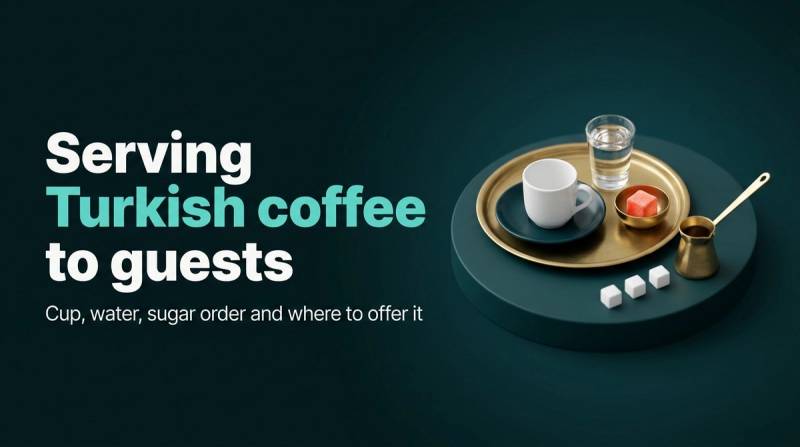
- The tray is fixed: a small warmed cup on a saucer, a glass of water served first, one small sweet and a napkin.
- Offer Turkish coffee only where someone can brew to order and clear within minutes, which rules out the buffet line.
- Cost the cup from weighed coffee, the sweet, the water, the washing and the minute of labor, and rinse the cezve instead of scouring it.
Turkish coffee service has a fixed order: ask the sugar level before brewing, brew each cup in a cezve, carry it with a glass of water and a small sweet, set the water down first, then the cup on its saucer. Offer it at the lobby welcome, after breakfast and in the spa.
A guest orders one Turkish coffee, the order reaches the bar without a sugar level, and the cup comes back. The fix is not a better cezve. It is a sequence that starts with one question and ends with a cleared tray. Serving Turkish coffee in a hotel is a training problem more than a product problem, and this article gives you the full sequence: the sugar question, the tray, the locations that work and the ones that do not, the cost per cup and a two-language staff card you can print today.
What is the correct order for serving Turkish coffee?
Sugar first, then brew, then water, then the cup. The order is fixed because each step depends on the one before it, and no step can be repaired at the table.
Ask the sugar level before the cezve goes on the heat. Sugar is stirred into the cold water and coffee at the start, so a cup brewed plain cannot be sweetened properly afterward. Brew to order, one cezve per cup or per round of the same sugar level, and never brew a batch and hold it warm: the grounds keep extracting and the cup turns bitter.
Bring the tray with the water and the sweet already on it. Set the water down first, then the cup on its saucer, from the guest's right. Pour slowly so the foam stays on top, and stop below the rim. A cup filled to the edge spills onto the saucer and reads as careless before the guest has tasted anything.
Say one sentence about the drink: the coffee is unfiltered, the grounds settle, so it is drunk slowly and the last sip is left. This prevents most complaints from first-time guests. Note the sugar level on the order slip with the table number and the time, so a second round and the bill match what the guest asked for. Clear the small cups separately from the water glasses: stacking them in one tub chips the rims and mixes the grounds into the glassware.
ChecklistPrint this sequence at the bar and at the floor station
- Greet and ask the sugar level
- Write table, sugar level and time on the slip
- Warm the cup with hot water
- Measure the coffee and water into the cezve
- Add sugar per the hotel's cube mapping
- Brew slowly and watch the foam
- Pour below the rim
- Place water, sweet and napkin on the tray
- Serve the water first, the cup second
- Say the grounds settle
- Clear within a few minutes of the guest finishing
How do you ask the sugar question in English?
Ask one question with four answers, plain, a little, medium or sweet, and write the answer down before the cezve moves. The Turkish words are sade, az şekerli, orta and şekerli.
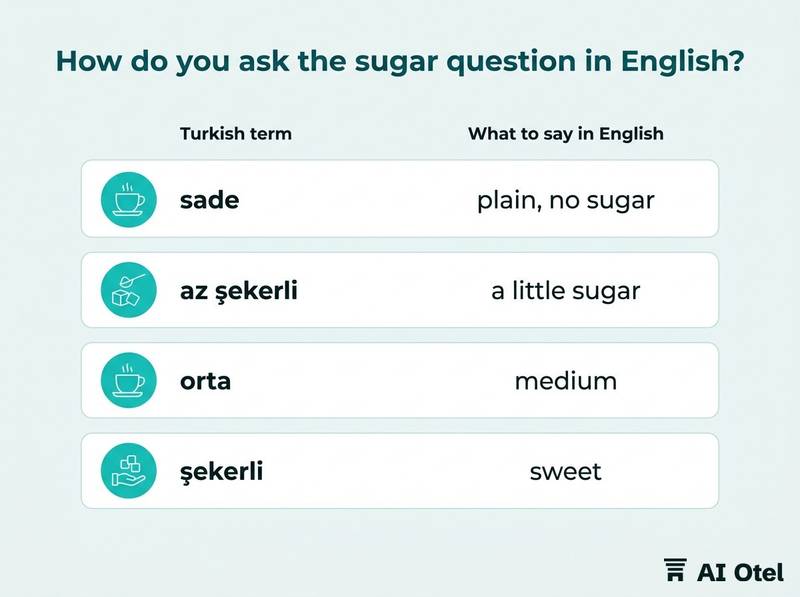
Do not ask how many sugars. A guest who answers one may mean one cube or one spoon, and the bar will guess. Offer the four words instead and repeat the answer back. Fix your own cube mapping and print it, so the bar and the floor give the same cup. A common mapping is none, one, two and three cubes for a small cup, but that is the hotel's rule, not a universal one, so write it as yours.
Ask at the moment of the order, before the guest settles, not after the tray is prepared. The question takes four seconds at the table and saves a whole cup at the bar. If a guest wants to add sugar at the table, brew plain and serve cubes on the saucer, and say so: cold sugar does not dissolve in a small cup the way it does in the cezve.
Use the same four words on the menu, on the order slip and in the staff card. Three vocabularies for four options is how orders drift. Train the phrase in both languages, so a Turkish-speaking runner can carry an English order to the bar without translating it twice.
| Turkish term | What to say in English | What the bar does | Note |
|---|---|---|---|
| sade | plain, no sugar | no cubes | some guests expect sugar on the side |
| az şekerli | a little sugar | one cube | the most misheard order, repeat it back |
| orta | medium | two cubes | the default in most Turkish orders, still ask |
| şekerli | sweet | three cubes | some guests want more on the saucer |
What goes on the tray: cup, saucer, water and sweet?
A small cup on its saucer, a glass of water, one small sweet and a napkin. Everything beyond that is a choice the hotel makes, and each choice adds a cost and a thing to wash.
The cup is small and sized to the cezve portion. Warm it with hot water before pouring so the coffee does not lose its heat on the way to the table. The cup sits on its saucer with the handle to the guest's right. A paper doily is optional and is the first thing to drop if the outlet is busy.
The water is a small glass, cool rather than iced, and it goes down first. It clears the palate so the first sip of coffee tastes of coffee. The sweet is one piece of lokum or a small chocolate on a side plate. Check what is in it before offering: nuts, gelatine and alcohol are the three questions guests ask, and staff should be able to answer without leaving the table.
A napkin and a small spoon for the sweet. The coffee itself needs no spoon, and putting one on the saucer invites guests to stir the grounds up. Nothing is added to the coffee at the table: no milk, no cream, no extra water in the cup.
Key pointWater first, coffee second
The glass is placed before the cup, not after, and never carried on a second trip. A tray that arrives with the coffee in front and the water behind has reversed the order the guest expects.
Where should you offer Turkish coffee: lobby, breakfast or spa?
Offer it where someone can brew to order and clear within minutes: the lobby welcome, the table after breakfast and the spa lounge. A buffet line is the one place it does not work.
Lobby welcome and the first ten minutes
The lobby has the highest visibility and the least control. It needs a station within sight of the desk, one person who can leave the desk for four minutes, and a written decision on whether the cup is complimentary or charged. The welcome sits inside the first ten minutes from the door to the room, and a well-timed cup fits that sequence better than a rushed one.
Breakfast service after the meal
Serve Turkish coffee at the table after the meal, as an included or a paid item. A cezve standing on a buffet holds, separates and cools, and the guest receives a cup that no longer tastes like the one you trained for. The wider question of a kettle in the room, a capsule machine or a lobby station shapes what guests expect from your coffee offer overall.
Spa and in-room: the two places to be strict
In the spa, serve a small cup, no sweet unless the guest asks, and give staff a clear instruction not to make health claims about caffeine in either direction. In-room, a kettle and a sachet is a different drink. If you offer Turkish coffee to the room, offer it as room service with the cezve on a tray, and collect the tray, or the corridor fills with cups. For the welcome itself, the welcome drink: what to serve and what it costs covers the choice in more detail.
Decide per outlet whether the cup is complimentary, on the menu or posted to the room account, and write it where the floor staff can see it. An offer that the bill contradicts costs more than the cup. Staff one trained person per shift per outlet, plus one backup who can brew. A station with a single trained person closes the moment that person takes a break.
| Location | Who brews | Equipment | Main risk |
|---|---|---|---|
| Lobby welcome | trained desk or bar person | one cezve station near the desk | the desk empties while one person brews |
| Breakfast | breakfast waiter | cezve station in the kitchen | coffee ordered early and arriving cold |
| Spa | spa attendant | small cezve at the spa bar | staff making caffeine claims |
| In-room | room service | tray with cezve, cups and sweet | trays not collected |
What does a cup cost, and how do you look after the cezve?
Cost the cup from the weighed coffee, the water, the sweet, the washing, the breakage and the minute of labor. Care for the cezve by rinsing it at once and never scouring the inside.
Build the cost per cup from six lines: coffee by weight, water, the sweet, the share of the cup and saucer replaced each year, detergent and hot water, and the labor minute. Add the station's share of rent and power only if you want a fully loaded figure. Weigh the coffee once and use that number everywhere. A level spoon varies with the grind and the hand, and a scale makes both the cost and the taste repeatable across shifts.
Rinse the cezve with hot water as soon as it is poured, then dry it upside down. Coffee residue left in the pot turns the next cup bitter before the first guest notices. Do not hold brewed coffee: a second cup is brewed, not poured from a pot that has been standing, and staff should be told this in one sentence.
Wash the small cups separately, dry them, and check the rims for chips before they go out. A chipped rim is the most common reason a guest sends the tray back. Log the cleaning of the cezve station and the descaling of any machine that heats the water, so the job survives a change of shift; a cleaning and descaling log for coffee equipment covers the format.
Watch outThe dishwasher and the scourer
A cezve washed in a machine comes out with a dulled interior and a soap edge that the next cup picks up, and a pot scoured with metal heats unevenly and scorches the foam. Rinse, dry upside down, and keep the pot out of the dish pit.
What should the two-language staff card say?
One laminated card, two columns, the same lines in Turkish and English, kept at the station where the order is taken. The card carries the sugar question, the four answers, the tray order and the one sentence about the grounds settling. Nothing else belongs on the front.
Keep it to phrases staff actually say out loud, not a vocabulary list. A card nobody reads aloud is a card nobody uses. Put the cube mapping on the back, with the outlet's charging rule, so one card answers both the bar's question and the floor's.
Test the card with one shift. If a runner cannot read a line aloud without stopping, the line is too long and gets rewritten, not memorized. Review the card when the menu, the outlet or the sweet changes, and date the back so the old version can be pulled. Keep a copy in the induction folder, so a new starter learns the sequence before the first guest rather than during it.
| Turkish line | English line |
|---|---|
| Türk kahvesi ister misiniz? | Would you like a Turkish coffee? |
| Şeker durumu nasıl olsun: sade, az şekerli, orta, şekerli? | How would you like it: plain, a little sugar, medium or sweet? |
| Suyu önce getiriyorum. | I am bringing the water first. |
| Kahve sade, yanında şeker getireyim mi? | The coffee is plain, shall I bring sugar on the side? |
| Kahve filtresizdir, telvesi dibe çöker, yavaş için. | The coffee is unfiltered, the grounds settle, so drink it slowly. |
| Hesaba mı işleyelim, oda hesabına mı? | Shall I put it on the bill or on the room account? |
What to do next
Write the sequence once: the sugar question, the four answers, the cube mapping, the tray order and the cezve care, on one two-language card, and print it for every outlet that offers the cup. Then stand at the bar for one service and watch where the card is ignored, because that spot is where the guest's cup is being spoiled. If your hotel takes orders and charges through software, the same logic applies to extras: the guest app, Built, ahead of launch, offers upgrades and extras before arrival and during the stay, and an accepted offer goes onto the bill, so the offer and its charge are recorded in one place; more on that in the guest app and the wider hotel platform. If you are a traveler rather than a hotelier, you can find a hotel in Türkiye (opens in a new tab) for your next stay.
Frequently asked questions
Is the water served before or after Turkish coffee?
Before, and on the same tray. The glass goes down first and the cup second, so the guest drinks water before the first sip. A second trip for the water reverses the order and cools the coffee.
How many sugar cubes is orta şekerli?
There is no single national count; the hotel sets its own mapping and prints it. A common mapping is none, one, two and three cubes for plain, a little, medium and sweet, but the important part is that the bar, the floor and the menu all use the same one.
Can we serve Turkish coffee in the guest room?
Yes, but as room service with a cezve on a tray, not as a sachet beside the kettle, which makes a different drink. Plan how the tray comes back, or the corridor collects cups.
Should Turkish coffee be on the breakfast buffet?
No. A cezve on a buffet holds, separates and cools, and the guest gets a cup that no longer matches the standard. Serve it at the table after the meal, either included or charged, and decide which in writing.
Do we need a separate cup for Turkish coffee?
Use a small cup sized to the cezve portion and warm it before pouring. An espresso cup can work if the volume matches the pot and the cup holds its heat, but the saucer, the water glass and the sweet should be the same set every time so the tray looks the same on every shift.