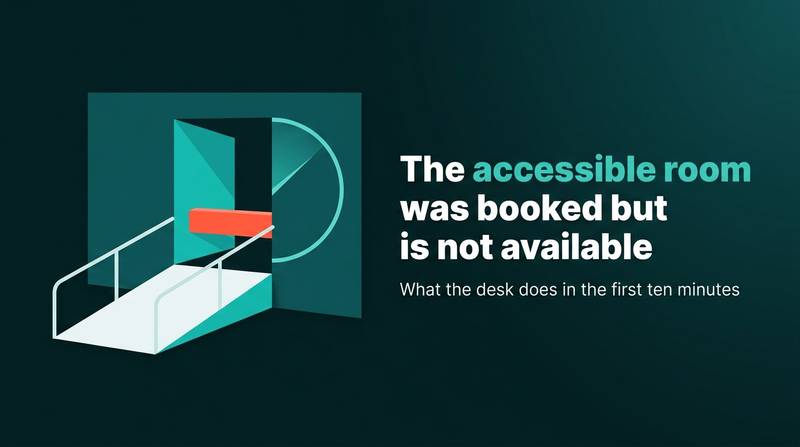
The accessible room was booked but is not available: what the desk does in the first ten minutes
When an accessible room is unavailable at arrival, the first ten minutes decide the guest's experience. This guide gives the desk the exact order of actions, the words to use, and the system rules that stop the next mismatch.
AI draft · awaiting editorial review
Contents
Key takeaways
- An accessible room is defined by its features, not its category: a higher room type without a roll-in shower and a step-free route is not an upgrade.
- Most mismatches come from three causes: the flag is a note rather than a block, an upgrade took the room, or the room went out of order after the booking was made.
- The desk's order is fixed: seat the guest, check the physical rooms, call a manager, then offer an equal room, a working route, a partner hotel.
- A promise the guest can keep on their phone is honored by the next shift; a promise made only at the desk is not.
- The flag holds only when the system refuses to assign the accessible room to a booking that does not carry it.
An accessible room is a room built with features such as a roll-in shower, grab bars and a step-free route. When it is not available at arrival, the desk seats the guest, checks every accessible room's real status, calls a manager, then offers an equal room, a working route, or a partner hotel, in that order.
It is 22:40. A guest arrives with a wheelchair. The booking says accessible room, the system shows that room occupied since yesterday, and the guest in it was upgraded there because it was the best room free that night. The next ten minutes decide what that guest remembers about the hotel. This article gives you the order of those ten minutes, the words to use, and the process changes that stop the next accessible hotel room not available at arrival from happening at all.
Why does an accessible room get lost between booking and arrival?
Almost always for one of three reasons: the accessible flag is a note rather than a block, an earlier assignment or upgrade took the room, or the room went out of order after the booking was made. Each one leaves a different trace on the desk screen, and each one has a different fix.
The flag often lives in the notes, not in the room. The reservation holds a room type, and the accessible feature is a sentence a person has to read. A sentence can be missed at two in the morning. Upgrade drift is the second cause: a guest is moved into the accessible room because it is the best room free that night, and the room is now held by someone who did not ask for it. Out of order is the third: a broken grab bar, a failed lift, a leaking shower tray. The room leaves sellable inventory, the reservation stays where it is, and nobody re-reads the arrivals list.
Two quieter causes sit behind these. Channel bookings can lose the flag entirely, because it travels as free text or not at all, and a rate sold as accessible on a third-party site may not map to a physical room in your system. Group and allotment blocks release rooms late, and the accessible room inside the block goes to whoever books first. Underneath all of it, nobody owns the arrival day: rooms are assigned automatically the night before, and no person compares the flagged list with the rooms that actually exist and work.
| Cause | What the desk sees at arrival | Prevention |
|---|---|---|
| Flag stored as a note | A room type but no accessible room | Make the flag a hard block on assignment |
| Upgrade drift | The room is occupied by a guest who did not request it | Exclude accessible rooms from upgrade and best-available logic |
| Out of order | The room is blocked in housekeeping but the reservation was never touched | Open a re-accommodation task on every affected booking |
| Channel booking without the flag | The reservation shows no requirement | Map the flag per channel; check by hand where it cannot travel |
| Group block released late | The room is gone to another booking | Protect the accessible room inside the block until release |
What happens in the first ten minutes?
The guest comes first, the room list second, and a manager third. Nothing is explained before there is an option to offer.
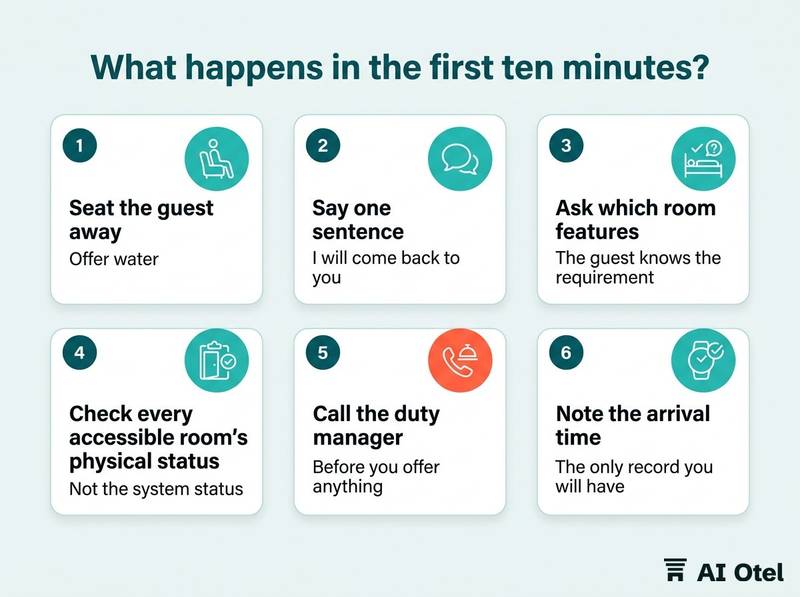
Seat the guest away from the queue, offer water, and say one sentence: I am checking this now and I will come back to you in a few minutes. Do not open with the cause. Then ask one question, not five: which features the guest booked and needs. A roll-in shower, grab bars by the toilet, a door wide enough for the chair, a connecting room for a carer. The guest knows the requirement better than the booking does.
Check the physical state of every accessible room, not the system status: the housekeeping board, the out-of-order list, departures due today, and rooms blocked for maintenance. Call the duty manager before you offer anything. A room move, a partner hotel and transport are manager decisions, and the desk should not promise what it cannot deliver. Test whether a room can be made ready: a departure that can be cleaned early, a repair that takes an hour. Give the guest a time, not a hope.
Write down the arrival time and the time you answered. It is the only record you will have if the conversation goes wrong later. For the wider picture on moving guests between rooms, see room change requests and when to move a guest.
ChecklistThe first ten minutes, in order
- Seat the guest away from the queue
- Say one sentence and give a time to return
- Ask which room features the guest needs
- Check every accessible room's physical status, not the system status
- Call the duty manager
- Check whether a room can be made ready, and by when
- Note the arrival time and the time of the answer in the reservation
Which option do you offer first?
An equal room in the same hotel, then a room whose route works, then a partner hotel. That order is decided before the guest arrives, not in front of them.
Equal means the features, not the category: a roll-in shower, grab bars, a step-free route, a door the chair fits through. A higher category without those is not an upgrade, it is a downgrade with a better view. Check the route, not only the room: the lift, the corridor width, the door threshold, the distance from the lift. A perfect bathroom at the end of a carpeted corridor with a raised threshold is not usable.
Another floor is a real option only when the route works. Say what changes, a longer walk or a different lift, and let the guest judge whether it works for them. A partner hotel is a real option only if there is an agreement, a confirmed accessible room and transport you arrange. Improvising this at eleven at night fails, and the guest pays for the failure. If nothing works, say so early. A guest who can call their own alternative at eight in the evening has options; at midnight they do not. For how to audit the rooms and routes themselves, see the accessible hotel checklist for rooms and routes.
| Option | Check before you offer it | Who decides |
|---|---|---|
| Equal room in the same hotel | Booked features and route confirmed on the floor | Duty manager confirms the room |
| Another room with a working route | Lift, corridor, threshold and door width checked | Duty manager with the guest |
| Partner hotel | Written agreement, confirmed room, transport arranged and paid under the hotel's rule | Duty manager and general manager |
| Nothing available tonight | The guest is told early enough to arrange their own alternative | General manager |
What do you say to the guest, and what do you offer?
One sentence of fact, one sentence of option, one question about what the guest needs. No excuses, and no blaming a colleague, a channel or the system.
Say what happened in plain words: the room you booked is not usable tonight, I have two options and I need five minutes to confirm the second one. Apologize for the hotel's failure, not for the guest's disability. The guest is not a problem to be managed. Ask, do not assume: what do you need in the room? A guest may travel with a carer, use a shower chair, or need the bed height they booked.
Offer something concrete and inside your authority: the equal room, the transport, the partner room, help with luggage, a late checkout. Keep money out of the first ten minutes; it is a manager conversation, not a desk improvisation. Put the promise in writing, in a message the guest keeps on their phone, so the evening shift and the morning shift honor the same thing. A confirmation the guest can show is stronger than a sentence at the desk. Record the conversation in the reservation: what was offered, what was accepted, who approved it, at what time. If your hotel gives guests an app of their own, the written promise can travel through the hotel's own guest app, built and working ahead of launch, where the guest can see their bill and requests. For the wording itself, see the words to use when serving guests with disabilities.
TipSay this, not that
Use: the room you booked is not usable tonight; here are two options; I will confirm the second one in five minutes; what do you need in the room; I will put this in writing now. Avoid: unfortunately we have a problem with your room; the system would not let us; the guest before you refused to move; are you sure you booked it as accessible; we will see what we can do.
How do you make the booking flag hold?
Turn the flag from a note into a rule the system enforces: the accessible room cannot be sold or assigned to a booking that does not carry it. This is the single change that removes most of the causes in the table above.
A hard block on assignment means the system refuses to give the accessible room to a booking without the flag, and refuses to confirm a flagged booking without a physical room number. Exclude accessible rooms from automatic upgrades and from best-available logic: the room exists for a requirement, not for a revenue decision made at midnight. Out of order must do two things at once: take the room out of inventory and open a re-accommodation task on every affected reservation, with a person's name on it.
Map the flag on every channel: your own website, agencies, booking sites. Where a channel cannot carry it, the reservation is checked by hand before arrival. Name one owner per arrival day, a person who signs off the flagged arrivals against the physical rooms before the evening. Write the rule down and put it in the front office briefing. A rule that lives in one person's memory leaves the building when they do. A hotel operating system, built and working ahead of launch, that enforces rules in the reservation flow rather than relying on notes, is one way to make the block hold; the principle matters more than the software.
Key pointThe one rule
The accessible room can only be assigned to a booking that carries the accessible flag, and a flagged booking is not confirmed until a room number and a working route are attached to it.
What does the weekly check look like?
Once a week, take the next two weeks of flagged arrivals and match each one to a physical room and a working route, while there is still time to fix what does not match. Fifteen minutes with two exports prevents most of the incidents described above.
Pull the flagged arrivals for the next fourteen days and the list of accessible rooms with their housekeeping and out-of-order status. Match every booking to a room number: a flagged booking without a room number is a front-desk incident waiting for a date. Walk the route yourself: lift, corridor, door, bathroom. Check the room as it is, not as the floor plan says it is.
Compare the out-of-order list with the arrivals. A room out for two weeks with three bookings behind it is a problem you can solve this week. Check upgrades and group blocks for the same period, because that is where the room usually goes. Keep a short log: what was found, who fixed it, when. It is the only evidence that the process works between one manager and the next.
ChecklistWeekly check
- Export flagged arrivals for the next fourteen days
- Export accessible rooms with housekeeping and out-of-order status
- Match each booking to a room number
- Walk the route for each matched room
- Compare out-of-order rooms against arrivals
- Review upgrades and group blocks
- Log findings, owner and date
What to do next
Write the one-page rule and the ten-minute checklist this week, then put the weekly check in a calendar with a name against it. The parts fit together in that order: the first ten minutes protect the guest in front of you, and the flag and the weekly check make sure the next guest never needs those ten minutes. The rule also covers guests whose needs are not about mobility: guests who are deaf or blind face their own arrival risks, and the same owner and the same weekly check can cover them too. If you are reading this as a traveler rather than a hotelier, you can search for a place to stay in Türkiye (opens in a new tab) and check the room features with the hotel before you book.
Frequently asked questions
Can we move the guest who is already in the accessible room to free it?
Only with that guest's agreement, and only after checking whether they need the room's features. Moving a guest who needs them creates the same problem one floor up. If the guest in the room does not need the features, ask, explain why, and make the move easy for them.
Should we tell the guest before arrival that the room is not available?
Yes, as soon as it is known. A guest who learns at the airport can replan the trip; a guest who learns at the desk cannot. The message should carry the option, not only the problem, and should be in writing so the guest can keep it.
What if the booking came through an agency or a booking site without the accessible flag?
The hotel still owns the arrival. Read the reservation notes, call the agency or the guest directly, and treat an unclear requirement as a requirement until a person confirms otherwise. After the stay, fix the mapping for that channel.
Who decides between a room change and a partner hotel?
The duty manager, together with the guest. The desk presents the options and the time each one takes; the guest chooses. The general manager sets the rule in advance, including who pays for transport and what the partner hotel must confirm before the offer is made.
Does an accessible room have to be held empty until arrival?
That is the hotel's own rule to write and publish internally. The practical version is that the room is only assigned to a booking that carries the flag, and that a flagged booking is not confirmed without a room number. Whether to hold the room unsold on a quiet night is a commercial decision the hotel makes and writes down.