The costs a new hotel owner forgets: replacement cycles, small recurring bills and the cost of empty rooms
Hidden hotel costs like replacement cycles and recurring bills often miss first budgets. Learn to track them with a one-page register that turns surprises into scheduled decisions.
Contents
Key takeaways
- A cost belongs in the operating budget if it will happen again while you own the building, even when it arrives only every few years.
- An empty room saves only the cost of cleaning and serving it; the rest of the hotel runs anyway, and the night itself is lost for good.
- A deferred replacement is not a saved cost: it is the same cost moved to a date you did not choose, usually in high season.
- Every recurring bill needs a renewal date, an owner inside the hotel and a notice period, or it renews by default for another year.
- One page, three cost groups and one named owner per line turn a surprise into a decision you can read with the owner every quarter.
Hidden costs of running a hotel are the expenses a first budget leaves out: items that wear out on a replacement cycle, small bills that renew all year, and fixed costs that run whether or not rooms sell. None of them appears as one line, so each needs a written trigger, a date and an owner.
The purchase price is the number everyone negotiates, and the number the seller can explain. The costs that decide whether the hotel actually works arrive later, in ones and twos, on dates nobody wrote down. After reading this you will be able to sort every cost your hotel carries into three groups, know what record to keep for each, and put one page in front of the owner that turns those surprises into scheduled decisions.
Why do first hotel budgets miss costs?
A first budget is built from the purchase price and the monthly bills someone can already name. The costs that hurt are the ones that arrive on a cycle, renew quietly, or never appear as a line at all.
A budget assembled from the seller's figures lists invoices that already exist: staff, electricity, water, maybe a marketing line. It cannot list what nobody has been billed for yet. The mattress run in year six, the lift inspection that comes due, the channel manager that renews per room each month: none of these has an invoice to copy on day one.
Before arguing about amounts, sort every cost into three behaviors: things that wear out on a cycle, small bills that repeat all year, and costs that run whether or not rooms sell. Each behaves differently when cash is tight, so each needs a different control. The common mistake is filing a recurring cost as one-off. A roof, a boiler or a mattress run is a project on the day it happens and an operating cost across the years it covers.
The decision rule is simple: if the cost will happen again during the time you plan to own the hotel, it belongs in the operating budget, divided across the months between now and then. A buyer of an existing building can ask for the maintenance history and the last two years of supplier invoices. A first owner of a new build has no history, so the register starts from the asset list instead.
One more fact shapes everything else: the night is the product, and it expires at midnight. That single fact is why an unsold room is a different kind of loss from unsold stock in a warehouse. If you are still building the basic model, start with how room count turns into monthly profit in five lines; this article covers the lines that model usually forgets.
What wears out on a cycle in a hotel?
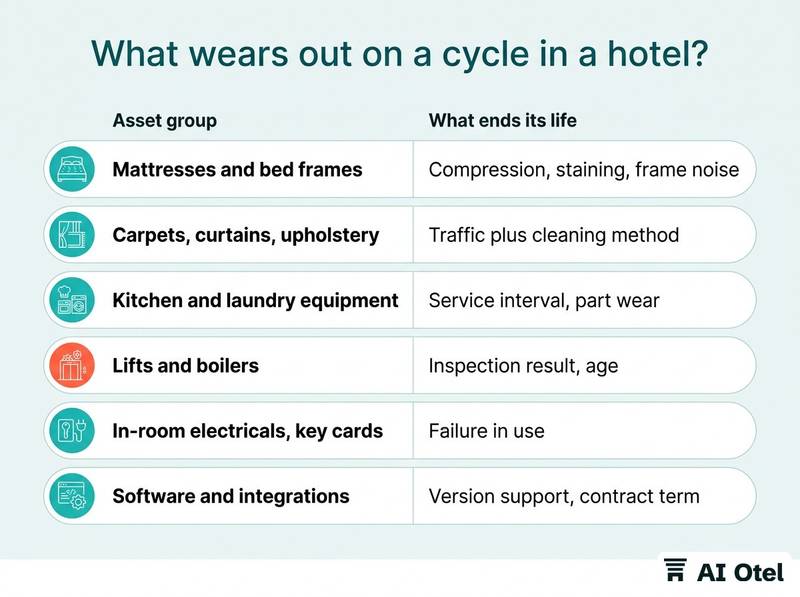
Everything a guest touches has a life measured in washes, sittings, cycles or software versions. The replacement is predictable even when the exact date is not.
Beds, soft goods and hard equipment
Beds and mattresses wear according to quality, protector use and how many guests sleep on them. The trigger is condition: compression, staining, a frame that creaks. Record the purchase date, the model and the room number for every one, so replacement is a lookup, not an argument. The same logic applies to choosing them in the first place, as covered in choosing hotel beds and mattresses and when to replace them.
Carpets, curtains and upholstery are shortened by the cleaning method as much as by traffic. A cleaning cycle is a cost decision, because doing it on time moves the replacement date later. Hard equipment is different again: for boilers, lifts, laundry machines and kitchen equipment, service intervals and spare-part lead times matter more than the purchase price, because a stopped laundry stops rooms from selling.
In-room electricals and small items, kettles, hairdryers, safes, televisions, key cards, fail in ones and twos. They belong in a standing replacement allowance rather than a project, because no single one justifies a budget line but the stream never stops.
Software has a replacement cycle too
Software wears out as versions, licenses and integrations. Licenses renew, integrations change, and a system that stops being updated turns into a security and compliance cost. Ask what the exit looks like before you sign: can you export your data, and in what format. A system you cannot leave cleanly is a cost that grows at every renewal.
For each group, write the condition that ends its life and the check that detects it, so replacement is decided by evidence rather than by the loudest complaint.
| Asset group | What ends its life | Record to keep |
|---|---|---|
| Mattresses and bed frames | Compression, staining, frame noise | Purchase date, model, room number |
| Carpets, curtains, upholstery | Traffic plus cleaning method | Install date, cleaning dates, method |
| Kitchen and laundry equipment | Service interval, part wear | Service log, spare-part lead time |
| Lifts and boilers | Inspection result, age | Inspection dates, service contract |
| In-room electricals, key cards | Failure in use | Annual replacement allowance, failure log |
| Software and integrations | Version support, contract term | Renewal date, notice period, export format |
If you have not counted the assets themselves yet, a hotel fixed asset list by room, lobby and kitchen is the starting point for every row in the table above.
Which small bills repeat all year?
The small bills are small once and large twelve times, and they escape the budget because each one is approved on its own by someone different.
Software subscriptions are the clearest case: the property system, channel manager, booking engine, review tools, accounting and payroll. Each renews on its own date, often per room or per module, and each has its own notice period. Licenses and permissions follow: music and broadcast licensing in public areas, the alcohol license, pool and beach permissions, elevator and pressure-vessel inspections, fire equipment checks, pest control.
Testing and inspection bills are small invoices with large consequences when skipped: water hygiene, pool water chemistry, kitchen hygiene, electrical safety, gas installations. Consumables that scale with guests, amenities, laundry, breakfast, cleaning chemicals, key cards, printing, look variable, but the standing order and the minimum stock level are fixed commitments. Payment and banking costs, terminal rental, a charge on each transaction, chargebacks, scale with revenue and hide because they net off before the money reaches the account.
The rule that makes them visible: every recurring bill gets a renewal date, a named owner inside the hotel and a notice period. A bill you cannot cancel in time is a bill you pay for another year. Review the list once a year as a set, not one invoice at a time, because the total is what changes the budget and each item alone looks harmless.
ChecklistFor every recurring bill, record
- What the bill is for
- The supplier
- The amount and how it is calculated (per room, per module, per month, per transaction)
- The renewal or invoice date
- The notice period to cancel
- The person inside the hotel who owns it
- Where it sits in the budget
- Whether the contract allows data export or handover at exit
What does an empty room cost?
An empty room still carries its share of everything that does not move with occupancy, and the night itself is lost for good. Only the cleaning-and-serving part is actually avoided.
The three behaviors of a hotel cost
Split costs by behavior, not by department. Some costs follow the guest: cleaning, laundry, breakfast, amenities. Some follow the building: base utilities, minimum staffing, some maintenance. Some follow the business: insurance, licenses, software, financing, management.
Key pointThe three cost groups
Costs that follow the guest disappear when a room stays empty. Costs that follow the building and costs that follow the business do not. Only the first group is saved by an unsold room.
The perishable night is the other half of the answer. Inventory expires at midnight and cannot be stored, which is why a rate that covers the per-guest cost plus something is better than an empty room, provided it does not take a room from a guest who would have paid more. The loss never appears on a line called empty room. It appears as a lower occupancy rate and a higher cost per occupied room, which is the number that makes it visible: the same fixed base is divided across fewer sold rooms even though total spending barely moves. Before approving any discount or group, ask which costs the booking actually adds, and which rooms it displaces on the same nights. For the full breakdown, see cost per occupied room, line by line.
Is it cheaper to fix late or on schedule?
On schedule, almost always. A deferred replacement is not avoided; it is moved to a date you do not choose, at a price you do not set.
Deferral moves a cost from a planned month to an unplanned one, usually in high season, and adds the workaround: a room out of order, an emergency call-out, a guest moved to another property. Failures also cascade. A skipped protector change leads to stained mattresses. A skipped carpet clean leads to replacement. A skipped service leads to a failed machine and a stopped laundry.
The cash-flow argument is real, so the answer is not "spend now". The answer is to know the date in advance, so a deferral is a recorded decision with a new date and a named owner, not a silent one. Keep a short condition check: one walk-through per room each quarter with a written note on beds, soft goods and equipment. Replacement then follows evidence, not a complaint. The same logic applies to cleaning and servicing, which are cheap on a cycle and expensive when compressed into a rescue.
Watch outThe most expensive deferral
The most expensive version of a deferred cost is the one a guest discovers first, because it arrives with a refund, a room move and a public review attached, and it still has to be fixed.
How do you build a one-page hidden-cost register?
One page, one row per item, three cost groups, and for each row a trigger, a date and a named owner. If it needs scrolling, it will not be read.
Start from the fixed asset list, not from memory: walk the building room by room and write down what is there and when it was bought or installed. Add every recurring bill with its renewal date and notice period, taken from the contract rather than from the last invoice. Add the per-hotel fixed costs with their annual dates: insurance, licenses, inspections, software renewals, financing payments.
For each row, write the trigger that starts the spend: a date, a condition found in the quarterly check, or a volume such as guest nights. Name one owner per row. A cost with two owners has none, and a cost with none is discovered by the accountant at year end.
The columns that make it work
ChecklistThe register's columns
- Item
- Cost group (wears out on a cycle, repeats all year, runs on empty rooms)
- Trigger (date, condition or volume)
- Next date
- Owner
- Where the money sits (budget line or reserve)
- Note from the last check
The build steps: walk the building with the asset list; add contracts and their notice periods; add annual fixed dates; assign one owner per row; set the review date in the calendar. Keep the register as a decision tool next to the budget, not as an accounting record. It does not replace the ledger; it tells you what is coming before the ledger does. Decide once a year how the cycle costs are funded, so the reserve is not renegotiated every month when cash is tight.
How should you read it with the owner each quarter?
Once a quarter, in one sitting, against the bank statements rather than against the plan. The disagreement between the owner and the manager is the useful part of the meeting.
The agenda is four questions: what came due, what was deferred and why, what is due next quarter, and what new recurring bill appeared since the last review. Compare the register with the actual statements. A cost that appears in neither is a cost nobody owns, and it will surface as a surprise.
Owner and general manager read the same page. Where they disagree about a deferral, write the decision and the new date on the page. Set the funding decision for cycle costs once a year, at the same meeting, so it is a policy rather than a monthly argument.
The register is also the handover document. A new manager or a new owner inherits dates and owners instead of rediscovering the building. Keep the meeting short and the page unchanged between quarters, so progress is visible as rows that moved rather than as a new format each time. A hotel that wants to see how software treats the rest of the work can look at how a hotel operating system keeps reservations, front desk, housekeeping, billing, restaurant sales, reports and compliance in one place, which is built and working, and at OtelCiro, the ecosystem's hotel growth and consultancy arm, for the commercial questions this register feeds. The asset and contract register itself stays a spreadsheet or a separate record.
What to do next
This week, walk the building with the asset list in hand and write the first version of the register: one page, three cost groups, one owner per row. Then put the quarterly review in the calendar with the owner. The three groups fit together because they answer the same question from different sides: what will happen again, what renews quietly, and what runs whether or not a room sells.
Frequently asked questions
What is a replacement reserve and how much should a hotel set aside?
A replacement reserve is money set aside during the years between replacements so the bill does not land on one month. The amount comes from the hotel's own asset list, the expected life of each item and its replacement cost, not from an industry percentage. Ask your accountant how to hold and label the reserve.
Are hotel software subscriptions a fixed or a variable cost?
Mostly fixed: they renew on a date whether or not rooms sell, often priced per room or per module. Treat each one as a recurring bill with a renewal date, a notice period and a data export question. A system you cannot leave cleanly is a cost that grows at renewal.
How do I work out what an empty room really costs me?
Split your costs into those that follow the guest, those that follow the building and those that follow the business. An empty room avoids only the first group. The visible measure is cost per occupied room, which rises when occupancy falls because the same fixed base is spread over fewer sold rooms.
Should I delay replacing mattresses to protect cash flow?
Sometimes, but as a recorded decision with a new date, not as a silent one. Weigh the guest complaint, the extra cleaning, and the risk of the replacement arriving in high season at an emergency price. Let the quarterly condition check, not the cash balance alone, set the date.