The hotel waste room: bins, sorting, collection times and a monthly count
A hotel waste room works when each stream has its own bin, route and collection time. This guide explains layout, labeling, hygiene checks and a weekly weighing sheet to track waste by department.
Contents
Key takeaways
- A waste room is a routing problem before it is a storage problem: every stream needs its own bin, its own color and its own way out of the building.
- Color alone does not sort waste; a pictogram and a word in the languages your team actually speaks do.
- Weigh every bin at the door, per stream and per source, or the monthly count cannot tell you which department changed.
- The night shift is the shift that meets the contractor, so the night shift needs the written rule, the walk-through and the name of a person to call.
- Smell and flies in a waste room are a drainage and closure problem before they are a spraying problem.
A hotel waste room is the single, closed room where every waste stream waits between collections: food, mixed residual, paper and cardboard, glass, metal, used cooking oil and small hazardous items. It works when each stream has its own labeled bin, a fixed route in, a fixed collection time and a weekly weight on a sheet.
The bags are stacked by the service door because the truck came two hours early, the bin store smells by Thursday, and nobody can say which department's waste grew last month. This is what an unmanaged hotel waste room looks like, and none of it is a budget problem. After reading this guide you will be able to lay out the room as a one-way flow, label bins so a new starter sorts correctly on the first night, set round times that match the collection window, and run a weekly weighing sheet that tells you where waste rises.
What actually goes in a hotel waste room?
A hotel produces several distinct streams, and each one needs its own container in the room. Mixing them at the point of production is what makes the room smell, the recyclables worthless and the monthly count unreadable.
Name the streams by where they are produced, not by material alone: kitchen food, kitchen packaging, bar glass, room residual, room paper, garden green waste, delivery cardboard, and the small hazardous items that must never enter a general bin. Food waste is wet and heavy and starts to smell within hours, so it gets the smallest bins, the most frequent round and the coolest corner of the room.
Used cooking oil is a liquid stream with its own container, its own sealed drums and its own paperwork; it never goes into a general bin or down a drain. Small hazardous items, meaning batteries, lamps, aerosols, half-empty chemical containers and anything sharp from a guest room, go into a closed, labeled, locked container that only a named person opens. Cardboard from deliveries is the stream that grows fastest and takes the most space; flatten it at the loading bay, not in the room.
Every stream needs a named owner in the hotel: the kitchen for food and oil, housekeeping for floors, technical service for the room itself and for hazardous items, and the garden team for green waste. If a stream has no owner and no container, it ends up in the residual bin, and the residual bin is the one the hotel pays for twice: once to buy and once to dispose of.
| Stream | Where it comes from | Container in the room | Where it goes next |
|---|---|---|---|
| Food and organic | Kitchen, buffet, outlets | Small lidded bins, coolest corner | Licensed food waste or composting service |
| Mixed residual | Rooms, floors, public areas | Closed wheeled bin | Local collection or contractor |
| Paper and cardboard | Offices, deliveries | Flat-stacked cage or bin | Recycling contractor |
| Glass | Bar, restaurant | Rigid bin, no overfill | Glass recycling service |
| Metal and tins | Kitchen, bar | Small rigid bin | Metal recycling service |
| Used cooking oil | Kitchen fryers | Sealed drums, bunded | Licensed oil collector |
| Small hazardous items | Maintenance, rooms | Locked, labeled cabinet | Licensed hazardous waste service |
| Garden green waste | Grounds | Open ventilated bin | Green waste service |
For the oil stream, the contract, the drums and the records each carry duties of their own: see used cooking oil collection in hotels.
How should the waste room be laid out?
Lay the room out as a one-way flow: dirty waste enters through one door, the collection truck takes it from the other side, and nothing crosses back over clean bins. The room is sized for one day of buffer plus the empty containers that replace what leaves.
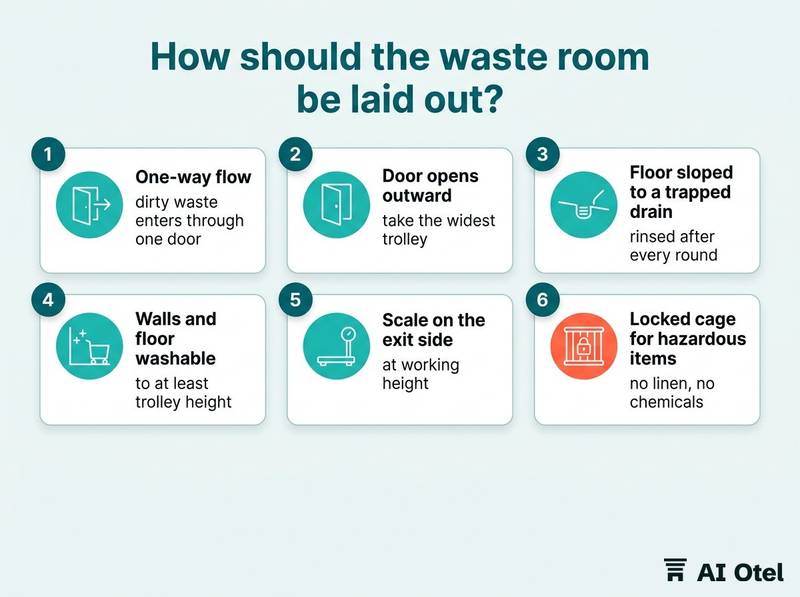
Position the room so the route from the kitchen and the service lift is short and does not pass a guest area, a food store or a pool deck. The door must take the widest trolley the hotel uses and open outward; a room that needs two people to maneuver a bin gets used badly at 2 a.m. Slope the floor to a trapped drain and fit a washdown tap and hose reel, so the floor can be rinsed after every round rather than once a day.
Walls and floor should be washable to at least trolley height; bare plasterboard and untreated wood hold odor and give pests somewhere to live. Put the scale on the exit side of the door, at working height, so weighing is part of leaving the room rather than a separate job somebody skips. Reserve floor space for one extra day of waste, because a missed or early pickup is normal and the alternative is bags on the street.
Keep a locked cage or cabinet for hazardous items, and keep everything that is not waste out of the room: no linen, no spare furniture, no chemicals, no staff belongings.
ChecklistBefore the room is signed off, answer each of these yes or no
- Door wide enough for the largest trolley
- Door opens outward and self-closes
- Floor sloped to a trapped drain
- Washdown tap and hose reach every corner
- Walls and floor washable
- Working light at bin height
- Extraction or louvered vent
- Scale fixed at the exit
- Space for one day of buffer
- Space for empty clean bins
- Locked hazardous container
- Pest-proof door seals
- Signage at eye height
- Nothing stored that is not waste
The floor trap and the drain matter as much as the bins: what happens to washdown water is covered in grease traps in hotel kitchens.
What colors and labels should hotel waste bins carry?
One color per stream, chosen by the hotel and written down, with a pictogram and a word in two languages on the lid and on the wall above the bin. The scheme matters less than its consistency across every floor, kitchen and back corridor.
Color alone fails: a new starter, a color-blind team member or a contractor at night cannot sort by shade, so every bin also carries a picture of what goes in and one of what does not. Label in Turkish plus the language most of the kitchen and housekeeping team actually speaks at work, and keep the same two languages on every bin in the building.
Use identical bins for the same stream everywhere; if the fourth floor has a different bin from the kitchen, the sorting rule quietly stops being a rule. Put the label on the lid and repeat it on the wall above the bin, because lids get swapped and walls do not. Post a mapping chart in the room when the contractor's own container labels differ from the hotel's colors, so nobody has to guess at the moment of handover. Label the collection point as well as the bins, so a relief driver or a new crew knows which container leaves and which stays.
TipThe label test
Hand a new starter one closed bag from each stream and ask them to name the stream and put it in the right bin without asking a question. Any hesitation means the label, not the person, has failed, and the label is what gets fixed.
When is hotel waste collected, and who carries it?
Run fixed rounds at fixed times, tied to service ends rather than to convenience, and give each round one named carrier and one route that avoids guests. The room then receives waste in a predictable rhythm and empties before the contractor's window opens.
Three internal rounds cover most hotels: after breakfast service, after dinner service, and one night round for room floors and bars; a fourth handles garden and delivery cardboard. Route every round through service corridors and the service lift, with closed carts; a bag carried through the lobby undoes a year of guest-facing work in ten seconds.
Match the last internal round to the collection window the hotel's contractor or local collection service gives, so the room is as empty as possible when the truck arrives. The night team usually meets the contractor; give that shift the keys, the handover sheet and the phone number, not just the instruction. Sign a short handover at each pickup: date, time, streams taken, containers returned, anything refused and why.
Never stack bags outside the room to wait; if the buffer is full, the round times are wrong or the pickup window has moved, and that is a conversation with the contractor. Keep the room locked between rounds and record who holds the key on each shift.
| Round | Time | Route | What leaves the building |
|---|---|---|---|
| After breakfast | (fill in) | Kitchen via service corridor | Nothing yet, room fills |
| After dinner | (fill in) | Kitchen and outlets via service lift | Nothing yet, room fills |
| Night round | (fill in) | Floors and bars, service lift | Nothing yet, room fills |
| Garden and cardboard | (fill in) | Loading bay and grounds | Nothing yet, room fills |
| Contractor pickup | (fill in) | Truck at the waste room door | Streams taken, handover signed |
How do you stop the waste room smelling and attracting pests?
Wash and dry the room after every round, keep every lid closed and every door sealed, and check the drain and the fly monitors daily. Odor in a waste room is usually wet cardboard, an open lid or a dried-out floor trap, not the waste itself.
Rinse the floor and the outside of the bins after each round, then dry: a wet floor plus cardboard is the smell, and a dry room smells of very little. Keep the floor drain trap wet and clean, and check it weekly; a dry trap lets sewer air back into the room. Close every lid and never prop the outer door; fit seals and a self-closing mechanism, and treat a propped door as a fault to report, not a habit.
Put sticky fly monitors in the room, date them and check them on a fixed day; a rising catch is a signal about closure and drainage, not a reason to spray near food. Ask the pest contractor to place and sign monitoring points inside the waste room and on its outside wall, and read those points with them, not for them. Keep the room as cool as the building allows and never store waste in the kitchen overnight; a bag left by the back door is a night's worth of flies.
ChecklistGive one person five minutes a day with a short check sheet, and have a supervisor sign it weekly
- Floor washed and dried after each round
- Bin interiors washed on a rota
- All lids closed
- Drain trap wet and clean
- Fly monitors dated and checked
- Pest monitoring points present and signed
- No waste left in the kitchen or by the back door
- Door seals intact
- Extraction running
- Daily sheet signed by the shift
Spraying is the last step, not the first: how to choose and supervise pest control in hotels is a topic of its own.
What should a weekly waste weighing sheet record?
Record the date, the stream, the source department, the net weight and who weighed it, every time a container leaves the room. Sum the sheets at month end and you have a count that points at a department and a week, which is the only kind of count anyone can act on.
Weigh at the door with one scale, and subtract the empty container weight so the number is net; gross weights drift as bins are replaced. Record the source as well as the stream: kitchen, floors, each food and beverage outlet, garden, deliveries. A stream total tells you what changed; a source tells you where.
Divide by a volume measure that matches the source, such as occupied rooms for floors and covers for the kitchen, so a busy week does not read as a wasteful one. Read the sheet for change, not for a target: a stream that rises in a week when the volume measure stayed flat is the question to ask on Monday.
Keep one sheet per week on the wall of the room, filled in by hand, and let the monthly count be the sum of four or five sheets rather than a separate exercise. Hold a short monthly meeting with housekeeping, the kitchen and technical service, bring the sheets, and agree one change for the following month. Treat the first month as a baseline with no target at all; a target set before the hotel knows its own pattern gets argued with instead of used.
| Date | Stream | Source | Net weight and note |
|---|---|---|---|
| (blank) | (blank) | (blank) | (blank) |
| For example | Food | Kitchen | Higher than last week while covers were flat: check portioning at the buffet |
For the kitchen's biggest stream, the method matters as much as the sheet: measuring buffet food waste against covers explains the volume measure that keeps the comparison honest.
How do you train the night team and the waste contractor?
Give every shift a one-page written rule in two languages and a twenty-minute walk-through in the actual room, then test them on it. Training that happens in a meeting room does not survive the first busy night.
The one-page rule states the streams, the color and label for each, the round times, the route, what must never go in a bin, and the name and number to call when something is wrong. Walk each new starter through the room itself, opening the bins, naming the streams and showing where the scale and the handover sheet are. Use the label test at the end of the walk-through, and repeat it after any change to a stream or a container.
Induct the contractor's crew once, in writing: where they may go, which containers leave, what they sign, and who they call if the room is locked or a container is missing. Name an owner per shift on the staff board, so the room has a person rather than a department. Supervise the first week after any change, and expect the sorting to be worse before it is better.
NoteWhat the one-page rule contains
The stream list, the color and label for each, the round times and routes, the collection window, the handover signature, the list of items that must never enter a general bin, the key holder per shift, and the escalation name and number. Written in Turkish and in the second language the team uses at work.
What to do next
Put a scale by the waste room door this week and start the sheet with the next collection. The layout, the labels, the routes and the training all exist to make that sheet readable, and the sheet is what turns a room full of bins into a decision about a kitchen, a floor or a delivery bay.
If you want the same discipline in the rest of the back office, a hotel operating system can hold the routine work in one place, and the wider platform overview shows how the pieces connect.
Frequently asked questions
How often should hotel waste bins be emptied?
Kitchen food bins at least once per shift and never left overnight in a food area; floor bins at the end of each housekeeping round; the room itself emptied to the contractor within the collection window. The hotel's own written rule should state the times, and the round sheet should show they happened.
Can food waste go in the same bin as packaging?
No. Food contaminates paper and cardboard and makes the dry stream worthless, and it makes the bin smell within hours. Separate at the point of production, in the kitchen, with a small food bin at every station.
Should a hotel weigh waste daily or weekly?
Daily is better if the scale sits at the door and takes seconds; weekly is the minimum that still shows a trend. Either way the monthly count is the sum of the sheets, not a separate weighing exercise.
Who should be responsible for the hotel waste room?
One named person overall, usually in technical service, plus one named person per shift. A room owned by everyone is cleaned by no one, and the handover sheet needs a signature from a specific person.
What should a hotel do when the waste contractor misses a pickup?
The room needs a buffer of one extra day so a missed pickup is inconvenient rather than a crisis. Call the contractor, log the time and the reason on the handover sheet, and never stack bags outside the room to wait.