The real cost of an empty room night and a no-show: the sum for your hotel
An empty room night costs the contribution you did not earn, not the full rate. Learn to sort fixed and variable costs, value a no-show honestly, and set a floor price for late sales.
AI draft · awaiting editorial review

Contents
Key takeaways
- An empty room night does not cost the room rate; it costs the contribution that night would have left after the costs that move with a guest.
- Rent, permanent payroll, insurance and base utilities stay whether the room sells or not, so counting them again in the cost of an empty night double-counts them.
- A no-show loses the night only while the room stays blocked; once it is released and resold, the loss shrinks to the difference between the two rates.
- The floor for a last-hours sale is the variable cost of one occupied room plus the cost of the channel you sell it through, not the average rate.
- The figure is an average across room types and dates; it sets a floor, it does not set a price.
An empty room night costs your hotel the contribution it did not earn: the room rate minus the costs that appear only when a guest stays, such as cleaning, laundry, breakfast and commission. A no-show costs the same contribution, less any charge you collect and less anything you recover by reselling the room.
A sales manager asks for a discount on twenty rooms and says the hotel loses nothing, because an empty room costs nothing to keep. A revenue manager answers with the average rate instead, and both numbers are wrong. The useful number sits between them, and you can build it from your own monthly figures. This article shows how to sort your costs, calculate the contribution of one room night, value a no-show honestly, and turn the result into a floor price your front desk can actually use.
What does an empty room night actually cost your hotel?
It costs the contribution you did not earn: the rate you would have taken, minus the costs that only appear when a guest actually stays. It does not cost the rate itself, and it does not cost nothing.
Define contribution per room night once, in plain words: room revenue minus the costs that move with an occupied room. Everything in this article is built on that one line. The rate overstates the loss because part of every rate pays for cleaning, laundry, breakfast, amenities and commission, and none of those are spent on an empty room. The "an empty room costs nothing" argument understates it because the room is perishable inventory: a night not sold at 23:00 cannot be sold at 23:01, and the contribution is gone for good.
Key pointContribution of one room night
Contribution of one room night = room rate − variable cost per occupied room. This is the number an empty night takes away and a discount eats into.
Separate the two questions hoteliers usually mix. What did this empty night cost me is an accounting question. What should I accept for it now is a pricing decision. The first gives you a floor; the second needs the market, the guest and the calendar.
The common error is using ADR or RevPAR as the cost of an empty night. Both are revenue measures, and neither subtracts the cost of serving the guest. If you want to see how those measures are built and where they mislead, read RevPAR, ADR and occupancy rate: formulas and common mistakes. Also note that the figure is per room type and per season, not one number for the whole hotel: a suite and a standard room do not carry the same variable cost.
Which costs stay when a room is empty, and which move with a sold room?
Costs that stay are there whether the room sells or not: rent or depreciation, permanent payroll, insurance, licenses, base utilities and software subscriptions. Costs that move appear only when a guest occupies the room, and only those belong in the cost of an empty night.
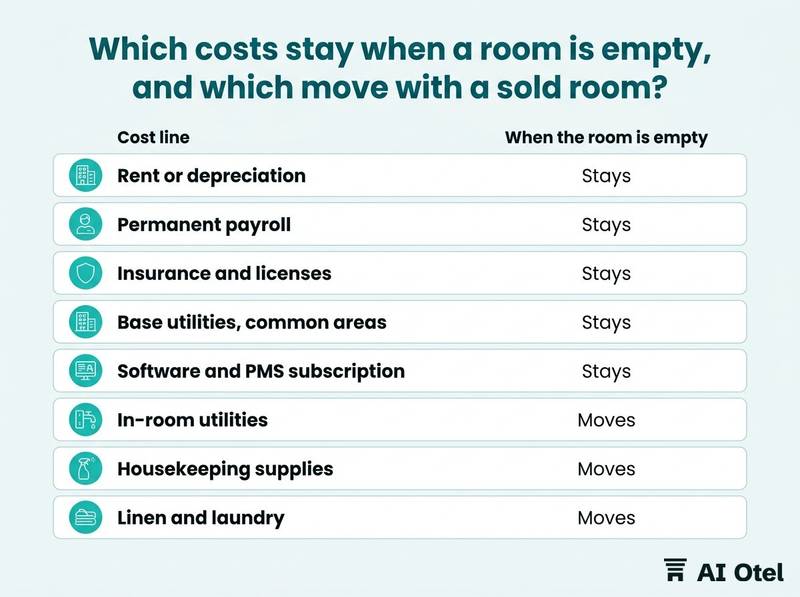
Sort every line on your profit and loss into three groups: stays, moves, and moves only after a threshold. The third group is the one hotels get wrong. Housekeeping payroll is the clearest threshold cost: the team is paid whether ten rooms or sixty are occupied, so the marginal cost of one more occupied room is the supplies and laundry, not the wage, until occupancy forces an extra shift or an extra floor attendant.
Percentage costs follow the bill, not the room. Channel commission and payment processing fees are only paid when there is a sale, so they reduce contribution rather than adding a fixed cost. Breakfast is a per-cover cost, not a per-room cost: a single occupancy and a double occupancy in the same room type carry different food cost. Build the figure per occupied room, and take breakfast cost from the cover count, since a double occupancy carries two covers in one room night.
Utilities split the same way. Lobby, pool and corridor lighting stay; in-room electricity, water and heating move, and can be estimated per occupied room from a meter reading or a sub-meter over one month. Anything you cannot trace to a guest staying is a staying cost, and belongs outside this calculation.
| Cost line | When the room is empty | Source document |
|---|---|---|
| Rent or depreciation | Stays | Lease, depreciation schedule |
| Permanent payroll | Stays | Payroll journal |
| Insurance and licenses | Stays | Policy, license invoices |
| Base utilities, common areas | Stays | Utility bill |
| Software and PMS subscription | Stays | Subscription invoice |
| In-room utilities | Moves | Sub-meter reading |
| Housekeeping supplies | Moves | Purchase and issue records |
| Linen and laundry | Moves | Laundry contract invoices |
| Amenities and welcome items | Moves | Purchase records |
| Breakfast and food cost | Moves, per cover | Kitchen issue records |
| Channel commission | Moves, percentage | Channel invoice |
| Payment processing fee | Moves, percentage | Provider statement |
| Housekeeping wages | Moves after a threshold | Payroll journal, shift plan |
How do you calculate the contribution of one room night from your own figures?
Take one month, add up the costs that moved with occupied rooms, divide by occupied room nights, and subtract the result from the rate you are testing. The answer is the contribution of one night at that rate.
Choose the period first: a full month in the season you care about, because a low month spreads the same supplies over fewer rooms and inflates the per-room figure. Pull occupied room nights, that is rooms sold, from the property management system, and pull breakfast covers separately, so that a double occupancy counts as one room night but two covers.
ChecklistCollect the moving costs from documents, not from memory: laundry invoices, housekeeping supply purchases, breakfast food cost from the kitchen's own issue records, commission invoices from each channel, and the payment provider's statement. Before you start, put these on the desk
- Occupied room nights for the month, from the PMS
- Laundry and linen invoices
- Housekeeping supplies purchased and issued
- Breakfast food cost and cover count
- Commission invoices per channel
- Payment processing statement
- One month of in-room utility readings, or a documented estimate
Divide the total by occupied room nights to get the variable cost per occupied room, then subtract it from the rate under test to get contribution. Repeat for two or three room types if their variable costs differ materially, and keep one house average for quick decisions at the front desk. For the full line-by-line method, see Cost per occupied room: what each sold room costs your hotel, line by line.
Recalculate the percentage costs at the rate you are testing. A commission on a discounted rate is smaller, and a floor built on a full-rate commission will be too high for a cheap sale.
A worked example, invented for illustration
For example, suppose a month had 900 occupied room nights, and the moving costs were: laundry 27,000, supplies 13,500, breakfast 63,000 for 1,400 covers, in-room utilities 9,000, and commission and payment fees of 54,000. The moving total is 166,500, so the variable cost per occupied room is 185. At a tested rate of 1,500, the contribution of one night is 1,315. That, not 1,500 and not zero, is what an empty room takes away. These numbers are invented to show the arithmetic, not to suggest typical values.
What to do when you cannot separate a cost
Some lines refuse to split cleanly, such as a single electricity bill covering both the corridors and the rooms. Estimate the split once, from a sub-meter if you have one, or from a month where occupancy was unusually low and the bill barely moved: the part that did not move is the staying part. Write the estimate and its date next to the figure, so the next review starts from a documented position rather than a fresh guess.
What does a no-show really cost, with or without a deposit, resold or not?
A no-show costs the contribution of that night only while the room stays blocked and unsold. Charge something and the loss shrinks; release and resell the room and the loss becomes the gap between the two rates, or disappears.
Fix the timing rule first. A no-show room is blocked inventory until someone decides to release it, and every hour it stays blocked is an hour it cannot be sold to a walk-in or a late booking. The release rule is an operational decision: who decides, at what hour, and by what channel the room goes back on sale. Rooms that stay blocked until morning because nobody owned the decision carry the largest hidden loss, and blocked rooms also feed the double-booking problems described in Hotel double bookings across channels: causes and prevention.
The release decision
Without a charge and without a resale, the hotel loses the full contribution of the night and carries no variable cost, because nobody stayed. With a charge, the loss is the contribution minus what was collected, adjusted for any commission or fee attached to that charge and for any tax that follows the bill. With a resale at the same rate, the hotel ends the night roughly where it started: one guest's contribution earned, one variable cost incurred, once. With a resale at a lower rate, the loss is the difference between the two contributions, not the difference between the two rates.
| Situation | What you collect | Net effect against a normal stay |
|---|---|---|
| No charge, not resold | Nothing | Full contribution lost, no variable cost |
| Charge collected, not resold | The charge, less fees and tax | Contribution minus collection |
| No charge, resold at same rate | New guest's rate | Roughly a normal stay |
| No charge, resold at lower rate | New guest's rate | Gap between the two contributions |
| Charge collected, resold | Charge plus new rate | Better than a normal stay, if terms allow |
Charging and reselling the same night
Whether you may charge, how much, and what happens when the room is also resold are questions about your own booking terms and the rules that apply to them. Put the arithmetic in place first, then confirm the wording of your cancellation and no-show policy with your legal adviser, including whether a charge and a resale can coexist under your terms.
A no-show also carries a second cost that does not appear in the sum. The room was held for a guest who never came while a real buyer may have been turned away, and that turned-away buyer is invisible in the accounts. This is the argument for releasing early rather than late: the earlier the room returns to inventory, the more of that invisible loss you avoid.
How do you use the figure as a floor price for late sales?
Set the floor at the variable cost of one occupied room plus the cost of the channel you sell through, and treat every lira above it as contribution. The floor tells you the lowest sale worth taking; it does not tell you the price to publish.
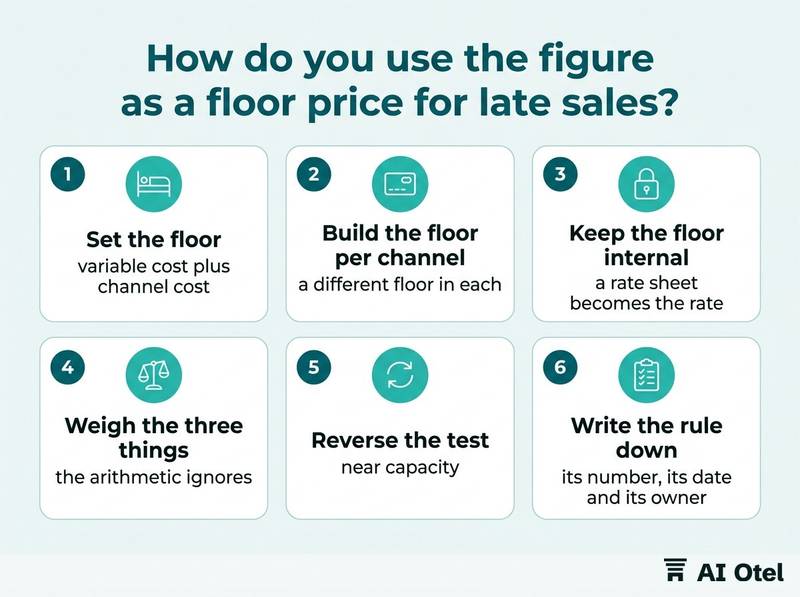
Build the floor per channel. A direct sale and a commission channel do not carry the same cost, so the same room has a different floor in each. Keep the floor internal: a floor that reaches a rate sheet becomes the rate, and the hotel spends the season selling at its own minimum.
Watch outA floor is not a rate
The floor covers only the costs that move with a guest. It says nothing about what the market will pay. And a floor that gets published stops being a floor.
Weigh the three things the arithmetic ignores: the guest who books at the floor today and expects it next August, the segment that sees the low rate and stops paying the high one, and the staff cost that appears when a discount fills rooms beyond the shift threshold. Use the floor where it belongs: last-hours sales to a closed audience, a walk-in at the desk, a group filling a gap the hotel cannot otherwise sell, and a decision on whether a no-show charge is worth pursuing. For the desk-side decision, the method in The walk-in rate: how the front desk prices a guest who arrives without a booking starts from the same number.
Reverse the test near capacity. When the hotel is nearly full, the question is not what the empty room costs but which guest the new booking displaces, and there the floor should be the rate of the guest you would turn away. Finally, write the rule down with its number, its date and its owner, so that two people at the desk on two different nights apply the same floor.
How often should you review the figure, and where does it stop being useful?
Review it once a season and again whenever a large cost line moves, because the number is an average that quietly goes stale. It stops being useful the moment it is treated as a rule for pricing rather than a floor for deciding.
Put a review date in the calendar at the start of each season, and add a trigger for a renegotiated laundry contract, a change in energy prices, a new channel commission or a change in the mix of room types sold. Record what changed and by how much, so that next season's figure is a comparison rather than a fresh guess.
Accept the limits. It is an average across room types and dates, it ignores displacement, it ignores what the guest would have spent on extras, and it ignores the value of a guest who returns. Keep it out of arguments it cannot settle: it does not decide whether a group is worth taking, whether a contract rate is profitable across a year, or whether a discount is fair to the guests who paid more.
Hand the front desk one page: the floor per room type, the release rule for no-shows, and the name of the person who can go below it.
What to do next
Build the one-room-night figure this week from last month's documents, write the floor beside it, and give both to the front desk with a release rule for no-shows. The three ideas fit together: the contribution of a night is what an empty room takes away, the same contribution is what a no-show costs until the room is released, and the variable cost inside it is the lowest price worth accepting. Review the number at the start of each season, and treat it as a floor for decisions rather than a price for the market.
Frequently asked questions
Does an empty hotel room cost the full room rate?
No. The rate includes costs the hotel never spends when nobody stays, such as cleaning, laundry, breakfast and commission. The loss is the contribution: the rate minus the costs that move with an occupied room. Using the full rate overstates the cost of an unsold hotel room night and makes every discount look more expensive than it is.
Should a hotel charge a no-show the first night?
The arithmetic says a charge up to the lost contribution recovers the night, and a charge above it does more than recover it. Whether the charge is enforceable, how it must be worded, and what happens if the room is also resold depend on the hotel's own terms and the rules that apply to them. Set the policy in writing and have the wording checked by a legal adviser.
Is the variable cost per occupied room the same as cost per occupied room?
No. Cost per occupied room usually includes a share of fixed costs allocated across rooms, which is useful for full-cost profitability. The floor for a last-hours sale needs only the costs that actually move when a guest stays, plus the cost of the channel. Mixing the two produces a floor that is too high and blocks sales that would have added contribution.
Why not simply discount until the room sells?
Because below the floor every sale removes contribution rather than adding it, and because a low rate is visible to guests who would have paid more. The floor tells you the lowest sale worth taking; the market tells you what you can actually get. Discounting inside the floor is a pricing decision, not a cost decision.
How often should the figure be recalculated?
Once a season, and again when a large cost line changes: a new laundry contract, an energy price move, a channel commission change or a shift in the room-type mix. Keep the previous figure so the new one is a comparison. A figure carried over from an old season quietly turns into a wrong floor.