What a booking really nets: comparing channels with the hotel's own numbers
Commission is only one cost line. This guide shows how to build a one-page sheet per channel from your own records, calculating net revenue per night to reveal which channel truly nets more.
AI draft · awaiting editorial review

Contents
Key takeaways
- Commission is one cost line among several; payment fees, cancellations, no-shows and staff time decide which channel actually nets more.
- Compare channels on net revenue per night and net average daily rate (net ADR), never on the gross rate or the commission percentage alone.
- A cancelled booking still costs work, so cancellation loss belongs to the channel that produced the booking, not to the month it was cancelled.
- A net rate hides the channel's markup, so a commission percentage on a net contract is not comparable with one charged on gross.
- The sheet ranks channels inside one period; repeat guests, reviews and demand effects stay beside it as notes, not as numbers.
Net revenue per booking by channel is what a hotel keeps from one reservation after commission, payment and card costs, cancellation and no-show loss, and the staff time the channel adds. Build it from your own property management system (PMS) records and channel statements, one page per channel, and compare net revenue per night, not the commission line.
Two channels confirm the same room for the same three nights. One shows the higher rate on the reservation screen and the smaller commission on the statement. At the end of the month the other has left more money in the bank, and nobody in the meeting can say why. This article gives you the method for saying why: a one-page sheet per channel, built from your own records, that turns each booking into the money it actually left behind.
Why does the commission line mislead?
Because commission is one cost among several, and the other costs sit in different places: bank statements, card statements, payroll and the guest ledger.
Commission is charged on the rate the channel records, while the hotel's own rate for the same night may differ, so two channels are rarely compared on the same gross figure. Payment cost arrives separately: virtual card handling, card processing, currency conversion and refunds appear on bank or card statements, not on the channel statement. Cancellations and no-shows remove revenue after the booking has already been counted, so a channel can look busy and still net little.
Extra work is a real cost too: re-keying reservations, chasing confirmations, correcting rate or availability errors, and answering guests inside another extranet. Net contracting hides the channel's markup inside the rate, which makes its commission percentage incomparable with a channel that charges commission on gross. And the comparison only holds when both channels are measured over the same stay dates, the same room types and the same length of stay.
Key pointThe rule in one sentence
Compare channels on what stays in the bank, net revenue per night after every cost the booking caused, and treat the commission line as one input to that figure.
What goes on the one-page sheet for each channel?
One page per channel, one row per cost, built so that anyone in the meeting can trace a number back to a statement.
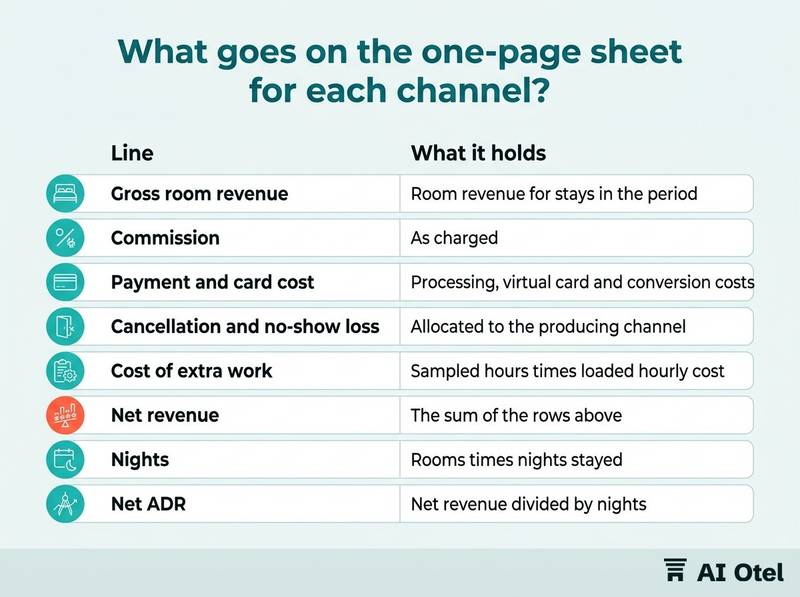
Start from gross room revenue for the stay dates inside the period, not the booking dates. Deduct commission exactly as charged on the channel statement, then payment and card costs, then the cancellation and no-show loss allocated to that channel. Add the cost of extra work as sampled hours multiplied by a loaded hourly cost the hotel already knows, and keep that assumption unchanged between months.
The sheet ends with three figures: net revenue, nights sold and net ADR, which is net revenue divided by nights. Two note fields carry no number at all: repeat chance and the review or complaint pattern. Keep the sheet identical from month to month; a changed definition silently breaks every trend the hotel was watching.
| Line | What it holds | Where it comes from |
|---|---|---|
| Gross room revenue | Room revenue for stays in the period | The PMS |
| Commission | As charged | The channel statement |
| Payment and card cost | Processing, virtual card and conversion costs | Bank and card statements |
| Cancellation and no-show loss | Allocated to the producing channel | PMS and statement |
| Cost of extra work | Sampled hours times loaded hourly cost | The revenue manager |
| Net revenue | The sum of the rows above | Calculated |
| Nights | Rooms times nights stayed | The PMS |
| Net ADR | Net revenue divided by nights | Calculated |
| Notes | Repeat chance and review pattern | No numbers |
Where do the numbers come from?
From three sources that must agree: the hotel's own system, the channel's statement and the bank.
Pull reservations from the PMS filtered by stay date, with the channel and rate code marked on every line. Take commission and adjustments from the channel's own statement and reconcile it to the system line by line; put any unexplained difference on the sheet as its own row until it is resolved. The same discipline applies to the money side: reconciling booking site payouts, commission and virtual cards against the bank is what keeps the payment row honest, and how a hotel checks a booking site commission statement is a skill worth practicing before the first sheet is built.
Take payment, card and currency costs from the bank and virtual card statements, not from the reservation screen. Count work in hours over a fixed sample, for example one week per month, and reuse that figure until the process itself changes. Write the period, the room types included and the date the sheet was made at the top; a sheet without its definitions cannot be compared with next month's. Give the sheet one owner, usually the revenue manager, with the accountant checking the money rows before it goes to the meeting.
ChecklistBefore the sheet goes out, check
- The period is fixed by stay date and written at the top
- Every reservation carries a channel code
- The channel statement is reconciled to the system
- Card and bank costs are collected for the same period
- Hours are sampled and the sample date recorded
- Definitions sit on the page
- Two people sign off, one for revenue and one for money
What does a worked example look like?
A worked example shows the mechanism: two channels, the same room and the same nights, and a different answer once every cost is on the page.
Hold the room type and the three nights constant so the comparison is like for like. Show the gross room revenue each channel records, then the commission it charges, then the payment cost per booking. Apply each channel's own cancellation experience from the hotel's records rather than any outside figure, and price the hours each channel costs per booking at the hotel's own loaded hourly cost. The result is plain: the channel with the higher gross rate can finish lower on net revenue per night.
| Line | Channel A | Channel B |
|---|---|---|
| Gross room revenue, 3 nights | 900 | 870 |
| Commission as charged | 135 | 70 |
| Payment and card cost | 9 | 26 |
| Cancellation and no-show allowance | 45 | 12 |
| Cost of extra work | 20 | 40 |
| Net revenue | 691 | 722 |
| Nights | 3 | 3 |
| Net ADR | about 230 | about 241 |
Example only, illustrative figures, not a market rate. Channel B records the lower rate and keeps more per night. Your own records will produce different numbers; the point is the shape of the answer, not the figures.
How do cancellations and no-shows change the comparison?
They move revenue out after the booking has already been counted, so a channel's real value depends on how much of what it confirms actually stays.
Measure cancellation rate by channel and by lead time; a channel that cancels late leaves little time to resell the room, as covered in detail in measuring cancellation rate by channel and lead time. Allocate the loss to the channel that produced the booking, not to the month in which the cancellation arrived. Treat no-shows separately from cancellations: a no-show charged for the first night and a no-show written off are different numbers.
Split flexible and non-refundable rate plans into separate rows when their behavior differs, even inside the same channel. Use a period long enough to include the cancellation tail of the bookings inside it, or the newest channel will look better than it is. Check what the channel statement actually did with commission on cancelled bookings, and record that rather than assuming it.
Watch outBookings are not stays
A channel measured on bookings rather than on stays will always look better than it is, and the gap is exactly the cancellation and no-show loss the sheet exists to show.
What can the sheet not tell you?
It cannot price a repeat guest, a review or the demand a channel sends to the hotel's own website, so those stay as notes beside the numbers.
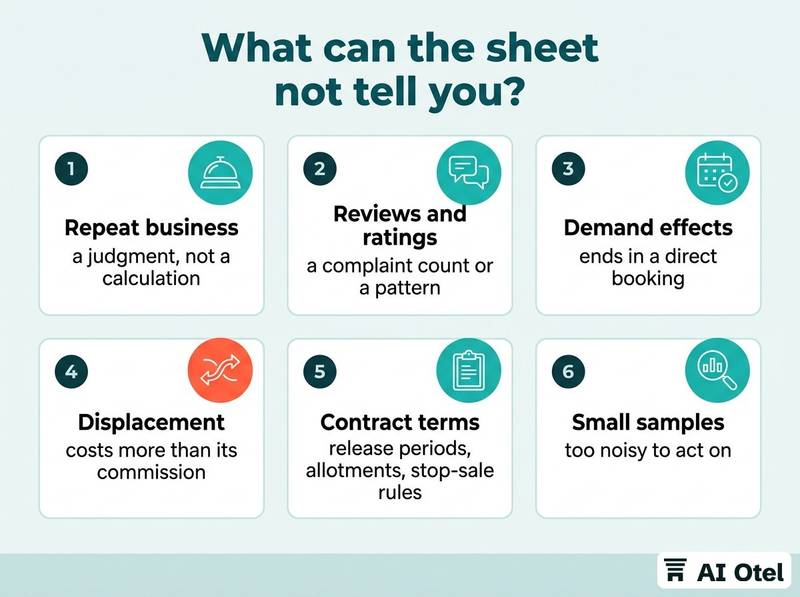
Repeat business: a guest who arrives through a channel once and returns direct is worth more than the first booking shows, but attributing the return to the channel is a judgment, not a calculation. Reviews and ratings: the sheet can carry a complaint count or a pattern, not a value. Demand effects: some channels send search traffic that ends in a direct booking, and the sheet only sees bookings it can match.
Displacement is harder still: a channel that fills the last rooms on a high-demand night costs more than its commission, because those rooms could have sold higher. Contract terms the sheet does not model include release periods, allotments, stop-sale rules and minimum commitments. And small samples matter: a channel with a handful of bookings a month produces a figure too noisy to act on by itself.
NoteKeep the notes column
Keep a notes column for what numbers cannot hold, repeat guests, complaints and the demand a channel sends to the hotel's own website, and read it before acting on the figures.
How do you use it in the weekly meeting?
Use it to ask one question per channel: is this channel earning its place in the mix, and what would change if a share of rooms moved elsewhere?
Read net revenue per night and net ADR side by side; a channel can lead on one and lag on the other. Write the rule in advance: the net ADR a channel must reach to keep its allocation, and who decides when it does not. Move allocation in small steps and give each step a review date, because a channel's response takes weeks to appear in stays. Keep the sheet monthly and the meeting weekly: the meeting reads the trend, the monthly close confirms the money.
Record every decision and its reason beside the sheet, so the next comparison starts from a known baseline. Watch concentration: a channel that dominates the mix is a risk even when its net revenue looks healthy, which is the broader question of when a hotel's channel mix needs rebalancing.
TipWrite the rule first
Write the allocation rule before the numbers arrive, because a rule written afterwards is a justification rather than a decision.
What to do next
Build the sheet for one channel this month, from your own records, and take it to the next revenue meeting. The method matters more than the first numbers: once the same page is filled the same way every month, the comparison between channels becomes a decision the hotel can defend. When the sheet is running, the same records that feed it, reservations, rates and channel codes held in a hotel operating system, are the ones a hotel would need to publish contracted rates to agencies through a distribution hub, so the discipline pays twice.
Frequently asked questions
Should a hotel compare channels by commission or by net revenue?
By net revenue per night, after commission, payment and card costs, cancellation and no-show loss and the cost of extra work. Commission is one row on that page. A commission percentage on a net contract is not comparable with one charged on gross, because the markup sits inside the rate.
How do I put a cost on the extra work a channel creates?
Sample the hours over a fixed period, for example one week per month, covering re-keying, corrections, confirmation chasing and guest messaging. Price them at a loaded hourly cost the hotel already knows from payroll. Keep the assumption unchanged between months and revise it only when the process itself changes.
Which period should the channel sheet cover?
Fix the period by stay date, not booking date, and make it long enough to include the cancellation tail of the bookings inside it. A monthly close with identical definitions each time gives a trend; a period chosen to flatter a channel gives nothing.
Do cancellations belong to the month they were booked or the month they were cancelled?
To the stay period of the booking, and to the channel that produced it. Otherwise a channel with long lead times looks strong in the month it sells and weak later, and the comparison shifts every time the mix changes.
Can I use published commission averages instead of my own statements?
No. Terms differ by contract, rate plan and market, and a net rate hides the markup. The sheet is only as good as its own inputs, so use the hotel's signed terms, its channel statements and its bank records, and let the accountant confirm the money rows.