What a hotel AI assistant should say when it does not know: answer rules and a handoff to staff
A wrong answer costs more than a delay. This guide defines the fact sheet, the standard handoff sentence, and the topics that always require a person.
AI draft · awaiting editorial review
Contents
Key takeaways
- A wrong answer becomes a promise the guest plans around; a slow answer is only a delay, and the front desk can still recover from it.
- The assistant answers from the hotel's own written fact sheet, never from general knowledge, reviews, other hotels or its own reasoning.
- One fixed sentence, written by the hotel and used every time, does three jobs: it admits the gap, it offers the handoff, it gives a time.
- Some topics never get an answer from the assistant at all: money, complaints, health and safety, legal duties, and anything about a named guest.
- The handoff is only as good as what the person receives: the guest's words, the assistant's last message, the reason, the channel and the clock.
A hotel AI assistant should answer only from the hotel's own written facts, say one fixed sentence when the answer is not there, and hand the question to a named person with the transcript and a reply time. Handoff means passing the conversation, with its context, to a staff member who can answer.
A guest asks the assistant whether the pool is open after midnight. It answers yes, in good English, with no source behind it. The guest plans a late swim, arrives at 00:40, and finds the pool closed and the front desk apologizing for a promise nobody in the building made. This article is about the hotel AI assistant what to say when unsure question: which facts it may answer from, the one sentence it says when it cannot, the topics that always go to a person, what that person receives, and how to test all of it with 20 questions.
Why does a wrong answer cost more than a slow one?
Because the guest acts on the answer before anyone at the hotel sees it. A delay is visible and recoverable; a confident error is invisible until it turns into a complaint.
The guest builds a plan on the answer: a transfer time, a late arrival, a request to a friend, a booking decision. By the time staff read the conversation, the plan is already made. The hotel then has two bad options: honor something it never offered, or correct it and look unreliable. Both cost more than saying "let me check".
A wrong answer usually surfaces at the worst moment: at the desk, at night, in front of other guests, when the person who could have answered in ten seconds is off shift. The asymmetry is the whole argument. Staff can fix a delay with one sentence. They cannot easily fix a fact the hotel never wrote down.
Assistants produce confident wrong answers because they are built to produce fluent text, not to check a source. That mechanism is worth understanding before writing any rule, and it is the subject of a separate piece on why hotel AI assistants invent facts and how to catch them. The rule that follows is not "make the assistant smarter". It is "make the assistant stop at the edge of what the hotel has written down".
Key pointWrite the rules for the second case
A delay costs minutes and one apology. A wrong answer costs the hotel either the promise or the guest's trust, and often both. Write the rules for the second case, not the first.
What may the assistant answer from?
Only from the hotel's own written facts: a single sheet the hotel owns, dated, that says what is true about this property today. If a question cannot be traced to a line on that sheet, the assistant does not answer it.
Write the fact sheet first, in the hotel's own words, before any assistant is configured. The sheet is the product; the assistant is only a reader of it. Each line carries an owner and a validity window. "Pool open 07:00 to 23:00, closed for maintenance 12 to 18 November" is a fact. "Pool open late" is not.
Exclude by rule: general knowledge about the city, what other hotels do, what a review said, what a guest mentioned last week, and anything the assistant would have to reason out. Prices and inclusions need a second signature, because a wrong price is a commercial commitment, not a piece of information. The sheet is not a brochure. It is short, plain, dated, and written in the same language the guest will read, with a translated version for every language the hotel serves.
When the assistant cannot find a line, that is not a failure of the assistant. It is a gap in the sheet, and the gap is the hotel's to close.
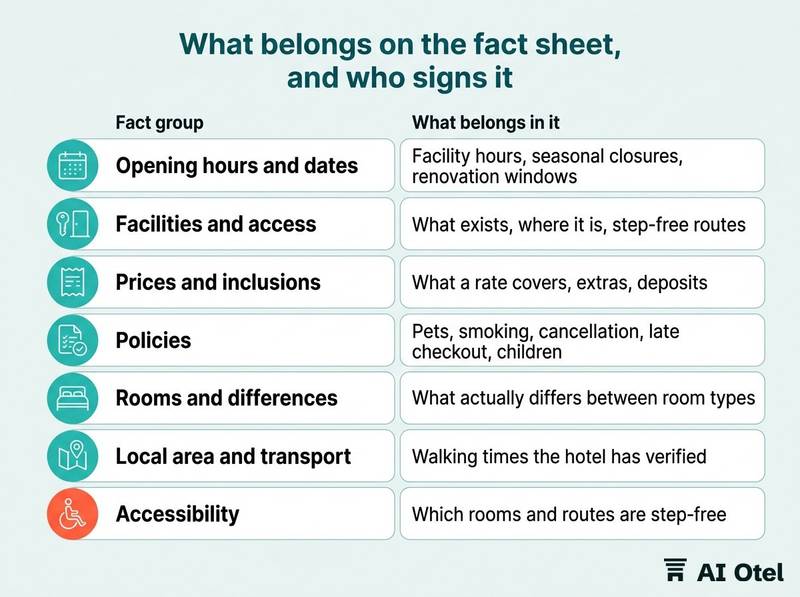
What belongs on the fact sheet, and who signs it
| Fact group | What belongs in it | Who owns it | Review trigger |
|---|---|---|---|
| Opening hours and dates | Facility hours, seasonal closures, renovation windows | Operations manager | Any schedule change |
| Facilities and access | What exists, where it is, who may use it, step-free routes | Operations manager | Any physical change |
| Prices and inclusions | What a rate covers, extras, deposits, what is charged at the desk | Revenue manager | Any rate change |
| Policies | Pets, smoking, cancellation, late checkout, children | Front office manager | Any policy change |
| Rooms and differences | What actually differs between room types | Front office manager | After any refurbishment |
| Local area and transport | Walking times the hotel has verified, airport transfer arrangements | Guest relations | Seasonal timetable change |
| Accessibility | Which rooms and routes are step-free, with measurements the hotel has taken | Operations manager | After any works |
What is the standard sentence for "I do not know"?
One fixed sentence, written once by the hotel, used every time the answer is not on the fact sheet. It does three things in order: it says the assistant does not have that answer, it says a person will, and it says when.
Keep it to one sentence plus a time. For example: "I do not have that information, so I am passing your question to our front desk, who will reply here before 18:00 today." One sentence, not many. Staff recognize it instantly in a transcript, guests get the same experience every time, and the hotel can test it with a single check.
Ban the softeners that read as answers: "probably", "usually", "I think", "it should be", "most guests find". Each one turns a gap into a guess. Ban the apology loop too. One short acknowledgment is enough; three lines of apology read as evasion and delay the handoff. The wording matters as much as the rule, and the wider question of tone is covered in a voice guide for AI-drafted hotel messages.
Write the sentence in every language the hotel serves, and have a native speaker read it. A translated handoff sentence that sounds cold undoes the work. The sentence must never promise an outcome, only a reply. "We will sort it out" is a commitment; "our front desk will reply here" is a handoff.
TipThe template has four slots
Acknowledgment ("I do not have that information"), owner ("our front desk" or "our reservations team"), channel ("here in this chat", "by email to the address on your booking"), deadline ("before 18:00 today"). No slot may be left empty, and the deadline must match the staff rota, not the hotel's hope.
Which questions always go to a person?
A fixed list of topics where the assistant never answers, even when the fact sheet seems to cover them. On these, it goes straight to the standard sentence and the handoff.
Money comes first: refunds, waivers, deposits, charges already on the bill, price negotiations, group and event quotes. A wrong number here is a dispute, not a correction. Complaints and compensation, including anything where the guest is angry, go to a person too, because tone is the answer and tone needs a person.
Health, safety and security: illness, injury, lost keys, a security concern, an emergency. The assistant routes to the number that is actually answered, and says so. Legal duties around a stay, such as guest identity notification, invoices and fiscal documents, and personal data requests, are described in general terms only, and a person handles the case.
Anything about a named guest or a specific reservation goes to staff: arrival times of other people, room numbers, who is staying with whom, changes to someone else's booking. So do special requests that depend on a judgment: accessible room assignment, connecting rooms, early check-in when the house is full, a room move. Some of these arrive from the other side, and the related question of what staff may share when a guest's AI assistant contacts your hotel has its own rules.
Finally, a catch-all trigger: if the guest asks the same question a second time, or says the answer did not help, the assistant stops answering and hands over, whatever the topic.
ChecklistAlways hand off
- Refunds and charges already on the bill
- Compensation and complaints
- Illness, injury or security
- Identity, invoice and personal data requests
- Anything about a named guest or another booking
- Accessible room assignment and connecting rooms
- Group and event quotes
- Any question asked twice
- Any message where the guest is clearly upset
What does the person receive on handoff?
A short packet, not a forwarded chat: who is asking, what they asked in their own words, what the assistant already said, why it stopped, and where and by when to reply.
The guest's exact words and language come first. Paraphrasing loses the detail that decides the answer, and the reply must come back in the language the guest used. The assistant's last message follows, verbatim, so the person knows what has already been promised. Ideally that is only the standard sentence.
A reason code from the rule sheet says which rule fired. "Not on the fact sheet" and "always hand off: refund" need different people and different urgency. The channel and the clock complete the packet: where the reply goes, and the deadline the guest was given. A handoff without a deadline is a message in a queue. The reservation link, if the conversation is tied to one, saves the guest from repeating a booking reference.
Then a closing loop. When the person answers, the answer is logged, and if the gap was a missing fact, the fact sheet is updated the same week. Otherwise the same question is handed off forever.
What the guest sees while waiting
| What the person receives | Why it matters |
|---|---|
| The guest's exact words and language | The reply must match the language and the detail |
| The assistant's last message | Shows what has already been promised |
| The reason code | Routes the question to the right team and urgency |
| The channel and the deadline given to the guest | A handoff without a clock is a queue |
| The reservation link, if any | Avoids asking the guest to repeat themselves |
| The outcome logged back to the fact sheet | Closes the gap instead of repeating it |
What happens when nobody is at the desk?
The assistant says so, gives the next time a person is there, and offers the channel that does work overnight. It does not promise a callback it cannot keep.
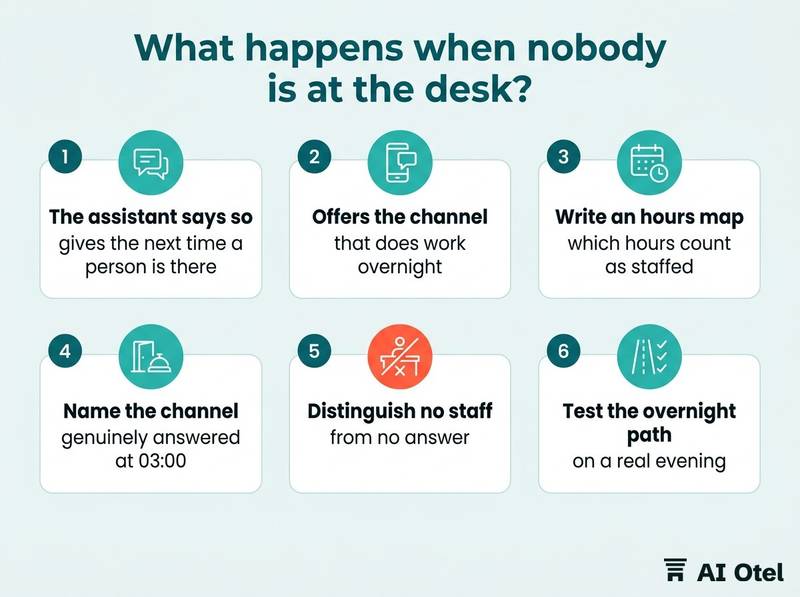
Write an hours map into the rules: which hours count as staffed, for which team, on which days, including public holidays and the night shift. The overnight sentence is a second standard sentence, not the daytime one with a different time. For example: "Our front desk is staffed again from 07:00. I have logged your question and it will be answered then."
Name the channel that is genuinely answered at 03:00, usually the duty phone, and route emergencies there instead of into a queue. Distinguish "no staff" from "no answer". A staffed desk that has not replied in the promised window is a service failure, and the assistant should say a person has been reminded, not repeat the original deadline.
Nothing that commits the hotel may be self-served overnight: no price agreements, no refunds, no room moves, no promises about tomorrow's availability. Test the overnight path deliberately, on a real evening, with a colleague playing the guest. It is the path least exercised and most likely to embarrass.
Watch outNever promise what the rota cannot keep
Never let the assistant write "someone will call you shortly" outside staffed hours. Either the desk is there and the sentence names a time, or it is not and the sentence names when it returns. A promise the rota cannot keep is worse than the original gap.
How do you test the rules with 20 questions?
Write 20 questions your front desk actually receives, run them through the assistant, and judge each answer against two things: the fact sheet and the rule sheet. Nothing else counts as a pass.
Build the set deliberately. Five easy facts, five near-misses that sound like facts but are not on the sheet, five from the always-hand-off list, three the hotel genuinely does not know, and two in another language the hotel serves. The wider discipline of testing before anyone uses the tool is covered in how to test a hotel AI assistant before staff or guests use it.
A pass is one of two outcomes: a correct answer traceable to a line on the fact sheet, or the standard sentence followed by a handoff that arrives with the full packet. A fail is a fluent answer with no source, even when it happens to be right. Right by accident today is wrong by accident tomorrow.
Score the handoff too, not only the answer: did the person receive the guest's words, the reason code, the channel and the deadline? Re-run the set after every change to the fact sheet, every seasonal opening or closure, and every new rule. The sheet moves; the test must move with it. Keep the failures in a log and fix the fact sheet or the rule, not the sentence. Rewording the assistant hides the gap; closing the gap removes it.
The 20-question mix
Checklist
- Five easy facts: opening hours, breakfast times, parking, wifi, pets
- Five near-misses: a facility that closed last year, a room type that no longer exists, a service the hotel never offered
- Five always-hand-off: refund, complaint, illness, invoice request, question about another guest
- Three genuine unknowns: something the hotel has never written down
- Two in another served language, one of them an unknown
What to do next
Write the rule sheet this week, on one page: the fact groups and their owners, the always-hand-off list, the standard sentence in every language you serve, and the overnight version. Then run the 20 questions before anyone else does. The rules, the sentence and the handoff packet are the same three ideas seen from three angles: the assistant answers only what the hotel has written, says one honest sentence when it has not, and gives a person everything needed to finish the job. If you are evaluating software that will host these rules, read how a hotel operating system carries front desk work and compliance in one place, and how the wider platform connects it to guests and channels.
Frequently asked questions
Should the assistant apologize when it does not know?
One short acknowledgment, then the handoff and the time. Long apologies read as evasion, delay the reply, and teach guests that the assistant is stalling. The apology is not the service; the reply from a person is.
Can we let the assistant guess and label the answer as a guess?
No. Guests read the substance and skip the label, then act on it. If the hotel wants to offer a possibility, that is a person's job, in a message that says who is speaking and what is confirmed. The assistant's only honest move is the standard sentence.
Who should write the fact sheet and the rules?
The front office manager writes the fact sheet because that person hears the questions; each fact group has its own owner for accuracy; the general manager signs the always-hand-off list and the standard sentence. Review on a fixed date each season and after any change to facilities, prices or hours.
Does handing off annoy guests?
A handoff with a named team and a time reads as service. What annoys guests is a wrong answer, or a promise of a reply that never comes. The two things that decide whether the handoff works are the deadline matching the rota and the reply arriving inside it.
What if the guest writes in a language the staff do not speak?
The standard sentence exists in every language the hotel serves, and the handoff carries the guest's own words plus the language, so the reply can be drafted and checked before it is sent. A person still owns the answer; translation is a step, not a substitute for one.