Writing hotel job descriptions with AI: duties, tools and a manager's check
AI can draft hotel job descriptions, but accuracy depends on real task lists. Learn how to collect duties, prompt tools with facts, and verify drafts against actual shifts.
AI draft · awaiting editorial review
Contents
Key takeaways
- A job description is only as good as the task list behind it: collect the tasks from the shift sheet and from the person doing the post before you open an AI tool.
- Give the tool the post, never the person: no names, pay, health notes, performance records or guest data belong in a draft.
- Every draft is checked against one real shift by the person who does the job, then signed and dated by the department head.
- The one-page role card, not the long description, is what a new hire actually reads in the first week.
- A cross-training grid keeps role cards current: a column nobody can cover is a card that needs rewriting.
A job description in a hotel is a short written record of why a post exists, what the person does each shift, which systems they use, whom they report to and what they may decide alone. AI can draft it from a real task list, but a manager must check every line against an actual shift.
The reception job description on the shared drive was written for a different hotel, names a system you retired two years ago, and has never been read by anyone working the desk. A better template will not fix that; a real task list will. This guide shows how to gather tasks from the work itself, how to prompt an AI tool with facts instead of a title, how to check the draft, and how to cut it into a one-page card that doubles as a training record.
What does a hotel job description need to contain?
Five blocks: why the post exists, what the person does, what they use, whom they answer to, and what they may decide without asking. Anything beyond those five is decoration until they are right.
The purpose should be one sentence that names what breaks when the post is empty: a check-in queue at 23:00, a night audit that never closes, a breakfast service with no one setting the room. Tasks should read as verb plus object plus frequency: "posts guest identity notifications at check-in", not "responsible for KBS". The second phrasing cannot be checked, trained or handed over.
Tools should be named the way the hotel names them internally, not the way a supplier's brochure names them. A new hire has to find the screen, not the category. The reporting block names one person the post answers to and the two or three posts it hands work to; a post with two bosses needs the split written down.
The block most descriptions omit, and the block staff ask about most, is limits of authority: what the person may do alone, what needs a supervisor, what needs a manager. Finally, keep facts about the post, not about a person: shift pattern, standing hours, languages the work actually requires. Each one narrows who can be hired, so each one has to be true.
| Block | Question it answers | A weak line (example) | A working line (example) |
|---|---|---|---|
| Purpose | What breaks if the post is empty? | "Ensures guest satisfaction" | "Keeps the front desk covered so no guest waits more than a few minutes at check-in" |
| Tasks | What does the person do? | "Handles front office duties" | "Posts guest identity notifications at check-in; reconciles the cash drawer at shift end" |
| Tools | What do they work in? | "Uses hotel systems" | "Posts charges in the PMS; encodes key cards at the desk terminal" |
| Reporting and working with | Whom do they answer to? | "Reports to management" | "Reports to the front office manager; hands late arrivals to the night auditor" |
| Limits of authority | What may they decide alone? | "Handles complaints" | "May move a guest to another room and add one drink to the bill without asking; anything above that goes to the duty manager" |
How do you collect the real tasks before you prompt?
From the work, not from the title. The shift sheet, the handover log and one shift spent beside the person doing the post give you the task list; the department head then edits it down.
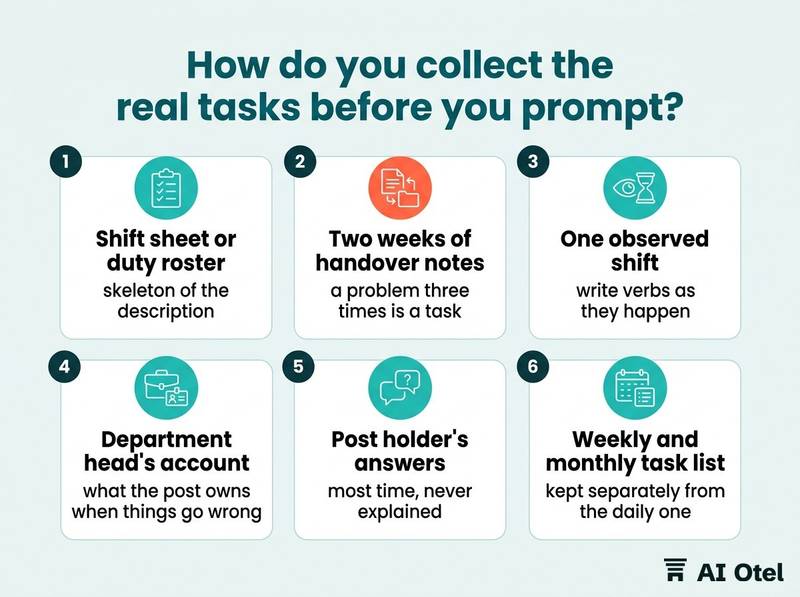
Start with the shift sheet or duty roster. It already lists what a shift must finish before it ends, which is the skeleton of the description. Then read two weeks of handover notes: a problem that appears three times is a task nobody wrote down, or a task written down for the wrong post.
Sit with the post holder for one shift and write verbs as they happen, without correcting them yet. Correction is the department head's step, not the observation's. Ask the department head what this post is accountable for when something goes wrong; that answer names the real scope faster than any interview question. Ask the post holder two questions: which three tasks take the most time, and which three were never explained when they started.
Keep two lists: tasks that happen every shift, and tasks that happen weekly or monthly, such as stock counts and night audit. Mixing them makes a normal day look impossible. Stop at roughly twelve to twenty tasks for the full description. A longer list is read once and never used, and it hides the tasks that matter.
ChecklistBefore you open any tool, work through these six sources
- The shift sheet or duty roster
- The last two weeks of handover notes
- One observed shift, written as it happens
- The department head's account of what the post owns when things go wrong
- The post holder's answers: most time, never explained
- The weekly and monthly task list, kept separately from the daily one
How do you prompt an AI tool with facts instead of a title?
Give the tool the raw task list, the systems, the reporting line and the limits, then ask it to group and phrase what you supplied. A title alone produces a text that fits no particular hotel, and AI hotel job description writing works only when the tool receives the hotel's own facts.
Describe the property first: type, size band, service style, and whether the desk runs one shift or three. The same post title means different work in a resort and a city hotel. Paste the task list in the hotel's own words, even if the wording is rough; rough and true beats polished and invented.
State the audience: a new hire on their first day, not a recruiter. That single line changes how short the sentences become. Ask for grouping, plain verbs and a question back: instruct the tool to list anything it had to assume, because the assumptions are where invented duties hide. Ban invention explicitly: use only the tasks supplied, and add no duties, targets, pay figures or legal requirements.
Do not ask the tool for compliance wording. Guest identity notification and personal data lines come from the hotel's own procedure, written by the people who run it. Keep the prompt in the same file as the draft, so the next revision starts from the current truth instead of a blank page.
TipA prompt skeleton in five lines
Who the hotel is (type, size, service style). Which post and which shift pattern. The raw task list, copied in as written. The systems, the reporting line and the limits of authority. The instruction: group the tasks, use only what was supplied, and list every assumption made.
How do you check the draft against the real post?
Read it with the person who does the job and test every line against one shift: if the line never happens, cut it; if it happens and is missing, add it.
Match the draft to the shift sheet task by task. Every sheet task appears once, and no task appears twice under two different names. Replace generic tool names with the names staff use at the desk, in housekeeping and at the till.
Check the limits block. If the draft says nothing about what the person may decide alone, the post will escalate everything and the manager will become the bottleneck. Check the reporting line against the organization chart, not against what the draft assumed. Hunt for smuggled requirements: a language, a license or a certificate the post does not actually need narrows the pool for no reason and is hard to defend later.
Read it aloud to someone who has never worked the post. Any sentence they have to read twice gets rewritten. Then have the department head sign and date the checked version; an unsigned description drifts back to the old copy within a month.
ChecklistThe manager's check, in order
- Every shift-sheet task is present, exactly once
- Tool names match the hotel's own names
- Limits of authority are stated
- The reporting line matches the organization chart
- No unnecessary requirement has crept in
- A newcomer can read it aloud and understand it first time
- The department head has signed and dated it
How do you turn it into a one-page role card?
Cut the checked description down to what a person needs in the first week, put it on one page, and have the person read and sign it. The long version stays in the file.
Keep five things: the purpose, the eight to twelve tasks of a normal shift, the tools, whom to ask, and what may be decided alone. Drop the history of the post, long competency lists and adjectives about attitude; none of them tells a new hire what to do at 07:00.
Write in the language the team reads at work. If the team is mixed, produce both versions from the same task list, date both, and keep one as the master. Put the escalation line at the bottom in plain words: who to call at three in the morning, and for what. Print it, have the person read it in the first week and sign; that signature is the training record, and it is the document a manager can point to later. The card is also the input for turning your SOPs into training material with AI, because the same task list becomes cards, quizzes and translations.
Key pointThe five lines of a role card
Why this post exists. The tasks of a normal shift. The systems used. Whom to ask and whom to report to. What may be decided alone, and the escalation line at three in the morning.
How do you keep role cards current?
Give every card an owner, a version date and a trigger for review. Cards go stale because nobody owns them, not because nobody cares.
The department head owns the content; HR owns the file and the dates. Splitting it the other way produces cards that are tidy and wrong. Name the triggers: a new system, a new service, a change in the shift pattern, or the same mistake appearing in handover notes three times.
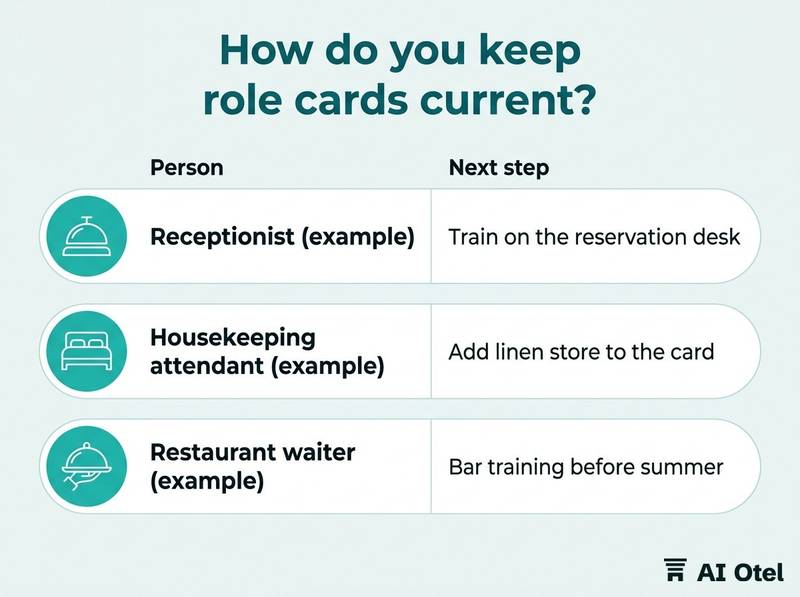
Use a cross-training grid: rows are people, columns are posts. A gap in the grid is a training task; a column nobody can cover is a card that needs rewriting. The grid also writes the "works with" line honestly, because it shows which posts actually hand work to each other.
Put a version number and date on every card and collect the old copies; two versions in circulation is worse than one outdated version. When a card changes, change the prompt file too, so the next draft starts from the current task list rather than from last year's text. Keep the answers staff get about procedures aligned with the cards, so a question at the desk and a line on the card never disagree; a staff question assistant for your SOPs only helps if it answers from the same checked text.
| Person | Post | Card version and date | Can cover alone | Next step |
|---|---|---|---|---|
| Receptionist (example) | Front desk | v3, this month | Desk and night audit, not reservations | Train on the reservation desk |
| Housekeeping attendant (example) | Floors | v2, this month | Floors, not the linen store | Add linen store to the card |
| Restaurant waiter (example) | Breakfast | v1, last month | Breakfast, not the bar | Bar training before summer |
What must never go into an AI tool?
Never a person. No names, identity numbers, contact details, pay, health notes, performance records or guest data. The tool receives the post, not the person doing it.
A job description is about a role; a CV, a disciplinary note and a salary are about someone. Keeping that line clear removes most of the risk in one decision. Pay and salary bands stay out of the draft entirely: they belong to the contract and the budget, and a draft that guesses them creates a document nobody can defend.
Guest data stays out: names, room numbers, identity scans, reservation details and complaint records. Special-category personal data never enters a draft, not even as a preference: health, religion, union membership, family situation. Check the tool's own settings before the first prompt: whether the conversation may be used to improve the service, where it is processed, and how long it is kept.
Write a short list of what staff may paste, such as a task list, a shift sheet with names removed, and a system name, and a short list of what they may not. Which data may leave the hotel is a question for the hotel's own written rule, applied the same way in every department; a fuller hotel AI policy on what staff may share with chat tools covers the same line for everyday use.
Watch outStop list before pasting anything into an AI tool
Names and identity numbers. Contact details. Pay, bonuses and deductions. Health notes and reports. Performance and disciplinary records. Guest names, room numbers and reservation details. Identity document scans. Anything about a person that the post does not require.
What to do next
Pick one post this week, sit one shift beside the person doing it, and write the task list before you open any AI tool. Then run the draft through the manager's check, cut it to a one-page card, and give the card an owner and a date. The description, the card, the cross-training grid and the prompt file are one loop: each one keeps the others honest, and the loop only works if the task list stays true.
Frequently asked questions
Can an AI tool write a hotel job description from a title alone?
It can produce text, but the text will describe a generic post that matches no particular hotel. The useful input is the task list gathered from the shift sheet and the person doing the job. Expect to spend more time collecting tasks than drafting, and treat the draft as a first pass that a department head edits.
Should a job description list every task the post performs?
No. Around twelve to twenty tasks for the full description and eight to twelve for the one-page card is enough to define the post. Rare tasks and detailed procedures belong in the SOPs, which can be revised without rewriting the description. A list that tries to hold everything hides the tasks that decide whether the shift works.
Does a job description replace an employment contract?
No. The description records what the post does and how it is checked; the contract records the terms of employment. The two documents should not contradict each other, and the wording of the contract is a matter for the hotel's own legal adviser.
How do we handle a team that reads two languages?
Produce both versions from the same checked task list, date both, and keep one as the master so a later edit cannot drift. A translation is a new draft: it goes through the same check with someone who reads that language at work, because a literal translation often names a task the team does differently.
Who should sign off a job description?
The department head signs the content, HR keeps the file and the dates, and the general manager signs posts that carry authority over money or over other staff. The person doing the post reads the one-page card in the first week and signs it as the training record.