A hotel term list for AI translation: room names, board types and policies kept the same in every language
AI translation drifts because each request starts with no fixed vocabulary. This guide shows how to build a term list that fixes one approved word per concept, ensuring room names, board types and policies stay consistent across every language and surface.
AI draft · awaiting editorial review
Contents
Key takeaways
- AI translation drifts because each request starts with no fixed vocabulary, so the tool picks a fresh synonym for the same Turkish term on every page.
- A term list fixes one approved word per concept per language, plus a rule column for what must stay untranslated or carry a gloss.
- Board types and payment words matter most: a synonym there changes what the guest believes they bought or paid.
- The list only holds if one named person owns it, one copy is current, and every change carries a date.
A hotel terminology list for AI translation is a one-page table of the words a hotel uses in every language: room names, board types, policy terms, facility and place names, each with one approved word per language and a note on what must never be translated. Staff paste it with every translation request and check the output against it.
A guest reads the room name on your website, then the same room in the booking confirmation, then on the sign by the door, and sees three different words for one product. Nothing was mistyped. Each page was translated in a separate request, and each request chose its own synonym. After reading this article you will be able to build the list that stops it, use it inside a translation request, and check the output against it.
Why do AI translations drift between pages?
Because each request starts from nothing. The tool has no memory of the word it chose last time, so the same Turkish term comes back with a different synonym on the next page.
A translation request is stateless: text goes in, a rendering comes out, and the next request begins again with no vocabulary attached. The same Turkish room name can return as three English versions across three pages, and each version reads perfectly well on its own, which is why nobody notices. For a fuller treatment of where this shows up first, see translating a hotel website with AI: which pages, who checks and how to publish.
Board types drift worst because they look like ordinary words. One request renders the same Turkish board term as an all-inclusive label, another as a full-board label, and only one of those matches the rate plan. Payment words carry money: an advance payment and a refundable security deposit are two different things, and a tool that renders both with one word changes what the guest thinks they are paying and what they think comes back.
Drift compounds across surfaces. The website, the agency listing, the guest app and the confirmation email each get their own wording, and the guest is the one who compares them. The fix is not a better tool. It is a fixed vocabulary the tool is told to use, and a check that it did.
Watch outFluent is not the same as consistent
A translation that reads well can still be wrong for your hotel. Fluent output and consistent output are two different tests, and only the second one protects the rate plan.
What goes on the list?
Five groups: room and facility names, board types, policy and payment words, place names, and the words that must never be translated at all.
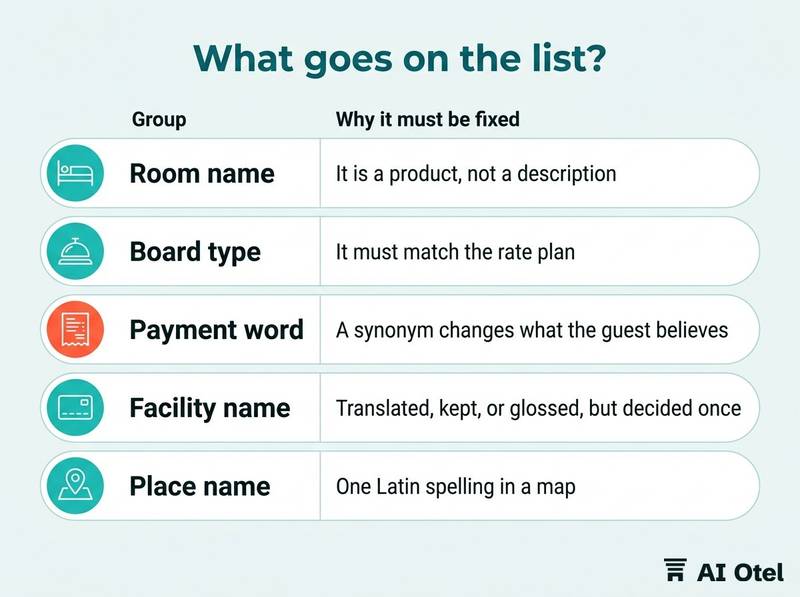
Room names are product names, not descriptions. A named room category is one product with one name per language, and the list is where that name is decided once. Board types are a closed set tied to the rate plan and the contract: room only, bed and breakfast, half board, full board, all inclusive. Each gets exactly one approved word per language, and no accepted synonyms.
Policy words are the sentences guests argue about at the desk: cancellation, prepayment, security deposit, children's age limits, check-in and check-out times, pets, smoking. Facility names need a decision per item: spa, hamam, à la carte restaurant, meeting room, beach bar. Each is either translated, kept in Turkish, or kept in Turkish with a short gloss in brackets. Place names get one Latin spelling each: the district, the beach, the airport, the nearest town. A guest should be able to paste the name straight into a map and land in the right place. Counting words are cheap to fix and appear in every price sentence: night, person, room, extra bed, child.
| Group | Illustrative example | Why it must be fixed |
|---|---|---|
| Room name | A named sea-view category | It is a product, not a description |
| Board type | A half-board label | It must match the rate plan word for word |
| Payment word | Advance payment vs refundable deposit | A synonym changes what the guest believes they pay |
| Facility name | Hamam | Translated, kept, or glossed, but decided once |
| Place name | The beach district | One Latin spelling so it works in a map |
The examples in the table are illustrative. The same vocabulary discipline applies to physical signage, covered in signs in several languages: room directories, pools, emergency exits and house rules.
What should the term list look like?
One table, one row per concept, one approved word per language, and a rule column that says what must not change.
Columns: the Turkish source term, the approved word in each language, and a rule column for the judgment that a table cannot make on its own. The Turkish column is the master, because Turkish is the language your staff write in. English is one target column, not the source of truth.
One approved word per concept per language. A second acceptable word is a second source of drift; if two are genuinely needed, write down where each one is used. The rule column carries the decisions: never translate, keep in Turkish, gloss on first use, or a grammar note such as how the word combines in a compound.
| Turkish term | Approved English | Approved German | Rule |
|---|---|---|---|
| Deniz manzaralı aile süiti (example) | Sea View Family Suite | Familien-Suite mit Meerblick | Fixed product name, no variation |
| Yarım pansiyon (example) | Half board | Halbpension | Must match the rate plan |
| Kapora (example) | Advance payment | Anzahlung | Never the same word as the deposit |
| Hamam (example) | Hamam | Hamam | Keep in Turkish, gloss once |
| Çamyuva Plajı (example) | Camyuva Beach | Camyuva Beach | One Latin spelling |
The rows are illustrative and the languages are examples. Keep the list to one page and store it where a colleague can copy the whole thing in one action; a list split across files does not get used. Put a version date at the top. A term list without a date cannot be trusted, because nobody knows which decisions it contains.
How do you use the list in a translation request?
Paste the list before the text, tell the tool to use only those words for those terms, and ask it to name any term in the text that the list does not cover.
Order matters. List first, then the text, then the instruction. A list placed after the text is treated as commentary on work already done. Say what the text is and who reads it: a booking page, a confirmation email, a sign by the pool. The same words carry different tone in each.
Ask for source and target side by side when the text is short. It turns the check into a mechanical comparison instead of a reading exercise. Ask the tool to list any term in the text that is not on the list, and to leave it in Turkish rather than guess. An unmatched term is information; a guessed term is a new inconsistency.
Translate in short batches of one page or one message type. Long batches lose the instruction partway through and the tail of the text drifts. Keep the source text and the request you used, so next season the same page can be reproduced with the same vocabulary instead of a new one. For live guest messages, where speed changes the trade-off, see AI translation for guest messages: when it is good enough and when it is not.
TipA four-part request pattern
(1) What the text is and who reads it. (2) The term list, pasted in full. (3) The instruction to use only these words for these terms. (4) The request to flag every term that is not on the list and leave it in Turkish.
How do you check the output against the list?
Check the listed terms first and the prose second, because a fluent sentence is exactly where a wrong word hides.
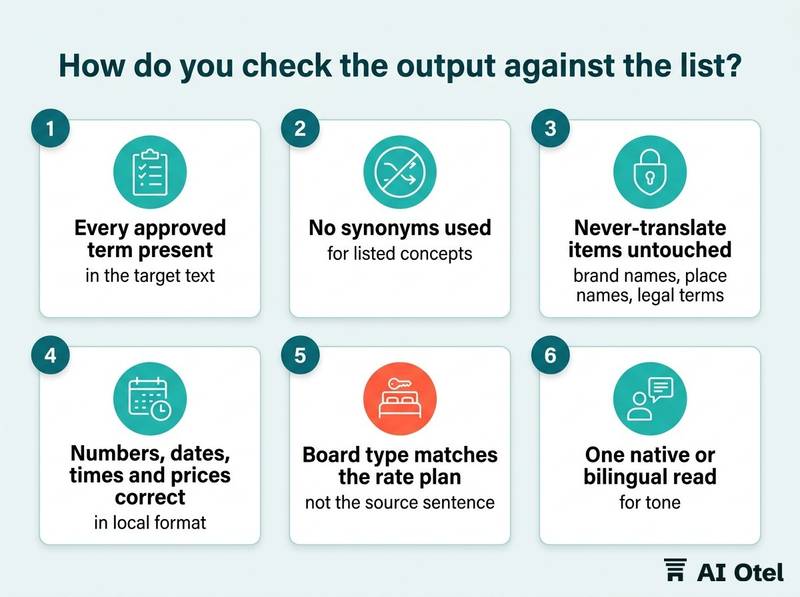
Search the target text for each approved word. A missing word means either a synonym slipped in or the term was dropped, and both need fixing. Check the never-translate items by eye: brand names, place names, legal terms. These are the ones a tool most wants to be helpful about.
Check what a term list cannot protect: numbers, dates, times, prices, currency, and the order inside a date, which differs between languages. Check the board type against the rate plan, not against the source sentence, because the source sentence may itself be out of date. Have a native speaker or a bilingual colleague read the finished page once for tone. The list guarantees words; it does not guarantee sentences.
Log every miss back into the list as a new row or a clearer rule. That is the only way the list gets better than the person who wrote it.
Checklist
- Every approved term present in the target text
- No synonyms used for listed concepts
- Never-translate items untouched
- Numbers, dates, times and prices correct in local format
- Board type matches the rate plan
- One native or bilingual read for tone
Who owns the list, and how does it change?
One named person owns it, one copy is current, and every change is dated and logged.
Name one owner in marketing or reservations. Everyone else proposes changes to that person, and nobody edits the shared copy directly. Changes come from evidence: a guest asked what a word meant, two colleagues used different words, a rate plan was renamed, a new room type went on sale. A new room type or board type gets its row before the page that uses it is published, not after a guest has already booked from it.
Keep a short change log under the table: date, term, what changed, who approved it. It answers the question of why a word is what it is. When the contract and the list disagree, the contract wins and the list is corrected. The list records decisions; it does not make them.
Adding a new language
Start from the Turkish column rather than from English. Have a native speaker approve each row once. Mark the rows that need a human every time, and test the new column on one page before the rest. The same vocabulary discipline applies to marketing copy, covered in AI for hotel marketing copy: room descriptions, posts and newsletters.
NoteThe list is a record of decisions
An undated list is a record nobody can rely on. Date the version, log the changes, and let the contract settle any disagreement.
What to do next
Open one document today and write the Turkish column from the room types and rate plans you already sell, then add a single target language and use the list on the next page you translate. The drift described at the start comes from having no fixed vocabulary; the list supplies one, the request pattern applies it, the check catches what slipped, and a named owner keeps it alive across seasons and languages.
Frequently asked questions
Should the term list start in Turkish or in English?
Start in Turkish, because Turkish is what your staff write and what the rate plans are named in. English is one target column among several, and treating it as the master means every other language inherits English choices rather than the hotel's own. The hotel terminology list for AI translation works only when the master column reflects the hotel's own products.
What do we do when the tool keeps translating a term differently and we cannot agree on one word?
Pick one, write it down, and put it in the rule column as fixed. Consistency is worth more than elegance here: a slightly plain word used everywhere beats a beautiful word used half the time. If two words are genuinely needed, say where each one applies.
Can the same list serve the website, guest messages and printed signs?
The terms yes, the tone no. Room names, board types and policy words should be identical everywhere, while the sentence around them changes with the surface. Keep one list and separate guidance for each channel.
Do we still need a professional translator if we have the list?
The list fixes vocabulary, not sentences. A native speaker or a bilingual colleague should approve each row of a new language once and read finished pages for tone, while the tool handles volume under the list's constraints.
How long should the list be?
Short enough that a colleague reads it in one sitting and copies it without editing. Cover the words guests actually see: room and facility names, board types, payment and cancellation words, place names. A long list that nobody opens protects nothing.