A spare parts store for the technical team: what to keep, how much and who may take it
Build a hotel spare parts store from your own work orders. Learn how to set minimum levels, sort parts into critical, consumable and supplier-held buckets, and control what leaves the store.
Contents
Key takeaways
- A part earns shelf space only when the cost of not having it is higher than the cost of holding it, so the store is a set of decisions, not a cupboard.
- The best source for the parts list is the hotel's own closed work orders: repeat faults name the parts that keep being needed.
- Critical spares, consumables and supplier-held items follow three different stocking rules and should never share one shelf policy.
- A minimum level is a reorder trigger, not a guess: it comes from how much the hotel uses while a replacement is on its way.
- A part that leaves the store without a work order number and a signature cannot be reviewed, costed or replaced in time.
A hotel spare parts store holds only the parts whose absence would stop a room, a service or a safety system, plus the consumables the team uses every week. Each part gets a minimum and maximum level, a labeled bin, a link to the asset it serves, and a signed issue slip when it leaves.
It is a Saturday in August, a room is out of order, and the repair stops because the right cartridge is not on the shelf. The part was cheap; the empty bin was expensive. Most hotel stores are not designed, they accumulate, and that is why the small failures hurt most. After reading this guide you will be able to build the list from your own work orders, set a level for each part, and control what leaves the store without slowing anyone down.
Why does a cheap part stop a repair?
Because the store was never designed around consequences: it grew from what someone happened to buy. A missing part costs far more than its price, and a store full of the wrong parts costs quietly every month.
Count the real cost of an empty bin before you decide it was bad luck. A room sold as out of order is lost revenue for every night it stays closed. A guest moved to another room spends part of their evening dealing with a problem the hotel created. A technician called out on a weekend is often on overtime. Buying the part at retail price from a nearby supplier costs several times the trade price. And if the technician cannot finish the job, there is a second visit, which means the room is out of order twice as long.
The opposite failure is quieter but just as real. Money sits in parts that have not moved in years. Shelf space is taken by items nobody will ever need, while the parts that matter sit in a cardboard box under the bench. Rubber seals harden, batteries drain, chemicals pass their date, and the stock quietly loses value. A store can be full and useless at the same time.
The decision rule is simple to state and takes judgment to apply: hold a part when the cost of not having it is higher than the cost of holding it. Write that judgment down for each part, with a reason, so it can be reviewed next season instead of argued about every week.
Separate the store from the workshop. A store is a controlled place with a list, a level and a record. The shelf above the bench, where anyone leaves anything, is not a store; it is a cache that nobody can count. This article covers the technical store only, not housekeeping linen, not food and beverage stock, not the minibar. The same logic applies whether your hotel has one locked cabinet or a dedicated room: the routine matters more than the size.
Key pointThe decision rule in one box
Hold the part if its absence would stop a revenue-producing room, a guest-facing service or a safety system, or if the delay to obtain it is longer than the hotel can tolerate. Otherwise buy it when it is needed.
How do you find out which parts your hotel actually keeps needing?
Read your own closed work orders from the last twelve months and count repeat faults by asset and by part. The pattern is already in the records; the store list should be written from it rather than from a supplier catalog. The full path from a guest complaint to a closed job is described in our guide to hotel maintenance work orders.
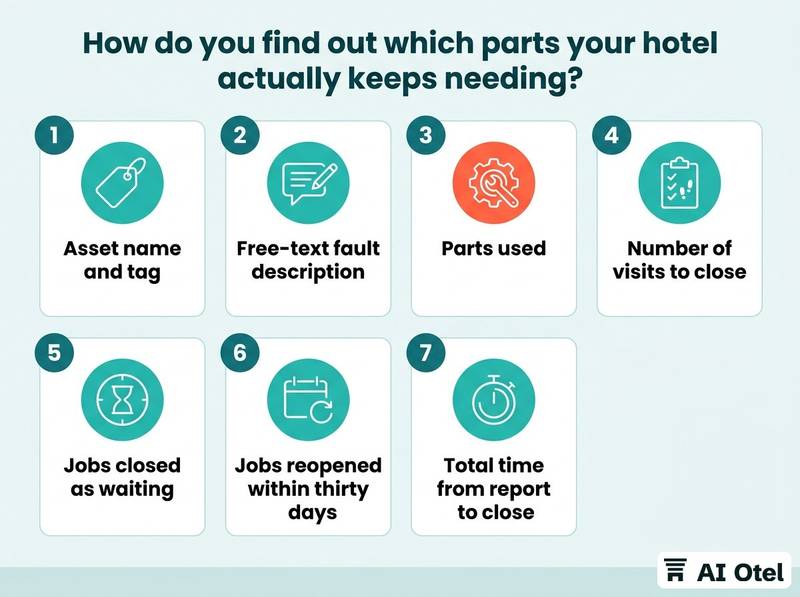
Pull every work order for the period with its asset, its free-text description, the parts used and the time to close. Export it into a spreadsheet if your system allows it, or work through the paper slips; twelve months of a mid-size hotel is a manageable pile.
Normalize the descriptions before you count anything. The same tap cartridge will appear as "cart", "kartuş", "cartridge leaking" and "bathroom tap drip, replaced seal thing". A count on raw text hides the repeat fault completely. Decide on one spelling per part and rewrite the descriptions, or at least tag them, before you tally.
Separate a part failure from an adjustment. A door closer that needed setting is not a part that needs stocking; it is a maintenance routine that needs scheduling. A cartridge that actually failed and was replaced is a part. If you stock adjustments, you fill the store with parts that fix nothing.
Look for two markers of a missing shelf item. The first is the job closed with a note that the part was ordered: the room or the machine waited, and that wait is exactly what the store exists to prevent. The second is the job that needed more than one visit. Both mark a part that should have been on the shelf.
Rank by frequency and by consequence together. A part used twice a year on the boiler controller can outrank a part used weekly on a cosmetic item in a back corridor. Frequency tells you what the team touches; consequence tells you what the hotel cannot afford to stop.
Finally, check the list against the plant and equipment the hotel actually has. Hotels replace machines, renovate floors and swap fixture brands, and stores keep carrying parts for what left the building years ago. The asset register is the reference: our guide to setting up the asset list and work orders in hotel maintenance software covers how to build one.
ChecklistWhat to pull from the work order history
- Asset name and tag
- Free-text fault description
- Parts used
- Number of visits to close
- Jobs closed as waiting for a part
- Jobs reopened within thirty days
- Total time from report to close
Which parts are critical spares, which are consumables, and which should the supplier hold?
Sort every candidate into three buckets, because each one follows a different rule. A critical spare protects a room or a safety system, a consumable is used continuously, and a supplier-held item is expensive and rarely fails.
A critical spare passes two tests together. Its failure stops a revenue-producing room, a guest-facing service or a safety system. And the lead time to obtain a replacement is longer than the hotel can accept. A part that stops a room but can be bought in an hour from a shop two streets away is an inconvenience, not a critical spare. A part that stops the hot water and takes ten days to arrive is critical.
A consumable is defined by turnover, not by price. Lamps, fuses, seals, filters, batteries, tap cartridges and sealant are used every week and should never run out. Their unit cost is low, so the cost of holding them is trivial next to the cost of a job that stops for want of one.
A supplier-held item is defined by the numbers: high unit cost, low failure rate, and a failure that can be planned for. A compressor, a large motor or a control board for a chiller sits in this bucket. The hotel does not stock it, but the supplier, the lead time and a contact name belong on the asset record, so the day it fails, nobody starts searching.
Add the shared-spare trick to your thinking. Where the hotel has several identical units, one spare can serve all of them. If you run four identical circulation pumps, one spare pump, or even one spare motor, covers the whole group. This changes the decision completely: the question is not "is this part worth holding" but "how many of these machines can be down at once".
Watch for the fourth, unmanaged bucket: parts bought once for one repair and kept forever because nobody dares throw them away. Every store has a shelf of these. They are not stock, they are souvenirs, and they take space from the parts that matter.
| Bucket | The test it passes | Typical examples | Stocking rule |
|---|---|---|---|
| Critical spare | Stops a room, service or safety system; long lead time | Pump seal kit, boiler controller board, lock mechanism, pool circulation pump | At least one held, two where the plant has no backup |
| Consumable | Used weekly, low unit cost | Lamps, fuses, O-rings, filters, batteries, silicone | Minimum and maximum in plain units, reordered on the trigger |
| Supplier-held | High cost, rare failure, planned replacement | Compressor, large motor, chiller part | Not stocked; supplier, lead time and contact on the asset record |
How do you set a minimum and maximum level for each part?
A minimum is the quantity that covers use while a replacement is on its way, plus a buffer the hotel chooses. A maximum is the minimum plus the order quantity, and both are written on the bin label in the units the team actually counts.
Work out the minimum from three inputs. How many does the hotel use in a normal week? How many weeks does the supplier take to deliver? And what buffer covers a busy period or a late delivery? Multiply the first two and add the third. That is the whole calculation; the difficulty is only that someone has to sit down and do it once per part.
For a critical spare the minimum is one regardless of usage, because the minimum is not about consumption, it is about availability. Make it two where a single failure would take out a whole service and no backup unit exists. A hotel with one boiler and a two-week lead time on the controller holds two.
Set the maximum as the minimum plus a sensible order quantity. The point of the maximum is to stop the store from holding a year of a part that may be obsolete, or simply wrong for the next renovation, by the time it is used. A maximum also gives purchasing a clear instruction: order up to this number, no debate.
Use the two-bin method where counting is unreliable, which is most hotels. Two identical bins sit side by side. The team takes from one until it is empty. The empty bin is itself the order signal: it goes to purchasing, or sits on the chief engineer's desk, and the full bin covers the lead time. Nobody counts anything, and the level still holds.
Write the level on the bin label with the part name, the asset it serves and the supplier. Anyone, including a night-shift technician who has never ordered a part, can then act without calling the chief engineer.
Review the levels after the season, not during it. A level set in a quiet month will fail in a busy one, because usage in August is not usage in February. The review belongs to the yearly routine, alongside the preventive maintenance plan described in what to schedule, check and record.
TipA worked example
For example: a hotel uses four tap cartridges a month, and the supplier delivers in two weeks. Use during the lead time is two, and a buffer of four covers a busy month and a late delivery, so the minimum is six; round to a sensible number, say eight. The maximum is eight plus an order of eight, sixteen. The label reads the part name, the asset group it serves and the supplier.
Who may take a part, and how do you record it?
One named person holds the store, and every part leaves against a work order number and a signature. The record is what makes the levels, the costs and the yearly review possible.
Name the store keeper and a named deputy. The key is never with an unnamed shift, because an unnamed key means nobody is answerable when the record and the shelf stop matching. The deputy matters as much as the keeper: people take leave, and the routine should not depend on one person's holidays.
Rule the after-hours case in writing, before it happens. Either a sealed emergency kit with a fixed contents list, opened only for genuine night calls and checked each morning, or a duty engineer who may take a part and must log it before the end of the shift. Choose one, write it down, and tell the team. An unwritten rule resolves itself, always badly, at two in the morning.
ChecklistRecord on the issue slip the date, the part, the quantity, the asset or room, the work order number, the name and the signature. The work order number is the field that ties everything together: without it, the part cannot be costed to a repair, and a repeat fault cannot be seen. The full field list
- Date and time
- Part name and bin location
- Quantity taken
- Asset tag or room number
- Work order number
- Name of the person taking it
- Signature
- Quantity returned, if any
Require unused parts to come back to the store and be entered back in. Technicians take two seals and use one; if the second never returns to the count, the stock figure drifts within weeks and the minimum stops meaning anything. A returns column on the same slip is enough.
Check the store physically at a fixed interval against the record: monthly for consumables, quarterly for the whole store is a common pattern. Treat a difference as a finding, not a fault to be punished. If the shelf and the record disagree, either the routine has a hole or someone needed a part badly and skipped the slip; both are things to fix, not to hide.
How do you link each part to the room, plant or machine it serves?
Give every bin the asset tag of what it repairs, not just the part name. That single field connects the store to the work order, the asset register and the yearly review.
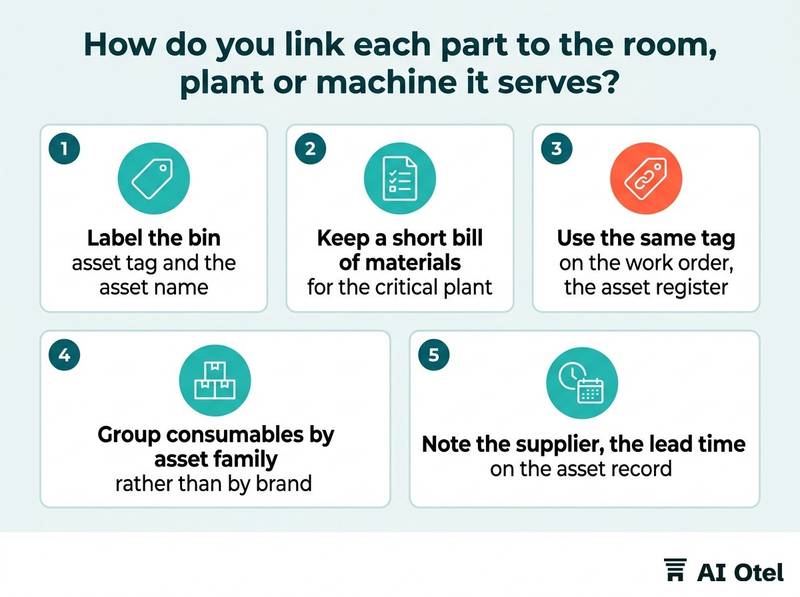
Label the bin with the asset tag and the asset name. A filter for the first boiler is not the same item as a filter for the second, even when the part numbers match, because their usage and their levels differ. The tag on the bin is what keeps the two apart at the moment a technician is holding one of them.
Keep a short bill of materials for the critical plant: the parts that machine needs, their levels, and where they sit. One page per machine, kept with its manual, is enough. The bill of materials is also the natural place to record which parts serve several assets, and to give those parts a level that covers the combined use rather than the use of one machine.
Use the same tag on the work order, the asset register and the bin, so one search shows the machine, its history and its stock. This is the quiet argument for tagging equipment properly in the first place; our guide to tagging furniture and equipment in a hotel asset register covers the scheme.
Group consumables by asset family rather than by brand, so a change of supplier does not orphan a bin. A bin labeled "mixer tap cartridges, standard" survives a supplier change; a bin labeled with one vendor's article number does not.
For the items the hotel deliberately does not stock, note the supplier, the lead time and the contact on the asset record. The supplier-held bucket only works if the information is where the failure happens, which is the machine, not a filing cabinet.
What should the yearly review before the season cover?
Walk the store before the season starts, not during it, and rebuild the list from last season's work orders. The review has four jobs: restock, remove, relabel and recheck the critical list.
Restock to the maximum before the season, so the first busy week does not start with an order. Suppliers also have lead times, and a purchase raised in the first week of high season arrives in the middle of it.
Remove parts for equipment that was replaced or removed, and parts that have passed their shelf life. Rubber seals, batteries and chemicals degrade on the shelf regardless of whether they were used. Check dates, not just quantities.
Recheck the critical list against the plant list, and confirm that every machine with no backup still has its spare on the shelf. This is also the moment to catch the shared-spare arithmetic: if a backup unit was removed or a second machine was added, the number of spares needed changes.
Recheck the levels against last season's usage, and raise the minimum where a part ran out. A part that hit zero in July was telling you something; the review is when you listen.
Relabel the bins that were relabeled by hand during the season, and correct the asset tags that drifted. Handwritten tape labels are a symptom of a store being used, which is good, but they should not survive into the next season unreadable.
Tie the review to the preventive maintenance calendar, so the store is ready before the scheduled work begins rather than after it. If the filters are changed in April, the filters should be on the shelf in March.
ChecklistThe yearly store review
- Walk every shelf and confirm the bin matches the record
- Remove obsolete and expired stock
- Restock to maximum
- Recheck critical spares against the plant list
- Update levels from last season's usage
- Confirm supplier contacts and lead times
- Relabel bins and asset tags
- Sign and date the review
Where to start on Monday
Start with the work orders you already have: pull the last twelve months, count the repeat faults, and write the first version of the list from them. Then set one minimum, one maximum and one labeled bin for the ten parts that appear most often, and add an issue slip before you add anything else. The store improves in the order the records improve.
If you keep these records in software rather than on paper, look for a system where work orders, the asset register and stock live in one place, so the link between a part and the machine it serves is a field, not a habit. The same logic sits inside a hotel operating system, built and working ahead of launch, that keeps reservations, billing and reports in one place, and the wider approach is described on the platform overview.
Frequently asked questions
How many spare parts should a hotel keep in stock?
There is no single number, and a target count is the wrong measure. The number follows from the hotel's own plant list, the lead times of its suppliers and which failures would stop a room or a service. A small hotel with fast local suppliers may hold very little; a resort with long lead times and no backup plant holds more.
Should a hotel keep a spare pump or motor in stock?
Only where the failure would stop a service and no second unit can take over. Where the hotel has several identical units, one shared spare can cover all of them, which is usually the better buy. Where the item is expensive and rarely fails, the supplier, lead time and contact belong on the asset record instead of on a shelf.
What is the difference between a minimum stock level and a reorder point?
In most hotel stores they are used for the same thing: the quantity at which someone orders. Be precise in your own written rule, and say whether the minimum includes the safety buffer or sits above it. What matters is that the number is written on the bin and that everyone reads it the same way.
Who should hold the key to the maintenance store?
One named person and one named deputy, with a written rule for nights and weekends. The after-hours rule is either a sealed emergency kit with a fixed contents list or a duty engineer who logs the part before the shift ends. An unnamed key is the same as no record.
Do spare parts belong in the hotel asset register?
The machine belongs in the asset register; the part is stock. Link the two by putting the asset tag on the bin, so the work order, the asset history and the stock level all point at the same machine. That link is what makes the yearly review possible without a separate list.