The children's pool and splash area: a daily checklist for water, surfaces and supervision
A children's pool needs its own daily routine for water, surfaces and supervision. This guide provides a checklist for opening checks, incident procedures and closing records.
Contents
Key takeaways
- A children's pool needs its own log, its own opening and closing checks and a named supervisor per shift, because its water, its users and its surfaces are not the main pool's.
- A missing or loose drain cover closes the pool until it is replaced: it is a stop item, not a maintenance note.
- After a diaper or sickness incident the area closes, the matter is removed rather than dispersed, and the pool reopens only on a recorded reading that matches the pool plan.
- The sign, the sentence staff use and the welcome letter must say the same thing, in the languages your own guests speak, and must match the supervision you actually provide.
- The closing record proves the day ended in a known state; the weekly review is where repeated failures become visible.
A children's pool checklist is a written daily routine, separate from the main pool's, covering water condition, surfaces and drains before opening, supervision roles during the day, cleaning after a diaper or sickness incident, and an end-of-day record signed by the person who checked. Depth, temperature and chemical limits come from the hotel's own pool plan.
For example, at eleven in the morning a children's pool may hold a handful of toddlers, a few inflatable rings, a floating toy and a parent reading on a bench. The main pool sheet on the wall is complete. The children's pool has no sheet at all. After reading this article you will be able to write that sheet: one page, a fixed opening walk, a stop list, a supervision chain, an incident procedure and a closing record, each with a name against every line. A children's pool hotel checklist is not more work than the main pool's routine, it is the same discipline aimed at different water and different users.
Why does a children's pool need its own checklist?
Because the water is shallower and smaller in volume, it is usually held warmer, and the people using it sit, crawl and swallow water. The checks, the interval between them and the person responsible are therefore different from the main pool's.
Small volume meets heavy use. One contamination event raises the load across the whole body of water faster than in a large pool, so the pool plan answers with a shorter testing interval and a written incident step, not with a stronger dose. Warm, shallow water and spray features add their own demands: a splash pad recirculates water that has run over the deck and over bathers, so its nozzles, trays and collection points are part of the water system, not furniture around it. For the chemistry itself, the daily routine of measuring and correcting pH and chlorine each day applies here too, on the children's pool's own interval.
The users are the surface. Toddlers sit and crawl on the deck, the steps and the splash pad floor, so tiles, edges and standing water matter as much as the chemistry. That means two documents, not one: the children's pool gets its own sheet with opening, interval and closing entries, kept apart from the main pool sheet so a missing line is visible. And it means one owner per shift: a named supervisor, so a missed reading has a name against it instead of a shrug at the handover.
The checklist does not decide depth, temperature, chemical ranges or testing intervals. Those come from the hotel's own pool plan, and the sheet only records that they were met.
| Check or routine | Main pool | Children's pool and splash area |
|---|---|---|
| Testing interval | Set in the pool plan | Normally tested more often: smaller volume, high bather load |
| Surfaces | Deck and edges | Also splash pad trays, nozzles and the floor children sit on |
| Supervision | A post at the water | A post that also covers the entrance gate and change area |
| Signage | Rules at the entrance | Also adult-supervision and swim-diaper rules, repeated at the shallow end |
| Closing | Readings and covers | Also toys out of the water and the lost-property box |
What do you check before the children's pool opens?
A short walk of the whole area in a fixed order, with every reading written down as you go. The order matters more than the speed: the same walk, by the same route, every morning.
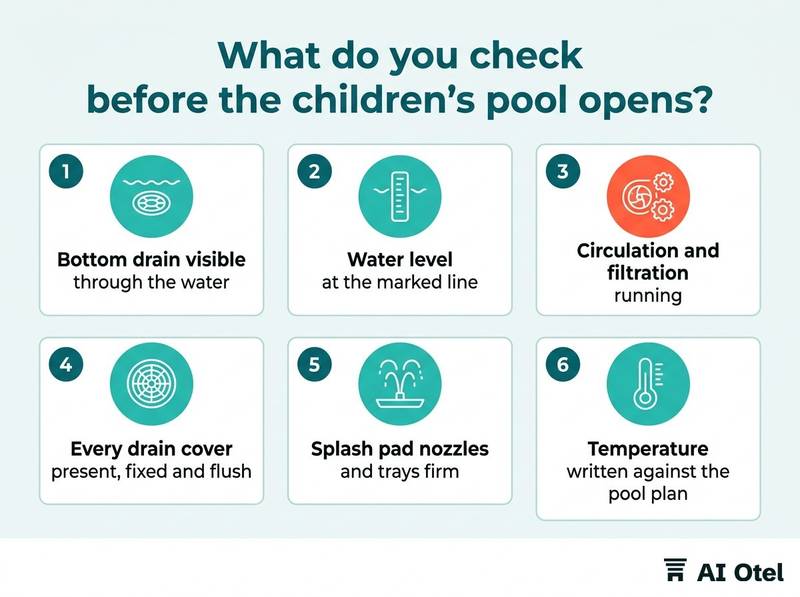
Start with the water: the bottom drain visible through the water, the level at the marked line, circulation and filtration running, return grilles clear. Then the drains and fittings: every cover present, fixed and flush. A loose or missing cover closes the pool until it is replaced, and the splash pad nozzles and collection trays are checked the same way. Read the temperature and write it against the figure in the pool plan, because a children's pool is usually held warmer and the written reading is the evidence.
Walk the surfaces next: no lifted tiles or sharp edges, handrail firm, steps and the shallow-end edge clearly visible, no standing water where children run. Check access and sightlines: the gate closes and latches by itself, there is no gap a small child fits through, and a seated adult can see the whole floor from the benches. Finish with the equipment and the record.
ChecklistThe opening walk, in order
- Bottom drain visible through the water
- Water level at the marked line
- Circulation and filtration running
- Every drain cover present, fixed and flush
- Splash pad nozzles and trays firm
- Temperature read and written against the pool plan
- Deck, steps and edges free of lifted tiles, sharp edges and standing water
- Handrail firm
- Gate closes and latches by itself
- Benches give a clear view of the whole floor
- Ring, pole, first-aid point and accident kit present and sealed
- Sign clean, complete and readable when wet
- Time, readings and name on the sheet, failures marked as failures
Anything that failed is written as failed, and the pool stays closed until it is put right.
How do you clean after a diaper or a sickness incident?
Close the area, remove the matter rather than disperse it, then treat the water and the surfaces to the dose and contact time your pool plan sets. The pool reopens on a recorded reading, not on a verbal all-clear.
Stop first: clear the water, close the gate, put the sign up, and keep one person on the spot until the job is finished. Then remove, do not disperse: net or scoop the matter out and bag it. Never push it toward a drain and never let the filtration system take it, because that spreads it through the water the children are still standing in.
Distinguish two cases. A formed stool and a diarrheal incident or an opened diaper are handled differently, because the second carries a far higher load. The plan must say which procedure applies and who decides which one it is. Surfaces are cleaned on the same visit: splash pad trays, deck, steps, handrails and any toy that was in the water. Dose and contact time come from the pool plan and the water-treatment supplier's written instructions; the reading after treatment is the evidence, and the smell of chlorine is not. If the water stays cloudy after treatment, move to finding the cause when pool water stays cloudy or green before anyone re-enters. Vomit and blood have separate steps in the plan: blood is a stop-and-call event, not a scoop-and-dose one.
Watch outNever reopen on a verbal all-clear
The pool reopens when the reading after treatment is written on the sheet, with the time and the name of the person who took it.
Who watches the water: lifeguard, attendant or parent?
All three, in a written chain, with each person told what they are and are not there to do. A hotel that gives an attendant a lifeguard's job on paper has created the gap the sign was meant to close.
Name the roles. A lifeguard is trained and authorized to enter the water and rescue; an attendant keeps the area, the rules and the equipment; a parent is responsible for their own child. The sign must match the staffing: if no lifeguard is on duty, the sign says so, at the entrance, in the guests' languages. Rotation runs on a fixed schedule with a written handover at each change, naming who is watching which zone and what is still outstanding.
Split the area into zones one person can scan from where they stand. A zone that cannot be seen from the post is not covered, however good the intention. The emergency plan sets how quickly the post must reach the furthest point of the water, and the post is placed to meet it. Enforcement is where the routine lives or dies: the adult-supervision rule is real only if staff say it to a parent the first time and every time. Write the sentence they use, so every staff member says the same one. And the post is a post: no folding towels, no phone, no side tasks that turn the back to the water.
| Role | Trained and authorized to | Responsible for | Not a substitute for |
|---|---|---|---|
| Lifeguard | Enter the water and rescue | The water and the rescue equipment | The attendant's area duties |
| Pool attendant | Keep the area, rules and equipment | The gate, deck, sign and accident kit | A lifeguard |
| Parent or guardian | Supervise their own child | Their child's behavior and whereabouts | The hotel's duty to staff and maintain the area |
| Duty manager | Close the pool | Staffing, escalation, the incident record | The person on the post |
What should the sign say, and in which languages?
The rules the hotel actually enforces, in the languages its own guests actually speak, with pictograms first and short sentences underneath.
Choose the languages from your own guest mix, using reservation and check-in data, and review the list each season rather than keeping a fixed set. What goes on it: adult supervision, the swim-diaper rule, no diving, no glass, the opening hours, where the toilet and change area are, the depth, whether a lifeguard is on duty, and where to get help. A picture of an adult and a child reads at a glance; the sentence underneath is for the parent who wants the detail. For the wider set of rules, see pool rules and the signs guests actually read.
Place the sign at the entrance at adult eye level, repeat it at the shallow end and at the splash pad, and make it legible when wet. Use one term per rule: if the sign says children must be accompanied, the staff sentence, the welcome letter and any guest-facing channel say the same thing in the same words. And remember that the sign is not the rule: a rule that is not enforced teaches guests that the signs are decoration, and that costs more than leaving the sign off.
ChecklistWhat the children's pool sign carries
- Adult supervision rule
- Swim-diaper rule
- No diving
- No glass
- Opening hours
- Location of the toilet and change area
- Depth
- Whether a lifeguard is on duty
- Where to get help
- Pictogram beside every line
- One language block per language your guests speak
- Readable when wet
What may stay in the water: shade, toys and swim diapers
Shade, toys and diapers all belong to the pool's routine, because each one changes what is in the water and what the person on the post can see.
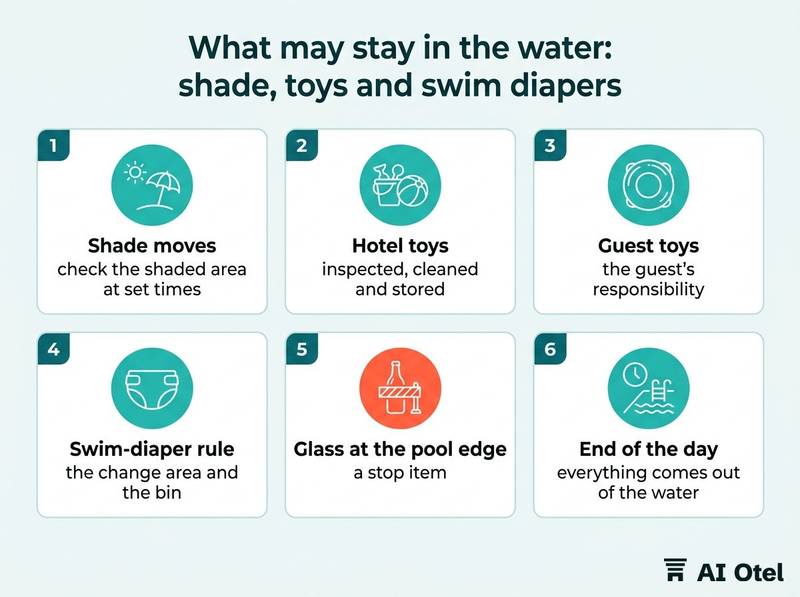
Shade moves: check the shaded area at set times during the day, not once at opening. A bench that was in shade at ten is in full sun at two. Hotel toys and guest toys are treated differently: what the hotel provides is inspected, cleaned and stored; what guests bring stays the guest's responsibility, and the hotel's rule on large inflatables, battery toys and hard plastic is written and applied. Anything that hides the bottom reduces what a supervisor can see, so the plan says where large floats may be used and where they may not.
Diapers need the swim-diaper rule, the change area and the bin next to it. A soiled diaper left on the deck is the next incident, waiting for a bare foot. Food and drink belong where the plan says they may be consumed, and glass at the pool edge is a stop item, not a reminder. At the end of the day everything comes out of the water, the hotel's toys are counted back in, and guest property goes into a labeled lost-property box that is cleaned with the rest. The wider equipment behind this routine is covered in the baby-friendly equipment list and its safety checks.
What goes in the closing record, and what does the weekly review look for?
The closing record proves the day ended in a known state. The weekly review looks for the pattern that no single day's sheet can show.
The closing checks: last guest out, water clear, toys and towels out, skimmers emptied, level at the line, nozzles and covers in place, gate locked, sign intact, readings taken and written. The signature carries a name and a time: a sheet signed at the end of the shift from memory is not a record. The incident sheet holds what happened, when, who was told, what was done and who reopened: facts and times, not opinions about who was at fault.
The weekly review reads the week's sheets together and looks for missed readings, the same item failing repeatedly, a gate propped open, an incident at the same hour of the day. It changes one thing: a review that changes nothing is a filing exercise. Write the change, the date and the person who owns it. How long the sheets and incident records are kept, and who may see them, is the hotel's own policy; set it with your legal adviser, because it touches incident records and personal data.
Key pointThe day is closed when the sheet says who closed it
The day is closed when the sheet says who closed it and what state the water and the area were left in. Everything else on the sheet exists to support those two facts.
What to do next
Write the children's pool sheet this week: one page, opening, interval and closing, a stop list at the top and a name against every line. Then walk the area with the person who will sign it, because the water, the surfaces, the supervision, the sign and the toys are one routine, and the sheet is only the proof that the routine ran. If you want the routine to run inside your hotel's systems rather than on paper, a hotel operating system, built and working ahead of launch, keeps reservations, front desk, housekeeping, reports and compliance in one place, and a written checklist can sit alongside those records; the wider platform is described here. And if you are reading this as a parent rather than a hotelier, you can browse hotels in Türkiye (opens in a new tab) and ask each one what its children's pool routine is.
Frequently asked questions
How often should the children's pool water be tested?
The interval is set in the hotel's own pool plan, and it is normally shorter than the main pool's because the volume is smaller and the bather load is high. What matters is that the interval is written, each reading carries a time and a name, and a reading outside the plan's range closes the pool until it is corrected and recorded.
Do we need a lifeguard at the children's pool?
The hotel decides what supervision it provides and must publish exactly that. The sign, the welcome letter and the sentence staff use all have to match the staffing. An attendant without rescue training is not a lifeguard, and labeling one as a lifeguard creates the risk the sign was meant to remove.
Can a child in a swim diaper use the main pool?
That is the hotel's own rule, written once and applied by everyone at every pool. Whatever the rule, the change area, the bin beside it and the deck cleaning routine are part of it, and the rule is printed on the sign in the guests' languages.
What should we do with toys left in the water overnight?
Take them out at closing, clean and store the hotel's own toys, and put guest property into a labeled lost-property box. Anything left in the water hides the bottom from the person on the post and blocks the skimmers, so the closing check treats the water as empty.
Who signs the daily checklist?
The person who did the check, by name, at the time of the check. A supervisor countersigns the week and reads the sheets together. A sheet signed at the end of a shift from memory records an intention, not a check.