A water slide and aquapark opening check: the daily routine before the first guest
A water slide opening check is a fixed walk and test completed before the first rider. This guide covers the daily routine for structure, water flow, and staff positions.
AI draft · awaiting editorial review
Contents
Key takeaways
- The opening check is a fixed route in a fixed order, so a new seasonal attendant can repeat it without judgment.
- Flow and clarity come before chemistry: a slide needs a moving film of water, and the bottom of the run-out must be visible from standing height.
- Every position watches one thing, and anyone working the slide can stop the ride without asking permission.
- Stop conditions are written before the season starts, so the decision in bad weather belongs to the rule, not to whoever is on the tower.
- The daily sheet is the record: times, initials, readings, every stop with its reason, defects and who was told.
A water slide opening check is the fixed walk and test a supervisor completes before the first rider: slide shell, joints, handrails and signs, then water clarity, level and pump flow, then attendant positions. It is a routine with a written sign-off, not an inspection, and the manufacturer's manual sets every limit.
The first guest is already on the stairs at nine, and nobody has walked the slide yet. What separates a routine morning from an incident is usually a fixed order of checks, done by a named person, and signed. This article gives you that order: the opening walk, the water and pump checks, the attendant positions, how to hold the rules at the top without an argument, the stop conditions, and the closing record. You can hand it to a new seasonal attendant on their first morning.
What does a water slide opening check cover?
It covers three things in order: the structure and the ground around it, the water that carries the rider, and the people who run the ride. Pool chemistry is a separate daily job and replaces none of them. If you want the water side of measuring and correcting pH and chlorine each day, that is its own routine; the slide check answers whether the ride itself is fit to run.
The manufacturer's operating manual is the authority for every limit: water flow, minimum depth at the run-out, rider height, riders at a time, wind. The hotel builds its own sheet from that manual, not from memory or from last season's habits. Where the manual and local practice disagree, the manual wins, and the disagreement goes to technical service in writing.
The same person walks the same route at the same time each morning and signs it. A supervisor signs after a spot check of the run-out and the joints, not instead of the walk. The sheet stays at the aquapark for the season: a defect found on Tuesday is visible on Wednesday to whoever opens, which is the whole point of writing it down.
For example, a two-slide tower sharing one landing pool is one person's short walk. A park with six slides and three landing pools splits the route between two people, each signing their own part. Nothing about the ride is decided at the top of the stairs by whoever is on duty that morning. The sheet and the manual decide, and the attendant applies them.
The opening walk: what do you check on the slide itself?
Walk the rider's route from the entrance gate to the end of the run-out, and look at what the rider touches, what carries them and what they land in. The order matters because the run-out and the joints are the parts people skip when they are in a hurry.
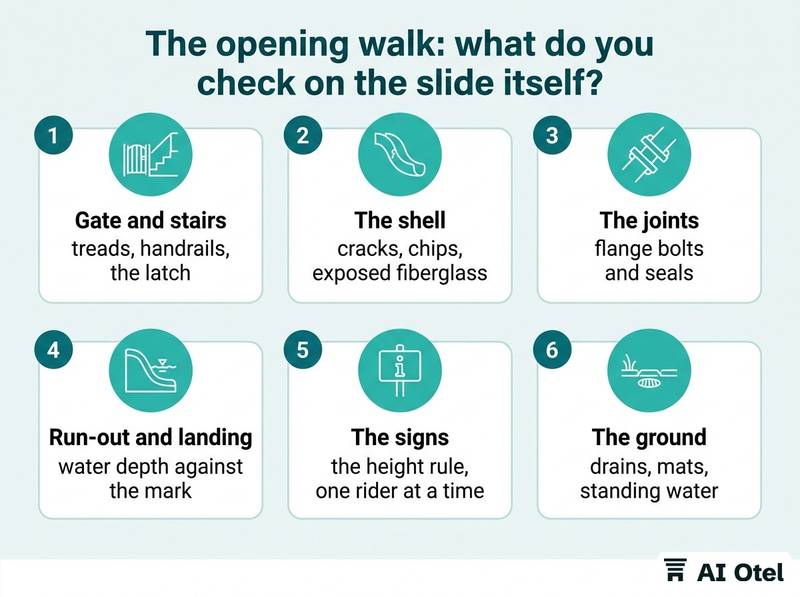
Start at the gate and the stairs: treads, handrails, the latch, and whether the queue line is holding standing water. Then the shell: cracks, chips, exposed fiberglass, worn gel-coat and patches that have lifted. A rough patch slows a rider and can graze skin. The joints come next: flange bolts and seals between shell sections, and the seal where the slide meets the tower. A missing bolt is a stop, not a note for later.
Finish at the run-out and the landing: water depth against the mark, exit steps, the handrail, and the area where riders stand up and walk out. Check the signs: the height rule, the rider-position picture, one rider at a time, the depth marking, and the languages your guests actually read. Finally, the ground: drains, mats, standing water, and the wet route a guest walks back to the stairs, which is where most slips happen rather than on the slide itself.
Checklist
- Entrance gate and latch working
- Stair treads and handrails sound
- Queue line surface free of standing water
- Slide shell: no cracks, chips or lifted patches
- Flange bolts and seals present at each joint
- Run-out water depth at the mark
- Exit steps and handrail clear
- Landing area clear of objects
- Height and rider-position signs legible and undamaged
- Drains and mats in place
- Route back to the stairs walkable and dry-drained
Which water and pump checks come before the first ride?
Flow, level and clarity come first, because the ride depends on them. Chemistry runs on the pool's own schedule and tells you nothing about whether the slide can run.
The pump must be running and steady before anyone climbs. A pump started late gives a thin film and a rider who slows or stops mid-slide. Check the flow at the run-out: the water film should cover the slide surface the way the manual describes, and a dry patch on a straight section is a stop. Watch the water level at the intake: too low pulls air, the flow breaks up, and the pump runs hot for the rest of the day.
Clarity is a safety reading, not a comfort one. You must see the bottom of the run-out and the landing from standing height, because cloudy water hides a rider who has not stood up yet. Empty the strainer basket and hair-litter trap before opening: a blocked basket shows up as falling flow within the hour, usually at the busiest moment. Backwash and filter work stay on the plant's own log and never run during opening hours, since a backwash changes the level and the flow while people are on the stairs.
| Check | What good looks like | Who signs |
|---|---|---|
| Pump running | Steady, no cavitation noise | Attendant or technician |
| Flow | Film covers the surface per the manual | Attendant |
| Water level | At the intake mark | Attendant |
| Clarity | Run-out bottom visible from standing height | Attendant |
| Strainer basket | Emptied before opening | Technician |
| Chemistry | Taken on the pool's own schedule | Pool staff |
| Readings | Written with time and initials | The person who took them |
A tick with no number cannot be checked by the next shift. Readings go on the sheet with the time they were taken.
Who stands where, and what does each attendant watch?
Each position watches one thing: the top controls dispatch, the bottom controls the landing, and the entrance controls who reaches the stairs at all. One person holds one position for a set block, rotation is scheduled, and the handover is spoken out loud, never assumed from the clock.
| Position | Watches | Can stop the ride |
|---|---|---|
| Top and dispatch | Rider position, gate, one rider at a time, signal from the bottom | Yes |
| Bottom and run-out | Riders standing and clearing, water depth, release signal | Yes |
| Entrance and queue | Height check, swimwear, stairs uncrowded | Yes |
| Splash area | Its own sightlines, separate from the run-out | Yes |
| Supervisor on call | The whole park, stop log, escalations | Yes |
The splash area and children's pool is a separate position with its own sightlines, and it has its own routine, covered in the children's pool and splash area daily checklist. A slide attendant watching the run-out is not watching the toddlers, and should not be asked to. The whistle or radio stop signal is the same across the park, and every attendant knows it before the first shift of the season.
If a position is unstaffed, the slide does not run. There is no version where one person covers the top and the bottom at once.
How do you hold the rules at the top of the slide without a confrontation?
Say the rule once in the guest's language, give the reason in one sentence, offer the alternative, and hold the queue until it is followed. The top of the stairs is the worst place in the park for an argument.
Rules that get argued about are usually rules nobody read. The sign sits at the bottom of the stairs while the decision happens at the top, so put the height gauge and the rider-position picture where the queue waits. The three that come up most are height, one rider at a time, and what cannot be worn, which is the hotel's own list rather than a general one. The wider question of which signs guests actually read is its own topic, covered in pool rules and the signs guests actually read.
Offer the alternative before the refusal lands: the shallow pool, the splash area, or a slide with a lower height rule. Never negotiate while a rider is on the slide: stop dispatch first, then talk, then restart. Escalation is a named person and a radio channel, not an instruction to find a manager somewhere in the park.
TipA four-line script for the top position
Name the rule. Give the reason in one sentence. Offer the alternative. State what happens next. Dispatch stops before any conversation starts.
Log refusals that turned into complaints. If the same rule fails at the same hour on the same slide, the problem is the sign or the position, not the guest.
When should the ride stop? Weather, noise and the queue
The stop conditions are written before the season and posted at the plant, so the decision in bad weather belongs to the rule rather than to whoever is on the tower.
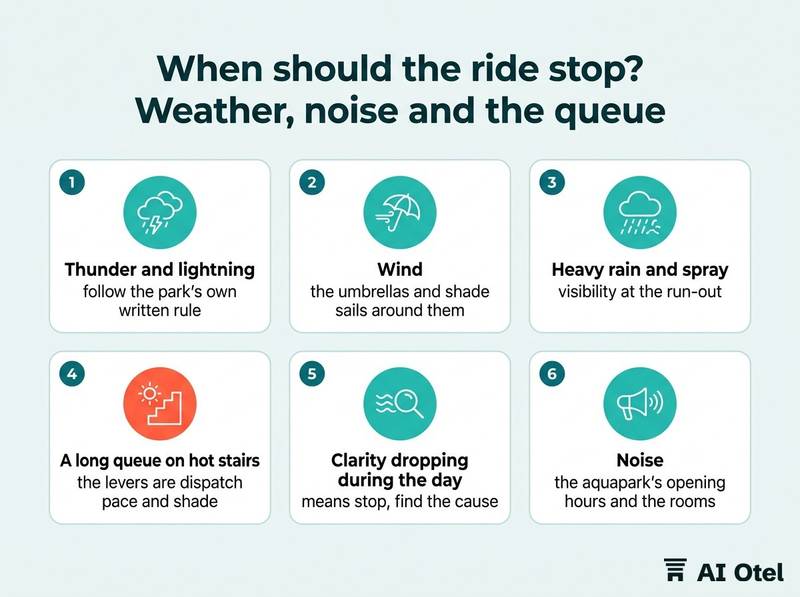
Thunder and lightning follow the park's own written rule, agreed with the manual and the hotel's safety plan, with a clear-all signal and a set wait before reopening. Wind is less about the slides than the umbrellas and shade sails around them: the risk is what blows into the run-out and what falls onto the stairs. Heavy rain and spray raise the question of visibility at the run-out, and whether guests will queue on wet stairs at all. A long queue on hot stairs is its own risk, and the levers are dispatch pace and shade, never a shortened check.
Clarity dropping during the day means stop, find the cause, and do not run on the hope that it clears by itself. Noise is a neighbor question: the aquapark's opening hours and the rooms that face it, and the supervisor's log is what the front desk reads when a guest calls at eleven at night. Every stop is logged with the time, the reason and who decided. A stop without a record is a story, not a fact.
Watch outStop conditions to write down before the season
Each with who decides and who is told: thunder and lightning; a pump or flow fault; clarity below the point where the run-out bottom is visible; a rider who will not follow the rules after one warning; a position left unstaffed; a structural defect found during the day.
What goes on the closing walk and the daily record sheet?
The closing walk repeats the opening route in reverse and ends at the sheet: what was found, what was fixed, and what was handed to technical service.
After the last rider, close the gate and the stairs. The slide is not assumed empty because the queue looks empty. Walk the run-out and the landing for a guest who has not left, for lost property, and for damage that happened during the day. Set the pumps off or on the night setting as the plant requires, and return the valves to where they started.
Checklist
- Date
- Opening and closing time
- Initials: opening walk, water and pump check, each attendant position
- Readings with the time taken
- Every stop: time, reason, decision-maker
- Defects found, fixed or handed on
- Supervisor signature
- Handover note to the next shift
A defect that was not fixed appears on the next morning's sheet in the same words, so nothing is lost between shifts. Incidents get their own record with their own fields; a line on the aquapark sheet is not an incident report, and the fuller routine is described in what to record after an accident, a theft or a dispute.
What to do next
Write the sheet before the season, take it from the manufacturer's manual, and walk the route once with the person who will sign it. The check works because it is the same every morning: the walk, the water, the positions, the stop rules and the closing record are one routine, and the signed sheet is what proves it happened. Hotels that want the daily record to live inside their management software, next to reservations and maintenance, can look at how a hotel operating system organizes daily operations, or the wider platform overview.
If you are reading this as a guest rather than an operator, you can find a hotel in Türkiye with the aquapark set-up you want at trbnb.com (opens in a new tab).
Frequently asked questions
How long should a water slide opening check take?
There is no fixed time: it depends on how many slides and landing pools the park has and how far apart they are. What matters is the order, because the run-out and the joints are the parts people skip when they are in a hurry. A supervisor's spot check follows the walk rather than replacing it.
Who trains a seasonal slide attendant, and what should the training record hold?
The hotel trains its own attendants, and the record is what shows it happened: name, date, who did the training, which positions the person was signed off on, and the date they were first left alone at a position. The content follows the manufacturer's operating instructions and the hotel's own written procedure. The hotel confirms what its operator and insurer expect.
Who has the authority to stop the ride?
Anyone working the slide, without asking first. The supervisor is told immediately afterward, and the stop goes on the sheet with the time, the reason and who decided. A rule that only a manager can stop the ride is a rule that waits too long.
How is the slide check different from the pool check?
The pool check is about water that is fit to swim in: chemistry, clarity, the pool surround. The slide check is about the ride: shell and joints, flow covering the surface, depth at the run-out, staffed positions. Neither replaces the other, and the splash area has its own round.