A standing overflow agreement with a nearby hotel: terms to agree before the night you are full
A standing overflow agreement turns a midnight crisis into a routine instruction. Learn the six clauses to agree with a nearby hotel before the season starts.
AI draft · awaiting editorial review
Contents
Key takeaways
- An overflow agreement is a one-page note between two hotels, signed before the season, not a contract with a channel and not a promise to send a minimum number of rooms.
- The rate clause matters less than the difference clause: agree in advance who pays the gap between what the guest paid you and what the partner charges.
- The hotel that took the booking keeps the reservation, the guest relationship and the review; the partner provides the room.
- One log line written at the moment of the move and one monthly statement turn a series of favors into a record both hotels can check and pay.
- Review the note after the season and after any case that produced a complaint, because a partner's rates, standard and night staffing drift.
A hotel overflow agreement with a nearby hotel is a short written note between two properties: which rooms a full hotel may send to the partner, at what rate, who pays any difference, how the guest is moved and told, and how each case is recorded and settled. It is signed before the season, not on the night it is needed.
It is 23:40. A guest with a confirmed reservation is standing at the desk, and the front office manager is calling a hotel two streets away that has never taken one of your guests. The rate, the room type, the taxi, who says what to the guest: all of it is being decided now, by whoever answers the phone. After reading this guide you will be able to choose a partner, write the six clauses, decide who talks to the guest and the channel, and run a log and a monthly settlement that both hotels trust.
Why agree with a neighbor before the night you are full?
Because at the desk, at night, you are negotiating with no time and nothing agreed. A standing note turns that call into an instruction your front office can follow.
The problem is rarely the absence of a nearby hotel. It is the absence of a decision: room types, rate, transport and the authority to say yes are all settled live, by a receptionist, at the worst possible moment. A written note fixes the four things that go wrong: which rooms, at what rate, who pays the gap, and who is allowed to authorize the move.
It also fixes the guest's experience, because the wording, the name at the partner's desk and the car are the same every time instead of being invented under pressure. The agreement does not replace walking a guest properly; it is the standing version of it, so the walk follows a known route instead of a phone call. For the act itself, read how to walk a guest when your hotel is overbooked.
The note also separates two decisions that get confused. Whether to oversell is a revenue decision made in advance from your own pickup data, covered in how many rooms to oversell, from your own data. What to do when a room is missing is an operational decision, made once, in writing.
Name an owner inside the hotel. The general manager signs the note, the front office manager keeps it at the desk, and the sales manager knows it exists and does not negotiate a second version.
How do you choose the right partner hotel?
Choose a hotel a guest would accept without feeling downgraded: similar standard, similar board, close enough to walk or a short ride, and with a desk that answers at night.
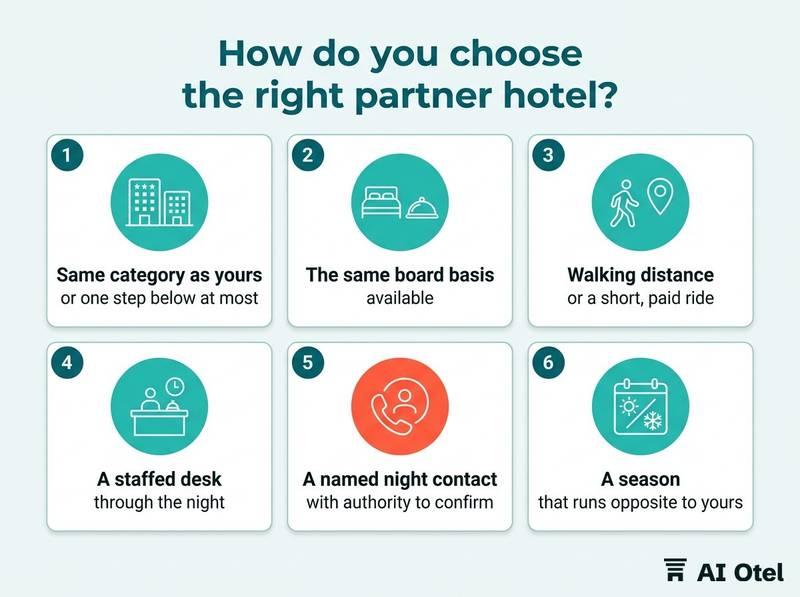
Match category, room size and board basis, not just the price. A guest who booked a four-star room with breakfast should not be sent to a two-star property with no food service. Distance decides the guest's mood: a partner five minutes away can be walked to with the luggage, while a partner across town needs a car, a promise about the morning and someone to carry the bags.
Look for complementary seasons. The best partner is busy when you are quiet, so the arrangement can run in both directions and neither side feels like it is only giving. Ask how many rooms the partner can take at once, and who at their desk can confirm at two in the morning; a partner who needs the owner's approval is not a night partner.
Keep a second and a third name on file, because on a peak night your first partner is often full for the same reason you are. Check the market overlap too: a hotel selling hard into the same source markets is your competitor next month, so keep the note commercial and specific rather than strategic. Finally, look at the partner the way a guest will: the lobby at night, the desk staffing, the recent reviews.
ChecklistPartner checklist
- Same category as yours, or one step below at most
- The same board basis available
- Walking distance or a short, paid ride
- A staffed desk through the night
- A named night contact with authority to confirm
- Capacity for at least your usual peak shortfall
- A season that runs opposite to yours
- A second and third property kept on file
What should the written note cover?
Six things: rooms, rate, the difference, payment, transport and the guest's bill. If a clause is missing, the person at the desk will invent it.
Rooms come first: the room types and a cap per night, plus whether the cap can be raised by a phone call and by whom on each side. The rate clause should be a formula, not a number: either a fixed net rate the partner charges you, or the partner's own rate with the difference settled between the hotels. A formula survives the season and the partner's price changes.
The difference clause is the one that produces the argument in January. Say plainly who pays the gap between what the guest paid you and what the partner charges. The payment route needs one choice: either the guest pays the partner and you refund or credit what they paid you, or you pay the partner and the guest's bill stays with you and closes as normal. Leaving both open is how a guest ends up paying twice.
| Item | What the note says | Why it matters at the desk |
|---|---|---|
| Rooms and cap | Room types and a maximum per night, plus who can raise it | The receptionist knows what can be promised without a call |
| Rate formula | Fixed net rate, or partner rate with a settlement formula | The price does not change because the night did |
| Who pays the difference | One named payer for the gap | The January argument is settled in advance |
| Payment route | Guest pays partner, or you pay partner; one route only | The guest cannot be charged twice |
| Transport and who pays | Who books the car and who pays, including at night | The move happens even when the taxi office is closed |
| Guest's extras at the partner | Extras belong to the partner; your bill closes at the transfer | Both bills close cleanly at check-out |
| Validity, notice and exit | A period, a notice term, and no minimum room commitment | Either side can leave without a dispute |
Transport deserves its own line: who books the car, who pays for it, and what happens at three in the morning when the taxi company is closed. The guest's extras, such as minibar, breakfast or the phone, belong to the partner, and your bill closes at the transfer unless the note says otherwise. Close with duration and exit: a validity period, a notice period to change or end it, and one line stating that the note is not a commitment to send a minimum number of rooms.
Who tells the guest, and who tells the channel?
The hotel that took the booking tells the guest and keeps the reservation; the partner provides the room. The channel is told by the hotel holding the reservation, and only if the reservation itself changes.
The guest hears it from you, in your name, before arrival if you know in advance and at the desk if you do not. The partner should never be the first person to explain the move. Say what is true and useful: the room is at another hotel of the same standard, at our cost, with transport arranged, and here is what happens at breakfast and at check-out. Give the guest a name and a number at the partner, and your own number for anything that goes wrong during the stay.
Keep the reservation in your system with a note: relocated, to which property, on whose authority, at what rate. Do not delete it and do not re-create it as a new booking, or the guest's history and the bill will not match. This is one reason room assignment and reservation notes belong in one place; the same discipline applies to assigning rooms before arrival and handling special requests.
On the channel side, if the guest keeps the same dates and the stay is honored, there is nothing to cancel. If the dates or the recorded property change, follow the channel's own change process rather than a cancellation, as described in when the hotel has to cancel a confirmed booking. The review will land on the hotel the guest booked, so ask for it and answer it honestly rather than pointing at the partner. Never send a guest to a property whose name and address you have not given them in writing.
Watch outNever move a guest silently
A guest who arrives at a hotel they did not book, without being told, is a complaint and a review, whatever the room is like. The move is explained by the hotel that took the booking, every time.
How do you record each case and settle the month?
One line per case in a log both hotels can see, and one statement per month that each side checks against its own records before anyone pays.
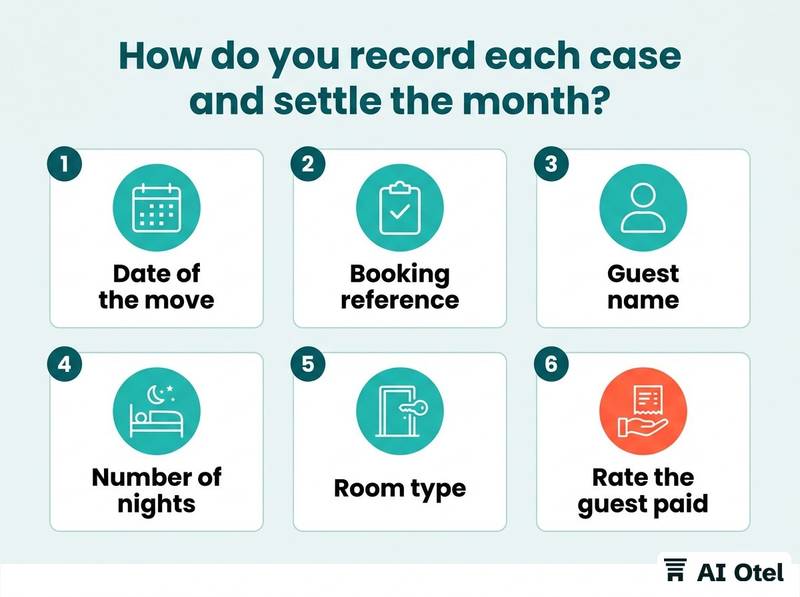
Log at the moment of the move, not the next morning. Agree the log format inside the note, so the two sides are not comparing two different spreadsheets at the end of the month. If your property management system keeps reservation notes, put the log line there as well, so the case sits with the booking when someone later asks about the bill or the review. A hotel operating system that holds reservations, notes and billing in one place makes this easier, because the log line and the guest's account stay together.
ChecklistLog fields
- Date of the move
- Booking reference
- Guest name
- Number of nights
- Room type
- Rate the guest paid
- Rate the partner charges
- Difference and who pays it
- Transport cost and payer
- Name of the person who authorized the move
- Confirmation reference from the partner
Monthly, the partner sends a statement of the rooms it provided, you match it line by line to your log, and any difference is raised before payment rather than after. The partner invoices for the rooms it provides; how the two hotels document the transfer and the difference is a question for your accountant, and the answer should be written into the note.
Read the totals each month. The number of cases and the average difference tell you whether the arrangement is working or quietly covering a planning problem. Keep the log with the reservation record, so a question about a guest's bill, a refund or a review can be answered from the file rather than from memory.
When should you review the arrangement?
After the season, and after any case that produced a complaint, a cost you did not expect or a night when the partner was full.
Triggers for an early review: a complaint from a relocated guest, a partner who could not take rooms on a peak night, a rate formula that no longer matches either hotel's prices, or a change of manager or owner at the partner. What to look at: how many cases there were, the average difference paid, how many guests returned to you the next morning as planned, and what the guests said afterwards.
What to change is usually the cap, the rate formula, the transport arrangement, and the list of people allowed to authorize a move on each side. Renew in writing before the next season starts; an agreement nobody re-signed quietly becomes a memory of an agreement, and the desk stops trusting it. Keep the note short, because a document nobody can read at 23:00 is not an operating document, however complete it looks in a folder.
TipKeep it to one page
Put both night phone numbers at the top, and store a copy at the front desk rather than only in the manager's mailbox. The person who needs the note at midnight is the person on shift.
What to do next
Write the note this month, before you need it: one page, two signatures, the night numbers at the top, and a log format both hotels accept. Then the pieces fit in order: choose a partner a guest would accept, agree the six clauses, decide who tells the guest and the channel, log every case and settle monthly, and review it after the season. The next time the desk is short a room, the decision has already been made and only the call is left. If you want the same discipline on the selling side, where hotels publish contracted rates to travel agencies on their own terms, read about how a distribution hub publishes rates to travel agencies. That hub is built, with seed data; no agency is connected yet.
Frequently asked questions
What is the difference between walking a guest and an overflow agreement?
Walking is the act of moving a guest whose room is not available. An overflow agreement is the standing arrangement that makes the act routine: rooms, rate, difference, transport, guest wording, logging and settlement agreed in advance. The agreement does not decide when to move anyone; it decides the terms if you do.
Should the guest pay the partner hotel or should we?
Both routes exist and both work, but only one should be in the note. If the guest pays the partner, you refund or credit what they paid you. If you pay the partner, the guest's bill stays with you and closes as normal. Whichever is chosen, the guest must not pay twice or be asked to settle the difference at the partner's desk.
What happens if the partner hotel is also full?
The note should name a second and a third property and say who calls them. The front office should never be searching for a room at midnight. If every partner is full, the case becomes a walk handled on its own terms, with the guest told by you and the record kept with the reservation.
Does an overflow agreement mean we can oversell on purpose?
No. It lowers the cost of a shortfall; it does not make the shortfall free. How many rooms to oversell is a separate decision taken from your own pickup data, and the agreement should never be used to justify a number nobody calculated.
How much notice should we give the partner before sending guests?
As much as the situation allows, and the note should set a target: a call as soon as the shortfall is known, and a confirmed room count by a stated hour, with a night-time fallback for cases discovered at the desk. For example, a hotel might call at 16:00 for the same evening and again at 22:00 if the count changes.