A time study of a room clean: how to set minutes per room from your own floors
Stop using borrowed cleaning times. This guide shows how to run a two-week time study on your own floors, separate cleaning from walking, and build a fair daily room load.
AI draft · awaiting editorial review

Contents
Key takeaways
- A minutes-per-room figure is the output of one building, one room mix and one linen system, so it cannot be moved to another hotel and still be true.
- Time departures, stayovers, suites and deep cleans as four separate jobs, and write down where the clock starts and stops before the first observation.
- Walking, restocking and waiting belong in the daily load as a named allowance, not hidden inside the cleaning time.
- Build the day's load from the day's room mix, express it as a range with a floor and a ceiling, and plan the breaks around the load rather than the other way round.
- Re-time the standard every season and after any change to the rooms, the linen or the cleaning sequence, and put a date and a version on it.
Housekeeping minutes per room is the standard time one room takes to clean, measured on your own floors rather than borrowed from another hotel. Time departures, stayovers and suites separately over two weeks, record walking, restocking and waiting on their own, then turn the result into a daily room load your attendants accept as fair.
For example: a general manager comes back from a sister property with a number, sixteen rooms per attendant per shift, and asks why your floors are slower. Nobody has timed a checkout clean on these corridors, with the linen store two floors down and a lift that stops at every landing. After reading this, you will be able to run a two-week time study on your own floors, separate cleaning from walking and waiting, and turn the result into a daily room load built from your building, not someone else's.
Why does a borrowed minutes-per-room figure fail on your floors?
Because a minutes-per-room figure is not a fact about cleaning. It is the output of one building, one room mix and one linen system, and moving it to another hotel moves the answer without the conditions that produced it.
The number travels without its conditions: room size and layout, bathroom configuration, carpet or hard floor, balcony, number of beds, whether attendants strip their own beds or a runner takes the linen, and how far the trolley has to travel. Two hotels can quote the same figure and be describing entirely different jobs. The layout of the floor and the organization of the work, as covered in a housekeeping organization chart by hotel size, change the number as much as the cleaning itself does.
A borrowed figure also hides what is inside it. Walking, waiting for rooms to be released, restocking, linen handling and the wait for inspection are all folded into one number, so nobody can see which part is the building's problem and which is the attendant's pace. The building sets a floor under the time that no effort can remove: distance to the linen store, lift waiting, floors per attendant, and where a trolley can safely park in the corridor.
The real danger is what the number becomes. A target with no measurement behind it is met by shortening the visible parts of the clean: the bathroom first, then the high dusting, then the check under the bed. And your own mix decides your own average: a hotel with a morning departure wave and a hotel with mostly stayovers have different days even when the rooms are identical.
Watch outA borrowed number is a target, not a standard
A figure copied from another hotel, or a round rule of thumb such as 20 minutes a room, has no measurement behind it. Used as a daily quota, it pushes attendants to cut the parts of the clean a guest notices last.
A usable standard looks different: a written, dated description of the work with each element named, built from observations on your floors, and revised when the building or the room mix changes. Before the stopwatch, fix the organization of the floor, because who does which task changes the number as much as the cleaning does.
What should you time, and where does the clock start and stop?
Time four different jobs separately: the departure clean, the stayover clean, the suite or large room, and the periodic deep clean. Define the start and the end of the clock in writing before the first observation, or the study measures the observer instead of the room.
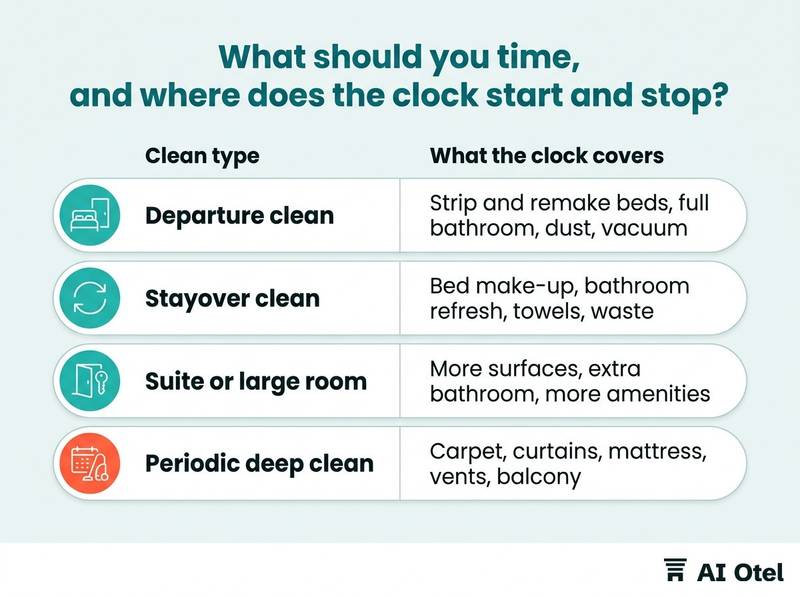
A departure clean covers stripping and remaking beds, the bathroom, dusting, vacuuming, restocking, waste and the final walk-through before release. A stayover clean is a refresh: bed make-up, bathroom refresh, towels, waste, restock and the floor, usually without a linen change unless your policy says otherwise. Suites, family rooms and connecting rooms have more surfaces, more bathrooms and more amenities, so they are timed as their own class rather than folded into the room average. The periodic deep clean, covering carpet, curtains, mattress, vents and balcony, rarely appears in the daily load but consumes attendant hours, so time it once and schedule it as a separate block.
| Clean type | What the clock covers | Why it is timed separately |
|---|---|---|
| Departure clean | Strip and remake beds, full bathroom, dust, vacuum, restock, waste, walk-through | A full reset with the most tasks; the day's largest block of minutes |
| Stayover clean | Bed make-up, bathroom refresh, towels, waste, restock, floor | A refresh, not a reset; a different job with fewer tasks |
| Suite or large room | More surfaces, extra bathroom, more amenities | Cannot share an average with standard rooms without hiding the suite |
| Periodic deep clean | Carpet, curtains, mattress, vents, balcony | Consumes hours outside the daily load; needs its own scheduled block |
The clock boundaries matter as much as the tasks. Decide whether the clock starts when the attendant knocks and enters or when the trolley stops outside the door, and whether it ends when the room is ready for inspection or when the attendant leaves. Both choices are defensible; mixing them inside one study is not.
Decide what sits inside the clean and write the list down: bed stripping, carrying linen to the trolley, balcony, minibar restock, final check. That list becomes the definition the standard rests on. Room status words differ between hotels and between property systems, so write your own definitions for a ready room, an occupied room and an out-of-order room, and use those words on the sheet. For the task order itself, follow a step-by-step room cleaning order for attendants so every observation times the same sequence.
How do you run a two-week time study with a simple sheet?
Record a start time and an end time for each room, over two weeks, spread across days, floors and attendants, until each clean type shows a stable range rather than a single figure.
For example, aim for ten to fifteen observations per clean type, spread over arrival-heavy and quiet days, over weekdays and the weekend, and across at least three attendants, so one fast or slow person does not become the standard. One row per room, never one row per shift.
Who holds the watch is a real decision. Attendants recording their own rooms covers many rooms cheaply but drifts over two weeks; a supervisor timing a sample is accurate but covers few rooms. Run both on the same days and compare. Record interruptions on their own line: a guest returning to the room, a missing item, a maintenance visit, a room move. Left inside the room time, the standard absorbs problems that are not cleaning.
Do not average on the first day. Look at the spread first: a wide spread usually means the definition of the clean is not yet stable, or the floors are not comparable. Keep the raw sheets with the date and the observer's name, because the standard is only as good as the record a supervisor can put on the table later. Two weeks is a starting sample, not a permanent truth; the purpose is to see a repeatable range and the reasons the slow rooms are slow.
ChecklistThe study sheet and the steps
- One row per room: date, floor, room number, room type, clean type, attendant code
- Start and end times for the room
- Interruption minutes and a reason, on their own line
- A free note column for conditions: guest in room, faulty item, blocked corridor
- A supervisor sample timed on the same days, for comparison
- Raw sheets kept with the observer's name and the date
How do you separate cleaning from walking, restocking and waiting?
Measure the non-cleaning elements on their own, because they are the part a supervisor can change without touching the cleaning standard.
Walking covers the distance between rooms, to the linen store, to the service lift, and back for a missing amenity. The distance is set by the building; the number of trips is set by how the trolley is stocked and how the rooms are ordered. Restocking covers loading the trolley at the start of the shift, refilling during it, and the return at the end: a trolley that runs out at the far end of a corridor costs a full round trip. Waiting covers rooms not yet released by departing guests, a room move the front desk has not confirmed, an inspection, a lift. Interruptions cover guests in the corridor, a request from an occupied room, and a room that needs maintenance before it can be cleaned.
The observation method is simple: follow one attendant for a morning and mark every time the trolley stops and why. You get the ratio of cleaning to non-cleaning without putting a stopwatch on every task. Then look at what you can change: trolley stock levels, the order rooms are cleaned in, where linen is held on the floor, grouping rooms by floor, and the hour at which rooms are released. What you cannot change is the layout of the building.
TipThe trolley-stop tally
One attendant, one morning, a sheet with two columns: time, and the reason the trolley stopped. At the end, count the stops that were cleaning and the stops that were walking, restocking, waiting or interruption, and read the ratio.
Finally, add the non-cleaning time back as a visible allowance in the daily load, so it is named in the plan instead of disappearing inside the clean.
How do you turn measured times into a daily room load?
Multiply each clean type by its measured time, add the non-cleaning allowance, and divide the shift by the result. Then express the answer as a range with a floor and a ceiling, not as one number for every day.
Build from the mix, not the average: a day of 40 departures and 70 stayovers is not the same working day as 110 stayovers, even at the same room count. The following table is an illustrative example only, not a benchmark; your own measured times replace every figure in it.
| Room type | Measured minutes | Rooms in the day | Cleaning minutes |
|---|---|---|---|
| Departure | 35 | 40 | 1,400 |
| Stayover | 18 | 70 | 1,260 |
| Suite | 50 | 10 | 500 |
| Subtotal | 120 | 3,160 | |
| Non-cleaning allowance (25%) | 790 | ||
| Total | 3,950 |
In this example, 3,950 minutes at 420 productive minutes per attendant-shift gives about nine and a half shifts. Set a floor and a ceiling on the load: the ceiling is what a person sustains across a full shift with breaks, and the floor protects quality on the days when the mix turns hard. Plan the breaks into the load: a fixed mid-morning pause and a lunch window that the room assignment respects, rather than a pause that happens when the corridor is finally empty.
Working hours, breaks and rest periods are questions for the hotel's own contracts, its HR practice and, where the hotel needs one, an adviser. The time study sets a workload, not a legal rule.
Publish the standard before the shift: room types, minutes, allowance and the day's expected load, so the assignment is visible and can be discussed at the morning briefing. Recalculate the load each morning from the actual mix. The standard stays; the load moves. To check whether the load is right over time, follow the housekeeping KPIs that show whether the load is right, especially room-ready time and the inspection pass rate.
How do you present the standard to the team so they accept it?
Present it as a measured description of their own work, with their own times on the page, and let them challenge the outliers before the number becomes a daily load.
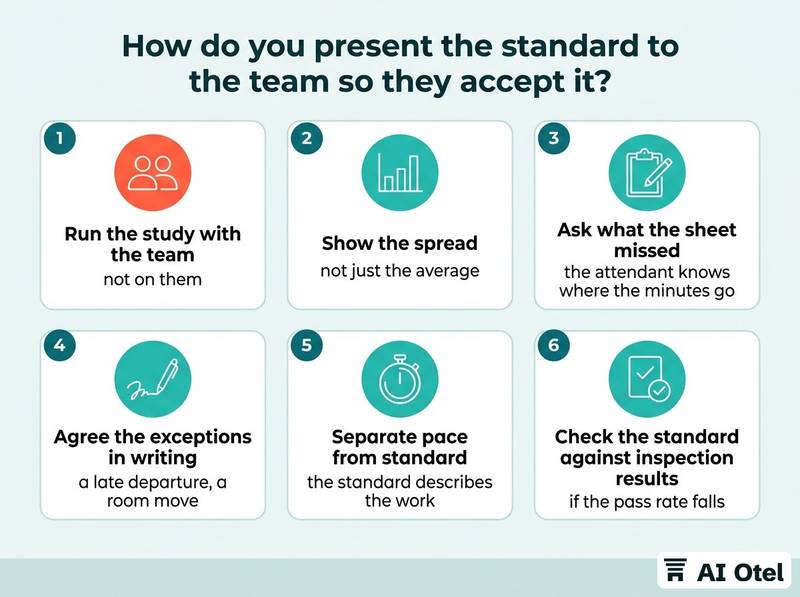
Run the study with the team, not on them: say what is being timed and why, and make clear that the sheet records the room and its conditions, not the pace of the person. Show the spread, not just the average: the fastest and slowest rooms, and the reasons behind them, a suite, a room with a faulty air-conditioning unit, a floor where the lift was full.
Ask what the sheet missed. The attendant knows where the minutes go: the trolley that will not fit through the door, the towel that was not delivered, the corridor blocked by a cart. Agree the exceptions in writing: a late departure, a room move, a deep clean added mid-shift, a new attendant in their first week, a floor with an out-of-order room.
Separate pace from standard. The standard describes the work; how quickly one person moves is a training, support and experience question, not a reason to rewrite the number. And check the standard against inspection results: if the pass rate on room checks, as scored on a room inspection checklist, falls while the load rises, the load is wrong, not the inspector.
Key pointThe number belongs to the building and the room mix, not to the person
- Show the raw spread, not only the average. - Agree the exceptions in writing before the load goes live. - Review the load against inspection results, every month.
What must the number never become, and when do you revisit it?
It must never become a quota that outranks the cleaning standard, a single average that hides the mix, or a figure quoted to the team as an industry benchmark. Revisit it every season and after any change to the rooms, the linen or the cleaning sequence.
Not a punishment: a number used in a disciplinary conversation without the day's mix, its interruptions and its room types is not evidence of anything. Not a race: minutes cut to hit a target come out of the bathroom, the high dusting and the check under the bed first, and the inspection pass rate shows it a few weeks later. Not one average: a single figure for all rooms hides the suite, the departure wave and the floor with the slow lift.
Not a legal rule: the standard is a workload. Hours, breaks and rest are set by the hotel's contracts and by the law, and questions there go to HR and, where needed, an adviser. Not a benchmark: your number describes your building, and published as an industry figure it misleads the next hotel that borrows it, which is exactly how the borrowed number arrived in the first place.
Not permanent: re-time after a refurbishment, a linen change, new amenities, a change in the cleaning sequence, a new property system that changes room statuses, or a shift in the guest mix. Put a date and a version on the standard and keep the old one. Safety sets a floor no target may go below: chemical handling, wet floors, lone working on a floor and heavy linen all take the time they take.
NoteTriggers to re-time the standard
A refurbishment or room change, a linen or amenity change, a new cleaning sequence, a new property system or new room status words, a shift in the guest mix, a new season, and a fall in the inspection pass rate.
Where to start on Monday
Take one floor, one clean type and one week: time ten departure cleans on the sheet, with the clock boundaries written down, and see the spread before you set anything. The rest of the method follows in order: time each clean type separately, measure walking, restocking and waiting on their own, convert the mix into a daily load with a named allowance, present the raw sheets to the team, and put a date on the standard so the next season re-times it instead of inheriting it.
Frequently asked questions
How many rooms should one room attendant clean in a day?
There is no universal number, because the answer depends on the mix of departures, stayovers and suites, the building and the non-cleaning time. Build it from your own measured times, add the walking and restocking allowance, and express it as a range with a floor and a ceiling. Check that the shift, its breaks and its rest periods fit the hotel's own contracts and HR rules.
How much longer does a checkout clean take than a stayover clean?
A departure clean is longer because it includes stripping and remaking beds, a full bathroom, restocking and the final check, while a stayover is a refresh. The useful figure is the ratio from your own floors, measured on the same days with the same clock boundaries. Suites and deep cleans are timed as separate classes again.
Can attendants time their own rooms, or does a supervisor have to watch?
Both, on the same days. Self-recording covers many rooms at low cost but drifts over two weeks, and supervisor spot-timing is accurate but covers few rooms. Compare the two samples, keep the raw sheets with the observer's name and the date, and re-time the outliers rather than averaging them away.
Should walking time be included in the housekeeping minutes per room?
Measure it separately first, then add it back as a visible allowance. Folded into the cleaning time it hides the layout problem, so nobody can tell whether a slow floor is slow because of the clean or because of the linen store two floors down. Keeping it separate means the right problem gets fixed.
How often should the housekeeping time standard be revisited?
Every season, and after any change that alters the work: a refurbishment, a linen or amenity change, a new cleaning sequence, a new property system with different room status words, or a shift in the guest mix. Date and version each standard, keep the old sheets, and re-time rather than adjusting the number by opinion.