Room credits in housekeeping: setting the time per room type and building the daily assignment
A room credit is the standard time a room takes to clean, set per type and status. This guide shows how to measure your own rooms, build a credit table, and assign daily work so each attendant's total credits match the shift, not just the room count.
AI draft · awaiting editorial review
Contents
Key takeaways
- A room credit is a standard time per room type and status; it turns a room list into a workload a supervisor can add up before the shift starts.
- Equal room counts are not equal work: a suite departure and a standard stayover are different jobs, and the gap shows up as overtime at the end of the day.
- Time your own rooms for a week and take the median, not the fastest or the slowest room; the credit belongs to the room, not to the person cleaning it.
- Departures, stayovers, deep cleans and turndown each carry their own credit, and the same room can carry two credits in one day.
- Review the table once a season and after any change to the rooms, the linen or the cleaning standard; a credit that damages inspection results is wrong, not the team.
A room credit is the standard time a room takes to clean, set per room type and status. Measure your own rooms for a week with a stopwatch, take the median time for each type and status, publish it as a credit table, then assign rooms so each attendant's total credits, not room count, match the shift.
Two attendants start the morning with fourteen rooms each. One finishes at four, the other at half past five, and neither sheet was wrong on paper. The difference is what the rooms were. This article shows how to time your own rooms for a week, turn the measurements into a credit table, and build the daily housekeeping assignment on room credits, so the work, not the room count, is what gets split.
Why is an equal room count not an equal workload?
Because rooms differ in the time they take, splitting by count gives some attendants more minutes of work than others while the sheet still looks fair. Three things move the time: the room itself (size, number of bathrooms, balcony, furniture), the room status (departure, stayover, deep clean, turndown) and the state the previous guest left it in.
A departure means stripping beds, a full bathroom clean, restocking, vacuuming and usually a linen change. A stayover means making the bed, refreshing the bathroom, bins and towels. Same room, different job. Counting rooms also hides walking: distance between rooms, floors, the service lift and where the linen store sits on the plan.
The usual result is predictable. The same people get the suites and the far wing, and the fastest attendant is quietly given more work as a reward for being fast. The fix is a common unit. Minutes work, and credits derived from minutes work, because both let the supervisor add up a day before it happens.
Key pointWhat a room credit is
A room credit is the standard time one room takes to clean, expressed in minutes or in points scaled from minutes, set separately for each room type and each room status.
Keep two calculations separate. The staffing plan decides how many attendants the hotel needs overall, and it is built from the same workload numbers; see building a staffing plan from the workload. The credit table decides who does what tomorrow. Sizing the team and splitting one day are different jobs, and confusing them makes both worse.
How do you time your own rooms for a week?
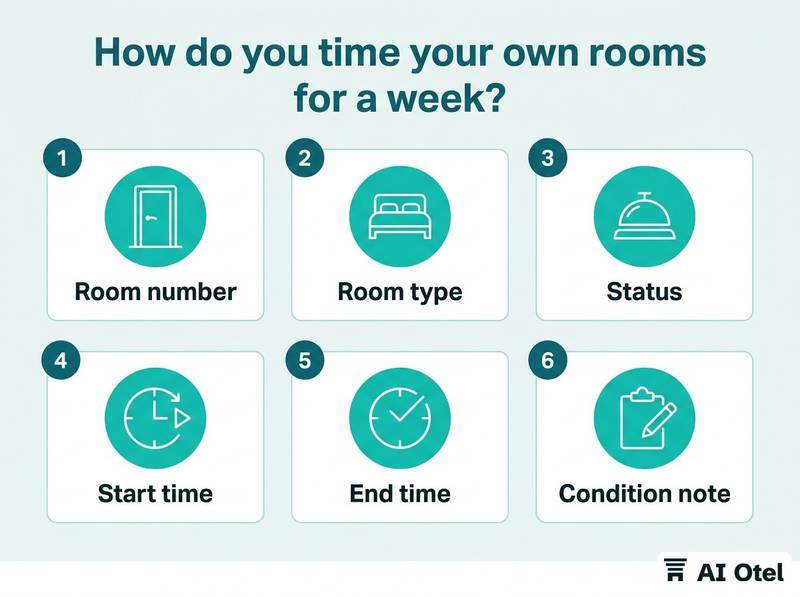
With a stopwatch, a printed sheet and a week of ordinary days: record the start and end of each room by type and status, then take the middle of the range rather than the fastest or slowest room.
Pick an ordinary week at ordinary occupancy. Note the days that are not ordinary, such as a group departure, a staff absence or a maintenance problem, and set them aside instead of averaging them in. Time the whole room, from the moment the attendant enters to the moment she leaves with the cart: stripping, remaking, bathroom, restocking, the final look, the window.
Time several attendants, not one. The point is the room, not the person; a range appears within two or three days. Take the median, not the mean. One room left in a bad state should not move the credit for every room of that type.
Time the fixed tasks that are not rooms as well: corridors, the linen room, trolley restock, lost property, guest requests. They consume the shift and must be visible in the plan. Keep the sheets for the season. They are the evidence the first time an attendant says a credit is unfair, and the baseline for next year's review.
What goes on the timing sheet
Checklist
- Room number
- Room type
- Status (departure, stayover, deep clean, turndown)
- Start time
- End time
- Attendant initials
- Condition note (light, normal, heavy)
- Fixed tasks done outside rooms, with minutes
Condition is the variable people forget, and it explains most of the outliers. One word next to each room is enough to separate a normal departure from one that needs an hour.
How do you turn measured times into credits per room type?
Give each room type and status a credit equal to its measured median time, and publish the table so every attendant can add up her own day.
Minutes are the simplest unit and need no explanation. Points help when you want round numbers, but then keep the conversion visible, for example ten points to fifteen minutes, written on the same sheet. Build the table by room type and status together. Never average across types: a suite stayover and a standard departure are not the same job and should not share a line.
Round to the nearest five minutes. False precision invites argument about two minutes while the real gap is twenty. Add a condition allowance only if you can defend it; otherwise let the supervisor adjust individual rooms and write down why, so the pattern becomes visible over a month.
Treat the credit as a planning target, not a disciplinary threshold. The inspection standard decides quality; the credit decides load. Mixing the two makes the team hide problems. Publish the table where the team can see it: credits work when attendants can check their own sheet and say so early, not at the end of the shift.
| Room type and status | Measured median minutes | Credit | Note |
|---|---|---|---|
| Standard double, departure | 35 | 35 | Full strip and remake |
| Standard double, stayover | 20 | 20 | Bed refresh, bathroom, bins |
| Suite, departure | 50 | 50 | Two bathrooms in this example |
| Suite, stayover | 28 | 28 | Guest belongings limit the work |
| Deep clean | 90 | 90 | Scheduled block, not daily |
| Turndown | 12 | 12 | Evening, separate credit |
For example: this is a hypothetical hotel's credit table. The minutes are illustrative; each hotel must use its own measurements, because a 35-minute departure in one building may be 25 or 45 in another.
What credits do stayovers, checkouts, deep cleans and turndown earn?
Each is a separate line in the table, because each is a different job: a departure earns the most, a stayover less, a deep clean several times a stayover, and turndown a small fixed credit.
Departure is the only status that returns the room to sale, so it carries the full job: strip and remake, full bathroom, restock, vacuum, under the bed, balcony, minibar. Stayover is shorter but not simple: the guest's belongings limit what can be touched and moved, which changes the order of work even when it does not shorten it.
Deep clean is periodic work such as mattresses, curtains, grout, high dusting and behind the furniture. Plan it as a block on a low-occupancy day, not as an extra on a full one. Turndown is a short evening credit, separate from the morning credit. The same room can legitimately carry two credits in one day, and the sheet should show both.
Some rooms deserve an extra credit for circumstances rather than type: a late checkout that compressed the window, a guest in the room during cleaning, a pet, a smoking room. Use the hotel's own status codes on the sheet. Properties label room status differently, so a sheet copied from another hotel creates confusion at the trolley, not clarity.
How do you build the daily assignment sheet each morning?
Start from the room list and each room's credit, total the credits, divide by the credits one attendant can carry in a shift, then balance by floor and by fairness across the week.
Order the work by consequence: departures first because they return rooms to sale, then stayovers, then the rest, with the front desk's expected arrivals setting the deadline. Give each attendant a target band rather than an exact number, so the supervisor can flex when a room turns out worse than expected.
Respect geography. Keep each attendant on one or two floors near her linen store; a perfect credit split across four floors loses the gain in walking and waiting for the lift. Judge fairness over the week, not the day. Rotate suites, rotate the heavy floors, and keep a running total so the same person does not always get the worst sheet.
| Attendant | Floors | Departures | Stayovers | Total credits |
|---|---|---|---|---|
| A | 3-4 | 5 | 7 | 295 |
| B | 5-6 | 8 | 6 | 296 |
| C | 7 + suites | 4 | 9 | 292 |
For example: this is a morning sheet for a hypothetical hotel, and the figures are illustrative. The room counts differ, 12, 14 and 13, while the credit totals sit within a few credits of each other. The sheet is balanced on work, not on room count.
Write the sheet where the team can see it, and make sure it agrees with the room status the front desk and the property management system are working from. Two versions of the truth produce cleaned rooms nobody sells. Leave slack in the plan: a sheet with no room for a late checkout or a spill breaks at the first surprise, and the surprise arrives most days.
The morning sheet sits inside a larger routine of briefings, inspections and handovers; the executive housekeeper's daily routine covers where the assignment fits in the day, and housekeeping organization charts by hotel size shows how the supervisor role changes as the team grows. Where room status already lives in a hotel operating system, the credit table belongs next to it, so the assignment and the front desk's view are the same record; the general shape of such a platform is worth knowing even if you start on paper.
How do you plan for DND rooms and late checkouts?
Reserve them in the plan before the shift starts: a do-not-disturb room is not a zero-credit room, it is a room whose credit moves later, and a late checkout is a room whose window shrank.
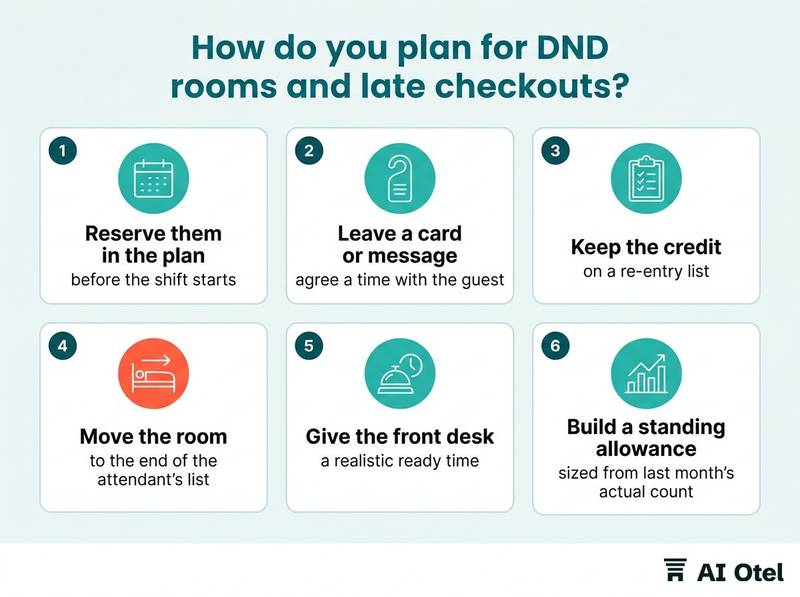
For a do-not-disturb room, leave a card or message, agree a time with the guest, and keep the credit on a re-entry list rather than deleting it. The room still has to be cleaned before it can be sold. If the room stays closed all day, the supervisor decides with the front desk: clean it late, or take it out of sale for the night. Either way the front desk must know before it sells the room.
A late checkout does not change the credit, it changes the window. Move the room to the end of the attendant's list and give the front desk a realistic ready time. Early check-in requests pull against late checkouts; decide the two together, in one conversation between front desk and housekeeping, not in two departments separately.
Build a standing allowance into the sheet for these rooms, sized from last month's actual count, so the plan absorbs them instead of collapsing on the days they cluster. Record what happened each day. Over a season the counts of do-not-disturb rooms and late checkouts tell you how much allowance the sheet really needs.
Watch outNever delete a DND room to balance the sheet
The credit has not disappeared, it has moved to the end of the day, and the room cannot be sold until it is cleaned. Deleting it makes the numbers look right and the evening go wrong.
When should you review the credits?
Once a season, and immediately after any change to the rooms, the linen, the team or the cleaning standard.
Re-time a sample every season. A new mattress, a different linen supplier or a renovated bathroom moves the median, and the table has to move with it. Watch for the two failure modes: credits too tight produce rushed rooms, failed inspections and overtime; credits too loose produce a sheet that finishes early and a team that fills the time.
Compare credits against inspection results and room-ready times, the kind of weekly numbers covered under housekeeping KPIs such as room-ready time and inspection pass rate. If quality falls as credits tighten, the credit is wrong, not the team. Ask the attendants which room type is mispriced; they usually know before the numbers show it, and asking costs one meeting.
Keep the old tables. Changing a credit is a management decision, and it should still be explainable a year later when someone asks why the suite is worth what it is worth. Publish the review outcome to the team in the same place as the table, so the sheet never looks arbitrary.
What to do next
This week, take a stopwatch and the timing sheet into one floor and time ten rooms across two room types and two statuses. That sample is enough to see whether your current sheet balances rooms or work, and it is the first block of the credit table you will publish next season.
Frequently asked questions
How many minutes should a checkout room take?
There is no figure a hotel can borrow. The time depends on room size, bathrooms, furniture, linen, layout and the team's experience, so the only defensible number is the hotel's own median from a week of timing. What matters is that the number is measured, written down and applied the same way to every attendant.
Should room credits be minutes or points?
Either works. Minutes need no explanation and are easier to defend to the team; points make round numbers and let you weight a heavy room without writing an odd number. If you use points, keep the conversion to minutes printed on the same sheet so nobody has to guess.
What do you do when an attendant is consistently slower than the credit?
Check the room before checking the person. Look at the inspection results and the condition notes for her rooms; if her rooms pass inspection and the credit does not fit, the credit is wrong. If her rooms fail, the gap is training or standard, not speed, and it belongs in a conversation about method rather than a warning.
Do credits belong in the property management system or on paper?
Start on paper or a simple sheet, because the value is in the rule, not the tool. Once the table is stable, put it where room status already lives, so the assignment and the room status the front desk sees are the same record. A credit table that disagrees with the system creates two versions of the day.
How do deep cleans fit into a normal day?
They do not fit into a full day. Give deep cleans their own credit and schedule them as blocks on low-occupancy days, with the room taken out of sale for the time needed. Squeezing a deep clean into a normal sheet is how the last rooms of the day end up rushed.