A zero-based budget for one hotel department: building each line from need, not from last year
Zero-based budgeting rebuilds a hotel department's budget from the work it must do, not last year's figure. Learn to list activities, price them from quantities, and rank lines by guest impact to make clear service level decisions.
AI draft · awaiting editorial review
Contents
Key takeaways
- Zero-based budgeting starts every line at zero and rebuilds it from the activities the department must perform at the service level the hotel has promised.
- The method's output is a ranked list with a written reason for every funded and unfunded line, not a single total.
- Price each activity as quantity times unit cost, so anyone who reads the line can rebuild the number and argue with the assumption instead of the total.
- Last year's actual is a check after the build: every difference from the zero-based total should be explained by quantity, price or standard.
- Run the method on one department first, usually housekeeping, where the drivers are countable and the standards are written.
Zero-based budgeting builds a department's budget from the work it must do: list each activity, set the service level the hotel's standards require, price it from quantities and unit costs, then fund the lines in order of guest and cost impact. Last year's figure is a check at the end, not the starting point.
The budget pack arrives and every line is last year's figure with a percentage added. Nobody in the room can say what the money buys, which standard it protects, or what happens to the guest if a line is cut. Zero-based budgeting answers those three questions, one department at a time. After reading this you will be able to pick a first department, list its activities, price each line from quantities, rank the result and present it as a choice of service levels rather than a number to approve.
What does zero-based budgeting mean for a hotel?
Zero-based budgeting means every line starts at zero and is rebuilt from the work the department must do this year. The previous year's figure is evidence you consult at the end, never the base you add a percentage to.
Incremental budgeting takes last year plus a correction. It is fast, and it quietly keeps every obsolete line, every unused subscription and every standard nobody checks anymore. Zero-based budgeting asks four questions of each line instead: what activity is this, what standard does it serve, what quantity does the hotel need, and what does one unit cost. If you are new to the vocabulary, hotel budget terms explained: zero-based, rolling, flexed, variance and reforecast covers the full set.
The method costs time. A department manager spends several days listing activities and pricing them, and finance spends time reviewing the assumptions. That cost is worth paying where the cost base is large, where many lines are variable, or where the service standard is about to change. It does not find savings by itself. It makes each line visible and arguable, which is what lets an owner decide with reasons rather than percentages.
The deliverable is a ranked list: what is funded, what is not, and what the guest loses when a line stops. A single total with no list behind it is not a zero-based budget. And it is one method among several. Rolling budgets, flexed budgets and reforecasts answer different questions, and a hotel normally uses more than one at once.
Watch outDo not run zero-based budgeting on the whole hotel in one year
The time cost multiplies by department, and quality falls when managers rush the activity lists. One clean department gives the owner a template and a credible result to compare the rest against.
Which department should you start with?
Start with the department that has the most countable drivers and the clearest written service standard, which is usually housekeeping or a single food and beverage outlet.
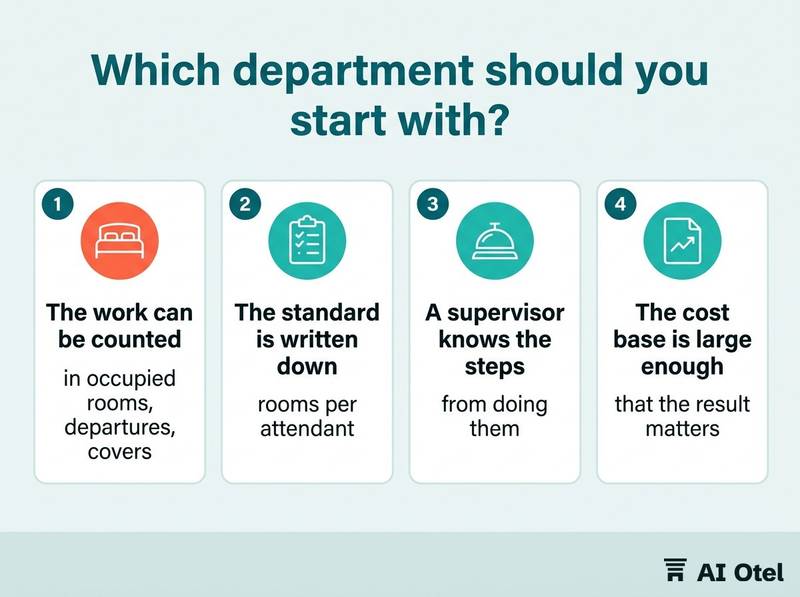
Four tests pick a good first department. The work can be counted, in occupied rooms, departures, covers or treatments. The standard is written down. A supervisor knows the steps from doing them. And the cost base is large enough that the result matters.
Housekeeping usually passes all four. Most of its cost moves with occupied rooms, its standards are written as rooms per attendant and linen change rules, and the supervisor can list the work without guessing. Its cost structure is also well understood, which housekeeping budget: which costs follow occupied rooms and which do not breaks down in detail.
Avoid starting with the front office or sales. Their cost is mostly people, their output is hard to count, and the argument turns into a headcount fight before the method has proved anything. Avoid the department in crisis, too. Under pressure the manager builds a defence of last year's spend, not an activity list, and the exercise loses its point.
If the first department is payroll-heavy, separate the headcount and seasonal calendar question from the activity question, so the two arguments do not tangle. One department in the first year is enough. The second department is easier once the owner has seen one ranked list with real reasons attached.
How do you list the activities and the service level each needs?
Write the department's work as a list of activities, and against each one the standard the hotel has promised: how often it happens, to what quality, and who checks it.
Name activities, not cost types. "Clean a departure room to the standard" is an activity. "Cleaning supplies" is an invoice category and tells you nothing about the guest. Give every activity a driver: occupied rooms, departures, covers, square meters, treatments sold. The driver is what will make the line flex later in the year.
Give every activity a service level in numbers the supervisor already uses: rooms per attendant per shift, linen change frequency, turndown yes or no, deep clean cycle in weeks. Mark each activity as must-do or should-do. Must-do covers safety, legal duties and brand standards. Should-do covers comfort and polish. The ranking later depends on this split being honest.
Walk the floor with the supervisor before writing the list. Office-made lists miss steps such as trolley restocking, linen room sorting and the second check of a room before release. Keep the list between fifteen and thirty lines. A longer list cannot be argued in a meeting, and a shorter one hides work inside vague headings.
Write who checks the standard and how often. An activity with no check is a wish, and it will be the first line the owner questions.
ChecklistChecklist for the activity list
- Each line names an activity, not a cost type
- Each line has a countable driver
- Each line states the service level in numbers the supervisor uses
- Each line is marked must-do or should-do
- Each line names who checks it and how often
- The list is between fifteen and thirty lines
- The supervisor has walked the floor and signed off the list
How do you price each activity from quantities?
Price each activity as quantity times unit cost, using the standard you just wrote, so that anyone reading the line can rebuild the number from the same inputs.
Quantity comes from the driver. If the hotel expects sixty departures a day, the departure clean line is sixty times the number of days the department operates. Unit cost comes from real inputs, not from last year's invoice: minutes of labor per room, milliliters of chemical per room, kilos of linen per occupied room.
Cost labor at the loaded hourly rate, which is the wage plus employer contributions and benefits, not the gross wage. Minutes times the gross wage understates every labor line. Where a supplier contract fixes a price, use the contract price and note the contract term, so the reader knows which part of the line is locked and which part moves.
Keep the fixed part of the department separate: supervision, equipment, the office that exists whatever the occupancy. Mixing fixed and variable in one line makes the whole budget unflexable. Label every figure as an assumption with a named owner. The argument then happens about the assumption, whether it really is twelve minutes a room, instead of about the total.
For example, a 120-room hotel at 70 percent occupancy, with a twelve-minute departure clean and a loaded hourly cost of a round figure, produces a labor line the finance manager can check in a minute. The figures are illustrative, and the method is the point.
TipBuild the assumption register first
A simple sheet with columns for activity, driver, quantity, unit, unit cost, source of the unit cost and the name of the person who owns the assumption. Every budget line then points to a row, and the meeting argues about rows, not totals.
How do you rank the lines and decide what to cut?
Rank every line by what it does for the guest and what it costs, fund from the top until the money runs out, and write the reason and the consequence next to every line that is not funded.
Use two axes, not one. Guest impact covers safety, legal duties, brand standards and what the guest actually notices. Cost impact covers how much the line moves the total. Sort into four tiers: must fund, should fund, could fund, and stop. Safety, legal duties and brand standards sit in the first tier and are not cut in a normal year.
Cut depth before breadth. Reducing the frequency of a deep clean cycle is visible to few guests; removing a whole guest-facing service is visible to all of them. State the consequence of each cut in the guest's terms: no turndown means evening guests find the room as they left it, and the standard the hotel advertises no longer matches what it delivers.
Never hand the owner one number. Offer two funded levels, each with its list and its consequences, so the decision is a choice between service levels rather than a negotiation about a percentage. Record the decision and the reason in one place. Next year's review starts from that record, which is how the method gets cheaper over time. To read the results in the accounts afterwards, USALI for hotel owners: reading the departmental profit and loss statement explains the statement these lines land in.
All rows below are illustrative and rounded.
| Line | Activity and standard | Guest impact | Decision and reason |
|---|---|---|---|
| Departure clean | 12 min per room, checked before release | Core to the product | Fund: must-do, brand standard |
| Linen change | Every third night, per policy | Noticed by most guests | Fund: keeps advertised standard |
| Turndown | Daily, evening guests only | Noticed by evening guests | Fund at reduced frequency: comfort, not core |
| Deep clean | 6-week cycle per room type | Rarely noticed | Fund at 8-week cycle: depth before breadth |
| Minibar restocking | Daily per occupied room | Noticed by few, low margin | Stop: guests buy at the bar; consequence stated |
Is last year's budget any use at all?
Yes, as a check after the build. Compare the zero-based total with last year's actual and explain every difference by quantity, price or standard.
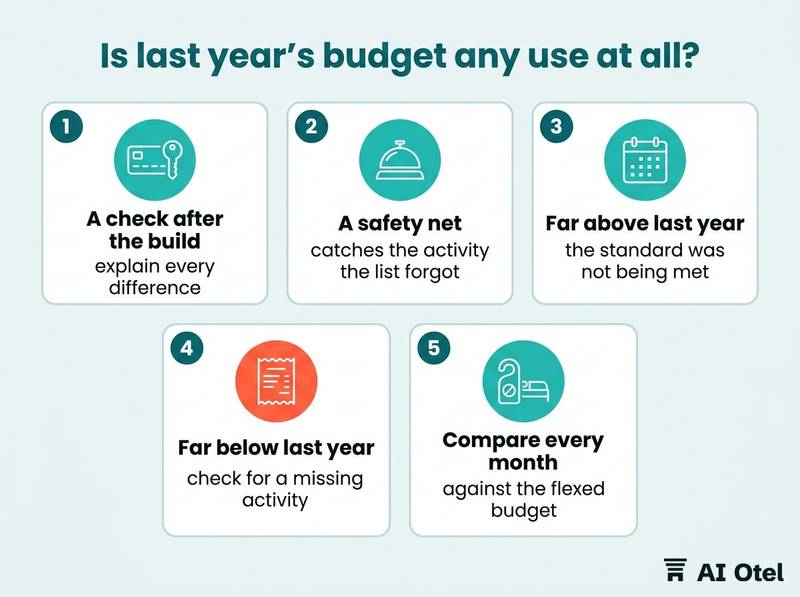
A difference is explained when you can name its cause: fewer occupied rooms, a supplier price change, or a standard that was quietly not being met. "We spent it last year" is not an explanation, and it is the sentence the method exists to remove from the room.
Last year's actual is also a safety net. It catches the activity the list forgot, such as a seasonal deep clean, an annual equipment service or a training day. Compare per driver as well as in total: cost per occupied room, cost per cover, cost per treatment. A total that looks close can hide two lines moving in opposite directions.
If the zero-based number is far above last year, one of two things is true: the written standard was not being met, or the build is wrong. Find out which before presenting anything. If it is far below, check for a missing activity before celebrating. A budget that is too low is a promise the department cannot keep.
Once the year starts, compare actual against the flexed budget every month, so the driver quantities are reviewed while there is still time to act. Budget vs actual in hotels: reading the monthly variance covers that monthly discipline.
How do you present a zero-based budget to the owner?
Present the ranked list, the standards behind it and the consequence of each cut, so the owner chooses a service level instead of approving a number.
Open with one page: the funded total, the two or three decisions the owner must make, and the guest consequence attached to each option. Show the assumption register next to the list, so the owner can challenge a quantity or a unit cost directly and see what changes.
Show what is not funded and what the guest will notice. An unfunded line with no stated consequence looks like an omission, and the owner will restore it without discussion. Show the check against last year's actual with the differences explained, so the owner sees that the new number is not a wish.
Agree the review points before the meeting ends: which drivers trigger a reforecast, who reports them, and when. Keep the language operational. The owner is deciding whether rooms are cleaned to the advertised standard, not approving a spreadsheet.
ChecklistPresentation checklist
- One page with total and decisions
- Assumption register attached
- Unfunded lines listed with guest consequences
- Check against last year's actual with differences explained
- Two funded levels offered
- Review points and driver owners agreed
- Decision and reason recorded for next year's review
What to do next
Pick one department this month, sit with its supervisor and write the activity list before touching a single figure. Price five lines from quantities and unit costs, rank them by guest and cost impact, and bring the ranked list, not a total, to the next budget meeting. The method earns its time on the first department, and every department after that starts from a template the owner already trusts.
If you want the budget to live in the same place as the operations it prices, you can read about a hotel operating system that keeps reservations, housekeeping, billing and reports in one place, or about how the wider platform is designed to connect a hotel's own systems. For the broader context of how hotels fit into Türkiye's tourism economy, see the Türkiye overview.
Frequently asked questions
Is zero-based budgeting worth the time for a small hotel?
It is worth it where a department has many small variable lines or where the service standard is changing. A small hotel with few fixed costs can run it on one department, or every second year, and use last year plus a correction in between. The time cost is real and should be planned, not discovered.
How is zero-based budgeting different from incremental budgeting?
Incremental budgeting starts from last year's figure and adds a correction, so every existing line survives by default. Zero-based budgeting starts each line at zero and rebuilds it from the activity, the standard and the quantity. Incremental is faster; zero-based is more defensible where the cost base is large or changing.
Do I need budgeting software to do this?
No. A spreadsheet with one row per activity and columns for driver, quantity, unit, unit cost, source and owner is enough for one department. Software helps once several departments report monthly and the same drivers must be flexed and compared, but it does not replace the activity list.
How often should a zero-based budget be rebuilt from scratch?
A full rebuild suits a change of standard, a renovation, a new outlet or a cost base that has drifted for several years. Between rebuilds, keep the activity list and flex the quantities monthly against actual drivers. The list is the asset; the total is only this year's reading of it.
What if the owner only wants a single total?
Bring two funded levels with their lists and consequences, and one page that shows what each level delivers to the guest. A single total cannot be argued with, so it will be cut by a percentage. A ranked list gives the owner a choice between service levels, which is the decision they actually own.