Hotel budget terms explained: zero-based, rolling, flexed, variance and reforecast
This guide explains essential hotel budget terms including zero-based, rolling, flexed budgets, variance and reforecasts. Learn how to classify costs correctly and interpret financial reports to make better management decisions.
AI draft · awaiting editorial review
Contents
Key takeaways
- Fixed, variable and semi-variable is a decision the hotel writes down, not a property of the cost itself: two hotels can classify the same laundry line differently.
- A flexed budget restates costs at the occupancy actually achieved, so the comparison separates cost control from volume.
- Favorable and adverse follow profit, not arithmetic: revenue above plan is favorable, cost above plan is adverse.
- A reforecast changes the expectation, not the approved plan; keep both columns visible or you lose the ability to explain what moved.
- Every budget line needs a driver before it needs a number.
A hotel budget is a written plan of expected revenue and costs for a period. Zero-based budgets build each line from the activity it must support; rolling budgets move the horizon forward each month; a flexed budget restates costs at actual occupancy; variance is the gap to actual; a reforecast updates the expectation without changing the approved plan.
The budget meeting reaches the third slide and someone says the department is adverse on a flexed basis. Heads nod. Nobody asks which occupancy the flex was built on, or whether the number is bad news at all. This article explains the hotel budget terms that decide those moments: fixed, variable and semi-variable costs, zero-based and incremental budgets, rolling budgets, reforecasts, flexed budgets and variance. After reading it, you will be able to ask, in plain words, what a number was built on and what question it answers.
What is the difference between fixed, variable and semi-variable costs in a hotel?
Fixed costs stay the same whatever the hotel sells; variable costs move with rooms sold, covers served or treatments delivered; semi-variable costs have a fixed floor and a variable part above it. There is one test you can apply at the desk: ask what happens to this line if the hotel sells ten fewer rooms tonight. If nothing changes, the line is fixed. If it falls roughly in proportion, it is variable. If it falls only after a step, such as dropping a shift or a second breakfast cook, it is semi-variable.
Hotel examples are easy to find. Property tax, insurance and the base salaries of key staff are fixed. Laundry per room, minibar stock, food cost per cover and agency commission are variable. Electricity, water, seasonal extra staff and a breakfast buffet that runs a minimum setup are semi-variable.
The classification is a management decision, not a law of nature. Laundry is variable in a hotel that outsources it and largely fixed in a hotel with its own plant. Two hotels can classify the same line differently and both be right, which is why the assumption that the label is objective causes so much confusion. Write the classification down once, in the budget file, and use the same one all year. Otherwise two reports disagree and the meeting spends its hour arguing about the definition instead of the number.
| Cost type | Hotel examples | When occupancy falls | Question to ask |
|---|---|---|---|
| Fixed | Property tax, insurance, base salaries | Unchanged | Is this line genuinely committed for the whole year? |
| Variable | Laundry per room, minibar, food per cover, agency commission | Falls roughly in proportion | What is the cost per room sold or per cover, and how does it compare? |
| Semi-variable | Electricity, water, seasonal staff, breakfast setup | Falls only after a step | Where is the step, and are we above or below it? |
| Step cost | One extra shift, one extra van | Disappears below the step | Which volume are we planning against? |
The classification matters downstream because only variable costs can be flexed. A flexed budget that also flexes fixed costs hides a real problem by making a volume miss look like a saving. For semi-variable lines, name the step in words, for example a second housekeeping shift above a stated number of occupied rooms, so the flex has something concrete to work with.
Zero-based or incremental: which budget should a hotel build?
Incremental budgeting starts from last year's number and adjusts it; zero-based budgeting builds each line from the activity it has to support. Neither is right for every line, and most hotels should mix them.
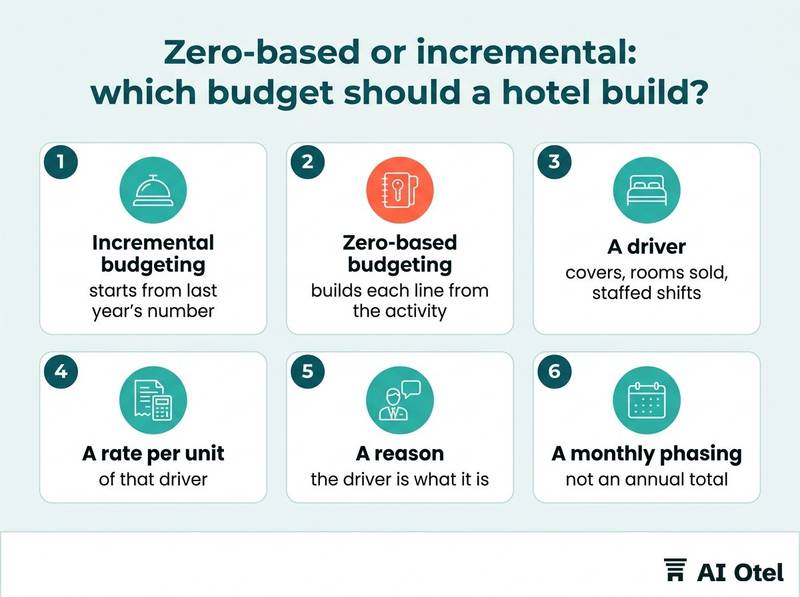
The failure mode of incremental budgeting is plain: last year's waste becomes this year's baseline, and nobody can say what the number is for. Zero-based budgeting asks for three things per line: a driver (covers, rooms sold, staffed shifts, laundry pieces), a rate per unit of that driver, and a reason the driver is what it is. The line is built, not carried forward. If you want to see the method worked through in full, read a zero-based budget for one hotel department, built line by line.
A decision rule: use zero-based where the activity is about to change, such as a new outlet, a renovation or a department that has missed its target for two years, and incremental where the activity is stable and the driver is hard to measure. Be honest about the cost of the work: zero-based budgeting takes management time, so take two or three departments a year rather than the whole chart of accounts at once. For example, a spa budget built from expected treatments per month times a cost per treatment, rather than last year's total plus a percentage, is a real project, not an afternoon.
Both methods must produce the same output: a monthly phasing, not an annual total. An annual total cannot be compared with a month, which is why so many budgets die in February.
TipRule of thumb
Build zero-based the lines that are about to change, carry forward the lines that are not, and write one sentence next to every carried-forward line saying why it is stable.
What does a rolling budget mean, and how is a reforecast different?
A rolling budget keeps a fixed horizon that moves forward, so next month you add a month at the far end and drop the oldest one; a reforecast keeps the same horizon and replaces the remaining months with the latest expectation.
The image that explains rolling is a window of fixed length: the window is always the same length, only the view through it moves. This is what makes a rolling budget useful for staffing and cash decisions that look past December. A reforecast works differently: the year stays the year, but the numbers for the remaining months are rebuilt from what is now known, and the approved plan stays visible beside them.
Insist on three columns in every report: original budget, latest reforecast, actual. Overwriting the budget with the reforecast destroys the explanation of what changed and why, which is the only thing the meeting actually needs. Give a reforecast a trigger and an owner: rooms on the books moving outside an agreed range, a cost line outside its range, a contract or rate change, a renovation date moving. Without a trigger it becomes a monthly ritual with no decisions attached. For example, a hotel that reforecasts only when rooms on the books for the next quarter move by more than an agreed margin has a rule anyone can check.
Be honest about effort. A full rolling budget across the whole chart of accounts is administrative work. A smaller hotel can roll five lines, revenue, payroll, cost of sales, utilities and capital, and still make better decisions than with a fixed annual plan. If you are building the plan itself, how to build next year's hotel budget month by month covers the phasing in detail.
NoteThe three terms in one line each
Rolling budget: a moving horizon. Reforecast: new numbers on the same horizon. Budget revision: a change to the approved plan, which needs the approver's signature.
What is a flexed budget in a hotel?
A flexed budget restates the budget at the occupancy or activity level the hotel actually reached, so that actual costs are compared with what they should have been at that volume, not at the planned volume.
The arithmetic in plain words: take each variable cost per unit of its driver from the budget, multiply by the actual units, add the fixed costs unchanged, and add semi-variable costs at the step the actual volume falls into. The flex then separates two questions. Actual against flexed shows whether the cost per unit was controlled. Original budget against flexed shows whether the volume was there. Two questions need two columns, and mixing them is the most common error.
The second common error is flexing costs but not revenue. Revenue also moves with rooms sold and rate, so an un-flexed revenue line beside a flexed cost line compares two different worlds. Require one driver per department and write it down: rooms sold for housekeeping and laundry, covers for food and beverage, treatments for the spa, arrivals for front office.
For example, take a budget built on 1,000 rooms with laundry at a stated cost per room. The hotel sells 900 rooms. The flexed laundry line is 900 times that cost, and the gap to actual is the only part management can be asked about. The volume miss belongs to a different conversation, with a different owner.
Key pointThe flex in one line
Flexed cost equals fixed costs plus, for each variable line, the budgeted cost per unit times actual units. Fixed costs are never flexed.
A flexed budget explains cost behaviour, not service quality. A housekeeping line under its flexed figure may mean efficiency or a standard that was not met, and only the rooms inspection answers that.
What does variance mean, and which way is favorable?
Variance is the difference between a budget figure and the actual figure, in money or as a percentage; favorable means it improves profit and adverse means it reduces it, so the same arithmetic carries opposite meanings for revenue and for cost.
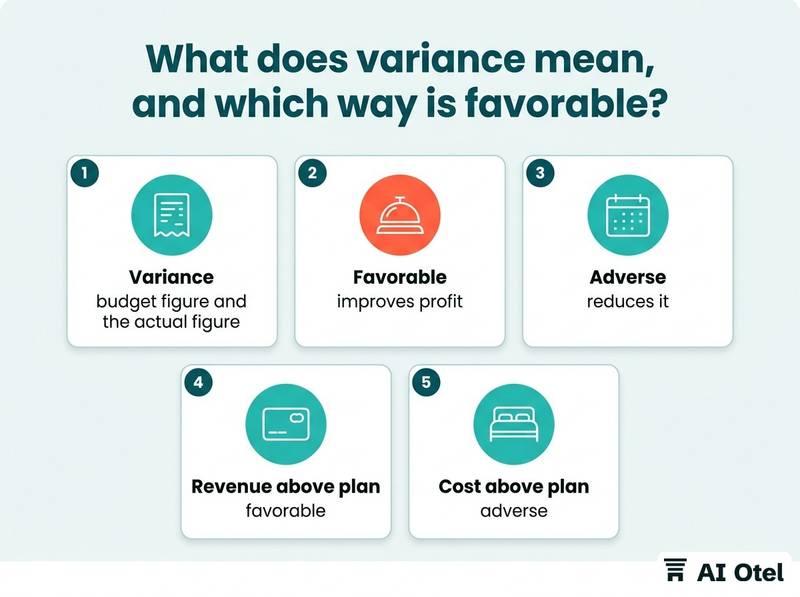
State the sign convention once and firmly: revenue above plan is favorable, cost above plan is adverse. Write the words rather than plus and minus signs, because a minus in front of a cost line is read as good news by half the room. Split a revenue variance into its two causes, volume and rate: selling fewer rooms and selling rooms cheaper are different problems with different fixes, and a single percentage hides which one happened.
Ask for the driver rather than the number: which line, which month, which decision, which person. A variance with no driver is a fact about the past, not a management tool. And be warned that a favorable cost variance is not automatically good: deferred maintenance, rooms cleaned below standard and unfilled shifts all show as savings in the month they happen. For the monthly practice, reading the monthly budget versus actual variance works through the report line by line.
Cost center and revenue center: why the label flips the sign
A revenue center such as rooms, food and beverage or the spa is judged on what it earns and its direct costs. A cost center such as housekeeping, maintenance or administration is judged on the service level it delivers and the cost per unit of that service. The practical consequence: never ask a cost center for revenue, and never accept a cost center's saving without asking what service level it bought. If you want the underlying report structure, reading a departmental profit and loss statement explains how departments are presented.
Which terms should you ask your accountant to define?
Ask for the hotel's own written definition of every term that changes a number in the report, and have it in the budget file before the year starts, not in the meeting where the number is questioned.
Split the responsibility. Definitions that touch tax and statutory reporting belong to your accountant; the management definitions in this article belong to the hotel and can be set by the general manager with the owner's agreement. A written definition beats a shared understanding because the same word is used by the accountant, the department head and the owner, and each has a slightly different picture behind it. Definitions must be dated and versioned, because a definition changed mid-year makes two months incomparable without anyone noticing.
When a term is genuinely ambiguous in the hotel's own report, ask for the number to be shown with its driver and its base, so the definition matters less than the arithmetic. The terms in this article are only labels until the hotel attaches its own drivers, steps and thresholds to them.
ChecklistTake this checklist into the next budget meeting
- Which lines are fixed, variable and semi-variable, and who decided
- Which driver each department's flex uses
- Whether the reforecast replaces or sits beside the approved budget
- Whether variances are shown in money, in percent or both, and against which base
- Which cost centers exist and who owns each
- How payroll is split between base and seasonal extra
- Which items are capital and which are operating, and where each sits in the report
What to do next
Before the next budget meeting, take one page and mark every line of the report as fixed, variable or semi-variable, and write the driver beside it. That single page is what makes a flexed budget possible, what turns a variance into a question with an answer, and what stops a reforecast from becoming a rewrite of history. If you want the numbers to arrive in one place, a hotel operating system can hold the budget, the reforecast and the actuals side by side, but the page comes first.
Frequently asked questions
How often should a hotel reforecast?
There is no universal interval; the cadence should be the hotel's own written rule. A common arrangement is a light monthly update plus a full reforecast when a trigger fires: rooms on the books moving outside an agreed range, a cost line outside its range, or a date change such as a renovation. The point is that the reforecast is tied to a decision, not to the calendar alone.
Is a reforecast the same as a budget revision?
No. A reforecast updates the expectation for the remaining months while the approved plan stays visible; a revision changes the approved plan itself and needs the approver's agreement. Keep original budget, reforecast and actual in three separate columns so the difference between the three can be explained.
Does a flexed budget replace the annual budget?
No, it sits beside it and answers a different question. The annual budget answers whether the hotel planned the right volume; the flexed budget answers whether it controlled cost at the volume it actually got. Both columns belong in the monthly pack.
Should a small hotel use zero-based budgeting for every department?
Rarely worth the management time. Build zero-based the departments whose activity is changing or whose numbers nobody trusts, carry the stable lines forward, and write one sentence next to each carried-forward line explaining why it is stable. The mix is the method.