Answering guest questions on booking sites before they book: a reply bank for the common ten
Guests ask the same ten questions before booking, often getting inconsistent answers. This guide shows how to build a reply bank that ensures accuracy and speed.
Contents
Key takeaways
- A reply bank holds one checked fact per question, not a script: the fact is what the hotel can prove, and the answer is written from it.
- Answer in the first line, add the one detail that decides the booking, and end with a next step; anything longer reads as evasion.
- Set a reply time the hotel can keep on its busiest Sunday, name the role for each block of hours, and publish only that.
- Questions about money, documents, refunds and specific room numbers go to a manager, never to the bank.
- The bank is a view of one master fact sheet: when a fact changes, one edit keeps the listing, the chat, the front desk and the pre-arrival email saying the same thing.
A reply bank is one page per pre-booking question holding three things: the checked fact, a short answer that ends with a next step, and the time within which someone replies. The same ten questions, answered the same way on every channel, so a guest never gets two versions of the truth.
A guest asks on the booking site whether parking is free. The listing says paid, the front desk says free, and nobody notices the gap until the car is at the gate. Booking site pre-booking questions are rarely hard; they are answered inconsistently, late, or not at all. After reading this, you will have the ten questions that arrive before almost every booking, the fact to check behind each one, the shape of a four-line reply, a reply-time rule you can keep, and a monthly review that keeps it all true.
Which ten questions arrive before a booking?
The same ten in almost every hotel: parking, breakfast hours, distance to the beach, cots, pets, airport transfer, late arrival, payment, room view and noise. They repeat because each one is a fact a guest cannot see in a photo and cannot confirm without asking.
They arrive on several channels at once: booking-site messaging, the hotel's own contact form, phone, WhatsApp, email, and the AI assistants people already use. The same question getting four different answers is the normal state before a reply bank exists.
Each of the ten is settled before booking and each is factual: a yes or no, a time, a distance, a count. None of them needs persuasion, which is why they can be standardized without sounding like a script. Behind each question sits the decision the guest is actually making. "Is there parking" means "can I arrive by car and leave it safely"; "what time is breakfast" means "can I eat before my early tour".
Noise is the question hotels answer least precisely, and the one that decides whether a light sleeper books a room facing the road. A reply bank is not a sales script and not a discount policy. It removes doubt; the offer, the price and the photos stay in the listing.
Two questions hide inside every one of the ten: is it true, and will it still be true on my dates. Seasonal hours, building works and a changed transfer operator are what turn a correct answer into a wrong one. If you are preparing to list the hotel in the first place, start with what to prepare before a hotel goes live on booking sites.
| Question as it arrives | What the guest is deciding | The fact that settles it |
|---|---|---|
| Is parking free? | Can I arrive by car and leave it safely? | On-site or street, number of spaces, height limit, charge, whether a space can be reserved. |
| What time is breakfast? | Can I eat before an early tour or flight? | Served start and end times, weekday and weekend, whether an early plate can be arranged and by when. |
| How far is the beach? | Can we walk it with children and towels? | Walking route and time from the door to the sand, and what is in between: hill, steps, road. |
| Do you have a cot? | Will the baby sleep safely without us bringing a bed? | Number of cots, age and weight limit, mattress and linen, charge, how it is reserved with the room. |
| Are you pet friendly? | Can my dog stay in the room, and where can it go? | Size limit, rooms allowed, charge, areas off limits, whether the dog may be left alone. |
| Do you have an airport transfer? | How do I get from the airport at night without negotiating? | Who drives, vehicle, price basis, what happens if the flight is late, how far ahead it must be booked. |
| Can we arrive late? | Will someone be there with a key at one in the morning? | Until what hour reception is staffed, the out-of-hours procedure, what the guest must do before arrival. |
| How do we pay? | Which cards, which currency, what is held and when? | Cards accepted, currencies, prepayment, the security deposit and when it is released. |
| Does the room have a sea view? | Will the room I get match the photo? | What the view category means here: which floors, which side, full or partial. |
| Is it noisy? | Will we sleep? | Which rooms face the road, bar or lift, what the hotel does about it, what it can move a light sleeper to. |
What does one checked fact mean, and who checks it?
A checked fact is a sentence someone at the hotel can stand behind, with a name, a date and the way it was checked attached. If nobody can say how it was checked, it is not a fact yet; it is a belief.
There are three ways to check. Someone walked or measured it. Someone read the document that governs it: the transfer contract, the parking lease, the card acquirer's terms. Or someone asked the person who runs it: the breakfast chef, the housekeeping supervisor.
Write the method next to the fact, in the guest's terms. For example: "measured from the lobby door to the beach gate, walking, nine minutes at normal pace, including 40 steps." Walking distance and straight-line distance are different numbers. Give the walking one and say what is between: a hill, steps, a road to cross, a building site.
Times need a window and an edge: the served start and end, weekday and weekend, and what happens one minute past the end. Capacity facts are counts with a rule: how many cots or parking spaces, and how the guest reserves one. A count without a booking rule becomes a promise the hotel breaks at full occupancy.
Money facts name the currency, the moment of charge and what comes back. The security deposit held against damage is not the advance payment counted toward the stay, and the two words must never be swapped in a reply. Every fact carries an owner and a review date. Facts that move with the season get two versions or a date range, not one sentence that is half true for six months.
ChecklistA fact is checked when
- someone at the hotel can repeat how it was checked
- the method is written next to the fact in the guest's terms
- the number is a count or a measured time, never "a few" or "close"
- the rule that goes with it is written: how the guest reserves it, what it costs, what happens when it runs out
- it has an owner's name and a review date
- it matches what the listing, the front desk and the pre-arrival email already say
How short should the reply be?
Three parts, four lines at most: the answer in the first line, one sentence of the detail that decides it, and one next step.
Answer in the first line. "Yes, free, on site" comes before any greeting; a warm opening costs the guest the one line they will actually read. The second line is the detail that changes the plan: a height limit, the last breakfast sitting, the steps on the walk. One detail, not five. The third line is a next step: a booking link, a question back, or an instruction such as "reply with your arrival time and we will note it on the reservation".
A no takes the same shape: no in the first line, the nearest alternative in the second, the next step in the third. Softening a no into a maybe costs the hotel more than the no. If the guest asked three things, answer in three numbered lines. A paragraph that contains three answers is read as one answer, usually the wrong one.
Use the same sentence on every channel. The chat reply, the email reply and what the front desk says on the phone come from one written line, or the hotel is running two versions of itself. Answer in the language the guest wrote in when the team can. When it cannot, say which languages the team answers in and keep the reply short enough that a translation cannot bend a time or a price. The same discipline applies when turning phone, email and WhatsApp inquiries into reservations.
TipA worked example
For example, a guest asks: "Is there parking and what time is breakfast?" The reply: "Yes: free parking on site, 14 spaces, first come, no reservation, height limit 1.9 m. Breakfast is served 07:30 to 10:00, and from 07:00 at weekends. If you arrive after 22:00, reply with your plate number and we will note it on the reservation." Three parts: answer, deciding detail, next step. The numbers are illustrative.
How fast should you reply, and who covers the weekend?
Set a reply time the hotel can keep at its worst hour, not its best, and name the role responsible for each block of hours, weekends included.
Build the target from the rota, not from ambition: who is at a screen between 09:00 and 18:00, who is on the front desk at night, and what happens during the check-in peak. A slower target kept beats a faster one broken. "Within four hours, 09:00 to 21:00" is a promise the hotel can print; a round-the-clock claim that lapses on Sunday is not.
Name roles for each block, not departments: the reservations desk on Saturday daytime, the night auditor overnight with the short answers only, the manager for anything the bank does not cover. The out-of-hours fallback is an acknowledgment that says when a person will answer, never an automatic answer to a question the system cannot check.
Measure from the guest's message timestamp to the sent reply, not from the moment someone opened it. Keep that figure for the hotel's own review; it is an operations number, not a marketing one. Test the rota against last month's Saturdays and Sundays: the messages that waited longest show where the coverage is wrong. Write the handover rule: what the weekend person may answer from the bank, and what waits for the manager on Monday morning. If several people share one inbox, rules for a shared reservations mailbox carry the same logic.
Watch outDo not promise what Sunday night cannot deliver
Do not publish a reply time the hotel cannot keep at eleven at night on a Saturday. A guest told "we reply within an hour" who waits until Monday has learned something the listing never said, and no follow-up message repairs it.
Which questions should not be answered from the bank?
Anything that commits money, documents or a specific room: refunds, rate negotiation, group terms, invoices, identity documents at check-in, accessibility that needs a real check, and any complaint.
The pass rule: say who will answer and when, then hand the message over with the guest's own words attached. A pass without a time is a drop. Money goes to the manager who owns the rate: discounts, refunds, cancellation exceptions, deposit disputes, group terms.
Documents and invoices are answered from the hotel's written procedure, not from memory; the procedure itself is set with the hotel's accountant or legal adviser. Room numbers: the bank answers the room type, never a number. Assignment belongs to the front desk or the reservations manager, and a number promised in writing is a number the hotel has to deliver.
Complaints and anything emotional get a person. The bank can supply the facts; it cannot supply the tone. Safety and accessibility questions are measurements, not opinions. If nobody has measured the step into the bathroom, the honest reply is that someone will check and come back today, and then someone does.
The one-line test: if the answer could change tomorrow without anything physical changing, it is a manager's answer, not a bank answer.
| Question | Who answers | Why not the bank |
|---|---|---|
| Refund or cancellation exception | The manager who owns the rate | It commits money the bank does not control. |
| Group of twenty rooms | Reservations manager | Terms, allocation and invoicing are negotiated. |
| Invoice details and tax documents | Front office manager with the accountant | The wording comes from the hotel's written procedure. |
| A specific room number | Front desk or reservations manager | A number in writing is a delivery obligation. |
| Is the bathroom step-free? | Whoever can measure it today | It is a measurement, not an opinion. |
| Complaint about a previous stay | A manager, by name | It needs a person and a remedy. |
How do you keep the bank in step with the rest of the hotel's facts?
Keep one master fact sheet and treat the reply bank as a view of it. When a fact changes, one edit and one note to the channels, or the hotel starts telling two stories.
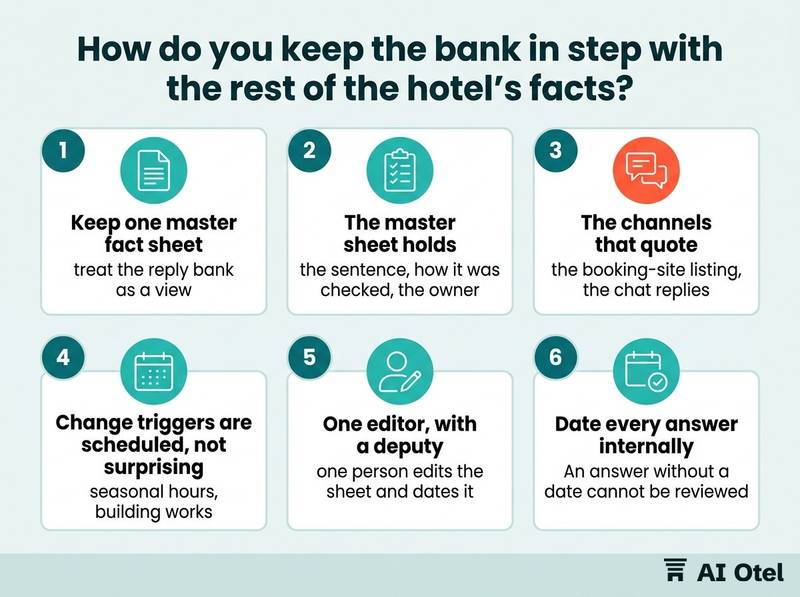
The master sheet holds, for each fact: the sentence, how it was checked, the owner, the review date, and where it is used. The reply bank is a view of that sheet, not a second copy. Two copies drift within one season, and the drift shows up as a guest quoting the website at the front desk.
The channels that quote the same fact: the booking-site listing, the chat replies, the hotel's own website, the guest app, the pre-arrival email, the front desk, and the fact sheet AI assistants read. If you are also writing a hotel fact sheet for AI assistants, it draws from the same master sheet, not from a separate draft.
Change triggers are scheduled, not surprising: seasonal hours, building works, a new transfer operator, a change in card acceptance, a new cot supplier. One editor, with a deputy. Anyone may propose a change; one person edits the sheet and dates it. Date every answer internally. An answer without a date cannot be reviewed, only argued about.
When a guest was told the old answer, the new fact needs a note on the reservation, not just a correction on the website.
NoteWrite each fact once
A fact that lives in two places is a fact that will disagree with itself. Write it once on the master sheet and let every channel quote it, rather than retype it per channel.
How do you review new questions every month?
Once a month, read the real messages, tag each one by question, and add the ones that repeat. The bank should grow slowly, by the questions guests actually ask, not by the ones the hotel imagines.
Read every channel, including the front desk's paper notes and the questions asked by phone; the phone is where the questions the hotel has never written down appear first. Tag each message by question and count what fell outside the ten. A question asked repeatedly is either a missing entry or a listing that is unclear.
Fix the listing first when the question is really about the listing. If guests keep asking whether parking is free, the answer belongs in the listing, not only in the chat. Retire what nobody asks and what no longer exists: the shuttle that stopped, the cot that broke, the low-season hours that are now year-round.
Re-check facts whose review date has passed, and re-date them even when nothing changed; a re-dated fact is a checked fact. Keep the no answers that worked. A clear no that ended in a booking is worth reusing in the same words. Record the change date, so a guest who was told the old answer can be recognized and corrected before arrival.
ChecklistThe monthly review
- pull last month's messages from booking-site chat, email, WhatsApp and the front desk notes
- tag each by question
- list what fell outside the ten
- decide for each one whether it is a new bank entry or a listing fix
- retire dead entries
- re-check and re-date facts past their review date
- note the date of every change on the master sheet
What to do next
This week, take the ten questions and write the fact behind each one, with the method, the owner and the date, then write the four-line answer from that fact. Everything else in this article, the reply time, the rota, the manager escalations and the monthly review, only holds once the facts are written down and one person keeps them current.
If the hotel's systems are part of the problem, the same facts can live in one place and serve several doors. A hotel operating system keeps reservations, front desk and billing on one set of data, and a distribution setup is built so that one room inventory feeds the hotel's own website, booking sites and travel agencies at once, so the channels quote one source rather than several retyped copies.
Frequently asked questions
Should we answer pre-booking questions in the guest's language?
Answer in the language the guest wrote in when the team can hold the facts straight in it. When it cannot, say which languages the team answers in and keep the reply to the three parts, so a translation cannot bend a time, a price or a distance. Naming those languages on the listing removes the question.
What should a reply say when the answer is no?
No in the first line, the nearest alternative in the second, a next step in the third. A clear no with an alternative keeps the conversation open; a soft maybe costs the hotel the booking and the guest's trust at check-in. Keep the wording of a no that worked.
Can we promise a specific room number before arrival?
The bank answers the room type, not the number. Assignment belongs to the front desk or the reservations manager, and a number written to a guest is a number the hotel must deliver. If a number is blocked on the reservation, say so and say who confirmed it.
Does a faster reply improve our position on the booking site?
This article makes no claim about ranking or conversion. What the bank fixes is consistency and the wait. Whether a site measures or rewards reply speed is set by that site's own rules, which the hotel can read in its extranet or its contract.
Who should own the reply bank?
One named person, usually the reservations manager, with a deputy for weekends and leave. Anyone may propose a change; one person edits the master fact sheet and dates it, so the listing, the chat and the front desk never quote two versions.