Available room nights when rooms are closed: what to count in the occupancy denominator
Discover how to calculate available room nights for accurate occupancy rates. Learn which rooms to exclude, how to handle closures, and how to document your house rule.
AI draft · awaiting editorial review
Contents
Key takeaways
- Occupancy is room nights sold divided by available room nights, so the denominator decides the rate as much as the sales do.
- The working test for the denominator is one question: could a paying guest have slept in this room tonight? If not, the room night leaves; if yes, it stays.
- Count room nights, not rooms: a room closed for seven nights of a 31-night month removes seven room nights, not one room and not the month.
- Excluding closed rooms raises occupancy and RevPAR and leaves ADR untouched, because only the denominator moves.
- A denominator rule that is not written down and printed on the report is not a rule, it is a habit that changes with the result.
An available room night is one room the hotel could have sold on one night. Rooms that cannot be sold (out of order, renovation, seasonal closure) leave the occupancy denominator; rooms the hotel chooses to hold or give away (house use, complimentary, group holds) stay in. Write the rule down and print it on every report.
Two hotels sell the same number of rooms in the same month and report different occupancy rates. One counted a renovation block in its available room nights and the other did not. Neither report is wrong; one of them is unexplained. After reading this you will be able to set a house rule for the available room nights calculation hotel reports depend on, record closures so the rule survives staff changes, and explain the number to an owner in one line.
What is an available room night?
An available room night is one room the hotel could have sold on one night, and the occupancy denominator is the sum of those room nights across the period being reported. The formula is room nights sold divided by available room nights, with both counts taken over the same dates and the same set of rooms.
Three counts get mixed up in daily work: physical inventory, available room nights and sellable rooms. Physical inventory is the keys the hotel holds. Available room nights are the rooms that could have been sold on each night. Sellable rooms are what is released for sale right now at a price, and that count moves by the hour as group blocks, holds and channel limits change. A live sellable count can never serve as a denominator, because it is a snapshot of a decision, not a record of the period.
| Count | What it means | When it changes |
|---|---|---|
| Physical inventory | The keys the hotel holds | With construction, handover or sale of a room |
| Available room nights | Rooms that could have been sold that night | Fixed once the period closes |
| Sellable rooms | Rooms released for sale at a price right now | Hourly, with blocks, holds and channel limits |
Only the middle row belongs in the occupancy denominator.
Decide the room set once: the whole property, one building, one wing. A rate calculated over a room set that changes between months cannot be compared with itself. The same logic works for a bed denominator, but a room rate and a bed rate answer different questions and must not be mixed inside one series; see occupancy by rooms or by beds for how the two rates diverge. Write the room set and the dates into the report header, not into someone's memory.
Which rooms leave the occupancy denominator?
Rooms that could not be sold on that night leave the denominator; rooms the hotel chose not to sell stay in it. The distinction is not moral, it is mechanical: a cancelled room was available and the sale failed, while a flooded room was never available at all.
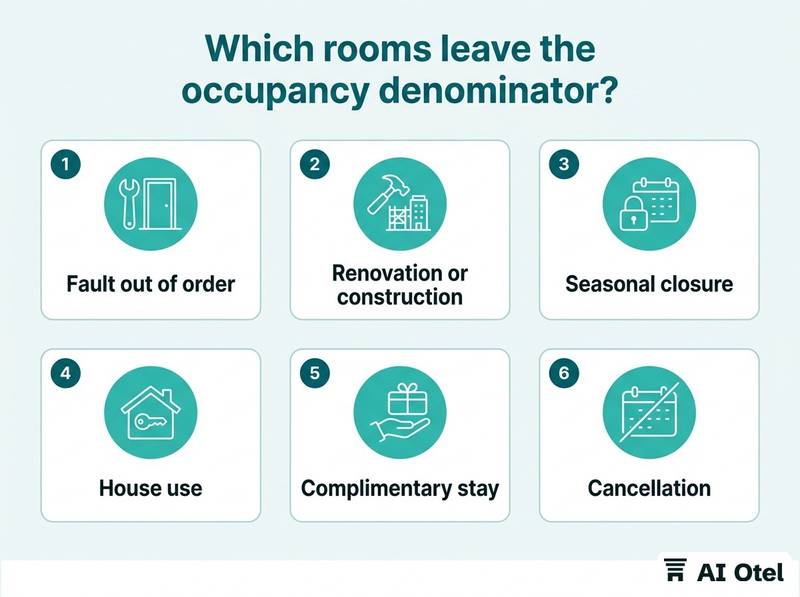
The test question to apply to every closed room: could a paying guest have slept here tonight?
ChecklistLeaves the denominator
- Fault out of order (water, air conditioning, electrical)
- Renovation or construction
- Seasonal closure of a wing or the property
- Room not usable for guests
ChecklistStays in the denominator
- House use
- Complimentary stay
- Upgrade (count one occupied room)
- Group block not yet picked up
- Cancellation
- No-show
- Room left empty by choice
The grey zone is a room kept empty for a maintenance window that could have been released. Apply the test question, accept that the answer is a judgment, then apply the same judgment next month. Moving rooms out of the denominator after the month has closed to improve the rate is the one practice that turns a definition into a misstatement. Keep the closed room nights visible in a separate line even when they are excluded, so the exclusion can be audited.
How do you count a room closed for a week in the middle of the month?
Count room nights, not rooms: a room closed for seven nights of a 31-night month contributes 24 available room nights, not zero and not 31. Work in room nights throughout: multiply rooms by nights for the period, then subtract the closed room nights room by room.
Record a start night and an end night rather than a date and a clock time, because the unit of sale is the night and a room closed at two in the afternoon may still have sold that night. Give every closure a reason code: fault, planned renovation, seasonal, project, other. The code is what lets you report the closed share separately and explain a movement later.
One person authorizes a closure and one person can reopen the room. At month end, list every room that was out of order, its nights and its reason, and compare the total with the previous month before the report is signed. Closing a room for a long stretch is a commercial decision as well as a technical one: repairing now, waiting for a quiet week and closing for the season produce different denominators and different cash, a trade-off covered in out-of-order rooms: repair now, wait or close for the season.
Watch outRooms left in out-of-order status
A room that stays in out-of-order status after it is back in service removes room nights from the denominator every night it is left there. Check the out-of-order list against the housekeeping board before the month closes.
Do house use and complimentary rooms count in occupancy?
Under the house rule they stay in both the numerator and the denominator, and they are reported on their own line so that paid occupancy stays visible. A complimentary room was available and was consumed. Removing it from the denominator hides the cost of the decision rather than reporting it.
Report three lines side by side: rooms sold for money, rooms used without charge, and available room nights. Paid occupancy is paid rooms divided by available room nights. An upgrade moves a guest, it does not create a second occupied room: the original room was still available that night and the guest occupies one room. A group block is available until it is picked up or released; only picked-up rooms count as occupied, and the unpicked remainder stays in the denominator.
Whatever you decide, keep it for every month and every report. A rule that changes when the result is inconvenient is not a rule.
How does the rule change occupancy and RevPAR?
Excluding closed rooms raises occupancy and RevPAR and leaves ADR unchanged, because only the denominator moves. For example, take a 100-room hotel over a 30-night month: 3,000 room nights of physical inventory. Twelve rooms are closed for ten nights, which is 120 room nights, leaving 2,880 available room nights. The hotel sells 2,000 room nights.
Occupancy with the closed rooms counted is 2,000 divided by 3,000, which is 66.7 percent. With them excluded it is 2,000 divided by 2,880, which is 69.4 percent. ADR is room revenue divided by rooms sold, so it does not move at all. RevPAR is room revenue divided by available room nights, so it moves with the denominator: TRY 2,000,000 of room revenue the same month gives TRY 667 against TRY 694.
| Measure | Closed rooms counted | Closed rooms excluded | Moves? |
|---|---|---|---|
| Occupancy | 66.7% | 69.4% | Yes |
| ADR | Unchanged | Unchanged | No |
| RevPAR | TRY 667 | TRY 694 | Yes |
| Room revenue | TRY 2,000,000 | TRY 2,000,000 | No |
The example is illustrative, not a benchmark. Choose the version that matches the decision: for pricing and demand questions, exclude rooms that could not be sold; for asset performance and cost per room, show both numbers. Print the excluded room nights beside the rate so any reader can rebuild the other version without asking you. The formulas behind these three measures, and the mistakes hotels make with each, are set out in RevPAR, ADR and occupancy rate: formulas and common mistakes.
How do you write the rule down once?
Write a one-page denominator policy, date it, and print its one-line summary on every occupancy report. The policy states the room set, what leaves the denominator, what stays, who authorizes a closure, where the closure is recorded, and which reports carry the note.
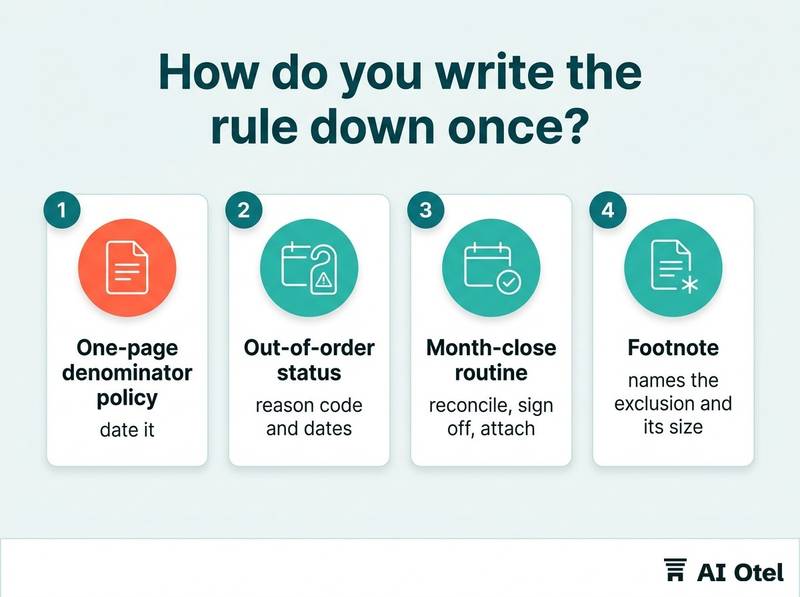
Keep the record in the property management system's out-of-order status with a reason code and dates, not in a spreadsheet on one person's desk. Version and date the policy; when it changes, say so on the report for the month it changed, so a reader is never comparing two definitions by accident. Build the month-close routine around it: reconcile the out-of-order list, sign it off, attach it to the report. The footnote does the work in meetings: one line that names the exclusion and its size ends most arguments about whose occupancy is right.
Key pointFootnote template for every occupancy report
"Available room nights: 2,880. Excludes 120 room nights out of order (12 rooms, 10 nights, renovation). Rule version 1, dated [month]."
How do you explain the number to owners and compare with other hotels?
Show both denominators, name the rule in one line, and treat any outside figure as a different question until you know how it was built. Owners read one number. Give them the rate, the excluded room nights and the reason in the same breath, or the next conversation will be about trust rather than performance.
Two hotels with identical sales can report different occupancy because one counts a renovation block. That gap is a definition, not a result, and it should be named before anyone draws a conclusion. Published market figures answer a market question. The Ministry of Culture and Tourism reported an occupancy rate of 49.54 percent for 2025 in Ministry-certified (İşletme and Basit) facilities, a figure for a facility population, not a benchmark for one property (Source: Ministry of Culture and Tourism, accommodation statistics 2025). Public data. No endorsement implied.
Ask three questions of any external figure: which room set, which period, and what was excluded from the denominator. When the conversation moves from revenue to profit, occupancy and RevPAR stop being enough on their own, and a profit-per-available-room view answers a different question. Keep one archive of monthly reports with their footnotes, so a comparison across years is a comparison of the same rule.
Watch outHouse-rule occupancy is not market occupancy
A house-rule occupancy and an outside occupancy figure are not the same measure until the room set, the period and the exclusions match. Put both numbers in front of the owner with their definitions rather than choosing the higher one.
What to do next
Write the one-page denominator policy this week, then attach its footnote to last month's occupancy report and send both to the owner. The pieces fit in one order: separate the three counts, apply the test question to every closed room, count room nights rather than rooms, fix the rule in writing, and show both versions of the rate so nobody has to guess which one they are reading.
Frequently asked questions
Should out-of-order rooms be excluded from occupancy?
Yes, if the room could not be sold that night, and only if the exclusion is stated on the report. The same exclusion must be applied to the RevPAR denominator, otherwise occupancy and RevPAR describe two different hotels.
Does a room under renovation count in available rooms?
A room that cannot host a guest leaves the denominator for the nights it is unusable. A soft refurbishment done room by room while the rest of the hotel sells does not remove the room for the whole period, only for the nights it is genuinely out of service.
How do I report occupancy for a hotel that closes for the season?
Report the open months on open room nights and show the closed months separately, or report the year on open room nights with the closure stated. Never mix a twelve-month denominator with a six-month sales figure, and never compare a seasonal property's annual rate with a year-round property's without saying so.
Do complimentary and house use rooms count as occupied?
Under the house rule they count in both the numerator and the denominator, because the room was available and was used. Report them on a separate line so paid occupancy and the cost of the complimentary nights are both visible.
What is the difference between available rooms and sellable rooms?
Available rooms are the rooms that could have been sold on that night, which is what the occupancy denominator counts. Sellable rooms are the subset released for sale at a price at this moment, and that count moves through the day with blocks, holds and channel limits, so it cannot be used as a denominator.