Charging points in guest rooms: how many sockets and USB ports, and where they should be
Set a working specification for sockets and USB ports at the bedside, desk and TV wall. Learn cheap fixes, electrician questions and testing steps to solve guest charging complaints.
Contents
Key takeaways
- Guests charge where they already are, beside the bed at night and at the desk by day, so the position of a socket matters more than the total count in the room.
- No standard fixes how many sockets a hotel room should have; the hotel writes its own room specification and the electrician confirms what the circuit can carry.
- A power outlet outlives any USB port built into furniture, so USB modules should be specified as replaceable parts with a known rating.
- Before rewiring, a power strip supplied and checked by the hotel, an adapter at the desk and a few cables on the lending shelf solve most complaints.
- Every charging point belongs on the preventive room round, tested with a real plug and a real cable, not checked by looking at it.
A charging point is a place where a guest can plug in without moving furniture. A workable target, set by the hotel rather than a standard: two power outlets and one USB-C port at each bedside, two outlets and two USB ports at the desk, and one outlet at the TV wall.
A guest unpacks the phone charger and finds the only free socket behind the mattress, already holding the bedside lamp. The fix is rarely a bigger electrical job; it is a decision about where power goes, taken once and written down. After reading this, you will be able to set a socket and USB count for each place in the room, apply cheap fixes this month, brief an electrician with the right questions, and test every hotel room charging point on the round.
What do guests charge, and where do they plug in?
Guests charge phones, tablets, laptops, watches, earbuds, power banks, cameras, hair tools and sometimes medical devices, and each one is charged where the guest is standing or lying at that moment. Start by sorting the devices by connector: USB-C cables, older USB-A cables, laptops with their own charger brick, and hair tools that need a power outlet and nothing else. The connector decides the hardware; the moment decides the place.
There are two moments, not one. Overnight, the phone, watch, earbuds and any medical device sit at the bed head. During the day, the laptop, camera and power bank sit at the desk. A power bank moves the charge away from the room, so the room needs fewer simultaneous points than a simple device count suggests.
A guest who forgot the plug or the cable is a front desk request, and the desk can count those requests over a month. That count is the hotel's own evidence for what to stock on the lending shelf, alongside the items the hotel lends, and the log that gets them back. Note that hair dryers, kettles and irons draw far more current than a phone charger and belong to a different check, covered in the hair dryers, kettles and irons in guest rooms safety checklist. A guest traveling with a CPAP machine or another medical device needs an outlet at the bed head, and the hotel should be able to answer that question before arrival, not at check-in.
How many sockets and USB ports should each place have?
No standard sets the count, so the hotel sets a working specification for each place, and a sensible one covers both bedsides, the desk, the TV wall and the bathroom mirror. The count follows the moment. Two guests sleeping on either side of the bed each need their own bedside point, or the second guest walks around the bed at midnight. The desk is the daytime place: one point for a laptop, one for a phone, and one left free so the guest is not forced to unplug the lamp or the television.
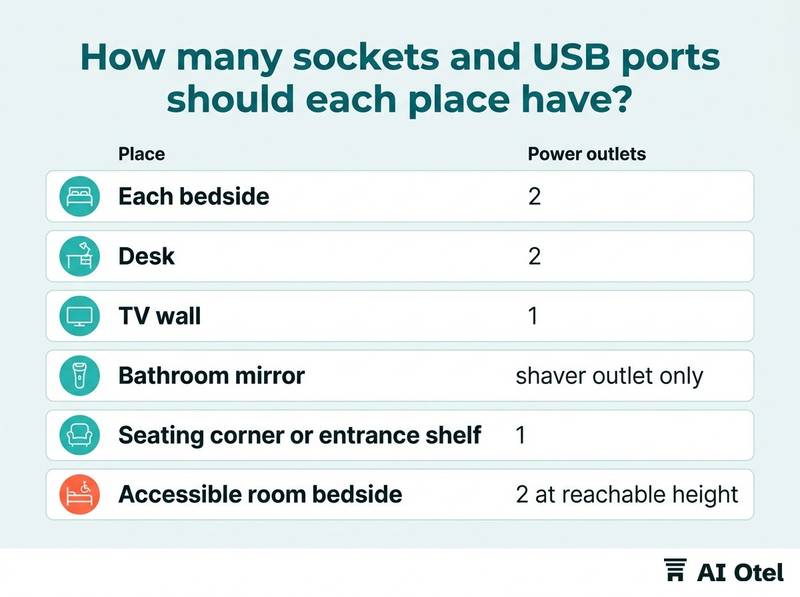
The TV wall is where the room's fixed devices live; one accessible outlet there stops the guest from pulling the television cable out to charge a camera. The bathroom mirror needs a shaver outlet, and hair tools belong at a mirror away from water, which in most rooms means the desk. A seating corner or an entrance shelf is where a power bank, a camera or a watch goes overnight, and it is the cheapest place to add a point during a refresh.
Write the numbers into the room type sheet so that a new build, a refurbishment and a maintenance order all use the same specification instead of three different opinions. Treat the counts as the hotel's own working target, reviewed when the room type changes, not as a rule that a supplier or an inspector can quote back at you.
| Place | Power outlets | USB ports | What it is for |
|---|---|---|---|
| Each bedside | 2 | 1 USB-C | Phone, watch, earbuds, medical device overnight |
| Desk | 2 | 2 | Laptop, phone, camera, power bank |
| TV wall | 1 | none | Keeping fixed devices plugged in |
| Bathroom mirror | shaver outlet only | none | Shavers and toothbrushes; hair tools at the desk mirror |
| Seating corner or entrance shelf | 1 | 1 USB-C | Power bank and camera overnight |
| Accessible room bedside | 2 at reachable height | 1 USB-C | The same devices from a seated position |
Where exactly should a bedside socket go?
Within arm's reach of the pillow, just above the top of the nightstand, and never behind the mattress or the headboard. Apply the reach test: a guest lying down should be able to plug in and pick the phone up again without getting out of bed. Set the height just above the nightstand top, so the cable does not bend sharply against the wall and the plug stays visible.
Keep one outlet free for the lamp. If the lamp takes the only outlet, the guest will unplug it, and the next guest reports a broken lamp. Do not hide the point behind the headboard, a curtain or a fixed panel; if it has to sit in furniture, put it on the front face where a hand can find it. Two guests, two sides: a single bedside point turns into an argument at midnight, and the front desk hears about it in the morning.
Add a small shelf or a hook beside the point so the phone charges off the floor and out of the bedding. Use the same logic at the desk: the socket goes above the desk top, not underneath it against the wall where the guest has to kneel to find it.
What can we fix this month without rewiring?
Most complaints are solved by moving power to where the guest already is: a checked power strip, an adapter at the desk and a few cables on the lending shelf. A power strip supplied by the hotel works as a short-term fix if it is fixed in place so it cannot slide, and never chained to a second strip. Never place a strip under the mattress, on the bed, or anywhere a drink can spill onto it; that turns a convenience into a fire risk.
Keep an adapter and a short charging cable at the desk, issued from the lending shelf and logged so it comes back. Sometimes the socket exists and the furniture covers it: moving the bed a few centimeters can expose a point, provided nothing is trapped or pinched. Replace a worn socket face rather than stacking a strip on top of it, because a socket that will not hold a plug is a repair job, not a capacity problem.
A small card or label telling the guest where the points are helps in rooms where the furniture hides them, and costs almost nothing. Buy strips and adapters from a supplier who provides the rating and the certificate, and keep that paperwork with the room's maintenance file.
TipThree fixes before you call an electrician
Fix a hotel-supplied power strip in place where the guest needs power, never chained and never near water or bedding. Issue an adapter and cable from the lending shelf, logged so they come back. Move furniture a few centimeters off an existing socket, after checking that nothing is trapped or pinched.
What must the electrician check before anything is added?
The electrician confirms the circuit's spare capacity, the earthing and protection of every new point, and whether the change needs approval; none of that is decided from a catalog. Load comes first: what the room's circuit already carries, and what the new outlets and USB modules would add to it, including the hair dryer and the kettle that run at the same time. Protection follows: whether the room's protective device covers the new point, and whether every new outlet is earthed.
The wall itself matters too: what the headboard is fixed to, and whether a cable can be run without weakening the fixing or the panel. On approval and paperwork, which local rules apply to the change, who signs it off, and where the record is kept: ask the electrician rather than assuming. USB modules are electronics, not wiring, so specify a replaceable module with a known rating; a failure then becomes a swap, not a wall repair. Ask for the as-built drawing to be updated, so the next technician knows what runs behind the panel. Anything close to water, such as a bathroom point, is the electrician's decision, not a housekeeping or front office decision.
Watch outFour questions to put to the electrician in writing
How much spare capacity does the room circuit have, with the hair dryer and kettle running? Are the new points earthed and covered by the room's protection? Does the change need approval, and who signs it off? Can the USB modules be replaced without opening the wall?
How do we test charging points during a room check?
Test each point in the room with a real plug and a real cable on the preventive round, because a socket that looks fine can fail to hold a plug or deliver power. Carry a socket tester and a phone with a charging cable on the round, alongside the usual tools. Plug the tester into every outlet, including the one behind the television and the one under the desk, and plug the phone into every USB port, one at a time, confirming that it actually charges rather than merely fitting.
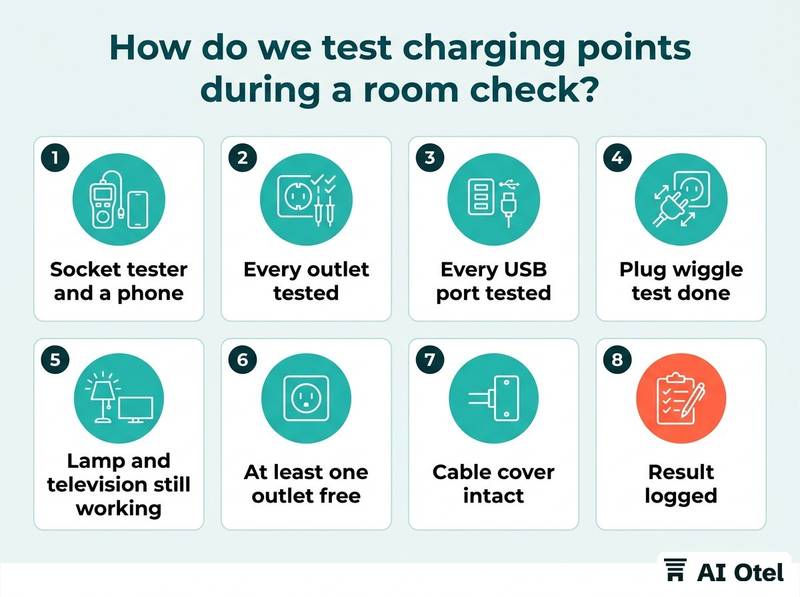
Wiggle the plug gently: a loose hold means a worn face, and that goes on the work order before a guest reports it. Check that the lamp and the television still work after the test, that at least one outlet is left free for the guest, and that the cable channel or cover is intact with nothing pinched behind the furniture. Record the room, the point and the result in the same log as the rest of the round, so the pattern shows up across rooms. This belongs inside the room-by-room preventive maintenance round.
ChecklistRoom charging point check
- Socket tester and a phone with a cable carried on the round
- Every outlet tested, including behind the television and under the desk
- Every USB port tested with a cable, confirming it charges
- Plug wiggle test done; a loose hold goes on the work order
- Lamp and television still working after the test
- At least one outlet left free for the guest
- Cable cover intact, nothing pinched behind furniture
- Result logged with room number and point
What does a refresh cost, and how do we budget it?
Budget per room, not per socket: the cost lines are the hardware, the electrician's time, the making good, the room's downtime and the replaceable USB modules. Ask for a quote per room type and multiply, rather than a price per point, so the labour and the making good are inside the number. Include the making good itself: paint, panel repair and refitting the headboard after the cable run.
Include the downtime: a room out of sale for a day has a cost the revenue manager can put a figure on before the work is scheduled. Include the lending shelf stock and the socket tester as a small recurring line, because both wear out. Phase the work: rooms that generate the most complaints first, the rest with the next planned refurbishment. Set the cost against the room's rate and the complaints the work removes, and drop the rooms where the sum does not work; the fuller method is in whether a room renovation pays for itself.
What to do next
Walk three rooms with a socket tester and a phone, note what you find at each bedside, desk, TV wall and mirror, and turn that into one room specification the electrician can price. The counts matter less than the position, and the position matters only if it is written down and checked again on every round. If your maintenance log lives on paper or in a spreadsheet, a hotel operating system can hold the room specification and the round results in one place, and the trust page explains how those records are kept.
Frequently asked questions
Is a USB port in the wall better than a power outlet?
A power outlet takes any charger and does not age with the connector, while a built-in USB port is a convenience that must be specified as a replaceable module with a known rating. The strongest combination at a bedside is a power outlet plus one USB-C port, so the guest with a laptop and the guest with only a cable are both served.
Should we fit USB-A or USB-C ports?
USB-C is the connector on most newer phones and laptops, while USB-A cables are still in many bags. The hotel can count what guests ask for at the front desk and decide from that. A power outlet covers both cases, because the guest's own charger plugs into it.
Can we put a power strip in a guest room?
Yes, as a short-term fix, if the hotel supplies it, fixes it so it cannot slide, never chains it to a second strip, and keeps it away from water and the bed. Buy it with a rating and a certificate and keep the paperwork. A strip is not a substitute for a socket where the guest actually needs one.
Should the bathroom have a socket?
A shaver outlet at the mirror is the usual provision, and hair tools are better placed at a mirror away from water. What may be installed in a bathroom, and where, is the electrician's decision. Ask before ordering anything.
How often should hotel room charging points be checked?
On every preventive room round, and again whenever a guest reports a problem. A worn socket face is replaced rather than tightened. The result goes into the same log as the rest of the round, so a pattern across rooms becomes visible.