Items the hotel lends: iron, adapter, umbrella, hair dryer, and a log that gets them back
A hotel lending items log prevents lost irons and umbrellas. This guide sets the lendable list, storage rules, log fields and departure checks to keep items in circulation.
Contents
Key takeaways
- Build the lendable list from a month of real requests at the desk, not from a supplier catalog.
- Keep one cupboard, one count and one log, so the number of irons is knowable on any shift.
- Never lend anything with a safety duty, a hygiene risk or an identity function, however small the request.
- The return line is the one that gets skipped: ask at the desk, before the bill closes, not after the guest leaves.
- When an item is lost or damaged, one written sentence from the hotel's own rule replaces whatever the shift would improvise.
A hotel lending items log is one line per borrowed item: room, item, date out, guest name, staff initials and the date it came back. The lendable list stays short, the count stays visible in one cupboard, and the desk checks every open line before the bill closes.
It is 22:40 and a guest in room 412 wants an iron. The desk has three; two are in rooms nobody wrote down, and the third has no cable. The fix is not a bigger cupboard. It is a short list of lendable items, one storage place with a visible count, and a log line that says where every item is, so the night shift can answer the question in ten seconds. This article sets out the list, the counts, the log fields, the departure-day check and the sentences to use when something comes back late, broken or not at all.
Which items should a hotel lend at the front desk?
Lend what guests ask for repeatedly and cannot reasonably pack, and keep the list short enough that one shift can count it from memory.
Start with a tally sheet at the desk and in housekeeping for one month. Anything requested most weeks belongs on the list; anything requested twice does not. The tally is the only honest source, because a supplier catalog sells what suppliers sell, not what your guests ask for.
Sort every candidate into three groups: already in every room, lendable at the desk, and not offered at all. An item in the first group should never appear on the loan list. Tea and coffee is the clearest case: if the hotel provides a kettle and supplies, the kettle belongs in the room, and the loan list is for what the room does not carry. The decision between a room kettle, a capsule machine and a lobby station is a separate one, covered in tea and coffee in the room: kettle, capsule machine or lobby station.
Publish the list where guests actually look: the in-room directory, the hotel website and any guest-facing screen. The in-room directory is where the guest meets the list first, and what the guest directory should list is worth deciding deliberately, in the languages your guests read. A guest who knows an umbrella exists before the rain starts does not discover it at the desk in a wet coat.
Write one line per item saying how it travels: handed over at the desk, delivered to the room, or collected by the guest and returned to the desk. Cap the list at what the desk can replace within a day. A lendable item that cannot be replaced quickly becomes a complaint the second time it is asked for.
ChecklistA starting list to test against your own tally
- Iron and ironing board, desk handover, shelf two
- Universal power adapter, desk handover, shelf two
- Umbrella, guest collects, stand by the door
- Hair dryer, desk handover, shelf two
- Phone charger cable, desk handover, shelf three
- Sewing kit, sealed, desk handover, shelf three
- Luggage scale, desk handover, shelf three
Which items should a hotel never lend?
Never lend anything that carries a safety duty, a hygiene risk or an identity or payment function, however small the request.
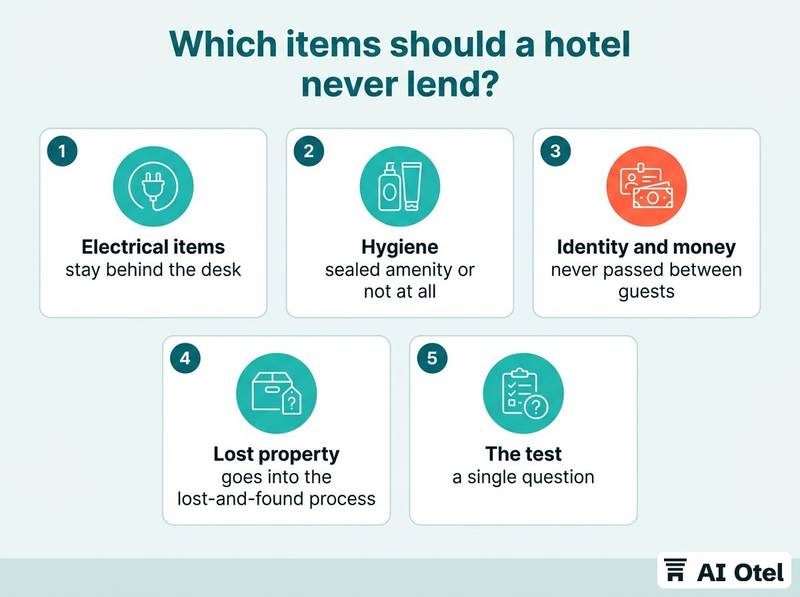
Electrical items are the first line. Heaters, unknown extension leads, damaged chargers and anything that warms up without a label stay behind the desk, meaning they stay out of circulation entirely. Hygiene is the second: razors, toothbrushes, nail clippers and anything that touches skin or a wound are given as a sealed amenity or not at all.
Identity and money are the third. Key cards, passports, payment cards, phones and laptops are never passed from one guest to another, and staff equipment is not lent at all. Anything the hotel cannot inspect between two guests, or cannot show was checked, stays off the list.
Lost property is never a lending pool. An item left behind goes into the lost-and-found process, not to the next guest who asks for one. How to log, store and return guests' lost items is a separate process with its own rules, and the two lists must not share a shelf.
The test is a single question: would you be comfortable if this item failed in a guest's room at two in the morning? If the answer is no, the item does not go out.
Watch outDo-not-lend list, printed inside the cupboard door
No heaters or unknown electricals. Nothing that touches skin unsealed. No key cards, documents or payment cards. Nothing the hotel cannot inspect between guests. No lost property, ever.
How many of each item should a hotel hold, and where should they live?
Set the count from your own request tally, add a margin for the busiest week, and keep every item in one locked place that the desk can see.
Take the busiest week in the tally, not the average. The loan list fails on the night four guests want an iron at once, not on an average Tuesday. For example, a hotel that logged fourteen iron requests in its busiest week might hold sixteen irons and two boards, and treat that as a floor rather than a target. The number is the hotel's own; there is no industry figure for it, and any number copied from another property is a guess wearing a costume.
Store everything in one cupboard with labeled shelves and a printed count taped inside the door, so a missing item is visible before anyone opens anything. Items that leave the building, umbrellas above all, live by the door in a stand with a visible count, because the desk needs to see the number fall. Anything with a cable or a battery gets a test point and a plug in the back office: a returned item is tested before it goes back on the shelf, not after the next guest reports it dead.
Two storage places is the same as no storage place. The second cupboard is where the count goes wrong, because the shift that checks one does not always check the other.
What should the loan log record?
One line per loan: room, guest name, item and count, date and time out, staff initials, and the date and time it came back.
The room ties the item to a departure list and a bill. The name covers the case where two guests share the room and one of them leaves early. The staff initials are what makes the entry answerable on the next shift; without them the line is an anonymous note nobody can ask about.
Leave the return column empty on purpose. An empty cell is the only reliable signal that an item is still out. Keep one log: a paper book at the desk plus a note in the shift handover is how items disappear quietly. If the hotel's system can carry a note on the guest's bill, put the loan there as well as in the log, so the departure check sees it without anyone remembering to look. A shared sheet works if the desk can open it in one tap; a spreadsheet on a back-office computer does not.
| Field | Why it is there | The mistake it prevents |
|---|---|---|
| Room number | Ties the item to a departure and a bill | Items that belong to nobody |
| Guest name | Covers shared rooms and early departures | "The other guest has it" |
| Item and count | An iron and a board are two lines | Half a loan being chased |
| Date and time out | Starts the clock | Items out for a week unnoticed |
| Staff initials | Makes the line answerable | Anonymous entries |
| Date and time back | Closes the line | Loans open forever |
| Condition on return | Records damage when first seen | Arguments two days later |
This is the hotel lending items log in one row: seven fields, each preventing a specific, recurring failure.
How do you get lent items back before the guest leaves?
Check every open log line at the desk while the guest is still standing there, and give housekeeping the same list.
Departure list first. Anyone with an open line gets one plain question before the bill closes, not a phone call to the room after check-out. Housekeeping reports both directions: what is missing from the room against the standard inventory, and what is in the room that should not be there, such as a desk iron in a room that never asked for one.
Group and early check-outs are the leak. The group leader gets the list the evening before, and the desk settles it with one person rather than twenty. An item that leaves with the guest goes onto the log as outstanding with a date, and the desk follows the hotel's written rule rather than deciding on the spot. Count the cupboard against the log once a week, on a fixed day, so the difference is found that week, not at the end of the season.
ChecklistDeparture-day check, in order
- Open the log and mark every line still out
- Match those rooms to today's departures
- Ask the question at the desk before the bill closes
- Take the item back and test it if it has a cable
- Write the return time and condition
- Hand the outstanding lines to the duty manager at shift change
What do you say when an item is lost, late or damaged?
Say it once, plainly, at the desk, and let the hotel's written rule decide what happens next rather than the mood of the shift.
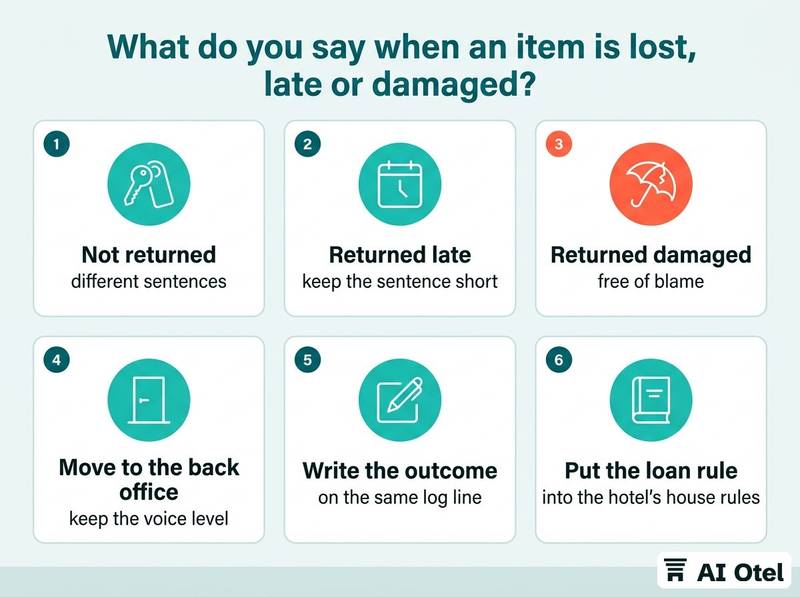
Separate three cases, because they need different sentences: not returned, returned late, returned damaged. Keep the sentence short and free of blame; the guest usually does not know the item is on a list at all. Where a replacement cost is involved, the hotel's written rule and the terms the guest accepted at booking are where the answer starts. Confirm the wording with your own accountant or legal adviser before it is printed, then apply it the same way every time.
Never settle it in front of other guests. Move to the back office, keep the voice level, and write the outcome on the same log line. An unresolved line is what makes the next shift reopen a conversation that was already closed. Put the loan rule into the hotel's house rules and where guests see them, so the desk applies a rule the guest has already seen rather than inventing one at midnight.
TipThree sentences the desk can use as written
"The iron is still showing as out on our list. Could you check the room before you come down?" · "The umbrella came back with a broken rib. Thank you for telling us, I will note it here." · "I will mark this as outstanding and the duty manager will follow up with you today."
When should the lending list be reviewed?
Once a season, against the log: items nobody borrowed leave the list, and items borrowed every week get a second unit.
Read the log as data: requests per item, losses per item, items that came back broken. Each item gets one of three outcomes: keep, increase the count, or drop it and give the shelf space to something else. Check the room standard at the same time; an item that is now in every room has no business on a loan list.
Rewrite the sentence that caused an argument at the desk, not just the item list. Put the review in the calendar before the season opens, because nobody reviews a cupboard in August.
What to do next
Start with the tally sheet, not the cupboard. One month of real requests tells you what to lend, how many to hold and what to drop. Then write the log line, print the do-not-lend list inside the cupboard door, and put the departure check into the shift routine, so the same three questions are asked the same way on every shift. If the hotel runs a guest-facing screen or app, the lendable list belongs there too: a guest app that shows offers and requests in one place is one way to publish it, and a hotel operating system that carries notes on the guest's bill can show the open loan at departure without anyone remembering to look.
Frequently asked questions
Should a hotel charge a guest for a lost umbrella?
There is no single answer that fits every hotel. The hotel's own written rule and the terms the guest accepted at booking are where it starts, and the desk should state that rule rather than improvise. Decide the wording once, print it, and record the outcome on the loan log line.
Does a guest need to sign for a borrowed iron?
A signature is optional; what matters is that the line can be answered later. A name, a room and staff initials are enough for most hotels. A signature is a choice the hotel makes when the item is expensive or leaves the building.
Paper book or software for the loan log?
Either works if the desk can open it in one tap during a check-in. What fails is a second copy in the back office, or a log that only the morning shift knows how to use.
Can a hotel lend to someone who is not staying there?
Only if the log can still identify the person, with a name and a phone number instead of a room. A hotel can also decide to lend only to in-house guests, which is simpler to apply and easier to explain at the door.