Food after midnight: a night menu, a vending corner or nothing, and what each costs
Choose the right hotel late night food service by logging guest requests. Compare the costs of a night menu, a self-service corner, or a clear no with alternatives.
AI draft · awaiting editorial review
Contents
Key takeaways
- A night menu is a short fixed list cooked at one station within written hours, not a second restaurant.
- Start the decision with a night log kept at the desk: time, arriving or in-house guest, the request in the guest's words, what was offered, and the outcome.
- Each option loads a different cost line: a night menu loads staff and waste, a corner loads stock and expiry, a clear no loads complaints.
- Tell guests before they are hungry, in the booking confirmation, the pre-arrival message, the room and the desk script, using the same words in all four.
- Choose the smallest option the log supports, write it down as one page, and review it against the same log at the end of the season.
A night menu is a short fixed list of dishes one kitchen station can cook after the restaurant closes. Choose it when your night log shows repeated requests for warm food, a self-service corner when requests are sporadic and staffing is thin, and a clear no with a named alternative when neither can be staffed safely.
It is 01:40. A guest whose flight landed two hours late puts the key card on the desk and asks what there is to eat. The answer the hotel gives in the next thirty seconds is either a decision it made in advance or one it is making badly. This article covers hotel late night food service as a decision with three honest outcomes: a short night menu, a self-service corner, or a clear no with a real alternative. You will finish with a log format, a menu rule, a corner rule, a desk script and a season review.
What do guests actually ask for after midnight?
Almost nothing about night demand can be known from outside your own building, so the answer comes from a log you start tonight: time, who asked, what they wanted, what you offered, and what they did next. Every other part of this decision depends on that log, so it is worth getting right before anything is bought or staffed.
Checklist
- Time of the request.
- Arriving guest or in-house guest.
- The request in the guest's own words.
- What the desk offered.
- The outcome: served, accepted an alternative, declined, left the building.
- Room number or booking source.
- Who took the request.
Two kinds of night hunger
A late arrival who has not eaten since the airport wants something warm within twenty minutes. An in-house guest at 01:00 usually wants something small and quick. They lead to different answers, so the log must separate them. Late arrivals and night charters change the shape of the demand, and the same desk also handles rooms, food and check-in after midnight, so read the log next to how those arrivals are handled.
Count repeats, not totals. One guest asking for soup every night for a week is a different signal from seven different guests asking once each. The second is a pattern; the first is a preference.
What the desk should write down
Let the night auditor keep the log at the desk, not the kitchen. The desk is where the request lands, and the kitchen only ever sees the requests that got through. Write down the refusals too, including the guest who says never mind and walks to the lift. The refusals are the cost you are trying to price.
Run the log for four weeks before deciding anything, and keep it running afterwards so the season review has a baseline to compare against. A decision made on one busy weekend is a decision made on noise.
Option one: what does a short night menu look like?
A night menu is a fixed, short list of dishes that one station can cook and one person can carry, served between written hours with a written last order. It is not 24-hour room service, and the difference is the whole point: the guest sees less choice, the hotel sees fewer staff hours and less waste.
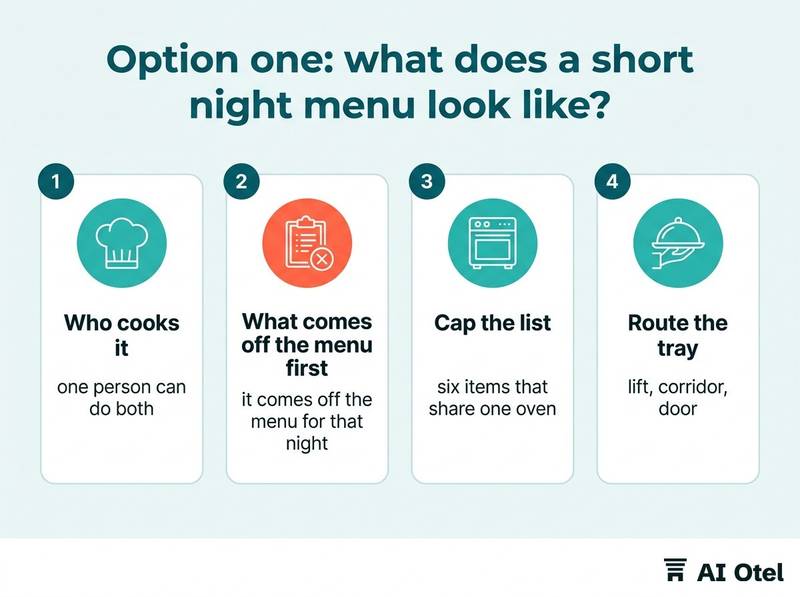
Cap the list at what one person can cook alone. For example, six items that share one oven, one fryer and one fridge, so a single cook can plate any of them in a few minutes. Choose for holding and speed, not ambition: a soup, a cold plate, a toasted sandwich, a pasta, a dessert already portioned. Nothing that needs a second pair of hands at plating time.
Who cooks it
A kitchen staffer on a night shift must not need help at 02:00. A cross-trained front-desk person must be able to cook the list while also checking in a group. If the only person who can cook the list is also the only person at the desk during a group check-in, the list is too ambitious and should be shortened until one person can do both.
Route the tray before you write the menu: lift, corridor, door, and the rule for entering a room. A night menu that cannot reach the fourth floor hot is a complaint generator. Put the charge on the guest bill at the moment of order, so the night audit closes a clean business day.
What comes off the menu first
Set a par level per item for the night and write what happens when an item runs out: it comes off the menu for that night, and the desk says so when the guest orders. Write the whole rule on one page: hours, last order, who to call when an item is out, and what the desk says when the kitchen is closed for cleaning. That page should sit next to the hotel's one clear list of what a stay includes, so the two never contradict each other.
Watch outThe single point of failure
One cook, one oven, one lift. If any of them fails at 01:00 there is no night menu that night, so write the fallback into the same page as the menu: the corner, the sealed snack at the desk, or the nearby list.
Option two: what are the rules for a self-service corner?
A self-service corner is a lit, stocked shelf or vending unit on the route between the entrance and the lift, selling sealed items at marked prices, with a named person responsible for restocking and dates. It answers sporadic, small requests without staffing a kitchen.
Checklist
- Sealed items only.
- A price on every item or shelf edge.
- One payment route, written down.
- Restocked and date-checked on the night round.
- Expired stock written off to a named line.
- Lit and signed.
- One named owner for stock and dates.
What belongs on the shelf
Stock only what survives without a kitchen: sealed snacks, bottled drinks, water, instant hot drinks, fruit that is checked daily. Anything needing heat or refrigeration belongs in a unit designed for it, not on a shelf. Mark every price on the item or the shelf edge and keep one price list. An unmarked item at night turns into a dispute at check-out.
Choose the payment route deliberately: a card reader, a charge to the room against a signed slip, or an honesty box. Each has a different loss profile, and the honesty box is the cheapest to run and the hardest to reconcile.
Who owns the stock
Restock on the night round, not in the morning. A corner filled at 09:00 is empty exactly when it is needed. Check dates on the same round and write expired stock off to a named line, so the waste is visible instead of absorbed into the restaurant's food cost. Light it and sign it: a corner in a dark corridor is a corner nobody uses.
Say what it is not. It is not a meal and it is not a minibar replacement, and the wording should make that obvious before a guest picks anything up.
Option three: how do you say no and still help the guest?
A clear no works when the guest hears it before they are hungry and is given something that actually helps: a sealed snack, a kettle for the room, or a short list of places nearby that are open. The no is not the service; the alternative is.
Say it at booking and again in the pre-arrival message: the kitchen closes at a stated hour, and the desk keeps sealed snacks and hot drinks. A guest who knows this eats on the way or arrives prepared. Say it at check-in for late arrivals, in the same words, before the guest asks. The same desk also handles holding the room, the key and the no-show decision for these arrivals, so the two scripts should be written together.
The desk script
Name the alternative concretely. "There is nothing" is a refusal. "The desk has water, biscuits and a kettle, and these places nearby are open until late" is a service. Write the desk script and practice it, so the answer does not depend on who happens to be on shift. Never promise "we will see what we can do": an unclear maybe becomes a complaint at the moment it turns into a no.
Key pointThe desk script, three sentences and one question
Our kitchen closed at 23:00. I can offer you a sealed snack, a hot drink, or a kettle for the room. These places nearby are open now, and I can mark them on the map. Would you like me to charge anything to your room?
The nearby list
Keep the nearby list current: someone walks it once a month and checks the closing times, because a closed restaurant on a printed list is worse than no list at all. A guest area guide that has been checked place by place serves both the desk and the pre-arrival message.
What does each option cost?
Each option carries four cost lines: staff time, stock, waste, and the complaint you pay for later. A night menu loads all four, a corner loads stock and waste, and a clear no loads the complaint line.
| Cost line | Night menu | Self-service corner | Clear no with alternative |
|---|---|---|---|
| Staff time | A dedicated shift, or cross-training and slower check-ins | A restocking round on the night walk | The minutes of the desk conversation |
| Stock tied up | Prepped items that may not sell | Shelf-stable stock that keeps | Nothing |
| Waste | What was prepped and not sold, plus tray returns | Expiry on dated items | None, and no revenue either |
| Complaint exposure | Low if the menu is honest about its limits | Low if prices are marked | A refused guest after a delayed flight may write about it or not return |
| Who can stop the service | Whoever staffs the station | The named stock owner | Whoever holds the desk script |
| What the guest gets at 01:00 | Warm food within written hours | Sealed items at marked prices | A snack, a kettle and a checked list |
Treat complaint exposure as a mechanism, not as a guess at a number: a guest refused food at 01:00 after a delayed flight may write about it, ask for a refund, or simply not return. Charge the night station's hours and stock to the night service, not to the restaurant. Otherwise the restaurant looks worse and the night looks free. How a night charge is recorded depends on the hotel's own registration and tax position, so confirm the treatment with your accountant before the first night of service.
Review the four lines together after a season, against the log from the first section, not against how busy the night felt.
How do you tell guests what is available before they arrive?
Put the same sentence in four places: the booking confirmation, the pre-arrival message, the room, and the mouth of the person at the desk. Write one sentence with four facts: what is available, until when, where, and how to order. For example: "hot food until 23:00 from the lobby bar, then sealed snacks and hot drinks at the desk."
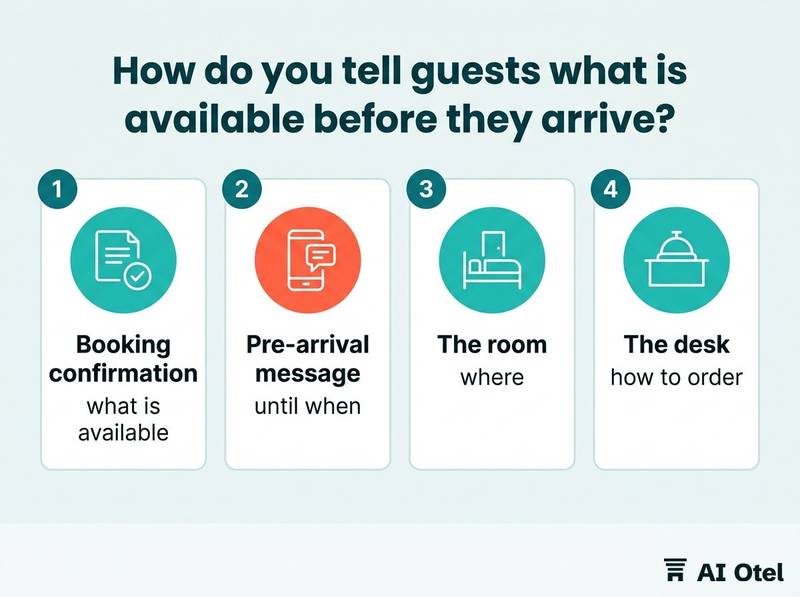
Use the same words everywhere. If the confirmation says 24-hour dining and the room card says snacks, the guest will believe the confirmation. Keep the line in the guest app or the in-room page rather than only on a printed card, so a menu change does not leave three versions in circulation. A hotel's own guest app is one place such a line can live and be updated in one step; the same idea applies to any in-room page the hotel controls.
TipThe model sentence and its four homes
What is available, until when, where, how to order. Write it once and repeat it word for word in the confirmation, the pre-arrival message, the room page and the desk script.
For late arrivals the pre-arrival message is the only moment that works. Once the guest is in the room and hungry, information only helps if it names a place that is open. Update the wording when the kitchen closes for a private event; a sign at the desk is not enough if the guest already read the app. If the hotel runs its guest communication and its desk operations on one platform, the change needs to be made in one place, but the rule is the same on paper.
How do you decide, and what do you review after one season?
Decide from the log, choose the smallest option the log supports, write it down as one page, and review it against the same log at the end of the season. The decision rule is short: if different guests repeatedly ask for warm food, a night menu earns its station. If requests are sporadic and mostly small, a corner is enough. If requests are rare and come almost only from late arrivals, a clear no with an alternative is honest and cheaper.
Start with the smallest option and add. Cutting a night kitchen is visible to guests; adding one is not. Write the rule as one page: hours, last order, what is on the list, who cooks, what happens when an item runs out, and what the desk says when the kitchen is closed. Set the review date at the start of the season, not at the end, and name the person who owns it.
Checklist
- Requests by type: warm food, small item, drink only.
- How many were met, how many refused.
- Stock and prepared food written off.
- Complaints that mention food.
- Staff hours actually worked at night.
- The one change for next season, and who owns it.
Change the rule between seasons where you can. Changing the night offer mid-season confuses the guests who booked on the old wording. Check the night offer against the hotel's one list of what a stay includes, so the two never contradict each other.
What to do next
Start the night log at the desk tonight and keep it for four weeks. When the four weeks are up, read it once, choose the smallest of the three options it supports, write that option on one page, and put the review date in the calendar for the end of the season. The log, the written rule and the review are what turn a 01:40 question into a decision instead of a scramble.
Frequently asked questions
Is a night menu the same as 24-hour room service?
No. Twenty-four-hour room service means the full menu and a brigade across the clock; a night menu is a short fixed list served between written hours with a written last order, cooked at one station by a person already on shift. The guest sees less choice; the hotel sees fewer staff hours and less waste.
Should night food be free or charged?
That is a positioning decision, not a cost decision. Whatever you choose must match the hotel's one list of what a stay includes and must be said in the same words in the confirmation, the room and the desk script. A free night snack is still a cost line and belongs in the season review like any other.
What do we do when the kitchen is closed and a guest is hungry at 02:00?
Offer what you actually have: a sealed snack, a hot drink, a kettle for the room. Name the nearby places that are open and mark them on a map. Write any charge to the room, record the request in the night log, and then fix the advance wording so the next guest is not surprised.
How do we keep a self-service corner from becoming a loss?
Sealed stock with dates, a price on every item, one written payment route, restocking and date checks on the night round, expiry written off to a named line, and one named owner. If the write-off line grows faster than the sales line, the assortment is wrong, not the idea.
Does a night menu need a separate kitchen team?
No. It needs one station and one person whose other duties allow it. If the only person who can cook the list is also the only person at the desk during a group check-in, the list is too ambitious and should be shortened until one person can do both.