Giving directions to the hotel: one message for taxi, car and airport arrivals
Guests rarely get lost on the motorway; they get lost in the last few hundred meters. This guide shows how to write one arrival message that carries a guest from the airport or motorway to your door without a phone call.
AI draft · awaiting editorial review
Contents
Key takeaways
- Guests rarely get lost on the motorway; they get lost in the last few hundred meters, where the pin, the sign and the entrance stop matching what a stranger sees.
- The map pin should mark the place where a car can stop and a guest can walk in, not the middle of the building.
- The taxi line stays in Turkish, because the driver is the reader and the guest only has to show the screen.
- Time ranges in the airport route come from the hotel's own timed runs at the hours guests actually arrive, never from a website.
- An arrival message is finished only when someone who has never been to the hotel reaches the door using that message alone.
An arrival message is one short text sent before the stay: the map pin at the vehicle entrance, a three-line address in Turkish a taxi driver can read, the car entrance and parking, the airport route with a time range the hotel measured, and a phone number a person answers.
The taxi has been circling the same two streets for ten minutes, the meter is running, and the guest is holding a phone with a map pin that points at a wall. Reception knows exactly where the car is. The guest cannot see it, and the driver does not speak the language the receptionist is using. Every hotel directions message guests receive should prevent exactly this scene. After reading this guide you will be able to write one message, in one block, that carries a guest from the airport or the motorway to your door without a phone call.
Why do guests get lost in the last kilometer?
Guests rarely get lost on the motorway. They get lost in the last few hundred meters, where the map pin, the sign and the entrance the hotel uses every day stop matching what a stranger sees. Navigation gets the car to the neighborhood. The hotel's own information has to finish the journey.
Staff give directions from muscle memory: they describe the turns they make daily and skip the one turn a stranger cannot guess. The person writing the message has driven that route a hundred times and no longer notices that the entrance is on a one-way street, or that the sign carries a different name from the booking. The stranger notices immediately.
Most failures come from a short list. The pin lands on the wrong side of the building or on a back gate. The sign carries a different name from the booking. A one-way street makes the obvious turn illegal. Two properties on the same street sound alike. The car entrance and the lobby entrance are in different places. Every one of these is fixable in the message, and none of them is fixable at 23:00 in a moving taxi.
The guest arrives tired, with luggage, often after dark, often without fluent Turkish, and cannot troubleshoot a wrong turn. The driver is a stranger with a meter running, so every extra loop costs the guest money and goodwill before check-in has begun. Reception pays twice: once in the phone call and once in the first impression, because the first ten minutes from the door to the room start at the curb, not at the desk.
The fix is not more words. It is one message, written once, checked by someone who has never been there, and reused for every arrival.
What should the map pin point at?
The pin should mark the place where a car can stop and a guest can walk in, not the middle of the building and not the postal address of the lobby. If a guest follows the pin and lands in a courtyard behind a closed gate, the pin has failed even though it looked correct.
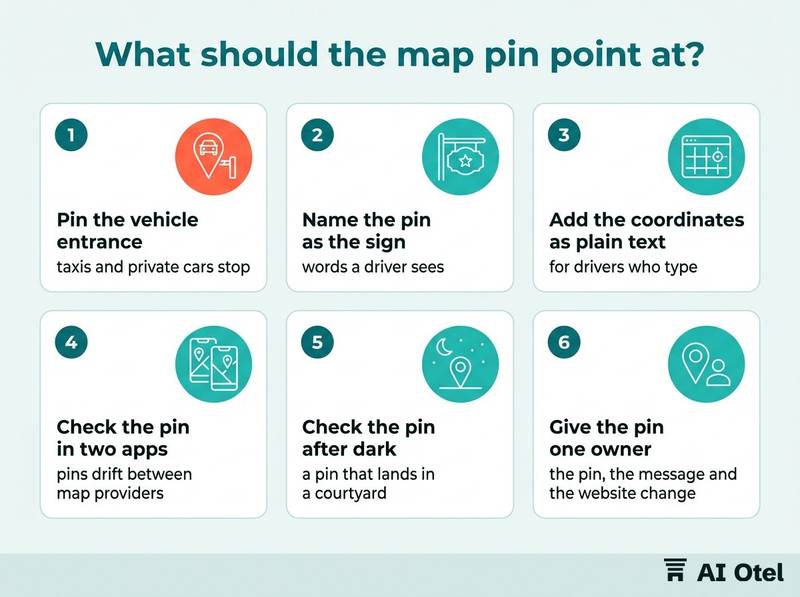
Pin the vehicle entrance. If taxis and private cars stop at the same door, that door is the pin. If parking is somewhere else, that is a second pin, named separately and explained in one line. Pins drift between map providers: the same coordinates can land on a different gate in two apps, so check the pin in at least two apps guests are likely to use, and check the walking route as well as the driving route.
Name the pin exactly as the sign reads, including the words a driver sees from the road. A brand name the sign does not carry is useless at the curb. Add the coordinates as a plain text line for drivers who type into their own navigation and for guests who forward the message to someone else.
Check the pin after dark. A pin that lands in a courtyard, on a service road or behind a closed gate is worse than no pin, because it looks correct. And give the pin one owner: when an entrance moves, the pin, the message and the website change in the same week, not eventually.
ChecklistPin check before you send
- Stand at the pin and confirm a car can legally stop there.
- Open the pin in two map apps and compare.
- Check the driving route and the walking route separately.
- Repeat the check after dark.
- Confirm the pin name matches the sign on the building.
- Confirm the coordinates in the message match the pin.
- Confirm a second pin exists if parking is separate.
- Confirm the pin is not inside a closed gate, courtyard or service road.
What should the line for the taxi driver say?
Three short lines in Turkish: the district and street with the door number, one landmark the driver can see from the road, and the hotel's phone number. That is the whole block.
Write it in Turkish even when the guest does not read Turkish, because the driver does. The guest only has to show the screen. Use the name drivers know, which is often the old name, the name on the sign or the street name, not the brand the guest booked under. Choose a landmark visible from the road and impossible to confuse: a corner mosque, a stadium or a named junction works; a pharmacy two streets away does not.
Keep it to about three lines. A driver reads it at a red light, not at a desk. Put it in a block the guest can copy and show, never inside an image and never buried in a paragraph of welcome text. Do not machine-translate the Turkish block: a translated street name is worse than no translation, because it looks helpful and is not. Put the phone number on the same screen, so the driver can call the hotel without the guest searching for the number.
TipA copyable template (illustrative)
For example: "[District], [Street] No: [door number], [landmark] karşısı. Tel: [number that is answered]". Three lines, no abbreviations, no brand name the sign does not carry.
What does a guest arriving by car need to know?
A driver needs turn-by-turn directions from a junction they will actually reach, the side of the street the entrance is on, and what to do with the car once they arrive. Everything else is decoration.
Start from the motorway exit or the main junction, not from the city center and not from the airport. Give the last three or four turns only. Say which side the entrance is on and what comes immediately before it, so the driver can change lane early instead of braking at the door.
Name the roads that look right but are not: the service road, the parallel street, the entrance of the building next door. These are the turns navigation gets wrong. State a turn in words as well as on the pin, because a driver following voice navigation needs the sentence to match what the voice says.
Cover the car itself. Who opens the barrier, the height limit for vans and roof boxes, whether the car may stop at the door first to unload, and where the keys go afterward. For night arrival, say whether the gate is closed, whether there is an intercom, and whether a person is at the door or only a night bell. If the hotel sits inside a pedestrian zone or a historic quarter, say exactly where the car must stop and how far the walk is with luggage, measured by the hotel itself.
How do you write the airport and station route?
Give the options the guest actually has, where to find each one inside the terminal, and a time range the hotel has measured itself rather than a single number copied from somewhere else. A guest standing at baggage claim needs to choose in thirty seconds, and the message has to make that possible.
Three options usually cover it: a taxi from the rank, a pre-booked transfer, and public transport such as a metro line, an airport bus or a train. Say where each is found after baggage claim, on which floor, and what the sign above it reads. Give time ranges, not single numbers, and only from the hotel's own timed runs at the hours guests actually arrive: the same road at 08:00 and at 23:00 is two different journeys.
Leave fares out. Prices change and a stale number becomes a complaint at the desk. If the hotel has confirmed how the fare is set, say that instead of an amount. For a pre-booked transfer, say who meets the guest, where that person stands and what the sign says; the choice between own vehicles, a partner and the guest's own arrangement is a separate decision. Cover late arrivals: what happens after midnight, whether the rank is still staffed, and which number the guest calls if the flight is delayed. For stations, say which exit, which side of the building, where the taxi rank sits, and whether walking with luggage is realistic.
| Arrival option | What the message tells the guest | What the hotel must check itself |
|---|---|---|
| Taxi from the airport rank | Rank location, floor, sign, time range | Time the route at arrival hours |
| Pre-booked transfer | Who meets the guest, where, sign text | Confirm the meeting point and sign |
| Public transport | Line, stop, floor, walking distance | Walk the route with luggage yourself |
| Own car collected at the airport | Parking, barrier, keys, night gate | Check the gate and intercom after dark |
| Coach or train station | Exit number, taxi rank, walk distance | Confirm which exit is open at night |
Which phone number should the message give?
The number a person answers at the hour the guest will call, which is often not the reservations line printed on the website. A lost guest at midnight does not need tomorrow's bookings desk.
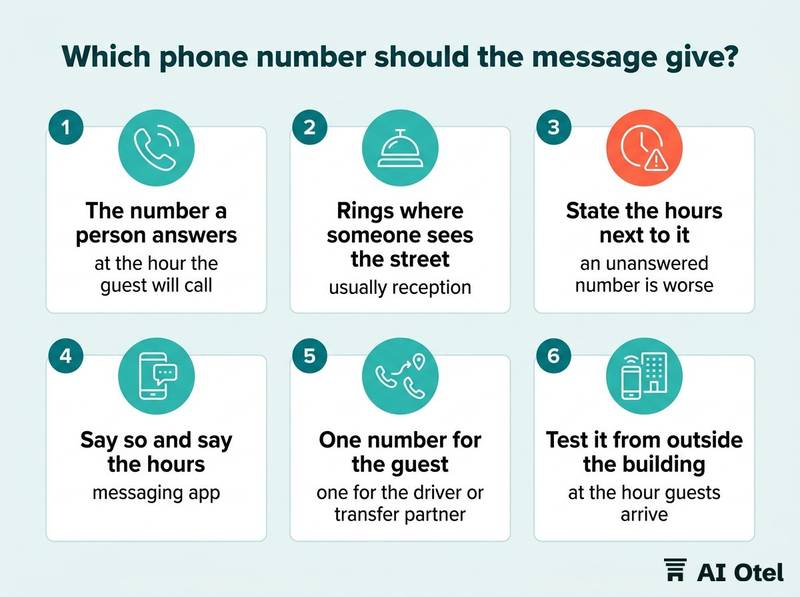
Give the number that rings where someone can see the street and the map, usually reception. State the hours next to the number: an unanswered number is worse than no number, because the guest stops trying and starts guessing. Decide what the person answering says, and make it the same three lines as the message, in the same order. Two versions of the directions is how the last kilometer fails.
If the hotel uses a messaging app, say so and say the hours. Do not offer three channels and answer only one. For a delayed flight or a late arrival, give one number for the guest and one for the driver or transfer partner, and label which is which. Test it from outside the building at the hour guests arrive, and check that the person who picks up can actually give directions rather than transfer the call.
How do you test the arrival message before you rely on it?
Give the message to someone who has never been to the hotel and let them arrive using only that message, then fix whatever made them stop. The hesitation points are the defect list; opinions about the wording come second.
Choose a tester who genuinely does not know the building: a new colleague before their first shift, a supplier, a friend visiting from another city. Test each mode separately, because a message that works for a taxi driver can fail for a guest on foot from the station, and the other way round. Test at the hour guests arrive, including after dark and in rain, when signs are harder to read and the entrance looks different.
Watch where the tester hesitates and write it down, in their own words. Fix one thing at a time and re-run the same route, so you know which change worked. Give the message an owner and a review date, plus a trigger list: a new entrance, a closed road, a changed one-way system, a renamed street, a new parking arrangement. Keep the message in the same place that sends the pre-arrival email, so there is one version and not four, and coordinate it with whatever the hotel collects through online check-in before arrival.
ChecklistTest protocol
- Pick a tester who has never been to the hotel.
- Send only the message, nothing verbal.
- Run the taxi route, the car route and the public transport route separately.
- Run at least one test after dark.
- Record every hesitation point in the tester's own words.
- Fix one defect.
- Re-run the same route with a different tester.
- Set the owner and the review date.
- Store the final text with the pre-arrival message.
A hotel that sends this message through its own guest app, installed from the browser with no app store, keeps one version in one place, next to the bill, room service and requests. Hotels thinking about how arrival information fits into the wider hotel operating system should treat the arrival message as one of its smallest and highest-value pieces.
What to do next
Write the message today, in one block: the pin at the vehicle entrance, three lines of Turkish for the driver, the car entrance and parking, the airport route with a range the hotel timed itself, and the number a person answers. Then hand it to someone who has never been to the hotel and let them arrive with nothing else. Every section above feeds that single test: the pin, the driver line, the car directions, the airport route and the phone number are not five documents but one message a tired guest can use at the curb. If you are a traveler rather than a hotelier, you can find a hotel in Türkiye (opens in a new tab) and put its arrival message to the test yourself.
Frequently asked questions
Should the arrival message be an email, a text message or a messaging app message?
Send the same words on the channel the guest will actually open at the airport, and keep the email as the record. Ask for a mobile number at booking, keep the message strictly about the stay itself, and route anything promotional through the hotel's own consent process. The words matter more than the channel, as long as there is only one version of them.
Our hotel has two entrances and shares a building. How do we describe that?
Name the one entrance the guest should use, put the pin there, and say in one line what the other entrance is for. A guest who is told there are two doors will choose the wrong one; a guest who is told which door is theirs will not. This is one of the most common hotel directions message failures for guests arriving at shared buildings.
Do we need to translate the whole message into every guest language?
No. The taxi block stays in Turkish because the driver reads it, and the rest can be written in the languages the hotel already serves at the desk. A short message with one Turkish block is better than a long one in five languages that nobody finishes. The guest only has to recognize the structure, not read every word.
How long should the arrival message be?
Short enough to read standing up with luggage: the pin, the Turkish block, the entrance and parking line, the route with its time range, and the phone number. Everything else belongs in a second message or in the guest's own app, not in the one they open in a taxi. If it does not fit on one screen, cut it.
What about guests arriving by coach or train rather than by plane?
Use the same structure with a different starting point: the exit they should leave from, which side of the building it puts them on, where the taxi rank is, and whether walking with luggage is realistic. A station exit is as confusing as an airport terminal, and the guest has fewer signs to follow. Time the walk yourself before you promise it.