A guest area guide: what to write about the neighborhood and how to check each place
A hotel area guide for guests is one maintained page of places near the hotel that a guest can act on. Each entry carries a walking time, checked hours, and one honest reason.
AI draft · awaiting editorial review

Contents
Key takeaways
- A guide entry earns its place with three things: a walking time, hours with the date they were checked, and one specific reason the place is listed.
- Verify hours by calling during service and asking a specific question; a website's opening hours are a claim, not a check.
- Ten places is a cap, not a target: a short guide that is true beats a long one that is stale.
- If the hotel has any arrangement with a listed business, one plain sentence on the page says so, and the reason line still has to earn the slot.
- Give the guide one named owner and a review date; a page without a date is a guess.
A hotel area guide for guests is one maintained page of places near the hotel that a guest can act on: each entry carries a walking time, hours checked in person or by phone with the date, and one honest line saying why it is listed. Ten entries is a working cap. The guide is reviewed monthly in season.
It is 21:40 and a guest at the desk asks where to eat. The answer the desk gives tonight is the answer it will give next month, unless someone writes it down, checks it and dates it. This article shows how to build that page: what to write about the neighborhood, how to verify each place, how to disclose arrangements, and how to keep the whole thing current without turning it into a project.
What do guests actually ask at the front desk?
Most desk questions repeat: where to eat now, where to eat well, how to get somewhere, what to do on a wet day, and where to buy a forgotten thing. Build the guide from that list, not from what the hotel finds interesting.
Keep a desk log for one month. A notebook or a shared sheet, one line per question, with the time of day and the language it was asked in. Tally the log into categories at the end of the month; those categories become the guide's sections, in the order guests ask them. Record the hour, because the same question at 13:00 and at 23:00 needs a different answer, and often a different place.
Separate the repeatable from the one-off. A question asked twice a week goes on the page; a question asked once stays a conversation. Ask the staff who work evenings and weekends, not only the day shift; the log is only as good as its coverage. Write down the answer the desk actually gave, because those answers are the raw material for the honest reason lines later. Note the questions the desk could not answer: each one is a gap the next review has to close.
| What the guest asks | What the entry must answer | Where it goes in the guide |
|---|---|---|
| Where can we eat right now? | Walking time, kitchen closing time, whether a table is needed | Eat, first entry |
| Where do we eat well, not just now? | Walking or taxi time, price band in words, booking needed | Eat, second entry |
| How do we get to the old town or the beach? | Route in steps, uphill or flat, last return time | Getting around |
| It is raining, what now? | Indoor options, hours, cost | Wet day |
| Where do we buy a charger or medicine? | Walking time, closing time, whether cards are taken | Practical |
A late-night food question deserves its own answer, not a shrug; the same thinking applies to what to offer a guest who asks for food after midnight.
Which ten places belong in a first-time visitor's guide?
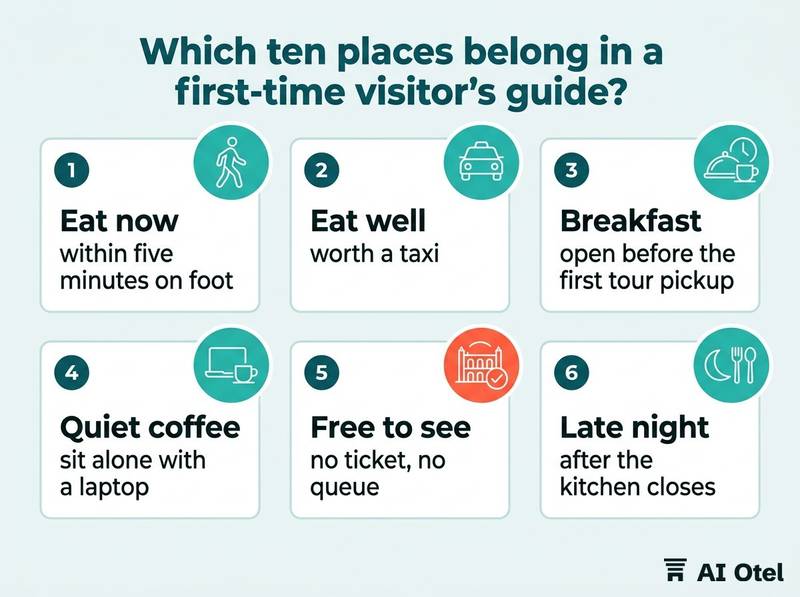
A mix that covers the questions, not ten restaurants: one place to eat within five minutes, one worth a taxi, one breakfast, one quiet coffee, one free thing to see, one practical stop, one wet-day option, one for families, one local specialty, and one late-night answer.
Ten is a cap, not a target. Five entries that are true beat ten where three are stale. Each entry must be reachable on foot or carry a stated transport and time; "nearby" without a time is not information. Only list places someone on the team has entered during the current season.
Keep one slot for a seasonal place, such as a summer beach club or a winter market, and mark it as seasonal. Do not rank the neighborhood: the guide answers "which of these fits my evening", not "which is best". Say who a place does not suit: stairs, noise, no cards, no menu in the guest's language. A guest with three hours and a guest with three days need different first entries, so label them and the desk can pick.
Checklist
- Eat now: within five minutes on foot, open when the desk is busiest
- Eat well: worth a taxi, booking stated
- Breakfast: open before the first tour pickup
- Quiet coffee: somewhere a guest can sit alone with a laptop
- Free to see: no ticket, no queue
- Practical: pharmacy, market, charger, SIM
- Wet day: indoors, open, priced
- Families: space, toilets, no stairs
- Local specialty: the thing this neighborhood is known for
- Late night: the one answer after the kitchen closes
How do you verify opening hours and walking time?
In person or by phone, and the date goes next to the result. A website's hours are a claim; a call during service is a check.
Call during service, not in the morning, and ask a specific question: are you serving food on Sunday at 19:00, and until what time do you take orders? Record three things beside the entry: who checked, how (call or visit), and the date. Walk the route yourself at a guest's pace, with luggage, and time it. A five-minute walk for staff is often ten for a guest.
Note what the walk involves: a hill, stairs, an unlit stretch, a crossing without a signal, a last turn that is hard to see at night. Check the return: last bus, last ferry, and whether a taxi is easy to find at that hour. Hours move with season, public holidays and Ramadan; a check in May does not describe August. A place that answers the phone during service will also answer a guest, and that is worth knowing on its own.
Watch outAn entry without a date is a guess
When a check cannot be made before printing, either leave the entry out or print it with a line saying the hours are unconfirmed and the desk should be asked, plus the date of the next check. Never print an unverified closing time as fact, and never carry a date forward from the previous edition without a new call.
Why is each place on the list? Write one line a guest can act on
The reason line replaces adjectives with a fact the guest can use: what the place is good for, at what hour, and what it costs in effort or money.
"Weak: great atmosphere. Useful: the only full menu within ten minutes after 22:00." The line must be checkable by the guest: a time, a distance, a dish, a queue, a payment method. Put the trade-off in the same line: small room, cash only, long wait at 20:00, no menu in English.
Write it in the hotel's voice. Copy from the business's own marketing reads like an advertisement and ages badly. If no specific line can be written, the place does not belong on the page. Keep it to one sentence; the guest reads it standing at the desk, often in a hurry. The same discipline of saying exactly what is and is not included runs through one clear list of what a stay includes and what it does not.
| Line that says nothing | Why it fails | Line that works |
|---|---|---|
| Amazing local food | Adjective, uncheckable | Home-style dishes, ten minutes on foot, open until 22:00, cash only |
| Best coffee in the area | A ranking the hotel cannot support | Opens at 07:00, so it works before an 08:30 pickup |
| Lovely beach club | No time, no cost, no season | Beach club, 15 minutes on foot, seasonal, entry charged, towels included |
| Traditional restaurant | Nothing a guest can act on | Grill house, 20 minutes on foot or a short taxi, booking needed at weekends |
Should the guide say when the hotel has an arrangement with a business?
Yes, in one sentence, and the arrangement never changes the reason line. A guest who learns later that a recommendation was paid for stops trusting the whole page.
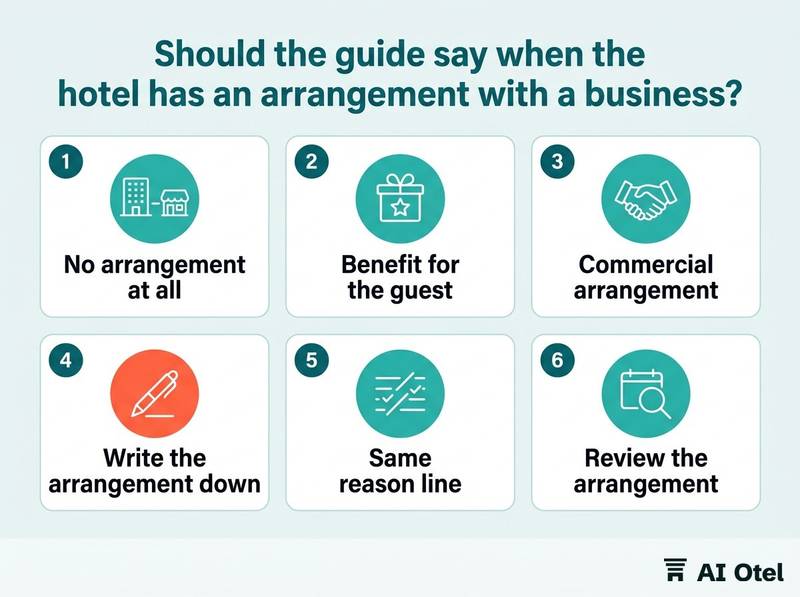
There are three cases: no arrangement at all, a benefit for the guest, or a commercial arrangement. Each has its own sentence, and the sentence must be true. Write the arrangement down with the business: what the guest gets, what the hotel gets, and for how long.
A place with an arrangement still has to earn its slot on the same reason line as the others. If it cannot, it comes off. The desk and the page must give the same answer; a guide that says one thing and the desk another is worse than neither. Never call a listed business a partner of the hotel unless a signed agreement says so. Review the arrangement when the guide is reviewed; an old arrangement is a claim the hotel can no longer support.
Key pointThree disclosure lines, use the one that is true
"Every place on this list is here because we think it suits our guests. We take nothing from any of them." / "Places marked with a star give our guests a small benefit. We take nothing for listing them." / "Places marked with a star are commercial arrangements. We say so, and we still only list places we would send a friend to."
How do you keep the guide current, and where should it live?
One master document, one named owner, a monthly check in season, and the same content in print, in the room and on the guest's phone.
Name one owner. A guide with three authors has no author. Review monthly in high season and quarterly outside it; the review is a round of calls or a walk, not a meeting. Remove, do not annotate: a closed place comes off the page, because a strikethrough tells the guest the page is not maintained.
Keep a change log with dates so the desk can answer "is this still true?" without guessing. Print in small batches with the version date on the sheet; a printed sheet cannot be corrected, so the date tells the guest how fresh it is. Publish the same content as a page the guest can open on a phone, so a correction reaches everyone without a reprint. A hotel's guest-facing pages work best when they hold the same facts everywhere, the same principle that applies to keeping the hotel's own profile facts and hours correct.
Write it in the languages the desk actually handles and say on the cover which those are; a machine translation of a place name sends guests to the wrong street. Hand it over at check-in with one sentence, not silently, and keep a copy where the question is asked. The handover moment is part of a wider craft, as with the first ten minutes from the door to the room.
Checklist
- Call every entry and confirm hours for the coming month
- Walk one route that has changed
- Remove closed places and refresh the seasonal slot
- Update the version date on the printed sheet and the phone page
- Tell the desk what changed
- Check that the desk's spoken answer matches the page
What to do next
Start the desk log tomorrow and let it run for one month. Then print a dated one-page guide with five entries you have checked yourself, and put a name and a review date on it. The guide is not a marketing page: it is the desk's best answer written down, checked and dated, and every check in this article exists to keep that answer true.
Frequently asked questions
How many places should a hotel area guide list?
Ten is a working cap, chosen to cover the questions guests actually ask, not a target to fill. Fewer entries that are checked and dated are better than a long list where some places have closed. Keep one slot free for a seasonal place and mark it as seasonal.
Do we have to take a commission to recommend a local business?
No. The guide works without any arrangement, and an unpaid list is the simplest to defend. If the hotel does have an arrangement, one plain sentence on the page says so, and the place still has to earn its slot with a specific reason line. The desk must give the same answer as the page.
How often should the area guide be updated?
Monthly during high season and quarterly outside it, with one named owner and a version date on every copy. The review is a round of calls or a walk, not a meeting. Closed places come off the page rather than being marked as closed.
Should the guide be translated into several languages?
Write it in the languages the desk can actually handle, and say on the cover which those are. Keep the same facts in every language: the same walking time, the same hours, the same trade-off. Check place names by hand, because a machine translation of a street or business name can send a guest to the wrong address.
Can we just link guests to a map instead of writing a guide?
A map gives distance and direction, not the reason a place is worth the walk, when it closes, or what it costs in effort. Use both: the map for the route, the guide for the decision. A map pin also cannot say that a place is closed for renovation this season.