Choosing a hotel's first three AI tasks: score each by volume, risk and checking effort
Score each candidate AI task on three columns: how often it recurs, how bad a mistake would be, and how long a person needs to check the output. High volume, low cost of error and short checks come first. Pick three, write the rules, review after a month.
AI draft · awaiting editorial review
Contents
Key takeaways
- A long list of AI uses is a menu, not a decision; three scores turn it into a shortlist.
- Volume, the cost of a mistake and checking effort are the only three columns a first choice needs.
- If checking the output takes as long as doing the task by hand, the task is not ready yet.
- Any task that ends in a payment, a fiscal document or a guest identity notification starts outside the first three, whatever its volume.
- Three tasks with a written rule and one named owner beat ten tasks nobody owns.
Score each candidate AI task on three columns: how often it recurs, how bad a mistake would be, and how long a person needs to check the output. High volume, low cost of error and short checks come first. Pick three, write the rules, review after a month.
A general manager opens a list of fifty things AI can do in a hotel, reads to number twelve and closes it. Nothing on the list says which task to do first, or what happens when the output is wrong. This article gives you a scoring sheet that answers that question with your own hotel's numbers: three columns, ten tasks, three winners and a written rule for each. You can build it in one week and review it in one month.
Why does a list of fifty AI uses not help a hotel manager?
Because a list describes what is possible, and a first choice needs a comparison. Fifty uses look equally attractive until each one is scored on the same three columns.
A use list is written from the tool's side. It names capabilities, not your hotel's actual work, its shift pattern, or who would check the output. Lists also mix tasks of very different size: drafting a reply to a review and preparing a night audit summary sit next to each other with no common measure.
Without a score, the choice falls to whoever is loudest or most curious, and the first failure shapes the hotel's view of AI for a year. A scoring sheet puts the same three questions to every candidate, so a plain back-office task can beat a glamorous guest-facing one. The sheet is a shortlist, not a business case: claims about time or money come later, from your own measurements after a month of use.
Keep the long list. Score it rather than deleting it, because next season's candidates come from the same place. If you are still collecting candidates, our overview of AI tools for hotel teams, department by department is a reasonable menu to score.
NoteA menu is not a decision
The scoring sheet turns a menu into a shortlist, and a shortlist into three tasks with owners. The list itself is never the output.
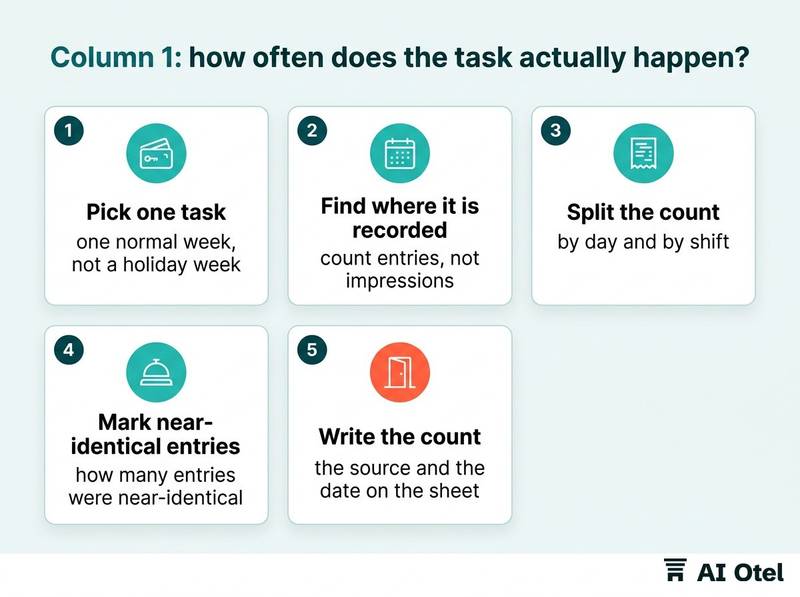
Column 1: how often does the task actually happen?
Count the real occurrences in a normal week, not the ones people remember. A task that happens twice a week rarely repays the effort of setting it up; a task that happens twenty times a day is worth a careful look.
Count from records, not memory: reservation notes, the guest request log, the phone and messaging inbox, the night shift handover book, the review queue. Separate a task that repeats identically from a task that only looks similar. The first is a candidate; the second is a category and needs splitting before it can be scored.
Note the shape of the week. A task concentrated in check-in hours or in high season behaves differently from one spread evenly across the month. A high count with high variation, where every request is different, is harder than a high count with a fixed shape. Score the shape, not only the count.
Write the count, the source and the week you counted. That number is the hotel's own baseline and the only thing the month-end review can compare against. Do not borrow a count from a vendor deck. Your hotel is the only relevant case, and its own records are the only honest source.
ChecklistCounting a task's volume in one week
- Pick one task and one normal week, not a holiday week
- Find where it is recorded and count entries, not impressions
- Split the count by day and by shift
- Mark how many entries were near-identical
- Write the count, the source and the date on the sheet
Column 2: how bad is a mistake, and can it be undone?
Rank the mistake by what it costs and whether it can be reversed. A wrong internal draft costs a minute; a wrong price sent to a guest or a wrong figure in a fiscal document costs money and trust.
Ask three questions of every task: who sees the output, what does it commit the hotel to, and can it be taken back. Reversibility is the sharpest test. An internal draft can be deleted before anyone reads it; a message already sent to a guest cannot be recalled.
Anything that ends in a payment, a fiscal document (an invoice or e-document) or a guest identity notification (KBS, the misafir kimlik bildirimi) is a stop sign for a first task, whatever its volume. Guest personal data adds a second kind of cost. The hotel's own data protection process decides what may be pasted into a tool, not the tool and not the vendor.
Score 1 for internal, reversible and unseen; 2 for guest-facing but correctable before it leaves the building; 3 for anything that commits money, creates a legal record or cannot be recalled. Where your own obligations are unclear, ask your accountant or legal adviser: the sheet ranks risk, it does not settle a legal question.
Illustrative examples, not recommendations:
| Kind of mistake | Illustrative example | Can it be undone? | Score |
|---|---|---|---|
| Wrong wording, internal draft | Housekeeping note rewritten more clearly | Yes, deleted before use | 1 |
| Wrong tone in a review reply | Reads cold to a guest | Yes, edited before posting | 2 |
| Wrong detail sent to a guest | Pre-arrival message names wrong restaurant hours | No, already sent | 3 |
| Wrong figure in a price quote | Rate quoted below the contracted level | Partly, once in writing | 3 |
| Wrong entry in a legal record | Guest identity notification or fiscal document | No, it is a record | 3 |
Column 3: how long does a person need to check the result?
Checking effort is the time a person spends confirming the output is right before it is used. If that time is close to the time the task took by hand, the task is not ready.
The gain comes from the difference between doing and checking, not from the tool. A task done in five minutes and checked in five minutes has gained nothing. Checks are fast when the output is short, in a fixed shape, and can be compared with a source the checker already holds: the reservation, the rate sheet, the guest's own message.
Checks are slow when the output is long prose, needs judgment about tone, or has no source to compare against. A check that depends on one person's memory is not a check. Write down what "right" looks like, in one line, before the task starts.
Decide the check before the task: a full check for the first weeks, sampling later, and never a silent skip. Score 1 when the check is a glance at a short output against a known source; 2 when it needs reading and judgment; 3 when it needs a second person or an expert.
ChecklistWhat makes a check short
- The output has a fixed shape: a list, a table, three lines
- There is one source to compare it with
- The checker knows the rule for "right" without asking
- A wrong output is visible, not buried in a paragraph
- The check has a time box
How do you score ten of your own tasks?
Write ten tasks from the hotel's own week, score each on the three columns from 1 to 3, and add the scores. The lowest totals are the shortlist.
Take the ten from the volume count, not from a list of AI uses. If a task never appeared in the count, it is not a candidate this season. Score volume in reverse: 3 for the most frequent, 1 for the rare. A low total then means frequent, low risk and quick to check.
Score in one sitting with the department heads in the room. The arguments about the middle scores are the useful part of the exercise. Do not average away a 3 on risk: a single 3 on the cost of a mistake keeps the task out of the first three, whatever the other columns say.
A one-off with a short check can still be worth doing, such as translating a menu once, but it teaches little about running a task every day. Do not count it as one of the three. Write one line of reasoning per task, so the review in a month has something to argue with.
Illustrative scoring sheet, not a benchmark:
| Task (illustrative) | How often | Cost of a mistake | Checking effort | Total | First three? |
|---|---|---|---|---|---|
| Answering the same pre-arrival question about parking and breakfast | 3 | 1 | 1 | 5 | Yes |
| Rewriting the night shift handover into a short summary | 3 | 1 | 1 | 5 | Yes |
| Drafting the first reply to a guest review | 2 | 2 | 2 | 6 | Maybe |
| Translating the menu and spa price list once | 1 | 2 | 1 | 4 | One-off, not counted |
| Drafting a rate change for a peak weekend | 1 | 3 | 3 | 7 | No |
| Preparing the guest identity notification at check-in | 3 | 3 | 3 | 9 | No |
| Sorting a supplier invoice against the delivery note | 2 | 3 | 2 | 7 | No |
Once the three are chosen, the scoring sheet becomes one page of a wider record. An AI register for hotels, listing every use, its owner and its risk tier, is the natural next document.
Which three do you pick, and what rules do you write?
Pick the three lowest totals that sit in different parts of the week, then write one page of rules for each: what it may do, who checks it, and what happens when it is unsure.
Spread the three: one back-office task, one guest-facing task with a check before sending, one that saves a supervisor time. Three tasks in one department teaches the hotel much less. If one of the three touches the desk, read our piece on AI at the front desk: which tasks change and which stay human before writing its rule.
Write the rule in five lines: the task, the input it may use, the shape of the output, the checker, and the stop condition. The stop condition matters most. When the input is missing, the guest is upset, or the amount is unusual, the task hands over to a person instead of guessing.
Name one owner per task by role, not by enthusiasm. The owner is the person who reads the catches at the end of the week. Decide where the output goes: a draft folder, a queue, or straight to the guest. The first weeks belong in a draft folder. Do not add a fourth task until the first three have run a full month with their checks intact.
TipThe five-line rule template
1) Task, in one sentence. 2) Input it may use, and what it may not. 3) Output shape, in one line. 4) Checker, by role, and what they compare against. 5) Stop condition, the point where it hands to a person.
What do you review after a month?
Review three things: whether the volume held, how often the check caught something, and how long the check actually took. Then keep, change or stop each task.
Compare the count with the baseline from week one. A task that turned out rarer than expected is not a failure; it is information for the next shortlist. Count the catches: every time the checker changed the output is a data point about the task, not a verdict on the tool.
Time the check for one week. If it has grown, the output shape has drifted, and the rule needs narrowing rather than the task abandoning. Watch for the silent skip. A check nobody performs is the failure that matters, and it looks like success on a dashboard.
Decide per task: keep as is, narrow the rule, or stop. Write the decision on the same sheet, next to the original scores. Recalculate the scores once a season, not once a week; weekly rescoring turns a working sheet into a ritual. When the shortlist points toward buying rather than building, our list of questions to ask an AI vendor before buying for your hotel is the bridge.
What to do next
Take one week, count one task, and score three. The whole method is three columns: how often it happens, how bad a mistake would be, and how long the check takes. Start with three tasks that are frequent, reversible and quick to check, write the five-line rule for each, and let a month of your own numbers decide what comes fourth.
Frequently asked questions
Can a small hotel start with one AI task instead of three?
Yes. Three is a ceiling, not a quota. One task run for a month with a written rule and a real check teaches more than three half-run ones, and it produces the baseline the next choice needs. Add the second task when the first has a month of numbers behind it.
Should the front desk or the back office go first?
Neither by default; the scores decide. Back-office drafting usually has a shorter check and no guest sees the output, which lowers the cost of a mistake. Front-desk work is high volume but guest-facing, so the check has to happen before anything is sent. A common first three contains one of each.
What happens if staff stop checking the output?
The check is the control. Without it the task is unmonitored automation running in a guest-facing process. Make the check short and visible, name who performs it by role, and treat a skipped check as a stop signal for that task. A task that cannot be checked goes back to manual.
Does a low-risk task still need a written rule?
Yes. The rule says what input the task may use, what shape the output takes, who checks it, and when it hands over to a person. Without it, staff improvise, the task drifts, and the month-end review has nothing to compare against.
How often should the scores be recalculated?
Once a season, or when the work itself changes: a new outlet, a new season, a new system at the front desk. Keep the old scores and the reasoning next to the new ones, so the hotel can see what moved and why.