Closing a hotel or a department: when the collective dismissal notice under Article 29 applies
Article 29 of Labour Law No. 4857 sets specific headcount thresholds for collective dismissals in Türkiye. This guide explains the thirty-day notice period, required recipients, and record-keeping duties for hotels closing departments or facilities.
AI draft · awaiting editorial review
Contents
Key takeaways
- Article 29 treats terminations with notice under Article 17, for economic, technological, structural or similar reasons, as collective when they reach 10 workers in a workplace of 20 to 100, ten percent in one of 101 to 300, or 30 in one of 301 or more, counted within one month (mevzuat.gov.tr, consolidated text, Madde 29, 2026-11-15).
- The collective dismissal notice goes in writing to the workplace union representatives, the regional directorate and İŞKUR at least thirty days ahead, and states the reasons, the number and groups of workers affected, and the period of the terminations.
- Termination notices take effect thirty days after the employer notifies the regional directorate of the intended collective dismissal.
- A workplace closed entirely, with its activity ended permanently, takes a lighter route: notice to the regional directorate and İŞKUR, and the notice posted at the workplace.
- Seasonal and campaign work where the dismissal follows from the nature of that work sits outside Article 29's collective dismissal provisions.
Under Article 29 of Labour Law No. 4857, a collective dismissal is a dismissal for economic, technological, structural or similar reasons that reaches the headcount threshold for the hotel's size within one month, counting terminations with notice under Article 17. The employer then notifies the workplace union representatives, the regional directorate and İŞKUR in writing at least thirty days ahead.
For example, a hotel closes its spa in November and lets twelve people go over three weeks. The department is gone; if those twelve reached the threshold, the Article 29 notice was due at least thirty days before the first of them left. After reading this article you will be able to read the threshold off your own headcount, know who must be told thirty days ahead and what the notice must contain, and know which records to keep after the exits.
When does closing a hotel department become a collective dismissal?
It becomes one when the dismissals rest on economic, technological, structural or similar reasons and the number of workers dismissed within one month reaches the threshold for the hotel's size. Article 29 of Labour Law No. 4857 is written for exactly this employer: one who wants to dismiss workers collectively for economic, technological, structural or similar reasons. A closed spa, an outsourced housekeeping function or a shut wing is the kind of change a hotel usually treats as structural.
The reason alone does not make a dismissal collective. What makes it collective is the count: how many workers' contracts the employer ends with notice under Article 17 within one month. Dismissals on the same date and dismissals spread over different dates inside that month are counted together, so spacing the letters out does not change the total.
The count is made for the workplace, not the department. Spa, kitchen and front desk dismissals in the same month are added together rather than judged department by department. The duty is procedural and comes before the terminations: written notice to three recipients at least thirty days ahead, then the talks, then the exits.
Handing the work to a subcontractor does not remove the dismissals of the hotel's own staff from the count. The subcontractor question is a separate decision with its own rules, covered in our article on outsourcing hotel housekeeping in Türkiye.
Key pointThe trigger is the count, not the reason
A structural reason such as a department closure opens the question. The answer depends on how many workers are dismissed within one month, measured against the band for the hotel's headcount.
What are the Article 29 thresholds: 20 to 100, 101 to 300, 301 and more?
The threshold rises with the size of the workplace: 10 workers in a workplace of 20 to 100, ten percent in one of 101 to 300, and 30 in one of 301 or more, all counted within one month. These three bands are set by the law, not by the hotel. The counting window is one month, and dismissals on the same or different dates inside it are added together.
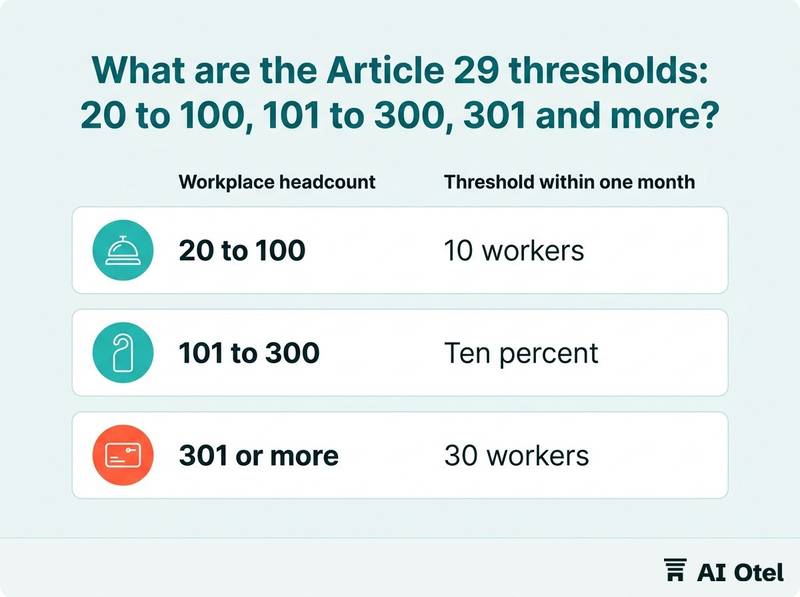
Reaching the threshold triggers the procedure. Below it, the ordinary rules on dismissing an individual worker still apply to each person, as our article on dismissing a hotel employee explains. Ten percent is arithmetic on the headcount, so work the number out before the first letter leaves the building rather than after.
A second round of dismissals in the same month counts toward the same total. This is where hotels that planned carefully still cross the line. Write the headcount and the planned dismissals on one page before the first termination letter; the band and the threshold follow from those two numbers.
| Workplace headcount | Threshold within one month | Illustrative case |
|---|---|---|
| 20 to 100 | 10 workers | A 60-employee hotel dismissing 12 spa staff in one month |
| 101 to 300 | Ten percent | A 150-employee hotel, where ten percent is 15 workers |
| 301 or more | 30 workers | A 400-employee hotel dismissing 30 workers |
The third column is illustrative only. Source: mevzuat.gov.tr, İş Kanunu No. 4857, consolidated text, Madde 29 (2026-11-15).
What must the written notice contain, and who receives it?
It goes in writing to the workplace union representatives, the regional directorate and İŞKUR at least thirty days ahead, and it must state the reasons, the number and groups of workers affected, and the period over which the terminations will take place. Three recipients, one document. Timing is at least thirty days ahead of the intended dismissals, not thirty days after the decision is taken internally.
The content has three parts. First, the reasons for the dismissals, written as the structural or economic change the hotel is making. Second, the number of workers affected and the groups they belong to, named the way the hotel organizes its work, such as spa therapists, kitchen staff or housekeeping. Third, the period over which the terminations will take place, so the reader knows whether the exits fall in one week or over several months.
Keep proof of delivery for each of the three recipients. The notice announces an intention and is not the same document as the termination letter.
ChecklistBefore sending the collective dismissal notice, check each item
- Addressed to the workplace union representatives
- Addressed to the regional directorate
- Addressed to İŞKUR
- Sent at least thirty days ahead of the intended dismissals
- States the reasons, the number and groups of workers, and the period of the terminations
- Proof of delivery kept for all three recipients
What happens during the thirty days: talks, the record, and when the terminations take effect
After the notice, the employer and the workplace union representatives hold talks on preventing the dismissal, reducing the number of workers or minimising its adverse effects. A document showing the meeting took place is drawn up, and the termination notices take effect thirty days after the regional directorate is notified.
The talks have three permitted subjects: preventing the collective dismissal, reducing the number of workers to be dismissed, and minimising its adverse effects on the workers. The talks are with the workplace union representatives, and they follow the notice rather than replacing it. At the end of the talks, a document showing that the meeting took place is drawn up; keep it with the notice and the delivery proofs.
The talks are where alternatives are tested: moving staff to another department or shift, changing hours, or voluntary exits, each with its own rules. Moving a worker to a different department or shift is itself regulated, as our article on changing a worker's duties or shift sets out. Termination notices take effect thirty days after the regional directorate is notified; whether a longer period can be set for a particular hotel is a question for its labour lawyer.
Watch outThe clock starts at the regional directorate
Termination notices take effect thirty days after the employer notifies the regional directorate of the intended collective dismissal. The date to diarise is the regional directorate notification date, not the day the board decided and not the day of the meeting.
Closing the whole hotel, or ending seasonal work: which rules apply?
A workplace closed entirely whose activity ends permanently takes a lighter route: notify the regional directorate and İŞKUR at least thirty days ahead and post the notice at the workplace. Seasonal and campaign work whose dismissal follows from the nature of that work sits outside Article 29's collective dismissal provisions.
The full-closure route is worded for a workplace closed entirely and an activity that ends permanently, and it drops the union-representative notice and the talks. It keeps two duties: notifying the regional directorate and İŞKUR at least thirty days in advance, and posting the notice at the workplace.
The seasonal and campaign exclusion is conditional. The dismissal must follow from the nature of that work, not from a business decision taken during the season. A winter shutdown that resumes in spring is not the same event as a permanent closure, and a hotel that closes one wing while the rest keeps trading is closing a department, not the workplace, and stays on the general route. Our article on when a hotel closes for the winter covers the alternatives to dismissal in that situation.
Which route applies is a question for the hotel's labour lawyer and accountant on its own facts. The answer belongs in writing before the first termination letter.
| Situation | What Article 29 requires |
|---|---|
| A department closed while the hotel keeps trading, the threshold reached | Written notice to the union representatives, the regional directorate and İŞKUR at least thirty days ahead, then the talks and the meeting record |
| Workplace closed entirely, activity ended permanently | Notice to the regional directorate and İŞKUR at least thirty days ahead, and the notice posted at the workplace |
| Seasonal or campaign work ending by its nature | The collective dismissal provisions do not apply |
Worked example: a 60-, 150- and 400-employee hotel
The same department closure produces three different answers, because the threshold moves with the headcount. For example, a 60-employee hotel falls in the 20 to 100 band, where the threshold is 10 workers; closing the spa and dismissing 12 people within one month crosses it, and the full procedure applies.
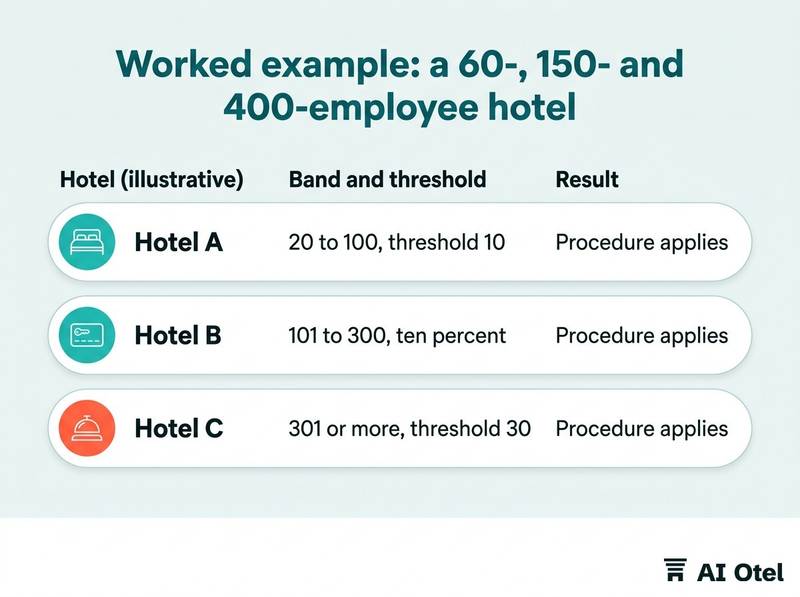
For example, a 150-employee hotel falls in the 101 to 300 band, where ten percent is 15 workers; dismissing 15 or more within one month reaches it. For example, a 400-employee hotel falls in the 301-or-more band, where the threshold is 30 workers; a wing closure that dismisses 30 people within one month reaches it.
The same 60-employee hotel planning 9 dismissals stays below the threshold, but a second round inside the same month is added to the first and changes the answer. The timeline is the same in all three cases: day 0 the written notice reaches the three recipients, the talks and the meeting record fall inside the thirty days, and the termination notices take effect thirty days after the regional directorate notification. The notice content is also the same: reasons, the number and groups of workers, and the period of the terminations.
| Hotel (illustrative) | Headcount | Band and threshold | Planned in one month | Result |
|---|---|---|---|---|
| Hotel A | 60 | 20 to 100, threshold 10 | 12 spa staff | Procedure applies |
| Hotel B | 150 | 101 to 300, ten percent | 15 | Procedure applies |
| Hotel C | 400 | 301 or more, threshold 30 | 30 | Procedure applies |
The hotels and numbers in this table are illustrative only.
After the dismissals: calling back, Articles 18 to 21, and the records to keep
Within six months of the collective dismissal becoming final, a hotel that wants to hire for work of the same kind calls back suitably qualified dismissed workers first, and Article 29 cannot be used to shut out the worker's rights under Articles 18 to 21.
The callback duty runs for six months from the collective dismissal becoming final and applies to work of the same kind. The order is set by suitability and qualification, so keep the dismissed workers' roles and skills on file rather than only their exit dates. Record the callback decision in writing even when no one is called back, with the reason the role was filled differently or not filled.
Article 29 bars the employer from using the collective dismissal provisions to prevent Articles 18, 19, 20 and 21 from applying; if it does, the worker may sue under those articles. Each individual dismissal still has to stand on its own under the ordinary rules, so the collective procedure does not replace the reason and the notice letter for each person.
ChecklistKeep one file with everything the procedure produced
- The headcount sheet used to fix the band
- The written notice and proof of delivery to the workplace union representatives, the regional directorate and İŞKUR
- The document showing the talks took place
- The list of dismissed workers with roles, groups and dates
- The written callback decisions for six months
- Each worker's own termination letter and reason
What to do next
Before the first termination letter, put the hotel's headcount and the dismissals planned for the next month on one page. Read the band and the threshold off that page. If the number reaches it, send the collective dismissal notice to the three recipients in writing and diarise day 30 from the regional directorate notification. The count decides the route, the notice starts the clock, the talks and the record fill the thirty days, and the callback duty and the individual reasons carry on after the exits.
Frequently asked questions
Does spreading the dismissals over several weeks avoid Article 29?
No. The law counts terminations with notice under Article 17 within one month, on the same or different dates, so a department closed over three or four weeks is counted as one total. The band for the workplace headcount sets the number that must be reached.
Do we still notify anyone if the hotel is shutting down for good?
Yes. Where the workplace is closed entirely and its activity ends permanently, the employer notifies the regional directorate and İŞKUR at least thirty days in advance and posts the notice at the workplace. The union-representative notice and the talks belong to the general route.
Is a hotel that closes for the winter closing the workplace entirely?
The full-closure route is worded for a workplace closed entirely whose activity ends permanently, and a seasonal shutdown that resumes is a different event. The hotel's own contracts and its labour lawyer settle which route its case follows, and that answer should be written down before the letters go out.
Must we rehire the workers we dismissed if business returns?
Within six months of the collective dismissal becoming final, a hotel that wants to hire for work of the same kind calls back suitably qualified dismissed workers first. Keep the roles and skills of the dismissed staff on file and record each callback decision in writing.
Does the collective procedure replace the reason for each dismissal?
No. Article 29 sets the procedure for a group of dismissals, and each worker's dismissal still has to stand on its own under the ordinary rules. Article 29 also bars the employer from using the collective dismissal provisions to prevent Articles 18 to 21 from applying.
The rules above come from the consolidated text of Labour Law No. 4857, Madde 29, published by mevzuat.gov.tr (2026-11-15), available as the İş Kanunu consolidated text. Confirm dates, penalties and your own case with your labour lawyer or accountant.
Sources
- İş Kanunu (Kanun No. 4857), consolidated text, Madde 29 (opens in a new tab)Türkiye Büyük Millet Meclisi / mevzuat.gov.trmevzuat.gov.tr
- İş Kanunu (Kanun No. 4857), consolidated text, Madde 29 (opens in a new tab)Türkiye Büyük Millet Meclisi / mevzuat.gov.trmevzuat.gov.tr
- İş Kanunu (Kanun No. 4857), consolidated text, Madde 29 (opens in a new tab)Türkiye Büyük Millet Meclisi / mevzuat.gov.trmevzuat.gov.tr
- İş Kanunu (Kanun No. 4857), consolidated text, Madde 29 (opens in a new tab)Türkiye Büyük Millet Meclisi / mevzuat.gov.trmevzuat.gov.tr
- İş Kanunu (Kanun No. 4857), consolidated text, Madde 29 (opens in a new tab)Türkiye Büyük Millet Meclisi / mevzuat.gov.trmevzuat.gov.tr
- İş Kanunu (Kanun No. 4857), consolidated text, Madde 29 (opens in a new tab)Türkiye Büyük Millet Meclisi / mevzuat.gov.trmevzuat.gov.tr
- İş Kanunu (Kanun No. 4857), consolidated text, Madde 29 (opens in a new tab)Türkiye Büyük Millet Meclisi / mevzuat.gov.trmevzuat.gov.tr
- İş Kanunu (Kanun No. 4857), consolidated text, Madde 29 (opens in a new tab)Türkiye Büyük Millet Meclisi / mevzuat.gov.trmevzuat.gov.tr
- İş Kanunu (Kanun No. 4857), consolidated text, Madde 29 (opens in a new tab)Türkiye Büyük Millet Meclisi / mevzuat.gov.trmevzuat.gov.tr
- İş Kanunu (Kanun No. 4857), consolidated text, Madde 29 (opens in a new tab)Türkiye Büyük Millet Meclisi / mevzuat.gov.trmevzuat.gov.tr