Moving a hotel employee to another department, shift or pay: what Article 22 of the Labour Law requires
Article 22 of Law No. 4857 requires written notice for essential changes to hotel employees' working conditions. This guide explains the six-day acceptance rule, how to draft a compliant notice, and what records to keep.
AI draft · awaiting editorial review
Contents
Key takeaways
- Article 22 of Law No. 4857 requires the employer to notify the employee in writing before an essential change in working conditions (mevzuat.gov.tr, İş Kanunu 4857, Article 22).
- A change that is not made in that written form, and is not accepted in writing by the employee within six working days, does not bind the employee (same source).
- Silence is not acceptance: when the six working days pass without a written answer, the old terms continue.
- The law uses the words essential change and does not list which changes are essential; that judgment belongs to the facts of each case, not to this article.
- A signed notice, a dated answer and a one-line log entry help a hotel demonstrate later what was offered, what was accepted and when. Confirm with a legal adviser that your own notice and record meet the requirement.
Article 22 of Law No. 4857 lets a hotel change an employee's working conditions only by written notice. An essential change is one to a term set by the contract, personnel regulations or workplace practice. A change not made in writing, and not accepted in writing within six working days, does not bind the employee.
The season starts in three weeks. The front desk has one person too many and reservations one too few, so a receptionist is moved to reservations and another is put on nights. Nobody signs anything. That is the moment Article 22 is about. This article explains what the law requires in writing, what happens when the employee accepts, stays silent or refuses, and how to build a one-page notice and a log that answer questions months later.
Which changes to a hotel job does Article 22 cover?
Article 22 covers an essential change in working conditions, meaning a term set by the employment contract, the personnel regulations or workplace practice. It does not cover every instruction a manager gives during a shift. The Turkish text uses the phrase "esaslı değişiklik", an essential change, and does not define it; whether a specific move is essential is decided case by case, and this article does not settle it.
Hotels make three moves constantly: department (front desk to reservations), shift pattern (days to nights), and pay or benefits (a tipped role to a fixed wage, a lost share of the service charge). Each raises a different question, because each touches a term that may come from a different document.
The source of the term decides whether Article 22 is engaged. If the contract names the department, moving the person changes a contract term. If the personnel regulation sets the rotation, changing it changes a regulation term. If neither says anything but the hotel has done it the same way for years, practice may be the term. A one-off instruction inside the agreed terms, such as covering the breakfast shift today, is direction of work, not a change of conditions.
A test a manager can apply without a lawyer: write the term as it stands today, write the term after the change, and see whether the two are the same sentence. If they are not, the move touches a term and the written route in Article 22 is the safe one. The same logic runs through the payroll terms a hotel already uses, such as the balancing period and the tip-share system, because those terms usually come from the same documents.
| The move | The term it touches | The question it raises |
|---|---|---|
| Front desk to reservations | Department or job title in the contract | Does the contract name the department, or only the role? |
| Day shift to night shift | Shift pattern in the contract, the regulation or the roster habit | Is the rotation written anywhere, or only habit? |
| Tipped role to fixed pay | Pay and the share of the service charge | Is the pay term written, and does the change lower it? |
| This season's post to a different post next season | Fixed-term contract terms | Is the new post the one the contract describes? |
What does Article 22 require in writing?
Article 22 requires the employer to notify the employee in writing. A change that is not made in that written form, and is not accepted in writing by the employee within six working days, does not bind the employee, as the consolidated text of Labour Law No. 4857 on mevzuat.gov.tr (opens in a new tab) (15 November 2026) states in Article 22.
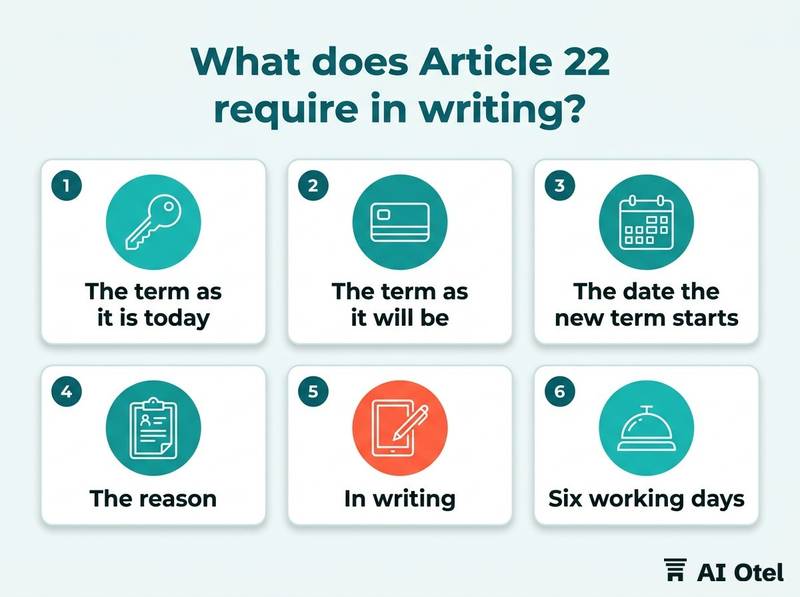
The notice is a document, not a conversation. It names the term as it is today, the term as it will be, the date the new term starts, and the reason. Give it in a form the employee can keep and sign, and keep a copy at the hotel. A notice read out in the corridor leaves nothing to compare later.
The six working days run from the notice, and the employee's answer must also be in writing to count as acceptance. Date the notice and state the start date, so the file shows when the new term began. A notice handed over after the move has already started still has to be answered in writing; days already worked on the new shift are not a written answer.
Keep the reason plain and honest. "Reservations is short-staffed from 1 April" tells the employee something; "operational needs" on its own does not.
Key pointThe three things a notice must fix
The term as it is now, the term as it will be, and the date the new term starts. If any of the three is missing, the employee cannot answer it and the file cannot show what was offered.
What happens if the employee accepts, stays silent or refuses?
Acceptance in writing within six working days binds the employee to the new terms. Silence means there is no written acceptance, so the change does not bind the employee. A refusal leaves the old terms in place.
Path one, acceptance: the signed answer sits with the notice in the file, and the new terms apply from the stated date. Path two, silence: the six working days pass with no written answer, and the change does not bind the employee. Article 22 makes written acceptance the test, so performing the new work is not the same as answering.
Path three, refusal: Article 22 says the change does not bind the employee, and the employment continues on the terms that were in force. What Article 22 does not say: it does not say a refusal is a valid reason for dismissal, and this article does not go into penalties. Whether an employer has grounds to end a contract is a separate question under other provisions, covered in the separate rules on ending a hotel employment contract, and is not answered here.
The manager's move: if the business genuinely cannot run without the change, the honest route is to agree new terms in writing, or to look at the contract and the law with an adviser before the start date. When a refusal comes back, restate the old terms in the file, so nobody later works from a notice that never took effect.
| What the employee does | What Article 22 says | What the hotel should have on file |
|---|---|---|
| Accepts in writing within six working days | The change binds | Signed notice, signed acceptance, start date |
| Stays silent | The change does not bind, because there is no written acceptance | Signed notice with the date given, and a dated note that no answer came |
| Refuses in writing | The change does not bind; the old terms continue | Signed notice, written refusal, and the old terms restated |
What should a one-page change notice contain?
A workable notice fits on one page: what changes, from when, why, and how and by when the employee answers.
The header carries the hotel name, the employee name, the current position and the date the notice is handed over. The body quotes the term today from the contract, the personnel regulation or the practice, with a note of where it is written, then states the term after the change in the same words, so the two can be read side by side. Add the start date of the new term and the reason in one or two plain sentences.
Close with the answer mechanism: the employee may accept or refuse in writing within six working days, and the notice says where to hand the answer in. Two signature lines, and a copy for the employee.
ChecklistBefore the notice leaves the office, tick these
- Hotel and employee named
- Current position and department stated
- The term today quoted with its source
- The term after the change in matching words
- Start date given
- Reason in plain language
- The six working days and where to answer stated
- Both signature lines and a copy prepared for the employee
How do season-start and season-end moves work?
A seasonal move is still a change of working conditions when it alters a term the contract, the regulation or the practice has set. The season is a reason for the change, not an exemption from the notice.
In a seasonal hotel the same move often repeats every year: the same person goes to the same post each May. A repeated, unopposed move can become workplace practice, which is itself a source of terms. When that happens, write the arrangement into the contract or the personnel regulation instead of relying on habit, so the next season starts from a written term.
Give the notice before the season starts, so the six working days run before the start date and the employee is not asked to answer a month after working the new post. At season end the return to the old post is also a change: say it in the same notice or in the closing letter, so the file shows both directions. A fixed-term seasonal contract that names the post is the cleanest base, because the notice then points at a written term rather than at a habit.
If the employee refuses, the old terms continue. What the hotel does about a post that no longer exists is a business and legal question beyond Article 22. Shift changes also interact with night shifts and the balancing period, so read the two together before writing the notice.
Watch outDo not let the season do the work of the notice
"Everyone moves in May" is practice, not consent, and practice is one of the things Article 22 protects.
What should the hotel keep on file?
Keep three things: the notice as it was given, the employee's written answer or a dated note that none came, and a log of who was told what and when.
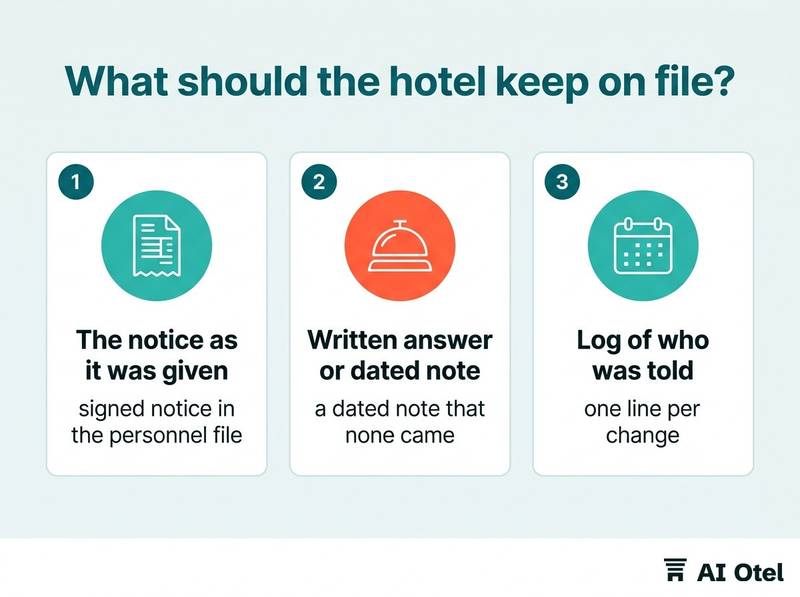
The signed notice and the signed answer sit together in the personnel file, so a later question can be answered from one place. The log is one line per change: date, employee, department, term before, term after, start date, answer, and who handed the notice over. The log also shows when a move has quietly become practice across a department, which is the point at which it should be written into the regulation.
A dated note that no answer came is worth more than an empty file: it shows the six working days ran and nothing was signed. Keep the old version of the contract or regulation next to the notice, because a change is only visible against the text it replaced. The same file answers the questions a payroll or an inspector asks months later about who worked which post and from when.
Where does Article 22 stop?
Article 22 sets the form of a change. It does not decide which changes are essential, how the six days are counted in every calendar, or what a court would do with a disputed move.
Essentiality is left to the facts of each case. Counting is not settled by the text alone: the law says six working days, and which days count as working days in a hotel with a rotating roster is a question the text does not answer. This article gives no case-law numbers, no compensation figures and no penalties, because none were verified for it.
A collective agreement, a personnel regulation or an individual contract can add duties on top of Article 22, so read all three before the notice is written. One clean handover: when a move is contested, or when the contract, the regulation and the practice disagree, take the file to a labour lawyer before the start date, not after.
What to do next
Before the next move, write the one-page notice and get a dated answer. Article 22 is short: it asks for writing, gives the employee six working days to answer in writing, and says a change without that does not bind. The notice and the log are how a hotel turns a habit into a record, and the record is what a manager, a payroll clerk and a lawyer can all read from the same page.
Frequently asked questions
Does a message on a phone count as written notice under Article 22?
The law says the notice must be in writing and the acceptance must be in writing; it does not settle which channels satisfy that. A signed paper notice with a signed answer is the record a hotel can rely on, and any other channel is a question for a labour lawyer.
Can a hotel move an employee between shifts if the contract says the employee works the shifts assigned?
Article 22 applies to changes to terms set by the contract, the personnel regulation or workplace practice. A broad assignment clause is itself a term, and what it allows depends on how it is written and on how the hotel has applied it. That reading is a legal question, not one this article answers.
Does refusing a change end the employment?
Article 22 says only that a change not accepted in writing within six working days does not bind the employee. It does not say a refusal is a valid reason for dismissal. Ending a contract is governed by other provisions, and the file should go to an adviser before any step is taken.
How are the six working days counted?
The law says six working days from the notice, and the employee's answer must be in writing. Which days count as working days in a hotel with a rotating roster is not settled by the text alone, so date the notice, date the answer, and ask an adviser about the calendar in a specific case.
Does Article 22 apply to a change in pay or in the share of the service charge?
Pay is normally a term of the contract, so a change to it touches a term, and the written route in Article 22 is the safe one. Whether a particular change is essential, and how it interacts with the tip-share system the hotel uses, depends on the documents and on the facts.
Sources
- İş Kanunu (Kanun No. 4857), consolidated text, Madde 22 (opens in a new tab)Türkiye Büyük Millet Meclisi / mevzuat.gov.trmevzuat.gov.tr
- İş Kanunu (Kanun No. 4857), consolidated text, Madde 22 (opens in a new tab)Türkiye Büyük Millet Meclisi / mevzuat.gov.trmevzuat.gov.tr