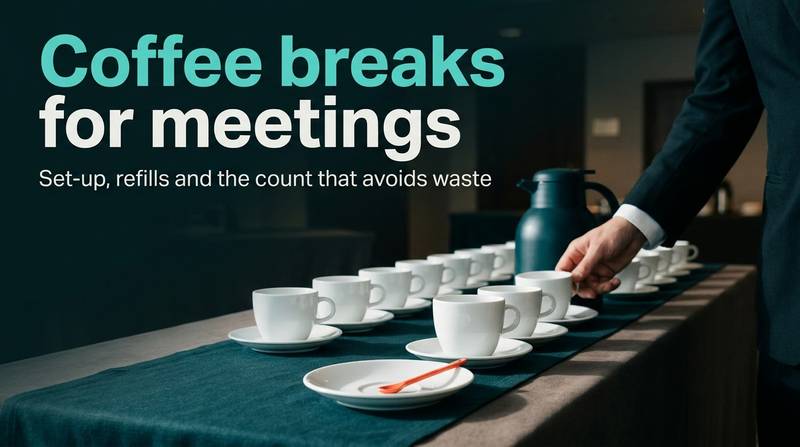
Coffee breaks for meetings: set-up, refills and the count that avoids waste
Plan the hotel coffee break service from the event order line, not room capacity. Learn how to place stations, refill on timed rounds, label allergens, and count cups to adjust future orders.
AI draft · awaiting editorial review
Contents
Key takeaways
- The event order line, not the room's capacity, is the number the break is planned, staffed and charged against.
- A station set after the session ends is a queue; set the still items during the previous session and hold only the hot items for the break itself.
- Refill by replacing a jug, never by topping one up.
- One named person owns each station for the whole break, from set-up to clear-down.
- Cups set out, cups used and cups returned, recorded per station, are the figures that adjust the next order.
A hotel coffee break service is the set-up, refill and clear-down of a self-service refreshment station during a meeting. Set the station before the session ends, count from the signed event order rather than the room's capacity, refill on a timed round with a visual check, and record cups out against cups returned.
The session ends four minutes early, forty delegates turn toward the door, and the coffee station is still being carried in. The twenty minutes delegates judge the whole meeting by are decided before the break starts, not during it. This article walks through the whole break: what the event order commits you to, where stations go and how many, when to set, how to refill and clear, how to label allergens, and how to count cups so the next order is right.
What does the event order line actually commit the hotel to?
The event order line fixes four things: the number of covers charged, the time window, the items, and whether refills are included. Everything else about the break is the banquet team's judgment on the day.
Start with the guaranteed count and the deadline for changing it. That number is what the organizer pays for; the number of people who actually arrive is a different figure, and the two are argued about after the event, not during it. If you have not worked with one before, the banquet event order that runs a hotel meeting is the document every break is planned from.
Read the time window as a range, not a clock time. A break written as 10:30 to 11:00 means the station is ready before 10:30 and stays until the last delegate leaves. Check the service style on the line too: a self-service station, service from a tray at the door, and passed service among seated delegates each change the labor, the number of stations and the amount of clearing.
Then look for what is missing. Dietary requirements, allergen labels, who clears the cups, and who takes the leftover food: these four gaps cause most of the disputes after a break. Cross-check the break against the program as well. If the session before it is a panel that runs long, the kitchen's holding plan has to move with it, and the line should say so. Finally, confirm whether refills are inside the per-person price or charged per round, because the banquet team cannot answer that at the station, and a delegate will ask.
ChecklistBefore the day, find these on the event order line
- Guaranteed count and the deadline for changing it
- Start and end of the break window
- Items and quantities
- Service style: station, tray or passed
- Whether refills are included, and how many rounds
- Dietary list and allergen labels
- Who clears, and who takes leftovers
Where should coffee break stations go, and how many do you need?
Place stations outside the meeting room door, within sight of it, with drinks separated from food. The number follows the length of the break and the width of the space, and the hotel sets its own rule of thumb from its own events rather than from a fixed ratio.
Outside the door, not inside: the room stays quiet, the queue has space to form, and delegates do not carry a full cup back through a row of chairs. A two-sided table halves the queue at the same footprint, so two service faces on one table beat two tables in a corridor. Keep the tray-return point and the bin at the exit end of the station, not at the far end of the foyer; cups left on a ledge are cleared twice.
| Station position | Why it works | What to watch |
|---|---|---|
| Outside the room door | Room stays quiet; queue has space | Must stay within sight of the door |
| Two-sided table | Halves the queue at one footprint | Needs an aisle behind each face |
| Drinks separate from food | Coffee-only delegates skip the food queue | Two tongs or servers, not one |
| Tray return and bin at the exit | Cups come back without staff | Empty it during the break |
| Away from door swing and draughts | Pots stay hot, napkins stay put | Check the air-conditioning outlet |
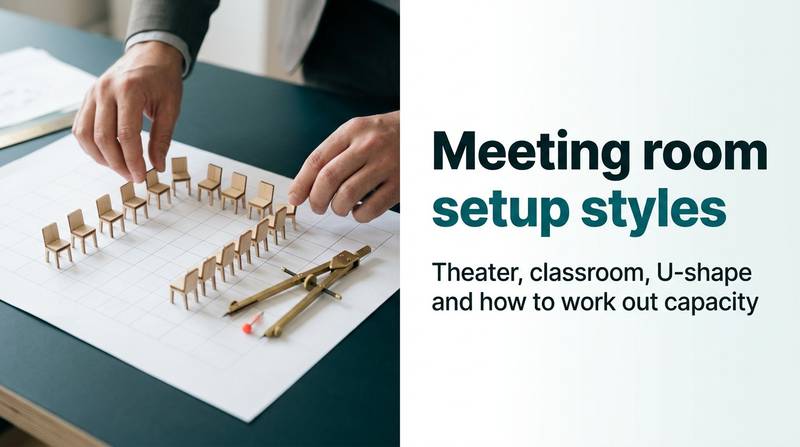
Check the room's setup style before you place anything. A theater layout empties through different doors than a classroom or U-shape, and the station belongs on the path people actually take. Meeting room setup styles and how capacity changes with them decides that path. Leave a clear aisle behind each queue so people can walk past without breaking the line.
When should the break be set: before the session ends or after?
Before. The station should be complete and untouched when the session ends. Setting it in the last minutes of a session is what creates the queue, the apology and the cold first cup.
Set the still items during the previous session: cups, saucers, napkins, sugar, stirrers, labels, signage, water. Do it quietly, from a service door, without crossing the presenter's sightline. Hold the hot items: coffee and tea come out at the moment the session breaks, so the first pour is hot and the station smells of coffee rather than of a flask.
Coordinate with a person, not the clock. Agree a signal with the meeting planner or the technician on the desk: a card placed on the table, a message, a hand raised at the back. Pre-pour only what will be taken in the first minutes, because a cup poured early and left standing is a cup poured twice and a cup wasted. Keep the clearing out of the session too: do not clear the previous break while the next session is running in the same room, since the noise carries and the presenter notices. Build the set-up into the sound, screen and Wi-Fi check before every event, so the station and the screen are confirmed in the same pass rather than in two separate ones.
How often do you refill, and when do you clear down?
Refill on a timed round plus a visual check from across the room. Clear down when the last delegate leaves the station, not when the break time on the program ends.
A refill round is a pass, not a top-up: replace the empty jug or the empty cup tray, wipe the surface, check the milk and the hot water, and take the used cups away. Assign one person to each station for the whole break. A station with no owner is refilled late, cleared late and reported to the organizer.
Milk and cream stay in a chiller or on ice, are replaced rather than topped up, and the time they went out is written down. Nothing is removed from the station while a delegate is standing at it: ask, wait, then clear. Leftovers are covered, labeled with the time and returned to the kitchen. Whether they can be used again is decided by the hotel's food safety plan, not by the banquet captain at the end of a long break.
Watch outThe top-up habit
Topping up a standing jug, or mixing a fresh pot into an old one, saves a vessel and costs the hotel its temperature, its taste and its record of when the item went out. Replace the vessel, label it, record the time.
How do you label dietary and allergen items at a self-service station?
Label every item where it is picked up, using the hotel's own allergen procedure and its approved wording, and never rely on a verbal answer at the station.
The label belongs on the item or on its tray, not on a single card at the end of the table. A delegate reads the label at the plate, not two meters away. The kitchen writes the label and the banquet team places it, and whoever places it checks it against the item in front of them.
Keep the free-from items in a separate covered dish with their own tongs: shared tongs are the usual point of cross-contact at a coffee break. Brief one person per station who can answer questions and knows the sentence that ends the conversation safely, "I will check with the kitchen". Collect dietary requirements when the booking is taken, not on the morning; they belong on the event order line, where the kitchen can see them. The guest makes the final decision about what to eat. The hotel's job is to label accurately and to answer honestly.
NoteOn wording
Labels follow the hotel's own allergen procedure and its approved terms. The banquet team does not improvise a description at the station, and does not confirm an item from memory.
How do you count cups and leftovers to adjust the next order?
Count what went out, what was used and what came back, per station, on one sheet, and compare it with the number the organizer was charged for. That gap is the only figure that improves the next break.
Count cups, not liters. The cup is the unit the delegate takes, the unit the store room issues and the unit the next order is written in. Record attendance against the guaranteed count, because the difference between those two numbers is what the organizer will raise when the invoice arrives.
| Record | Unit | Why it matters |
|---|---|---|
| Items set out | Cups, jugs, pieces | What the store room issued |
| Cups used | Cups | The real consumption figure |
| Items returned | Cups, jugs, pieces | The gap that adjusts the next order |
| Attendance | Heads | Against the guaranteed count |
| Time set and cleared | Clock times | Late set-up shows in the cup count first |
| Issues noted | Text | Explains any unusual number |
Keep one sheet per event, per break and per station. A single total for the whole day hides which break ran long and which station was over-supplied. Write down the time the station was set and the time it was cleared, then use the gap to adjust the next order for the same client and the same program; one event is not enough to set a house-wide rule. The same method applies to the buffet: measuring buffet food waste and planning quantities from covers uses the same planned-versus-returned correction.
What do you agree with the organizer before the day?
Five things in writing: the count and when it is frozen, the time window, what refills cover, the dietary list, and who takes the leftovers. Everything else can be settled at the station.
The count first: the guaranteed number, the deadline for changing it, and whether the charge follows the guarantee or the actual attendance. Then the window: when the break starts and ends, and what the hotel does if the program runs late. Refills: included or charged per round, and how many rounds the price covers. Dietary requirements: the list, by requirement, delivered before the day and carried on the event order line. Leftovers and equipment: what the hotel takes back, what the organizer takes away, and by when.
Add a named person on each side, and a short signature at the end of the break on the count actually served. That signature is the conversation that does not happen three weeks later.
TipThe five agreements, in order
Count and freeze deadline; time window and late-running rule; refill basis; dietary list; leftovers and equipment. Then the two named contacts, and the signature on the served count.
What to do next
Take the count sheet from your last coffee break and the event order it was served against, and read them side by side before the next booking: the gap between the two is your first correction. Then write the hotel's own station, refill and clear-down rule down, so the break does not depend on who happens to be on shift.
Frequently asked questions
How many coffee break stations do I need for 100 delegates?
There is no fixed ratio the hotel should import from elsewhere. Set the number from the queue length at your own last comparable event, split drinks from food so the coffee-only queue moves, and use two-sided tables before adding a second table. Write the rule down once you have measured it.
Should coffee be pre-poured before the break?
Only the first minutes' worth, and only if the station is already staffed. A cup poured early and left standing is cold, looks used and is poured again. Pour at the break, hold the pots hot, and let the first round come out as delegates arrive.
Who pays for the coffee that was set out but not drunk?
It depends on what the event order says: a guaranteed count is charged as agreed, while a consumed count is charged from what was actually served. Agree which one applies, and when the number is frozen, before the day. The count sheet is what supports the invoice conversation.
How do we handle a delegate with a serious allergy at a self-service station?
Label every item where it is picked up, keep a separate covered portion with its own tongs, and have one briefed person per station who can answer and who will check with the kitchen rather than guess. Follow the hotel's own allergen procedure, and let the guest make the final decision.
What should the banquet captain record after a coffee break?
Items set out, cups used, items returned, attendance against the guaranteed count, the time the station was set and cleared, and any issue at the station. One sheet per break and per station, kept with the event order, is enough to correct the next order.