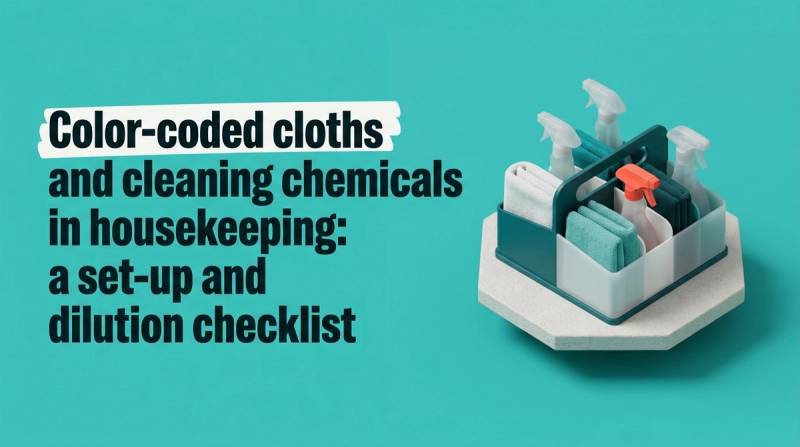
Color-coded cloths and cleaning chemicals in housekeeping: a set-up and dilution checklist
Fix your housekeeping color code with a written system for zones, cart setup, and dilution. This checklist helps you prevent cross-contamination and keep standards consistent.
AI draft · awaiting editorial review
Contents
Key takeaways
- Color is a carrier of meaning, not a standard: one color must mean one zone in your house, on the cart, in the laundry bin, in the store and on the wall card.
- Set each zone by the dirtiest surface its cloth may touch, so the toilet cloth can never become the cloth that wipes a glass.
- Dilution ratios come from the product label and the safety data sheet, never from memory, a colleague or an article.
- Every secondary bottle carries the product name, the dilution if any, the date it was filled and the initials of the person who filled it.
- A faded cloth is a code failure: replace it before it teaches the wrong habit.
Color coding is a house rule that gives each cleaning zone its own cloth color. Fix one scheme for your house, print it on one card, and set up carts and bottles so the wrong cloth is hard to reach. Dilute chemicals only as the maker's label states.
A room attendant reaches into the cart and pulls out a blue cloth. Nobody on the floor can say what blue means, because the previous supervisor used blue for glass and the current one uses it for the toilet. The scheme exists only in two people's heads, and one of them has left. This article gives you a way to fix color coded cleaning cloths in hotel housekeeping as a written system: zones, colors, cart set-up, dilution and labeling, laundry, and the weekly check that keeps it all together.
Why do published cloth color schemes disagree with each other?
Because color is a convention, not a standard: each published scheme encodes a different set of zones and a different laundry. Yours has to be one scheme, written down and taught.
Color carries no meaning by itself. The meaning is assigned by your house, and it must be identical on the cart, the soiled bag, the laundry bin, the store shelf and the training card. Published schemes differ because they split zones differently: some separate the toilet from the rest of the bathroom, some fold glass into general surfaces, some add a color for public areas. None of them is wrong; each was written for a different building.
A scheme copied from a video or from another hotel fails when your room layout, your cart design or your laundry capacity differs from the one it was written for. The real test of a scheme is not the colors but whether a new attendant can pick the right cloth without asking anyone. Two colors that look alike under corridor lighting, or a color that fades first in the wash, break the scheme silently.
Write it on one card: color, zone, what the cloth may touch, what it must never touch. One page, in every language your team reads. For the vocabulary your team uses on the floor, see our housekeeping terms and abbreviations glossary.
Key pointOne rule
One color, one zone, in every place the color appears, or the scheme is not a scheme.
Which four zones should a hotel separate?
Bathroom, toilet, glass and surfaces, and kitchen areas: four zones cover a guest room plus the back areas, and each one gets a single color.
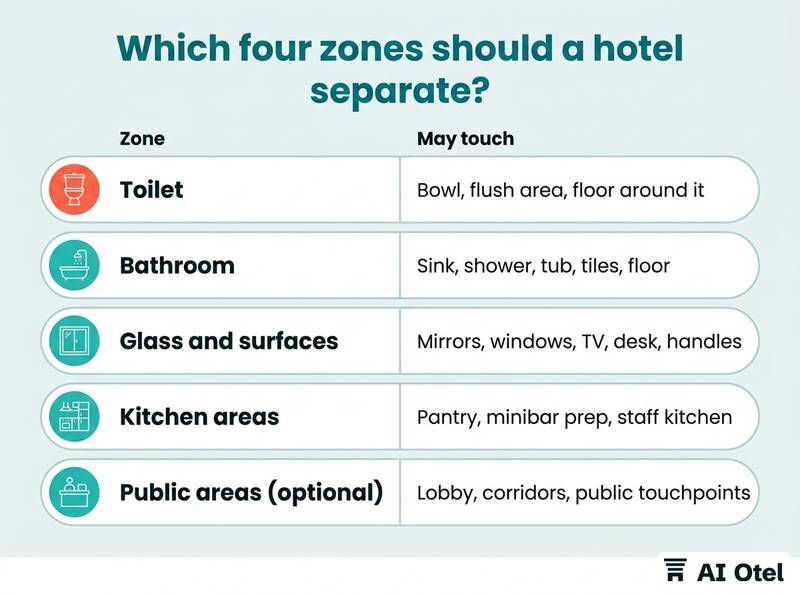
The toilet zone is the toilet bowl, the flush area and the floor immediately around it, and nothing else, ever. The bathroom zone covers the sink, shower, tub, tiles and the bathroom floor away from the toilet. Glass and surfaces means mirrors, windows, the television, the desk, handles, light switches and polished furniture. Kitchen areas cover the pantry, minibar preparation, the staff kitchen and food and beverage back areas, kept apart from every guest-room cloth. If the same team cleans public areas and the lobby, that is a useful optional fifth zone.
Name each zone by the dirtiest thing its cloth may touch, so the rule survives a refurbishment or a new room layout. Choose colors your team can name in one word, and check them side by side under the lighting your corridors actually use.
| Zone | May touch | Must never touch | Your color |
|---|---|---|---|
| Toilet | Bowl, flush area, floor around it | Any surface outside the toilet | |
| Bathroom | Sink, shower, tub, tiles, floor | Toilet zone, glass, guest surfaces | |
| Glass and surfaces | Mirrors, windows, TV, desk, handles | Toilet and bathroom zones | |
| Kitchen areas | Pantry, minibar prep, staff kitchen | Guest-room cloths and surfaces | |
| Public areas (optional) | Lobby, corridors, public touchpoints | Guest-room zones |
Hygiene details are what guests see first; for what to tell them, see our guide to room hygiene worries and what to tell guests.
How should the housekeeping cart be set up so the right cloth is the easy one?
Store cloths in the order the room is cleaned, one compartment or bag per color, with a photograph of the correctly loaded cart fixed inside the lid.
Order the compartments to match your room cleaning sequence, so the hand moves forward through the room instead of searching the cart. One compartment per color: a mixed pile in the middle of the cart defeats the scheme faster than any training failure. Soiled cloths go into a separate bag at the point of use, never back into the clean compartment and never onto the cart shelf.
Chemicals travel in a tray that cannot tip, with caps closed and labels facing outward so the label is read before the bottle is lifted. Fix a laminated photograph of the correct cart inside the lid or on the end panel; a photo settles a disagreement faster than a paragraph. Restock at a fixed point at the start of the shift, from the store, not from a shared pile left in the corridor. For the first month of a new scheme, the supervisor signs the cart off before the attendant leaves the floor. The sequence the cart supports is the one in our room cleaning order checklist for room attendants.
ChecklistCart sign-off list
- Compartments arranged in cleaning order
- One color per compartment, no mixed pile
- Soiled bag present and empty
- Chemical tray secure, caps closed
- Labels facing outward
- Photo card in place inside the lid
- Restocked from the store, not the corridor
How do you dilute and label cleaning chemicals without guessing?
You take the ratio from the product label and the safety data sheet, you use the measuring device the maker supplies, and you label every bottle you fill.
The ratio lives on the label and the safety data sheet. If the label is missing or unreadable, the product does not go onto the cart. Use the dosing pump or measuring cap supplied with the product: a cup, a splash or a count of seconds is not a dose. Fill at a fixed station with water at the temperature the label states, not in a guest bathroom where the tap and the light are wrong.
Never mix two products in one bottle. Some combinations produce a dangerous gas, and the bottle gives no warning. Every secondary bottle carries four things: the product name, the dilution if any, the date it was filled, and the initials of the person who filled it. Ready-to-use products skip the dilution step but not the label, because a decanted bottle has lost the original one. Concentrates stay closed, in a locked or supervised store, out of reach of anyone not trained on them. Train new staff at the filling station with the real bottles, not with a slide in a meeting room.
Watch outThe unlabeled bottle
An unlabeled bottle removes two pieces of information at once, what the product is and how strong it is, and the person holding it cannot get either back.
How do you wash and store cloths so the colors stay separate?
Sort at the point of use, not at the laundry: each color has its own soiled bag, its own wash load and its own shelf.
The bag on the cart decides the sort. Once cloths of different colors are in one bag, the laundry cannot recover them. Keep one bin per color in the laundry, labeled with the same card that hangs on the wall and sits in the cart. Wash colors separately, or only with colors that share a zone, never all together.
Common practice: wash microfiber without fabric softener, which coats the fibers, and dry at the temperature the cloth maker states. Store folded by color on a labeled shelf; a mixed basket undoes a cart set-up in a single shift. Retire a cloth when the color fades, the edge frays or it stops absorbing. Keep guest-room and kitchen cloths in separate laundry streams even when the colors sit in the same family.
TipFour places, one card
The same card goes in four places, cart, soiled bag, laundry bin and store shelf, so the color means the same thing at every step.
What should a supervisor check every week?
Three things: the cloth in the attendant's hand against the surface being cleaned, the labels on the bottles on the cart, and the cart against its photograph.
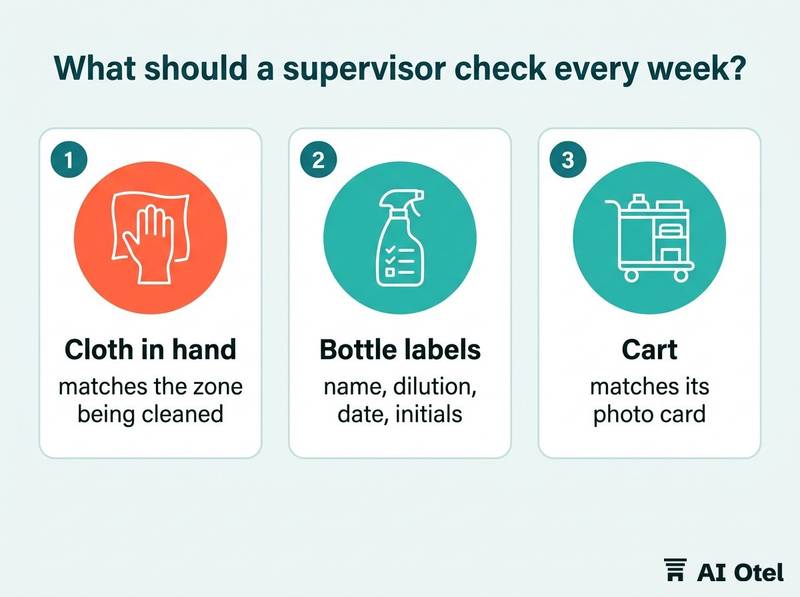
Walk in mid-clean, not after; a finished room hides the sequence that produced it. Check one cart and one room per floor, rotating floors and shifts so the check is not predictable. On the bottles, check the four label items and that each cap is closed: a legible label on an open bottle is half a check.
Record on a one-page sheet: date, floor, cart, three findings, action taken, who was shown. Correct on the spot, as a demonstration with the right cloth in hand, not a note for next week. If the same error appears twice, change the set-up rather than the person: colors too close, compartments too far apart, card missing. Feed the findings into the room inspection routine, the one in our hotel room inspection checklist for supervisors, so the same standard is checked twice from two directions.
ChecklistWeekly spot check list
- Cloth in hand matches the zone being cleaned
- No mixed pile on the cart
- Soiled bag used at the point of use
- Bottle labels complete: name, dilution, date, initials
- Caps closed
- Cart matches its photo card
What do you do when a cloth is used in the wrong zone?
Stop, take the cloth out of service, clean the surface again with the correct cloth and product, and record what happened.
Do not rinse the cloth and carry on. The cloth has already carried material from one zone to a surface in another. Re-clean the surface with the correct cloth and the product the surface calls for, not with the product that happens to be in hand. The cloth goes into the soiled bag for its own color, not into the nearest bag, or the laundry inherits the error.
Tell the supervisor in the same shift. A cloth that touched a toilet and then a guest surface is a cross-contamination event worth writing down. Look for the cause in the set-up: a missing color, a faded cloth, a compartment in the wrong place, a new attendant who was never shown the card. Retrain with the card and the cart, at the cart. If the same mistake repeats across the team, the scheme is too complex: cut a color rather than a corner.
NoteSet-up first
The wrong cloth is a set-up signal before it is a person signal, so fix the cart, the card and the color before the conversation.
Write the card this week
Write the card this week: four zones, four colors, what each cloth may touch and what it must never touch, on one page in every language your team reads. Then load one cart to the card, photograph it, and tape the photo inside the lid. The card, the cart, the laundry bin and the store shelf are the same rule seen four times, and the weekly check is what keeps them the same rule.
Housekeeping checklists live longest inside the system the team uses every day, and a hotel operating system that carries housekeeping tasks and room status in one place gives the card a place to be read. For how the pieces of a hotel's daily workflow connect, see the wider platform overview.
Frequently asked questions
How many cloth colors does a hotel actually need?
As many as the zones you genuinely separate, and no more. Four covers a guest room plus kitchen areas; a fifth helps if the same team cleans public areas. Every extra color is another thing to remember and another bin in the laundry, so add one only when a real cross-contamination risk justifies it.
Can the bathroom and the kitchen share a color if they are washed separately?
No. The color carries meaning at the point of use, in the attendant's hand, not at the laundry. Two zones sharing a color means the cloth that leaves the bathroom can enter the pantry without anyone noticing, and the wash happens too late to prevent it.
Do we still need a label if the product is ready to use?
Yes, whenever the product is decanted out of its original container. The label must state the product name and the date it was filled; the dilution is added only when the product was diluted. A ready-to-use product removes the dosing error, not the labeling duty.
When should a cloth be thrown away?
When the color has faded enough to be confused with another, when the edge frays, or when it no longer absorbs. Color loss is the one that matters most here, because a pale cloth still looks like a cloth while it has stopped carrying its meaning.
What if a supplier cannot give us a written dilution instruction?
Then the product does not go onto the cart. Ask the supplier for the label text and the safety data sheet before the product enters the building, and keep both where the filling station is. A ratio remembered by one person leaves the building when that person does.