Deciding in a family-owned hotel: who decides what, and how to keep money separate
A family hotel runs on a decision-rights table: for each recurring question, one named person proposes, one named person decides, and the others are told. Written down, it separates the owner's money, the hotel's money, and family use of rooms and meals.
AI draft · awaiting editorial review
Contents
Key takeaways
- A family hotel decides faster when every recurring question has one named decider, one named substitute and one place where the outcome is recorded.
- Authority follows the role, not the surname: the owner decides capital and the property, the manager decides the operation inside the written table.
- Family use of rooms and meals costs real money, so it is recorded at an agreed rate at the moment it happens and shown as its own line in the monthly report.
- Every lira that enters or leaves the hotel passes through the hotel's account and books, and every withdrawal is written down with a date and a purpose.
- A decision-rights table is an internal working document; anything that changes shares, employment terms or the company's articles belongs with a lawyer and an accountant.
A family hotel runs on a decision-rights table: for each recurring question, one named person proposes, one named person decides, and the others are told. Written down, it separates three things that otherwise blur: the owner's money, the hotel's money, and family use of rooms and meals.
The rate was agreed in the kitchen on Tuesday and changed at the front desk on Thursday, and the receptionist who took the booking is the only person who heard both versions. Nobody in the family thinks this is unusual, which is exactly the problem. Family owned hotel decision making does not fail because the family disagrees; it fails because nobody wrote down who decides. After reading this, you will be able to draft a one-page decision table, a money rule and a monthly meeting agenda, and to tell the difference between an internal working document and the questions that belong with a lawyer.
Why do family hotels get stuck on decisions?
Because authority follows kinship instead of role. Anyone related to the founder can reopen any decision, so decisions get made twice, staff learn to ask the wrong person, and the same argument returns every season.
Three patterns do most of the damage. A decision made in the kitchen is reversed at the desk. Two family members give one supplier two different answers in the same week. A hired manager cannot tell who may approve what, so nothing above routine gets approved at all.
The difference between the two kinds of authority is structural, not temperamental. A role has a scope, a substitute and a record. Kinship has none of the three, so every decision has to be renegotiated with a person rather than looked up in a document. The cost lands where you would expect: a group request that arrives at 22:00 waits until morning, a repeat guest is quoted two prices in one month, and staff start routing around the family instead of through it, because routing through it is slower.
Silence is also a decision. With no table, the loudest or most senior person wins by default, and the quieter family members stop proposing anything. The family later reads this as disinterest, when it is really the absence of a place to propose.
The fix is small and credible: one page, five to ten recurring questions, three columns. This is not a company reorganization, and it does not need a consultant on day one. It works on one condition: the family agrees the table together in a meeting and writes it down. A table one person wrote alone is that person's opinion with a heading.
Key pointAuthority follows the role, not the surname
Every recurring decision needs one named decider, one named substitute and one place where the outcome is recorded.
What is a decision-rights table, and what belongs in it?
A decision-rights table is a one-page list of the questions that come back every month, and for each one: who proposes, who decides, who is told. It is a working document, not a contract.
The three columns
The proposer gathers the facts and brings one recommendation, not three options. The decider is one named person with a named substitute. The people told are those who must hear the outcome before it takes effect, not everyone who is curious.
Two hard rules hold the table together. One decider per row, because two deciders is the same as none. And the decider is a role with a name attached, so the row survives a change of person: when the general manager changes, the row does not.
Rows worth writing first
Write rows for the questions that actually recur: room rates for a date range, a discount beyond the standard band, hiring and dismissing, repairs and purchases above a figure the family sets, family use of rooms and meals, owner withdrawals, signing a group or agency contract, and choosing or changing the property management system.
Leave out strategy, investment, borrowing and the sale of the property. Those are owner decisions on a different and shorter document; mixing them in makes the table too heavy to use. Set a review rule as well: the table is reviewed once a year, and a row changes only in that meeting, never in a corridor or a phone call. The common drafting mistake is the reverse of the useful instinct: families write rows for things that happen once a year and leave out the rate and discount rows that cause most of the daily friction.
| Question | Proposes | Decides | Is told |
|---|---|---|---|
| Room rates for a date range | Revenue or front office manager, with pickup and the competitor set | General manager inside an agreed band; owner above it | Reservations, sales, owner |
| A discount beyond the standard band | Whoever holds the request | General manager | Owner, in the monthly report |
| Hiring a receptionist | Department head | General manager | Owner |
| A repair or purchase above the family's figure | Department head, with two quotes | Owner | General manager, accountant |
| Family use of a room or a meal | The family member | General manager, against the written rule | Owner, housekeeping; accountant sees it in the report |
| An owner withdrawal | Owner | Owner, against the written rule and the accountant's classification | Other owners, accountant |
| Signing a group or agency contract | Sales | Owner above a set room-night figure; general manager below it | Reservations, finance |
| Choosing or changing the property management system | General manager | Owner | Front office, finance |
How should family use of rooms and meals be recorded?
Like any other consumption: written down at the moment it happens, at a rate the family agreed in advance, and visible as its own line in the monthly report. Recorded, not assumed.
Unrecorded use hides real costs: housekeeping hours, laundry, breakfast covers and the room that could have been sold. Every monthly comparison quietly stops describing the hotel, and the manager is judged against numbers that include invisible free stays.
Write the rule before the season: who counts as family for this purpose, which rooms, which periods, what is free and what is charged, and who approves. For example, a sibling's three nights in August might be free in a standard room and charged at the agreed rate in a suite. The point is not which choice the family makes; the point is that it was made in advance.
Choose one rate and keep it all year. The simplest choice is the rate the hotel already applies to staff stays or complimentary rooms, so the report stays comparable from month to month. Record the same fields every time, on the same day rather than at month end, and make sure housekeeping and the restaurant see the record too, because they carry the cost. Apply one rule to everyone, including the family members who work in the hotel: the first exception is what turns a rule into a negotiation. The fiscal, identity-notification and insurance treatment of a family stay belongs with your accountant; the operational record is what makes that conversation short and factual. If you use complimentary rooms for other purposes too, the same recording discipline applies, as covered in complimentary and house use rooms: rules, reports and questions for your accountant.
ChecklistRecord the following for every family stay
- Date and room number
- Number of nights
- Who stayed, and their relationship to the family
- What was free and what was charged
- Who approved it
- The value at the agreed rate
How do you keep the owner's money and the hotel's money apart?
One rule: every lira that enters or leaves the hotel goes through the hotel's bank account and the hotel's books, and every lira the family takes out is written down as a withdrawal with a date and a purpose.
The rule breaks in familiar ways: the till used as a wallet, an owner's personal card paying a supplier, a family phone bill on the hotel account, cash from a walk-in that never reaches the bank. It matters even when the family trusts each other completely. The hotel's figures stop meaning anything, the manager cannot be held to a budget, and a lender, buyer or accountant later cannot reconstruct the year from what is left.
The mechanics are simple. One hotel bank account. Card terminals that settle into it. A fixed day each week when cash is counted by two people and banked, with the count written down. Petty cash stays honest with a fixed float, receipts and a monthly count by someone who is not the person who spends it. Family members paid in cash for helping get the same treatment as any wage: a record and a payroll entry, not an envelope at the end of the week.
The weekly cash count
Two people, one fixed day, one written line: date, counted amount, banked amount, both signatures. Ten minutes. If the count is skipped for a month, the gap is where the questions will come from later.
Owner withdrawals
Withdrawals need a written rule on how much and how often, recorded as a draw in the books. How the draw is classified, as salary, profit share or a loan from the owner, is a question for your accountant, and the answer should be written next to the rule. At the end of the month the accountant needs exactly three things: a clean bank statement, a withdrawal log and the family-use record. That is the whole package, and it takes minutes to assemble if the rule held.
Watch outThe till is not a wallet
If cash leaves the hotel without a date, a purpose and a signature, the hotel's reports stop describing the hotel.
Who is who in a family hotel: owner, manager and the family member who helps out
Three different things that a family hotel often rolls into one person: the owner holds the capital and the final say on the few owner decisions, the manager runs the operation inside the table, and the family helper does a defined job for a defined period.
The owner decides capital, the property, the appointment of the manager and the rows the table gives them. Being the owner does not make them the decider on a Tuesday room rate, and saying so out loud protects the manager. The manager needs three things to be accountable at all: a written scope, the rows they decide alone, and a monthly report they present in person. Without the third, the first two are decoration. For how the role divides in practice, see what a hotel operations manager covers and how the role differs from the general manager.
The family member who helps at reception in high season needs a start and end date, a task list, a supervisor and a rate. Without them, it becomes a permanent undefined position that nobody can manage and nobody can end. The founder who has stepped back should keep a named, limited role, for example supplier relations and a weekly walk-round, so the experience is used without every decision being reopened. The sibling or spouse who owns shares but does not work in the hotel is an owner decision-maker, not a manager: they receive the report and attend the meeting, and they do not appear on the shift plan.
Apply one test to each person: can you write their decider rows on one line? If you cannot, the role is not defined yet, and no amount of goodwill will fix it. If you are weighing software against this structure, the same logic applies to systems as to people: a hotel operating system can record who did what, but it cannot decide who may.
What should the monthly family meeting cover?
The numbers first, the decisions second, and a written note at the end of what was decided and by whom. Same order every month, so nobody has to negotiate the agenda as well as the content.
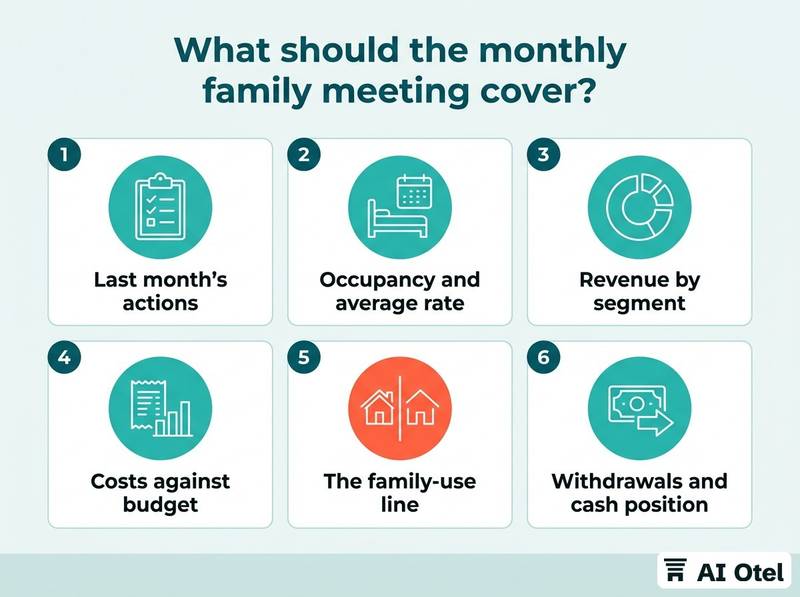
Fix the date and the length, and send a one-page agenda two days ahead, so the meeting is not the first time people see the numbers. Restrict discussion to the rows where the decider genuinely needs the family's input; everything else is reported and noted, not debated. A topic not on the agenda is written down for next month rather than discussed now, and the person who raised it owns the item. Keep minutes to one page: each decision, the person who owns the action, and the date it is due, circulated within two days while the reasoning is still fresh. Reserve one annual item: the review of the table itself, which is the only place a row changes.
ChecklistThe agenda, in order
- Last month's actions
- Occupancy and average rate
- Revenue by segment
- Costs against budget
- The family-use line
- Withdrawals and cash position
- Decisions needed today
- New items for next month
- Date of the next meeting
Here is the diagnostic. If the same argument returns three months running, it is a missing row, not a personality problem, and the fix belongs in the table. For what the underlying numbers should look like, see the monthly owner's report: what to ask your hotel operator for.
When should a family hotel bring in an outside adviser?
When the same decision has been reopened three times, when two family members can each block the other, or when the numbers no longer settle the argument.
An outside person does three things: interviews each family member separately, drafts the table from what they hear, and chairs the meeting where it is agreed. The value is the process and the chair, not the opinion. Three triggers justify it: a deadlock that stops operations, a generational handover in progress, and a decision the family cannot make alone, such as a sale, a loan or a second property.
Match the person to the question. An accountant for the money rules. A lawyer for anything that changes shares, employment terms or the company's articles. A revenue or operations adviser for the trading decisions. Do not ask one to do another's job. And keep the order of work: table first, money rule second, monthly meeting third. An adviser brought in before the family accepts there is a problem usually produces a report nobody uses. The cost of waiting is operational, not abstract: decisions default to whoever is loudest, good staff leave because they cannot get an answer, and the year's figures cannot be read afterwards.
What to do next
This week, write down the five questions that came back most often last season and fill in the three columns for each one. Agree them in a single family meeting, then write the money rule, then set the monthly meeting date. The table, the rule and the meeting work as one system: the table decides who may act, the rule keeps the hotel's money describing the hotel, and the meeting is where both get corrected.
Frequently asked questions
Should the hotel pay a family member who helps at reception?
Decide by role, not by surname. If it is a real job with hours and a supervisor, write a task list and a wage and put it through payroll. If it is occasional help, record the hours and treat it as a family contribution. How the payment is taxed and classified is a question for your accountant.
Can the owner take cash from the till?
Under the one rule, no: cash goes to the bank, and the owner takes money out as a recorded withdrawal from the hotel's account, with a date and a purpose. How that withdrawal is classified in the books, as salary, profit share or a loan, is settled with the accountant and written next to the rule.
How many people should be able to approve a discount?
One named person per category, with a named substitute, inside a band the family sets. Above the band, the row names the owner. A second signature is a threshold, not a second decider, and the threshold is written down rather than remembered.
What if the family cannot agree who decides?
Start with the five questions that recur most and leave the rest for later. If the family still cannot agree after two meetings, the missing piece is usually a chair rather than a rule, and an outside facilitator who interviews each person separately can draft the table and run the meeting where it is agreed.
Does a decision-rights table need a lawyer?
Not for the table itself: it is an internal working document about who acts inside the hotel. Anything that changes ownership shares, employment terms, borrowing or the company's articles goes to a lawyer and an accountant, because those are legal and fiscal instruments, not working notes.