The hotel operations manager: what the role covers, how it differs from the general manager and the department heads
The hotel operations manager owns daily standards and cross-department hand-offs, while the general manager keeps strategy and budget. This guide defines decision limits, weekly rhythms and when to create the post.
AI draft · awaiting editorial review
Contents
Key takeaways
- A hotel operations manager owns the daily operating standard and the seams between departments; the general manager keeps strategy, budget and people decisions.
- The role only works when every decision has a written limit, so the operations manager decides inside it and escalates above it.
- Department heads raise the ceiling on quality; the operations manager raises the floor on consistency.
- If the standard collapses when the operations manager is away for a week, the role has absorbed work instead of assigning it.
- A duty manager covers a shift; the post exists to coordinate across departments, so create it when the problem crosses departments.
A hotel operations manager owns the day-to-day running of the guest-facing operation: rooms, housekeeping, food and beverage service and technical service, plus the hand-offs between them. The general manager keeps strategy, budget, people decisions and anything that changes what the hotel promised. Department heads keep their craft standards and their own teams.
A group is due at noon, housekeeping is two attendants short, and breakfast service ran late. By 07:40 the general manager is on the phone. The question behind that call is not who is to blame; it is who owns the decision. This article defines the hotel operations manager by decisions rather than by a job description, so after reading it you can write the decision rights list, run a weekly rhythm, and judge whether your property needs the post at all.
What does a hotel operations manager actually own?
The role turns the general manager's annual plan into a daily operating standard: a written, checkable definition of what "ready" means for a room, a table, a lobby and a repair. It owns the sequence of the day and the hand-offs between departments, not the departments themselves.
Four things belong to the post: the operating standard, the daily sequence (who does what by when), the hand-offs between departments, and the exceptions that cross department lines. Owning a decision has three parts: a named person, a limit within which that person decides alone, and a record of what was decided. Without the limit, the role becomes a message relay between the general manager and the department heads. For a fuller map of who reports to whom, see the hotel organisation chart: departments, roles and who decides what.
The content of the job changes with the property. A city hotel with one restaurant and a resort with several outlets, pools, a spa and evening entertainment need different spans of control; the title stays the same, the decision list does not. What the role does not own: the room rate, the sales contract, the annual budget, and the hiring or dismissal of department heads.
The operations manager is also not a duty manager. The duty manager covers one shift and its exceptions; the operations manager covers the week and makes the standard hold across every shift. The output is a repeatable result, not activity: the same room standard at 07:00 on a Tuesday and at 23:00 on a Saturday, with different people on duty. Where the property is part of a group, the role usually carries two lines: the property general manager for the daily operation, and a cluster or regional operations lead for the standard and the reporting pack. The split has to be written, or the hotel receives two sets of instructions.
Key pointOwning a decision
A name: one person accountable, not a committee. A limit: the amount, the hours or the guest impact inside which that person decides alone. A record: where the decision and its reason are written, so it can be reviewed and reversed. A decision with no limit is not owned, it is forwarded.
Operations manager vs general manager: who decides what?
The general manager decides anything that changes the hotel's promise, its money or its people; the operations manager decides how the promise is delivered today. The line between them is drawn in writing, decision by decision.
Daily staffing inside the approved roster: the operations manager decides and informs the department head. Changing the roster budget belongs to the general manager. Waiving or reducing a guest charge: the operations manager decides up to a set amount per guest and per month, and above that the general manager decides. The limit is a number the owner sets, not a habit.
Closing a floor, an outlet or a facility for repair: the operations manager decides inside the maintenance window and handles the guest move; the general manager decides when the closure affects revenue, safety or what was sold to a group. An overbooked night: the operations manager runs the process and chooses the alternative; the general manager approves the policy and any compensation, because that is a rule the hotel applies to every guest, not a case-by-case favor. Room rates for a given date: the operations manager proposes from what the house can actually deliver; the decision sits with the general manager and revenue.
| Decision | Operations manager | General manager |
|---|---|---|
| Daily staffing inside the roster | Decides, informs department head | Sets the roster budget |
| Waiving a guest charge | Decides up to a set amount | Decides above the limit |
| Closing a floor or outlet for repair | Decides inside the window | Decides if revenue, safety or a sold promise is hit |
| Overbooked night | Runs the process, picks the alternative | Approves policy and compensation |
| Room rate for a date | Proposes from deliverable capacity | Decides with revenue |
| Capital spend, supplier contracts | Recommends with evidence | Decides |
| Appointing a department head | Recommends | Decides |
| Changing a published service | Decides inside the approved standard | Decides when it changes what was sold |
What stays with the department heads?
Department heads keep the craft standard, the method and the team: how a room is cleaned, how a table is served, how an arrival is handled. The operations manager owns what happens where two of those meet.
The front office manager owns the arrival and departure sequence and the desk's decision limits, described in detail in front office manager duties, daily routine and decision limits. The executive housekeeper owns room cleanliness, the linen cycle and the housekeeping team, covered in executive housekeeper duties, the team and the costs. The operations manager does not re-run either. The seam is the real work: a late checkout colliding with an early arrival, housekeeping behind while the desk has a queue, a group's luggage arriving before its rooms are released.
Escalation triggers should be written, not felt: a defect that touches more than one department, a complaint already answered once, anything above a set cost, anything that changes a guest's room or bill. The common failure is the operations manager redoing the department head's job. The department head then disengages, and the standard quietly becomes dependent on one person being present.
The test is absence: if the operations manager is away for a week and the standard holds, the role is assigning work. If it collapses, the role has absorbed it. Quality and consistency are different jobs. Department heads raise the ceiling on what the hotel can do; the operations manager raises the floor on what it always does.
What does the weekly rhythm look like?
The rhythm is fixed and short: a morning stand-up, a walk-round at a different hour each day, one defect log, one forecast and labor review, and a Friday readiness check. The point is repetition, not length.
The morning stand-up lasts about fifteen minutes and answers three questions: what changed since yesterday, what is at risk today, who decides. It is not a status report around the table. The morning page, what a general manager's daily report should contain, is read before the stand-up, not after it, so the meeting starts from numbers rather than impressions.
The walk-round follows a fixed route at a varying hour, so the hotel is seen at breakfast one day and at turndown another: lobby, one corridor, one room mid-cleaning, one bathroom, the breakfast area during service, a back corridor, the loading bay. Every finding goes into one defect log with an owner, a date and a re-check. Nothing closes on a verbal "done", because a verbal close is how the same defect returns next month.
Once a week the forecast and the roster are read together: arrivals, departures, groups, the shape of the occupancy, and the labor that matches it. The roster is the operational answer to the forecast. Friday is a readiness check for the weekend: staffing, supplies, open repairs, VIP and group arrivals. The weekend is where an unclosed defect becomes a complaint. Once a month, one standard is inspected on purpose and the process is fixed rather than the person. A name in the log is a symptom; a step missing from the routine is the cause.
Checklist
- Every morning: read the daily page, then hold the fifteen-minute stand-up with the three questions
- Every day: walk a fixed route at a different hour and log every finding with an owner and a date
- Once a week: review forecast and roster together
- Once a week: hand off with sales and revenue on group promises and capacity
- Every Friday: run the weekend readiness check on staffing, supplies, repairs and arrivals
- Once a month: inspect one standard and fix the routine behind it
How does the role hand off to revenue, sales and finance?
Revenue decides the price, sales decides the promise, finance keeps the record, and operations decides whether the thing that was sold can actually be delivered. Each hand-off needs a number and a moment, not a good intention.
Revenue sets the rate; operations confirms the product behind it: room type, bedding, view, quiet side, connecting doors. A rate sold against a room the house cannot deliver is a complaint with a schedule. For group and contract business, the operations manager needs the pickup daily, meaning the rooms already taken from the block, not the block size. Pickup drives the housekeeping plan, the breakfast covers and the staffing.
Sales promises should be signed off for feasibility before the contract, not after: set-ups, group space, inclusions and the exact wording of what the rate covers. Finance owns the record, operations owns the reason. Voids, complimentary stays and transfers between guest accounts are operational decisions that leave a financial trace; the operations manager writes why, finance checks that it reconciles. The night audit closes the business day, and the operations manager is the person who answers for the exceptions it finds the next morning.
Two cost lines move week to week under this role: labor and consumables. Neither can be managed without a baseline, so the first month is measurement, not savings. The simple rule: anything that changes a number on the profit and loss statement needs a written reason from operations and a check from finance.
Does your hotel need the post, or is a deputy enough?
Create the post when the problem crosses departments; use a deputy or duty manager when the problem is coverage. The two look similar on a payroll and solve different things.
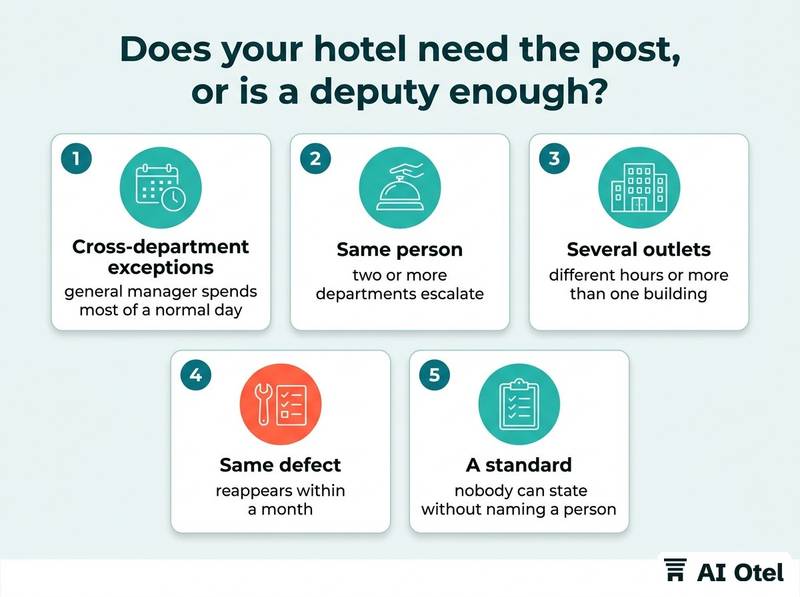
Signals that the post is needed: the general manager spends most of a normal day on cross-department exceptions; two or more departments escalate to the same person for the same reason; the property runs several outlets with different hours or more than one building; the same defect reappears within a month. A further signal is a standard nobody can state without naming a person. If room readiness is defined by who is on shift, there is no standard yet, only a habit.
When a deputy is enough: one outlet, one shift pattern, a small team, and a general manager who is on the floor every day. The gap is hours, not coordination. The trade-off is real. A new post adds a layer between the general manager and the departments; a stronger department head adds depth without a layer. Choose the layer only when the work genuinely sits between departments.
Do not create the post to reward tenure or to keep someone who is leaving another role. The decision rights list will expose that within a month. For a group, the same test applies per property. A cluster operations role can cover two small hotels that share a standard, but only if the travel time between them is part of the job description.
TipThe three-signal test
The general manager's day is mostly cross-department exceptions. The same escalation reaches the same person from different departments. The property has several outlets, buildings or shift patterns. Any two signals point to the post; one signal points to a stronger department head or a deputy.
What should be written down before the role starts?
One page of decision rights, one page of escalation thresholds, and the reporting pack. Written before the first day, these three pages decide whether the role works or becomes another inbox.
The decision rights list: each recurring decision, who decides, who is informed, and the limit. One page, reviewed once a year, kept where department heads can read it. Escalation thresholds come in two currencies: money and guest impact. A defect that closes a room, a complaint that has already been answered once, a cost above a set figure. The budget lines the role controls and the lines it only watches should be listed too; confusing the two is how an operations manager starts negotiating contracts that belong to finance.
The reporting pack: which numbers, from which system, by what hour, and who reads them. A report nobody reads is a ritual, not a control. A ninety-day review with three standards named in advance, measured by inspection rather than impression. If the three standards cannot be named, the role has no target yet. The owner's quarterly check, described in what an owner can check each quarter through internal audit, should sample the defect log and the decision record and ask whether the limits were used or quietly avoided. What the general manager hands over at the same time: the daily exceptions, the cross-department meetings, and the authority to say no to a department head inside the written limit.
What to do next
Write the one-page decision rights list: each recurring decision, the person who decides, the limit, and who is informed. Everything else in this article follows from that page. The scope of the role is the list, the seams between departments are where the list runs out, the weekly rhythm is how the list is used, and the hand-offs to revenue, sales and finance are the decisions that must never sit inside the operations manager's limit alone. Once the page exists, a hotel operating system, built and working ahead of launch, can hold the record behind it: reservations, housekeeping, billing and reports in one place, so decisions and their reasons are written where finance and the owner can read them. For the wider picture of how hotel systems connect, see the platform overview.
Frequently asked questions
Can the general manager also be the operations manager?
In a small property, yes, and it often works because the general manager is on the floor daily. The cost is time: the strategy work, the owner reporting and the commercial relationships lose the hours the exceptions consume. The test is whether the general manager's week still contains planning time; if it does not, the hotel has an operations manager with a general manager's title.
What is the difference between a hotel operations manager and a duty manager?
The duty manager covers one shift and its exceptions inside a written limit, then hands over. The operations manager covers the week, sets the standard that every shift follows, and owns the hand-offs between departments. A hotel can need one, the other, or both, and the two roles should not share the same decision limits.
Is a rooms division manager the same job as an operations manager?
Often not. A rooms division manager usually covers front office and housekeeping only, while an operations manager also covers food and beverage service and technical service. Titles vary between hotels and groups, so read the decision rights list rather than the title, and check whether the post includes the outlets.
Who does the operations manager report to in a hotel group?
Usually two lines: the property general manager for the daily operation, and a cluster or regional operations lead for the standard and the reporting pack. The split has to be written, naming which line decides in a conflict, otherwise the property receives two sets of instructions and the department heads choose the easier one.
Should the operations manager attend the revenue meeting?
Yes, as the person who knows what the house can deliver, not as the person who sets the rate. The useful contribution is capacity and product: which rooms are sellable, which are out for repair, what a group commitment does to the roster and to breakfast. Rate decisions stay with the general manager and revenue.