Hotel internal audit: what an owner can check each quarter, how to sample and who should do it
Run a quarterly hotel internal audit to verify daily controls. This guide covers five key areas, simple sampling rules, and how to assign findings for action.
AI draft · awaiting editorial review
Contents
Key takeaways
- Internal control prevents and catches errors every day; internal audit tests, once a quarter, whether those controls actually ran.
- No one person should be able to both create a transaction and hide it: receive goods and approve the invoice, take cash and reconcile it, or set a rate and approve the override.
- A sample chosen by a written rule can be repeated and compared next quarter; a sample chosen by feel cannot.
- Every finding needs three things before it leaves the room: a named owner, a date, and a rating that says how much is exposed.
- The reviewer reports to the owner, not to the manager whose work is being tested.
A hotel internal audit is a periodic, independent test of whether daily controls actually worked. An owner can run it quarterly across five areas: cash, stores, guest bills, discounts and rate overrides, and system access. Sample by a written rule, give each finding an owner and a date, and let someone who does not run the process do it.
The month closes, the cash count matches the system, and the report balances. The owner still cannot answer the one question that matters: who removed that room charge, and who checked that they were allowed to. This article separates the daily controls from the quarterly test, lists what an owner can check each quarter, gives a sampling method that works without an audit department, and shows how to write one page the owner will act on.
What is the difference between hotel internal control and hotel internal audit?
Internal control is the set of rules and system limits that stop or catch a mistake on the day it happens. Internal audit is a periodic test, by someone outside the process, of whether those controls actually worked.
Control lives inside the day: who may void a line on a guest bill, who may open the cash drawer, the discount ceiling set in the system, the second signature on a purchase. Audit happens after the fact. You choose a period, choose records by a rule, and compare what the written rule says with what the records show happened.
The two fail differently. Weak control leaks money every day. A missing audit means nobody knows whether the controls were followed at all. An audit is not a department: in a hotel without one, it is a task with a scope, a period and a named person, and it fits in a few days a quarter. It is also not the accountant's tax work and not an inspection. The reader is the owner and the general manager, and the output is a decision, not a filing.
The owner's question is narrow: did the controls work last quarter, and can I show that to a bank, an insurer or a buyer later.
| Aspect | Internal control | Internal audit |
|---|---|---|
| Purpose | Prevent and catch on the day | Test whether controls ran |
| Timing | Continuous | Once a quarter |
| Who runs it | The operating team, inside its own work | Someone who does not run the process |
| Output | A limit, a signature, an approval | A one-page report with findings, owners and dates |
| Typical failure | The rule exists but is bypassed | Nobody ever checks, so nobody knows |
Which duties must stay apart in a hotel?
Keep apart any two steps where one person could create a transaction and then hide it. The test is simple: could this person make a charge disappear without a second person seeing it?
The classic pairs are the same everywhere. A person who receives goods and also approves the supplier invoice can accept short deliveries and sign them through. A cashier who also reconciles the cashier report or makes the bank deposit can absorb an overage or shortage. Someone who sets a rate and also approves the override below it can sell rooms to anyone at any price. The same logic covers voids, system rights and the storeroom.
Small hotels cannot separate everything. Compensating controls fill the gap: the owner reading the exception list, rotating who counts, surprise counts, and a second signature above a set amount. Write the result as a one-page matrix: process, who does it, who checks it, who may approve an exception. Review it whenever someone leaves or changes role. For the day-to-day mechanics, see how cash and rooms go missing at the front desk.
ChecklistChecklist of pairs that must not sit with one person
- Receives goods and approves the invoice
- Takes cash and reconciles or banks it
- Sets a rate and approves the override
- Voids a bill line and reviews voids
- Holds admin rights and reviews the access log
- Counts stock and keeps the storeroom key
What can an owner check each quarter?
Five areas cover most of the exposure in a hotel: cash, stores, guest bills, discounts and rate overrides, and system access. Each is tested the same way, by comparing the written rule with a sample of what actually happened.
Cash first, because it moves daily: cashier closures and overages or shortages by person, petty cash vouchers against the float, deposits matched to the day's receipts, refunds paid out in cash. Stores follow: a counted sample of high-value items against the book, receiving records against invoices, requisitions without a signature, goods bought and never issued. Guest bills come next: voids and corrections, transfers between folios, balances still open after departure, complimentary items and who approved them. Then discounts and rate overrides: every override below the approved floor, the same name appearing repeatedly, overrides on days when the manager was away. Finally access: who holds administrator rights, logins still active for people who have left, shared logins at the desk, who can delete rather than void. On rate authority itself, see who may change a rate and within what limit.
Rotate the depth: test one area thoroughly each quarter and glance at the other four, so the whole set is covered within a year. One boundary: corrections that touch an invoice or an electronic document are a question for your accountant. The internal check tests the hotel's own rule, not the tax treatment.
| Area | What to test | What a finding looks like |
|---|---|---|
| Cash | Closures, petty cash, deposits | A refund paid in cash with no guest signature |
| Stores | Counted sample against the book | High-value stock short with no requisition |
| Guest bills | Voids, transfers, open balances | A room charge voided after departure with no approval |
| Discounts and overrides | Every override below the floor | One user overriding repeatedly on weekend shifts |
| Access | Admin rights, leavers, shared logins | A login still active for someone who left months ago |
How do you sample hotel records without an audit department?
Define the population, write the selection rule before you look at anything, and record what you tested. A small hotel does not need a statistics department; it needs a rule it can repeat next quarter.
Start by defining the population precisely: all voids in the quarter, all rate overrides, all cashier closures, with a date range and the report they came from. Two workable rules then cover most hotels: a fixed count spread evenly across the period, or every item above a value threshold plus a random draw below it. The size is the hotel's own choice; what matters is that it is written down first.
Add a risk layer on top of the base sample: the largest values, unusual hours, the same staff member appearing again and again, days when the approver was absent. Pull the evidence, not just the record: the signed void slip, the registration card, the delivery note, the approval trail in the system. Record each item as reference, expected, found, evidence. A clean sample is a result: note the size and state that nothing was found.
Two disciplines keep the sample honest. Do not quietly enlarge it after a hit; if you do enlarge it, record that you did and why. And keep the working papers, because the sample is only useful if the next reviewer can repeat it and compare.
TipWrite the rule before you open the report
Write down the population, the period, how many items, how they are chosen, and who signs the rule off, all before looking at a single record. A rule written after the sample is a justification, not a test.
Who should carry out the internal audit?
Someone who does not run the process being tested, and who reports to the owner rather than to the manager whose area is under review. In a small hotel that is usually a combination of two people, not one.
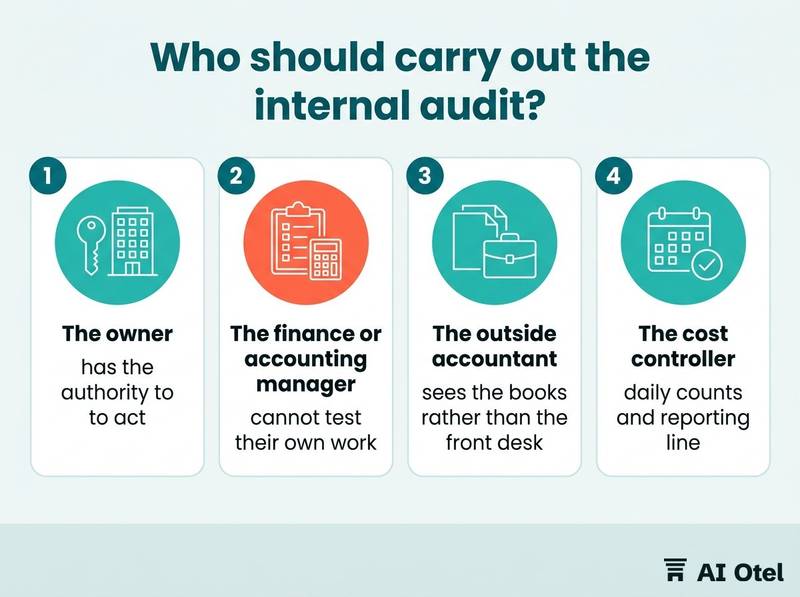
Consider the candidates in turn. The owner has the authority to act, but often approved the very transactions being tested, and rarely has time for the working papers. The finance or accounting manager knows where the records are, but usually runs the cash and billing processes, so cannot test their own work. The outside accountant is independent and used to evidence, but sees the books rather than the front desk; give that person a defined scope and a list of what to test. For the operational side of stores and purchasing, the cost controller's daily counts and reporting line show where that role fits.
A practical split works for most hotels: the owner appoints a reviewer from a department that does not touch the area, and brings in the outside accountant once a year for the areas with money at stake. Rotation matters more than seniority: change the reviewer every year or two, and never let one person review the same area indefinitely. The general manager is told the plan and the results; the general manager does not approve the findings. Record the appointment in writing: who reviews what, for which quarter, and to whom the report goes.
How do you write a finding the owner will act on?
A finding states the rule, what was found, what it exposes and who fixes it by when. Anything longer than a page does not get read in the week it is needed.
Four parts per finding: the rule, meaning what should have happened; the evidence, with date, reference and amount; the exposure, meaning what is lost if it repeats; and the action, meaning who, what, by when. Rate by exposure and repetition, not by how serious it felt in the room: high, medium or low, with a repeat flag. A finding that appears twice means the fix did not hold. Escalate it and change the fix, not the wording of the finding.
Keep the summary page clean of names: area, finding, owner, date. Names and documents stay in the working papers. Open the report with what was tested and what was clean, so the reader can see the scope and trust the rest of the page. Fix the follow-up date when the report is issued, and start the next quarter by reading last quarter's open items.
One technical note. If the review reads from the hotel's own system reports, the same report must be reproducible next quarter, or the comparison is meaningless. A hotel operating system that keeps its reports stable and its records of who did what is what makes this possible; for the reporting side, see the reports a hotel operating system keeps and how they fit into the wider platform.
ChecklistThe one-page report
- Period and scope
- What was tested and how many records were sampled
- Findings with a rating and a repeat flag
- An owner and a deadline for each finding
- Open items carried from last quarter
- The reviewer's sign-off and the date of the next review
What to do next
Pick one area for this quarter, write the sampling rule before you open a single report, name a reviewer who does not run that process, and book the follow-up date in the same week you issue the page. The pieces fit together in one order: control is designed into the day, the quarterly check tests whether it ran, the written sampling rule makes the test repeatable, and the one-page report turns a test into a decision the owner can follow up.
Frequently asked questions
How often should a hotel run an internal audit?
A quarterly cycle for the full set of five areas, with cash counts more often because cash moves daily. The rhythm matters more than the depth: a shallow check that happens every quarter beats a thorough one that happens once. Each quarter opens with the previous quarter's open findings.
Can the owner do the hotel internal audit themselves?
Yes for areas where the owner did not approve the transaction, and no for areas where the owner set the rate or signed the expense, because nobody can test their own approval. The owner always signs the report and owns the follow-up, even when someone else does the testing.
How many records should we sample?
There is no universal number, and the hotel sets its own. What matters is that the rule is written before the sample is drawn and repeated next quarter, so the results can be compared. A fixed count spread across the period, or every item above a threshold plus a random draw below it, both work for a small hotel.
What is the difference between an internal audit and the accountant's work?
The accountant records and reports for tax and statutory filings, working from the books. The internal check tests whether the hotel's own controls ran, working from operational records such as cashier closures, voids and receiving notes. Different reader, different output: a filing for the authority, a one-page decision for the owner.