Preparing for a brand standards audit: the evidence folder, a mock audit and the fix list
Prepare for a hotel brand standard audit in four weeks. Build an evidence folder indexed to the manual, run a cross-department mock audit, and close gaps with a dated fix list.
AI draft · awaiting editorial review
Contents
Key takeaways
- A brand audit scores what the hotel can show, so any standard without a document, a log or a dated photograph behind it is already a gap.
- Build the evidence folder from the standards manual's table of contents, one index line per clause, with a department and a person's name against each.
- Run the mock audit with a checker from another department, because a team's own supervisor has stopped seeing what the team has stopped doing.
- Rank gaps on two axes, guest impact and fix effort, and close the high-impact, low-effort corner in the first week while the rest gets a dated plan.
- The fix list needs six things per line: clause, gap, owner, date, cost and the proof that will show it closed.
A hotel brand standard audit is the brand's periodic check that a hotel meets its standards manual. Prepare in four weeks: build one evidence folder per department, run a mock audit in which each department checks another, rank every gap by guest impact and fix effort, and close the quick ones with a named owner and a date.
Picture the week before a brand audit. The general manager asks for the pool water test log and the last fire drill record. Both exist somewhere. Neither can be produced in under an hour, and that is the finding. This article turns the four weeks before a hotel brand standard audit into a repeatable routine: an evidence folder indexed to the manual, a cross-department mock audit, and one fix list that survives until the auditor leaves.
What does a hotel brand standard audit actually look at?
It looks at two things: whether each requirement in the brand's standards manual is true in the building, and whether the hotel can show evidence that it is true and stays true. The manual is the scoring document, not the auditor's personal taste.
The manual is the scoring document
Read the manual as a list of testable statements. Turn each clause into a yes or no question plus the piece of proof that answers it: "is the pool water tested and recorded daily" becomes "show me the log". What the brand scores, how often it inspects and what a low score triggers sit in your franchise or management agreement and in the brand's own manual. Read both before you plan anything, and if you are still weighing the brand route itself, start from weighing brand fees against your own numbers.
A brand audit is not a government inspection and not the owner's internal audit: different authority, different document set, different scoring. Prepare for each one separately.
Four kinds of evidence
Every clause needs one of four kinds of proof. A standing document, such as a certificate, contract or license. A running record, such as a temperature log, cleaning sheet, drill record or training list. A physical condition in the building. Or a staff answer that points at one of the first three.
Audits sample. The auditor picks a room, a shift, a log page and a staff member, so the goal is not to have everything perfect but to be able to produce any clause's evidence in minutes. The auditor also walks the guest path and talks to staff, so "the manager keeps that" is itself a finding, even when the document exists.
NoteThe ten-minute question
Apply this test to every clause: if the auditor asked for proof of this today, who would bring it, and how long would it take? Anything over ten minutes goes on the preparation list, whatever the condition of the building.
How do you build the evidence folder by department?
One folder per department, indexed to the manual's clause numbers, holding the current document, the running record and the proof that the record is being kept.
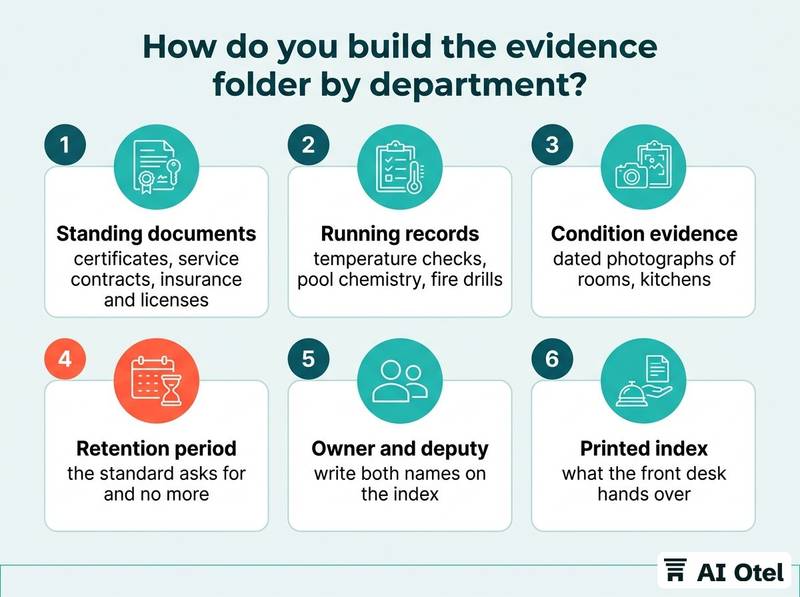
Start from the manual's table of contents, not from what the hotel already has. Assign every clause to a department and a named person, including the clauses nobody currently owns. Sort the contents into three groups: standing documents such as certificates, service contracts, insurance and licenses; running records such as temperature checks, pool chemistry, fire drills, pest control and training; and condition evidence, meaning dated photographs of rooms, kitchens, plant rooms and signage.
Keep the retention period the standard asks for and no more. A folder holding five years of everything is harder to audit than one holding the required period, sorted. Give each folder an owner and a deputy and write both names on the index; the owner is responsible for the folder being current, not for the standard being met, which stays with the department head. Keep one electronic master and one printed copy of the index, because the printed index is what the front desk hands over when the auditor arrives at an awkward moment. If the underlying routines need work first, see writing hotel SOPs that staff actually follow.
ChecklistEvidence folder index, one line per clause
- Clause number and the manual's wording
- Department and named owner
- Proof type: document, running record, condition or staff answer
- Where the item is kept, physically and electronically
- The retention period the standard requires
- Last updated date and who updated it
- Deputy owner's name
Index every item the same way, so that a clause number leads to a location in seconds rather than a search.
Who should run the mock audit, and who checks whose area?
Someone from a different department who has read the standard, checking an area they do not run. Cross-checking is the point: a department's own supervisor has stopped seeing what the department has stopped doing.
Pair areas so that nobody checks their own work. The checker works from the manual's wording, not from personal preference. A finding must quote the clause it fails, or it becomes an opinion and gets argued away. Brief the checkers first: they are collecting evidence and condition, not writing a performance review of a colleague.
Walk the guest path in order: arrival, lobby, room, bathroom, breakfast, pool, check-out. The auditor experiences the hotel as a sequence, not as a list of departments. Record as you go: photograph, clause number, location and one sentence on what is wrong. Do not fix anything during the walk, because fixing mid-walk hides the pattern that produced the gap.
Time-box it. Half a day per area, two areas per checker, one week in total. A mock audit that runs for three weeks becomes the work it was meant to prepare for. For a different lens on the same question, compare this with mystery guest audits for hotels.
| Area checked | Who checks it | What the checker carries |
|---|---|---|
| Front office and lobby | Housekeeping supervisor | Manual extract, guest-path checklist |
| Guest rooms and floors | Front office supervisor | Room list, torch, dated photo log |
| Kitchen and food and beverage outlets | Maintenance supervisor | Temperature record list, manual extract |
| Pool, spa and public areas | Food and beverage supervisor | Chemical record list, cleaning schedule |
| Back of house, plant and storage | General manager | Fire and safety clauses, maintenance log |
| Staff interviews and training records | Human resources lead | Training matrix, three questions per role |
How do you rank the gaps by guest impact and fix effort?
Score each gap twice, by how much a guest would notice it and by what it takes to close, then work the high-impact, low-effort corner first. That corner is where a week of work changes the most of the audit.
Define guest impact in things a guest can see, smell, hear, touch or wait for: a stained corridor carpet, a missing shower gel, a twenty-minute check-in, cold food at breakfast. Not "standards compliance". Define effort in hours and money, with a rough figure and the person who would do the work. "Needs budget" is not an effort score, and it hides items that cost a purchase order.
Some gaps are contractual rather than cosmetic. An expired certificate or a missing service contract can matter more to the brand than a scuffed door, so check how the manual weights its own sections before ranking by eye. Write down what you decided not to fix and why: an auditor who sees a known gap with a dated, budgeted plan reads it differently from an auditor who sees the same gap unmentioned. Re-score after the first week, because closing ten cheap items changes the picture, and some items that looked expensive turn out to be a phone call.
Key pointThe four boxes
Do now: high guest impact, low effort, close this week. Plan and budget: high impact, high effort, owner and date in the fix list. Fix quietly: low impact, low effort, fold into routine maintenance. Accept and document: low impact, high effort, record the decision and the reason. Rule: the do-now box is empty before the mock audit's findings are a week old.
What goes on the fix list, and how do you keep it moving?
One line per gap: the clause, the gap in one sentence, the owner, the date, the cost and the proof that will show it closed. A line missing any of the six is a wish, not a task.
The owner is a person's name, not a department, and the date is a day, not "before the audit". Both are what turn a list into a schedule. Write the proof column from the auditor's side: the photograph, the signed contract, the log page or the training record that will exist on the day the item closes.
Review the list twice a week for the four weeks. A list reviewed once becomes a list of explanations. Escalate anything needing capital to the general manager in week one, because approvals and deliveries take longer than the fixes themselves, and a purchase order raised in week four arrives after the auditor. Close, photograph and keep the closed lines visible: staff who watch the list shrink work differently from staff who are told it is under control. Keep one list for the whole hotel, because department lists drift apart within days, and the auditor asks about the hotel, not about a department.
ChecklistFix list line
- Clause number and the manual's wording
- The gap in one sentence, with its location
- Guest impact score and effort score
- Owner by name and a deputy
- Due date as a day
- Cost and who approved it
- The proof that will close it
- Date closed and the photo reference
How do you brief staff the week before the audit?
Tell them the date, the areas, the questions the auditor will ask and where the evidence lives, then rehearse the answers rather than a script.
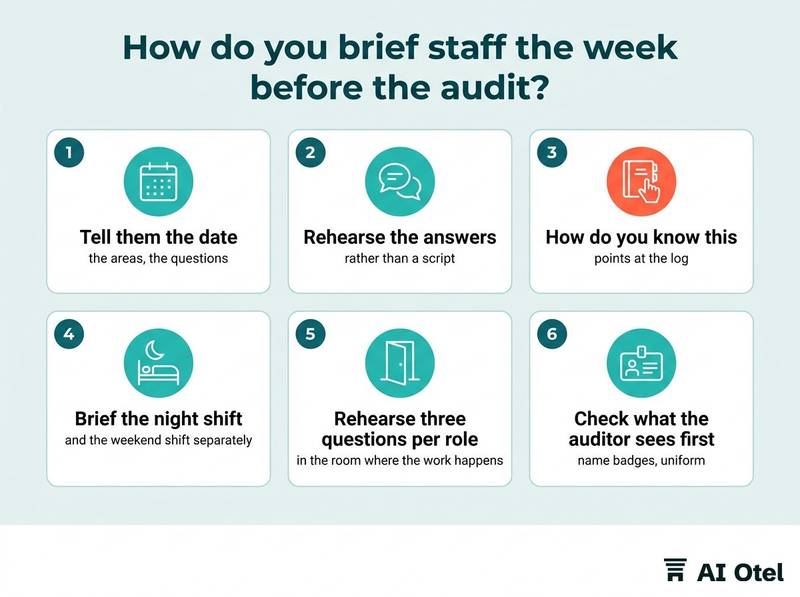
Every team should be able to answer one question: how do you know this was done? The good answer points at the log, the checklist or the system, not at the manager. Brief the night shift and the weekend shift separately; they are the ones an audit misses, and the ones on duty when something goes wrong at three in the morning.
Rehearse three questions per role, in the room where the work happens. Rehearsing in a meeting room teaches people to talk about the work instead of showing it. Make "I don't know, I'll find the person who does" an acceptable answer, because a staff member who invents an answer creates a finding where there was none. Check what the auditor sees first: name badges, uniform, the state of the front desk, and whether the folder can be produced within ten minutes. Do not run a cosmetic week; cleaning only the visible areas moves the dust into the corridor the auditor walks next.
TipThe ten-minute test
On the Monday before the audit, pick three clauses at random and ask the front desk to produce the evidence for each. Time it. Whatever takes longer than ten minutes is the week's work, and everything else can wait until after the audit.
What should you do after the audit?
Turn the auditor's report into the same fix list, keep the folder current month by month, and start the next quarter's mock audit from the items that were closed.
Record the result, the date and the areas that were sampled. The sampling pattern tells you what the next audit is likely to open first. Convert every finding into the fix list format with an owner and a date, including the ones you disagree with: a documented disagreement with evidence behind it is stronger than an argument in the corridor. Ask which clauses were not sampled and check those yourself, because the gaps an audit misses are still gaps, and they are the ones that surface next time.
Move recurring findings into the SOP and the training matrix, so that the fix survives the staff member who made it. Keep the folder alive with a monthly check of the index; without it, the same four weeks of scrambling return every year. Run the next mock audit a quarter later with different checkers, so that the cross-check stays a cross-check and not a ritual. For the wider routine, pair this with what an owner can check each quarter and how to sample it.
What to do next
This week, take the standards manual's table of contents and write a department and a person's name next to every clause. That single page becomes the evidence folder's index, the mock audit's route and the fix list's skeleton, which is the difference between four weeks of preparation and four weeks of worry.
Frequently asked questions
How long does it take to prepare a hotel for a brand standards audit?
Four weeks is a workable plan: one week to map the manual and build the folder index, one week for the mock audit, and two weeks to close the quick items and brief staff. If the audit is closer than four weeks, run the mock audit first and build the folder from what it finds, because the findings tell you which clauses actually need evidence.
Does the brand auditor check every clause in the standards manual?
No. Audits sample rooms, shifts, records and staff, so no hotel can predict which clause will be opened. That is exactly why the folder is indexed by clause number: the aim is not to perfect everything but to produce any clause's evidence within minutes.
Can a hotel fail a brand audit over paperwork when the building is in good condition?
It can, because a standard that cannot be evidenced reads the same as a standard that is not met. How the brand scores that, and what a low score triggers, is set in its own manual and in your franchise or management agreement. Read both and put the question to your brand contact rather than assuming.
Is a brand standards audit the same as a government inspection?
No. They have different authorities, different purposes and different document sets, and a hotel can do well in one and struggle in the other. Keep two separate folders and two separate preparation calendars instead of assuming that one set of documents serves both.
Should we hire an outside consultant to run the mock audit?
It is optional. A peer from another department who has read the standard is usually enough, and costs nothing. An outsider brings fresh eyes but still has to work from your manual's wording, so brief them on the clauses and keep the findings in the same fix list format.