Mold in hotel rooms: finding the damp, treating it and what to tell the guest
Mold in hotel rooms is a moisture problem, not just a cleaning task. This guide covers inspection routes, safe treatment, stop-sell rules, and clear communication with guests.
AI draft · awaiting editorial review

Contents
Key takeaways
- Mold in a hotel room is a moisture problem first: find the water, dry the surface, then clean.
- An empty room goes damp because nobody airs it, so closed rooms need a written round, not a complaint.
- A damp room comes out of sale until it is dry and the cause is fixed, and one named person releases it.
- A guest who reports mold needs a move and a plain sentence about what you found, not a diagnosis.
Mold in a hotel room is a moisture problem before it is a cleaning problem: water arrives from a leak, a cold surface or air that never moves. Find the water source, dry and treat the surface with a product your supplier approves, take the room out of sale until it is dry, and tell the guest plainly.
A guest pulls back the curtain and the hem is grey with damp, and the front desk has one minute to answer. What happens next depends less on the cleaning cupboard than on whether the hotel already knew about that corner. This guide covers the causes of mold in hotel rooms, an inspection route that works room by room, a stop-sell rule, the wording for a guest who found it, and the records that keep it from returning.
What causes mold in hotel rooms?
Moisture that stays on a surface long enough for growth to start. Mold needs water, a material to sit on and time; take away the water and the rest stops mattering.
Water arrives by four routes. It comes in through a leak, a roof, a pipe or rain past a seal. It condenses out of warm moist air onto a cold wall, pipe or window. It comes from use: showers, wet towels, a kettle, a drying rack. And it stays because the air in the room does not move. Each route has its own fix, and only one of them is a cleaning job.
The cold-surface mechanism is worth understanding in plain words. Warm air carries water as vapour; a cold surface cools that air and the water drops out onto it. This is why the corner of an external wall, the wall behind a headboard and a cold water pipe all show staining first. The answer is insulation, air movement or both, not harder scrubbing.
It shows first in predictable places: the silicone line and grout in the bathroom, the ceiling above the shower, the window reveal and the curtain hem, the back of the wardrobe, the wall behind the headboard, and the cold corner of an external wall. A damp smell with nothing visible is still a finding. The growth may sit behind furniture, under a carpet edge or inside a wall, and a nose at the doorway is the cheapest detector the hotel owns.
Cleaning removes what you can see and none of the water. That is why the same corner returns after the season, and why the second visit costs more than the first. Split the ownership so nobody assumes someone else has it: building and plumbing belong to technical service, use belongs to housekeeping, room status and the guest belong to front office, and all three meet in one room record. A hotel operating system that keeps room status, work orders and guest notes in one place makes that record possible; more on that below.
| Moisture source | Where it shows first | First check |
|---|---|---|
| Pipe or roof leak | Ceiling corner, a wall stain that grows | The room above and the roof drain |
| Rain past a window seal | Window reveal, curtain hem, frame drain holes | The seal and the drain holes |
| Condensation on a cold surface | External wall corner, behind the headboard, a cold water pipe | Insulation and air movement |
| Bathroom steam | Ceiling above the shower, grout, silicone line | The extract fan and whether it runs |
| Wet textiles | Mattress base, carpet edge, wardrobe floor | How wet towels and bath mats are stored |
| Still air in an empty room | Whole room, wardrobe, behind furniture | The empty-room round and the set point |
Why does an empty room go damp?
Because an occupied room is aired, heated and watched, and an empty one is none of those. It holds the moisture of its last stay and any water arriving quietly, and nobody is there to notice.
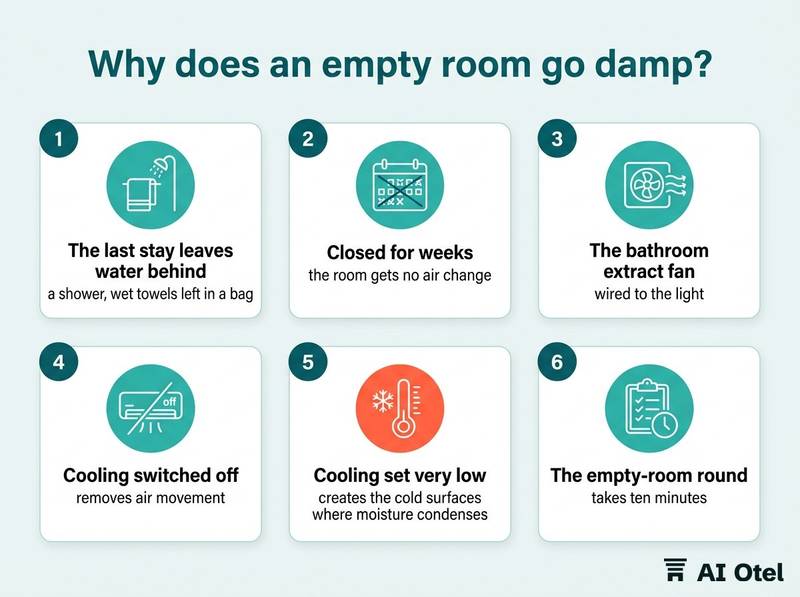
The last stay leaves water behind: a shower, wet towels left in a bag, a bath mat thrown over the tray, a mattress protector that went back on damp. Closed for weeks, the room gets no air change. In many hotels the bathroom extract fan is wired to the light, and in an empty room nobody switches the light on.
Cooling is a decision, not a default. Cooling switched off removes air movement; cooling set very low creates the cold surfaces where moisture condenses. Either way the room loses. Agree a set point with the equipment supplier and write it into the housekeeping sheet, because a written number beats a verbal instruction that changes with every shift.
The empty-room round takes ten minutes: open the window or run the ventilation for a set period, run the extract fan, look at the bathroom ceiling and the window reveal, smell inside the wardrobe, and write the date and initials on the sheet. Rooms used for storage, closed wings in winter and rooms held for a season carry the highest risk, because nobody opens the door for weeks at a time.
How do you inspect a room for damp?
Follow the same route in the same order in every room, so the result does not depend on who walks in.
Start at the doorway: smell the room before touching anything, and note whether the air feels heavy or the window has clearly been shut for days. In the bathroom, check the grout lines, the silicone at the tray and the bath, the ceiling above the shower, the back of the door, the extract grille for dust and a flap that does not open, and the base of the cistern.
Move to the furniture. Pull the wardrobe and the bedside tables a hand's width from the wall, then check the skirting, the back panel, the mattress base and the wall behind the headboard. At the windows and external walls, check the reveal, the curtain hem, the cold corner, the seal, and the drain holes in the frame that let water out. Finish with equipment: the fan grille, the air-conditioning filter and drain pan, the fan coil under the window, and the minibar recess.
Record with a photo and a location, not a category. "Shower tray silicone, left corner" gets fixed; "bathroom damp" does not. Set the frequency: one floor a month on a rolling route, every room at the change of season, and every room after a leak or a guest report. A maintenance work order process that runs from the finding to a closed job keeps these findings from dying in a notebook.
ChecklistWalk-through checklist, in order
- Doorway: smell the room, note heavy air or a long-shut window
- Bathroom grout, silicone, ceiling above the shower
- Extract grille: dust, flap movement
- Wardrobe and bedside tables pulled a hand's width out
- Skirting, back panels, mattress base, wall behind the headboard
- Window reveal, curtain hem, frame drain holes
- Air-conditioning filter and drain pan
- Fan coil and minibar recess
- Photo and exact location recorded
How do you treat mold safely, and when do you call a specialist?
Clean the surface with a product your supplier approves for that material, dry the area completely, and fix the water source in the same job. Call a specialist when the growth is inside the structure, covers a large area, or returns after a correct repair.
Staff safety comes first: gloves, eye protection and open ventilation; the label's dilution and contact time; never two cleaning products mixed; and the room out of use while the work is done.
The material decides the treatment. Porous materials hold growth inside: plasterboard, grout, silicone, fabric, mattress, carpet underlay. Cleaning the face does not clean the material, so the silicone line or the affected board is replaced. Non-porous surfaces such as tile, glass, enamel and metal can be cleaned, rinsed and dried. Never paint or seal over a damp surface: the coating traps the moisture and fails, and the next finding is worse than the first.
Call a specialist when the growth is inside a wall or ceiling, the area is large, a musty smell persists with nothing visible, or a leak has soaked insulation or a slab. The specialist's report joins the room record: what was found, what was done, and when the room may return to sale. Keep the language about the room, not about health: staff and guests get what you found and what you did, not a medical opinion.
Watch outThree things not to do
Do not paint or seal over a damp surface. Do not mix two cleaning products. Do not return the room before it is dry and the source is fixed.
Should the room stay on sale?
No. An affected room comes out of sale until it is dry and the cause is fixed, and one named person releases it back.
The hotel writes its own stop-sell rule and applies it the same way every time: any visible growth, any damp smell that does not clear after airing, any active leak means out of sale, with no exception for a full house. Separate out of order from out of service: the first is not sellable and not counted as inventory, the second is held for a short job. Hotel systems name and count these differently, so agree the meaning in writing.
Release needs three confirmations in one record: technical service confirms the repair and the dryness, housekeeping confirms the clean, front office returns the room to inventory. The record holds the room number, the date, what was found and where, photos, the work order number, the treatment, the drying period and the release. The cost is real: an out-of-sale room is lost revenue, which is the argument for fixing the cause in the same visit rather than cleaning and reopening. A room that goes out of sale three times for the same corner is a building item for the budget, not a housekeeping failure.
Under pressure, block the room in the system in the morning, not at check-in, and move the booking while there is still a room to move it to. The trade-offs of timing, repair windows and seasonal closures are covered in the guide to out-of-order rooms.
| What you found | Room status | Who releases it |
|---|---|---|
| Visible growth on tile or glass, source fixed | Out of sale until dry | Technical service, then housekeeping |
| Damp smell, nothing visible | Out of sale, inspection the same day | Technical service |
| Active leak or a growing water stain | Out of sale, specialist called | Technical manager |
| Dry silicone line needing replacement | Out of service for the morning | Housekeeping with technical service |
What do you tell a guest who reports mold?
Thank them, go and look, and offer the move before they ask for it. The guest is asking two things: is this room all right, and does the hotel take it seriously.
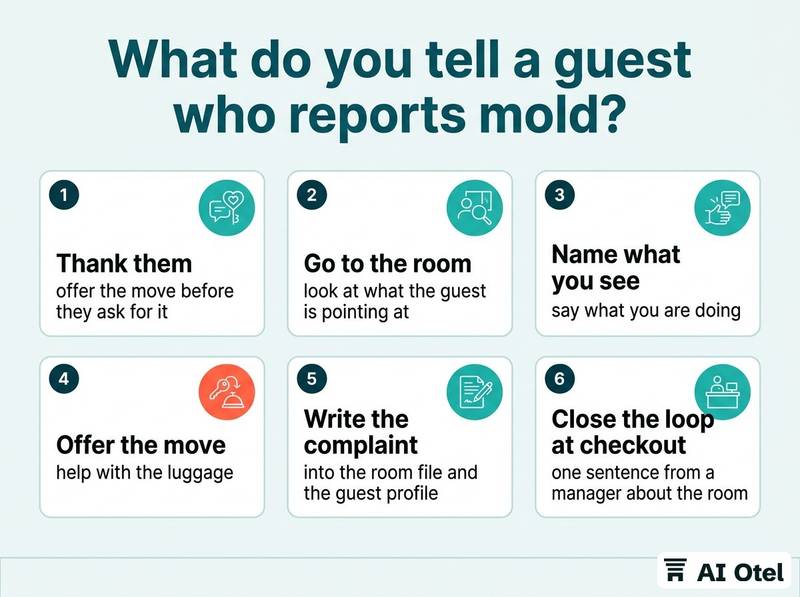
Go to the room and look at what the guest is pointing at. Do not decide from the desk, and do not say "that is not mold" before you have seen it. Name what you see, say what you are doing, and say when you will come back: three sentences, no speculation about the building, no blame on the previous guest or the cleaning team.
Offer the move rather than waiting to be asked, and help with the luggage. If the hotel is full, say what you can do, by when, and give the guest a name. Keep health out of it: the desk describes the room and the action, not what damp does to a person.
Write the complaint into the room file and the guest profile with the time, the words used and the action taken. The same complaint twice from the same room becomes a technical job. Decide in advance who can approve what for a guest who asks for compensation, so the answer does not depend on who is on shift. Whether a guest has a legal claim is a question for your legal adviser. Close the loop at checkout: one sentence from a manager about the room is worth more than a discount applied quietly.
Key pointFour sentences the front desk can use as they stand
"Thank you for telling us. I can see the staining on the ceiling above the shower. I am moving you to another room now, and this room stays out of use until it is repaired. I will come back to you before 18:00 with what we found."
The same hour-of-the-crisis discipline applies to any room smell a guest reports; the guide to answering a smell complaint within the hour gives the timeline.
How do you keep it from coming back?
By running moisture as a monthly routine with a named owner, instead of reacting to the next complaint.
The monthly damp check uses the same route as the inspection, starts with the rooms that failed last time, and ends with a photo of anything new. Ventilation is the cheapest repair: the extract flap moves, the grille is clean, the window trickle vents are open, the air-conditioning filter and drain pan are clean, and the fan coil drain runs.
The empty-room round is written into the housekeeping sheet with a set airing period and a set point agreed with the equipment supplier. Building work goes into the shoulder season: a roof or window seal reported in August becomes a room out of sale in January if it is left, so schedule it before the quiet weeks arrive.
Count the rooms that went out of sale for damp this year. The ones that repeat become a capital item in the budget, not a repair line. Sample the records against the rooms each quarter, the way any other internal check is sampled, so the routine survives a change of staff; the guide to what an owner can check each quarter shows how to sample.
What to do next
Write the stop-sell rule and the empty-room round this week, put one name on the release, and walk one floor with the inspection route before the next sold-out night. The chain is simple: water, surface, time. Find the water, dry the surface, keep the room out of sale until both are done, and tell the guest what you found.
If you want the record to live somewhere sturdier than a sheet, a hotel operating system can hold room status, work orders and guest notes in one place, so the second complaint from the same corner is visible before the guest makes it. The wider platform covers how the pieces connect.
If you are a traveller reading this rather than a hotelier, you can find a hotel in Türkiye (opens in a new tab) for your next trip.
Frequently asked questions
Does mold in a hotel room mean the hotel is dirty?
No. It is a moisture and ventilation finding, and a room can be cleaned every day and still be damp behind a wardrobe or under a mattress protector. The test is the inspection route and the record, not the mop. Say what the hotel found and what it did about the water.
Can we paint over it and keep the room on sale?
No. Paint or sealant over a damp surface traps moisture and fails, and porous material holds growth inside, so the silicone line or the affected board is replaced. Fix the source first. The room returns when it is dry and the release is signed.
How long should a room stay out of sale?
Until the source is fixed, the material is dry and the release is signed. Drying time depends on the material, the drying equipment and the season, so the hotel writes its own rule and applies it the same way every time rather than working to a fixed number of days.
What if the guest says they do not mind staying?
The room's status is the hotel's decision, not the guest's. A guest cannot accept a room the hotel has taken out of sale. Explain what was found, move them, and record the conversation. The guest's tolerance is not a repair.
Who should own the damp check, housekeeping or technical service?
Technical service owns the route and the repair, housekeeping reports what it sees during cleaning, and front office owns the room status and the guest conversation. One named person signs the release, so the room does not return on a verbal yes.